On this page
- Start with an audience-eligibility ladder
- Build a policy-first YouTube experiment workflow
- Compare YouTube with Search, LinkedIn, Meta, and DSP media
- Set budget with a learning threshold, not an arbitrary minimum
- Measure channel lift and pipeline quality
- Identify B2B companies that can learn from YouTube
- Use external intent for planning, suppression design, and sales context
- Avoid the policy and measurement mistakes that invalidate the test
- Sell a recurring agency service around approved channel decisions
- Keep research, targeting and outcomes separate
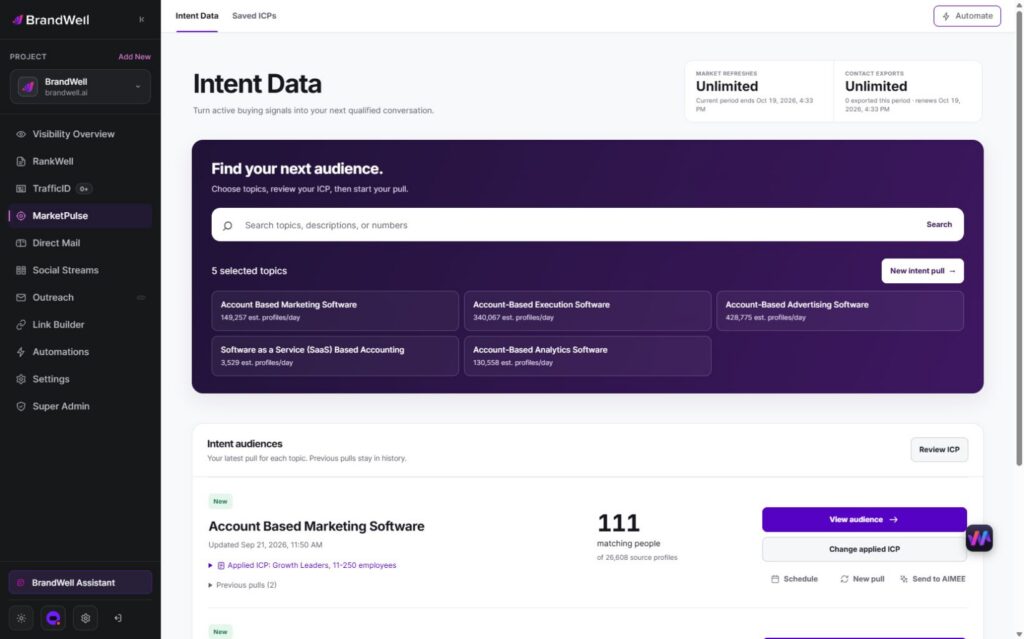
- Use MarketPulse to inform a test brief
- Frequently asked questions
B2B advertisers should start with Google-native in-market segments or another audience explicitly eligible for their exact campaign. External intent can inform market research and creative planning; do not upload an external MarketPulse list as a YouTube targeting audience. A purchased contact does not become first-party data by being added to a CRM.
Who this is for: B2B paid-media leaders, demand-generation teams, growth operators, and agencies evaluating YouTube as a secondary reach and consideration channel.
Google’s data-use policy prohibits using third-party data to create targeting audiences, while allowing it to segment first-party audiences. DV360’s YouTube audience documentation says third-party audiences are unsupported for YouTube & partners line items. Check the exact campaign, provenance and current eligibility before implementation.
Current MarketPulse offer: intent-data plans start at $500/mo. See the product, demo, and current plans. Updated October 3, 2026.
Start with an audience-eligibility ladder
A safe YouTube audience strategy asks questions in this order:
- Is the campaign surface eligible? Confirm campaign type, inventory, account status, geography, audience feature, sensitive-category restrictions, and current policy.
- Is the audience native or eligible first party? Use Google-native in-market segments or first-party lists that meet collection, consent, account, size, and platform requirements. Do not relabel external intent as first party.
- Is the targeting purpose permitted? Check sensitive-interest, personalized advertising, customer-data, regional, and client policy constraints.
- Is the audience fresh enough? Define membership and removal windows for the business decision, while respecting platform rules.
- Are exclusions and overlap controlled? Suppress customers where appropriate, excluded regions, employees, irrelevant accounts, and overlapping treatment groups.
- Can the team measure incrementality? Protect a holdout or comparison plan before campaign changes make the result impossible to interpret.
External B2B intent belongs outside that eligibility ladder unless counsel and platform specialists approve an exact use. It can inform which native segments to test, which industries need creative, which accounts sales should research, and how the agency allocates effort. It does not make an otherwise prohibited list targetable.
Build a policy-first YouTube experiment workflow
A useful YouTube audience implementation guide names the media, data, privacy, and measurement owners.
- Write the hypothesis. State the eligible audience type, message, business stage, comparison, primary outcome, budget guardrail, and stop rule.
- Confirm audience documentation. The paid-media owner saves the official audience definition and campaign eligibility. Privacy/legal reviews collection and use for any first-party input.
- Audit first-party readiness. Verify source, notice and consent where required, account ownership, hashing or upload requirements, retention, suppression, customer status, and minimum size. Never mix purchased or third-party records into a first-party upload.
- Use external intent only for approved planning. Research themes, prioritize markets, generate account briefs, propose native segment tests, and plan exclusions without transferring a prohibited audience.
- Design the comparison before launch. Use an eligible platform experiment where feasible; otherwise document the observational design and its assumptions. Keep geography, bidding, creative and instrumentation comparable. A phased rollout alone does not establish causality.
- Launch through Google. The channel operator – not the data vendor – creates the eligible audience and campaign in the approved account.
- Monitor quality and safety. Check delivery, reach, frequency, placement quality, exclusions, conversion tagging, brand suitability, and policy notices. Pause when the result or process violates the agreed boundary.
- Reconcile business outcomes. Join campaign exposure and conversions only through permitted, privacy-reviewed methods. Compare qualified outcomes and costs without claiming every view created pipeline.
The RACI should make the Google Ads or DV360 operator Responsible for platform configuration, the paid-media leader Accountable for budget and experiment integrity, privacy/legal Consulted on data use, RevOps Consulted on outcomes, and the client Informed or approving according to the SOW. BrandWell or another intent provider may support research; it does not replace the platform owner.
Compare YouTube with Search, LinkedIn, Meta, and DSP media
YouTube is useful for visual explanation, category education, reach, and consideration when the market is large enough to deliver. Google Search captures explicit queries but is limited by search volume and auction economics. LinkedIn offers professional context but can be expensive and still requires careful audience logic. Meta can deliver efficient reach but may have less direct B2B professional context. A DSP can broaden inventory and data options, subject to its own contracts, privacy rules, and platform eligibility.
Do not force every channel into one audience recipe. Choose each channel by observable behavior, available native or eligible first-party audiences, creative strength, measurement limits, and marginal reach. External intent can inform the portfolio decision while staying outside prohibited targeting.
Set budget with a learning threshold, not an arbitrary minimum
YouTube audience pricing has two distinct layers: media spend and the cost of strategy, data, creative, production, platform operation, measurement, and agency service. There is no universal B2B minimum. Budget must support enough eligible reach and outcomes to learn without risking an uncontrolled amount.
Create a test budget from expected reachable population, auction conditions, creative variants, campaign duration, frequency guardrail, conversion volume, and the minimum detectable change that matters. If qualified pipeline is too rare for a short test, use intermediate outcomes while keeping a longer revenue window. Never manufacture a result projection to justify spend.
MarketPulse plans are starting at $500/mo. Starter includes 1 topic, weekly refreshes, and 25,000 exportable contacts per month. Growth includes 3 topics, daily refreshes, and 100,000 exportable contacts. Scale includes 10 topics, daily refreshes, and unlimited contact exports. AIMEE for the initial user is included with Growth and Scale. Compare MarketPulse plans and current offers.
Measure channel lift and pipeline quality
Track delivery metrics – eligible reach, impressions, frequency, view behavior, clicks, and platform conversions – but do not optimize the program on cheap views alone. Add qualified site sessions, target-account engagement where lawfully measured, accepted conversions, meeting quality, opportunity creation, pipeline, and revenue.
Protect a holdout or use a platform experiment when possible. Keep creative, bid strategy, geography, and conversion instrumentation comparable. Record cross-channel overlap and avoid crediting YouTube for every account that later appears in CRM. View-through reporting can be useful context, but it is not automatically incremental.
Identify B2B companies that can learn from YouTube
Good fits have a sufficiently large market, a product that benefits from demonstration or education, strong video creative, a measurable website journey, eligible audience availability, privacy and policy ownership, and enough budget to run a controlled test. Complex software, professional services, and category-creation campaigns may benefit when search alone cannot explain the offer.
Delay the channel when the addressable market is tiny, creative is weak, conversion tracking is unreliable, first-party permissions are unclear, the team expects third-party list upload, or sales cannot handle the response. Search, customer marketing, content, or a smaller native-channel pilot may be better.
Use external intent for planning, suppression design, and sales context
External intent can help identify themes worth testing, regions or industries to prioritize, content gaps, accounts for separate human sales research, and customers or active opportunities that should be considered in suppression plans. It can also help an agent draft creative hypotheses and experiment briefs.
Keep those outputs outside YouTube audience construction unless the exact method is approved. The fact that a vendor can sync something to “Google Ads” does not establish that the data is eligible for YouTube, that it is first party, or that every account and campaign can use it.
Avoid the policy and measurement mistakes that invalidate the test
The highest-risk mistakes are uploading third-party intent as a YouTube audience, mislabeling purchased data as first party, using sensitive categories, failing consent or account-ownership checks, leaving customers in acquisition targeting, allowing stale membership, ignoring audience overlap, over-frequency, poor placement quality, broken conversion tracking, and treating view-through overlap as causation.
Save the policy and eligibility evidence used for the launch. Recheck it before material changes. Have privacy, legal, and platform specialists review the actual account, geography, data provenance, and action; a generic vendor assurance is insufficient.
Sell a recurring agency service around approved channel decisions
An agency can package market and intent research, native audience mapping, first-party readiness assessment, policy preflight, creative briefs, experiment design, campaign operation if explicitly in scope, weekly quality review, outcome reconciliation, and quarterly channel recommendations. Separate research support from Google account execution and state which party owns each.
Use MarketPulse for topic research and ICP filtering, then document how that research informs creative or a permitted workflow. It does not turn external contacts into a Google-eligible first-party list.
AIMEE can prepare configured research and campaign briefs through connected tools. Define inputs, permissions, review points and the responsible channel operator. Verify destination behavior; a proposed instruction is not an implemented campaign.
Start by reviewing the MarketPulse demo and plans, starting at $500/mo. Choose a relevant topic and ICP, then evaluate audience fit, available contact fields, and the workflow you will use. The first-purchase 3-day satisfaction guarantee requires no data exports and no more than 2 Intent Scans; review the current guarantee terms before testing. A short evaluation can establish fit, but cannot prove future pipeline or revenue.
Keep research, targeting and outcomes separate
Use three records: a research brief stating the topic and creative hypothesis, an audience record stating the native or eligible first-party input, and an outcome record stating delivery and defined conversions. The topic brief is not the uploaded audience. A person’s later CRM appearance is not proof of ad exposure.
In a fictional test, $1,200 in media produces 20,000 impressions, 200 clicks and eight accepted conversions under a defined tracking rule. CTR is 1%, media cost per click is $6, and media cost per accepted conversion is $150. If creative and operator costs add $600, included cost per accepted conversion becomes $225.
Those rates do not establish incremental revenue. State the attribution window, acceptance criteria, missingness and whether conversions are deduplicated. If qualified opportunities are rare, report a learning result rather than manufacturing an ROI forecast.
Use MarketPulse to inform a test brief
- Choose a relevant topic and apply the intended ICP.
- Review available people and companies for market context; record uncertainty and overlap.
- Draft a message hypothesis based on the business problem, without assuming purchase intent is certain.
- Have the channel operator select an independently eligible Google audience and verify the campaign’s rules.
- Keep data provenance, approvals and outcomes linked to the experiment brief.
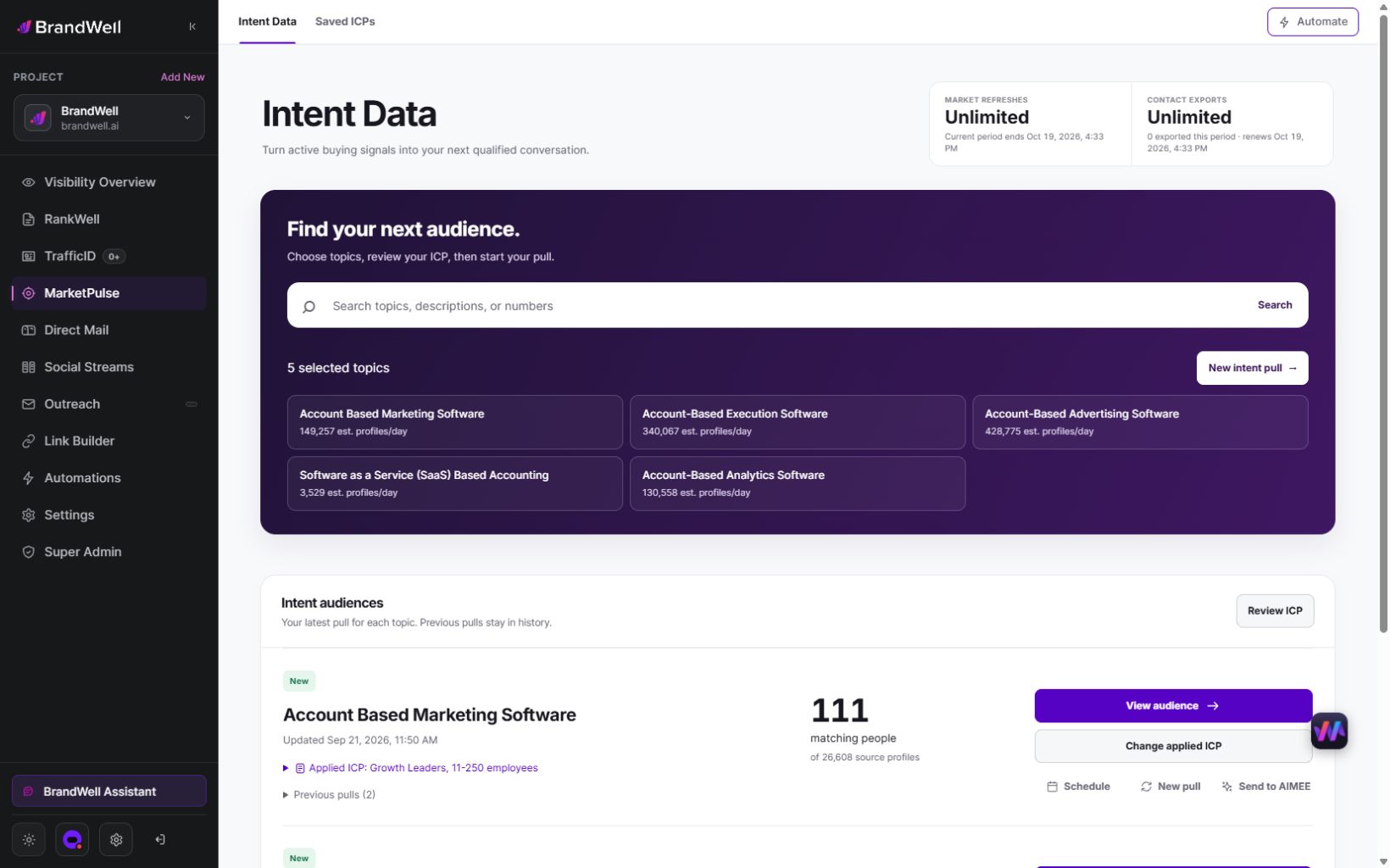
Watch the MarketPulse demo and compare plans. Standard plans are starting at $500/mo. Include campaign operation, creative and measurement costs separately from the software subscription.
Frequently asked questions
Can I upload purchased intent contacts to target them on YouTube?
Do not use an external intent list to create a YouTube targeting audience. Adding purchased records to your CRM does not change their provenance.
Can external intent help with the campaign?
It can inform permitted market research, message hypotheses and planning. Verify the exact use and keep it separate from audience construction.
Does an in-market segment identify confirmed buyers?
No. Treat it as a platform audience input, then evaluate fit, delivery and defined outcomes.
Do low-cost views prove a good B2B result?
No. Include quality, accepted conversions, full relevant cost and a defensible comparison where impact measurement is feasible.
Reviewed and updated October 3, 2026.

Written by