On this page
- What changes when you use an all-of-funnel approach?
- Why combine useful content with conversion copy?
- Prepare the strategy before the draft
- The eight-step AoFu article framework
- Use RankWell to prepare and review the article
- A practical brief for one article
- Measure the article without claiming causality
- Common AoFu blogging questions
All-of-funnel (AoFu) blogging means writing one useful article that helps readers understand a problem, evaluate ways to solve it and take a relevant next step. It combines education with product context. It does not mean forcing every stage of a buying journey into every post or replacing the rest of your content strategy.
A reader may arrive asking a basic question and leave ready to compare options. Another may need several visits, conversations and internal approvals. A well-organized article supports both without promising that one blog post will produce an immediate sale.
What changes when you use an all-of-funnel approach?
Top-of-funnel content introduces a problem or subject. Middle-of-funnel content helps readers compare approaches. Bottom-of-funnel content supports a specific buying decision. These distinctions remain useful for planning. AoFu brings selected elements together when they serve the same reader question.
For example, an article about building a content calendar can explain what a calendar is, show a usable planning process, discuss approval bottlenecks and demonstrate how a content workspace supports the process. The article can then link to a product page for readers who want software. Readers who only need the planning method should still receive a complete answer.
- Education: Explain the problem and the terms a reader needs.
- Evaluation: Show tradeoffs, costs, examples and limitations.
- Action: Offer a practical next step that matches the discussion.
Separate pages remain appropriate when questions have different audiences or require different depth. A beginner’s definition, a technical implementation guide and a procurement checklist do not always belong in the same article.
Why combine useful content with conversion copy?
Informational writing explains. Conversion copy helps someone decide what to do next. Combining them can make an article more useful when the offer genuinely addresses the problem discussed. The argument should follow from the evidence, rather than interrupting the explanation with unrelated sales language.
Describe what your product does, who it suits and what it does not do. Replace vague claims about transforming a business with a concrete workflow: who supplies the inputs, who reviews the work and where the approved output goes.
Brand personality can help readers recognize your company. An author photograph, a first-hand example or a product screenshot can support that connection. They do not substitute for evidence or establish that every reader will trust or buy from you.
Prepare the strategy before the draft
- Choose one primary reader: Define their task, existing knowledge and immediate constraint.
- Choose the main question: State the answer your article must deliver.
- Identify related decisions: Select the objections and comparisons that naturally follow that question.
- Prepare evidence: Collect current primary sources, product details and original examples.
- Choose an appropriate offer: Link to the product, demonstration or resource that helps with the next step.
- Assign review ownership: Name the person responsible for factual, product and editorial approval.
Keep a short brand brief with your positioning, audience, terminology and claims you can support. Avoid inventing statistics to make the introduction more compelling. A specific reader problem is often a stronger opening than a large but unrelated industry number.
The eight-step AoFu article framework
1. Write a clear headline and useful hook
Make the headline describe the actual subject and benefit. Start with the reader’s problem and give a concise answer before expanding. A hook can be a practical question, an observed difficulty or a clearly labeled example. It does not require a dramatic statistic.
For the content-calendar example: “A content calendar connects publication dates with owners, review stages and the business questions each article answers.” That statement immediately helps the reader understand the purpose.
2. Add navigation when the article needs it
A linked table of contents can help people navigate a long article. Use descriptive labels and test the anchors on mobile. Navigation is a usability choice, not a guarantee of better rankings or longer sessions.
3. Explain the subject and its boundaries
Use the first main section to define the concept or answer the primary question. A “What is…” heading can work for a definition, but it is not mandatory. Explain what the method includes and where a different approach is more appropriate.
4. Show the process with an example
Give the reader steps they can follow, including inputs, decisions and checks. Use screenshots only when they demonstrate the current interface. An original example or a small worksheet can be more useful than a decorative image.
5. Address related questions and objections
Explain limitations, alternatives and implementation constraints that affect the reader’s decision. Group related questions under clear headings. Avoid repeating the same keyword in every heading or adding unrelated sections just to make the article longer.
W3C’s heading guidance explains that headings communicate page organization and support navigation. Use heading levels to reflect sections and subsections, rather than choosing levels for their visual size.
6. Connect the relevant product to the problem
Introduce the offer after the reader has enough context to evaluate it. Describe the specific capability that addresses the task and link to its current product page. There is no universal rule that the first product mention must appear three-quarters of the way down.
For a content workflow, explain how RankWell helps organize and review articles. Do not insert buyer-intent pricing into a writing tutorial unless the article actually discusses connecting content with prospect research.
7. Finish the practical explanation
Complete the method before asking for a sale. Include quality checks, ownership and a realistic first action. A reader should be able to use the educational part even if they do not become a customer.
8. Close with a specific next step
Summarize the decision and offer an appropriate action: use the checklist, review a product demonstration or discuss your workflow. A forceful “stop doing this” formula is optional. Clear, accurate language usually works better than manufactured urgency.
Use RankWell to prepare and review the article
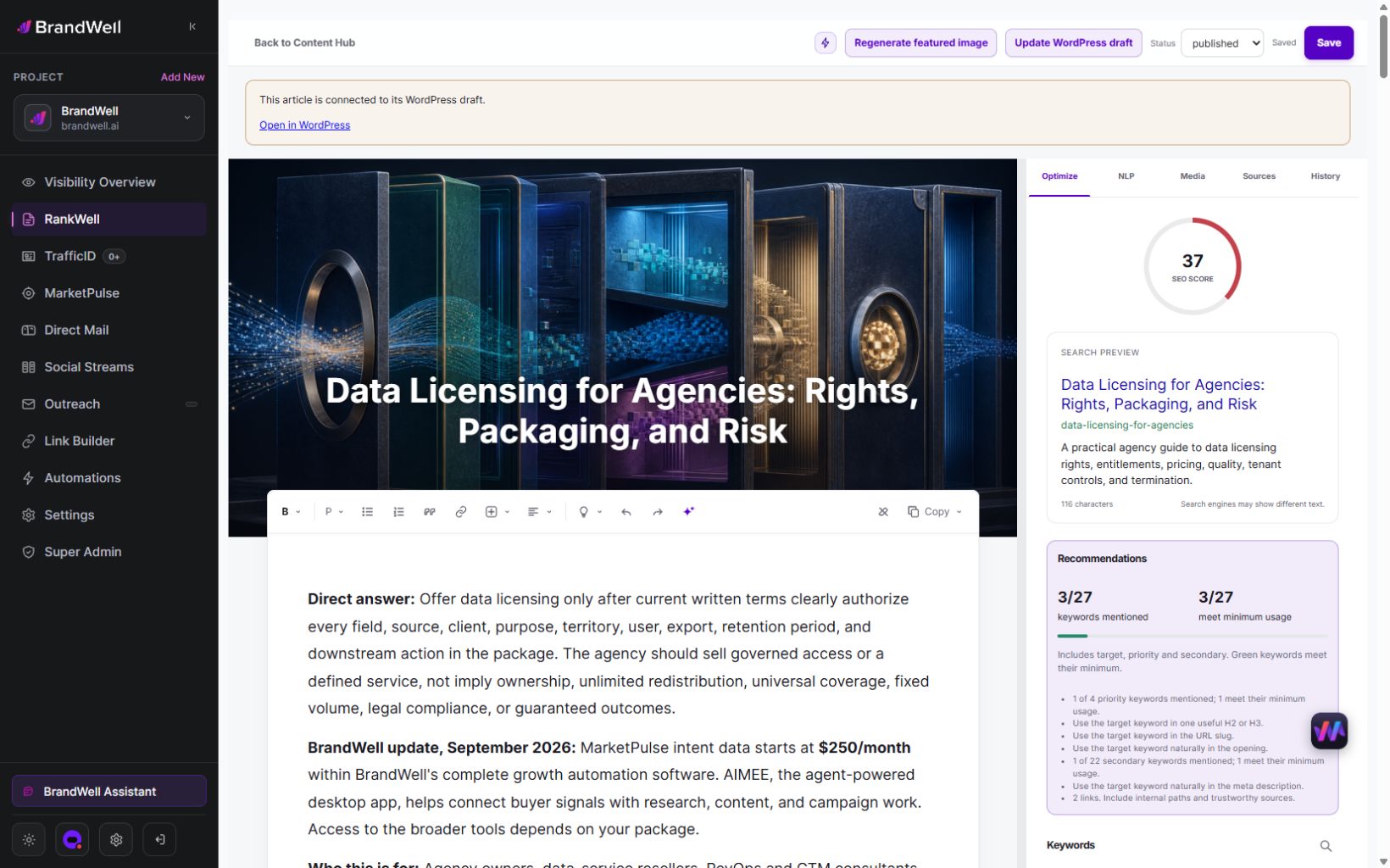
In the current BrandWell portal, RankWell’s Content Hub brings together articles, strategy, queue and calendar work. The editor includes the article, search preview, SEO recommendations, NLP, media, sources and history. Use these tools to support your editorial process.
- Prepare the reader question, offer and evidence in your brief.
- Organize an outline around the eight-step framework where it suits the topic.
- Use drafting assistance to develop the explanation and examples.
- Verify claims against their sources and current product information.
- Review heading structure, links, images and mobile readability.
- Check the search preview and approve the finished article before publication.
Confirm which input methods and publishing connections are available in your workspace rather than assuming an old tutorial’s document-upload options still apply. Generated text and editor scores do not establish factual accuracy or promise search visibility.
A practical brief for one article
- Reader: A marketing lead coordinating writers and reviewers.
- Question: How do we build a content calendar that survives approval delays?
- Direct answer: Plan publication dates alongside owners, review deadlines and dependencies.
- Original example: A four-article schedule with a named reviewer and a backup publication slot.
- Decision support: Explain when a spreadsheet is sufficient and when a shared content workspace helps.
- Product context: Show relevant RankWell calendar and article-review capabilities without claiming unverified automation.
- Next step: Explore RankWell and compare its workflow with your team’s requirements.
This brief keeps the article focused. A product section should demonstrate a relevant capability, while the educational sections explain the underlying task.
Measure the article without claiming causality
Track search impressions and clicks, relevant on-page actions, qualified inquiries and eventual purchases separately. Compare consistent periods and account for changes in query mix, rankings, seasonality, traffic source and sales follow-up.
Fictional example: An article receives 2,000 visits, 100 product-link clicks and 10 qualified inquiries. That is a 5% product-link click rate per visit and a 0.5% inquiry rate per visit. These rates do not establish that the article caused ten purchases, and they are not performance benchmarks.
Record writing, research, editing, design and distribution costs. If someone reads several pages before buying, keep those touches visible rather than assigning the entire sale to the last article. A before-and-after comparison can suggest a question to investigate; it does not isolate the effect of your writing framework.
Common AoFu blogging questions
Does one article replace the whole funnel?
No. It can support several related decisions, but some readers need dedicated tutorials, comparisons, product details or a conversation before acting.
Can AI write the article?
AI can assist with outlining and drafting. A responsible reviewer still needs to check facts, permissions, current product claims and whether the explanation actually solves the reader’s problem.
Do you need exactly two people?
No. Strategy and editorial review are responsibilities, not a fixed headcount. A small business may combine them; a larger team may involve specialists, legal reviewers and product owners.
Will this format earn an AI Overview citation?
No format guarantees inclusion. Give clear answers, show useful original evidence and make the page understandable. Treat any search exposure as an observed result rather than a promised outcome.
Where should the CTA go?
Place it where it follows naturally from the explanation. Keep the main answer complete and make the next step clear. Test alternatives using defined metrics rather than assuming a universal winning position.
Build one article around a useful question, supported evidence and a relevant next step. Explore RankWell to see how the current BrandWell content workflow can support that process.
Reviewed and updated October 3, 2026.

Written by
Julia McCoy has contributed articles to BrandWell on content marketing, writing, and search engine optimization. This archive retains her original bylines; individual articles may be updated by the BrandWell editorial team.