On this page
- 1. Organize customer feedback
- 2. Draft emails for an approved audience and offer
- 3. Develop a useful educational article
- 4. Create ad-copy variations without changing the claim
- 5. Prepare a sales handoff from known information
- 6. Prepare support replies from current policies
- Connect the work through configured Automations
- Evaluate outputs and outcomes
- Frequently asked questions
Useful AI marketing work starts with a defined task, approved source material and a result someone can review. Six practical use cases are feedback analysis, email drafting, educational content, ad-copy variations, sales handoffs and support-response preparation. Each needs evidence and clear approval before it affects customers.
This guide focuses on those jobs within BrandWell’s current product context. The sample instructions below are original examples to adapt; they do not establish that every workspace has a particular connection or that a generated message will improve conversions.
1. Organize customer feedback
Start with a permitted set of feedback records and a specific question. Group recurring themes, retain references to the original comments and identify exceptions. Do not treat sentiment labels as certain measurements of a customer’s feelings.
Group these approved feedback notes into onboarding, reporting and support themes. Identify repeated requests and conflicting comments. Include the record reference behind each finding. Do not infer satisfaction or intent where the comment does not establish it. Flag ambiguous items for review.
Review the categories against the actual records. Avoid extrapolating a handful of comments to every customer. A theme is a reason to investigate, not proof that a product change will succeed.
2. Draft emails for an approved audience and offer
Provide the audience, offer, timing, approved facts and desired action. A draft can suggest subject lines and structure. Sending, scheduling and recipient eligibility depend on the configured workflow and permissions.
Draft a short follow-up for recipients who requested information about this service. Use only the approved offer below. Lead with the next step and include three concise bullets. Preserve the price and expiration exactly. Do not invent discounts, results or urgency. Return a draft for approval; do not send it.
Check links, prices, personalization and the reason the recipient should receive the message. Email opens are not conclusive evidence of reading. Purchases, opt-outs and other eligibility changes should be handled by the actual sending workflow.
3. Develop a useful educational article
Use Visibility for keyword research and RankWell for article work. Select a question you can answer with current evidence, then add an original explanation or example.
Prepare an outline for an IT services business explaining how to plan a client onboarding meeting. Use the approved service notes and sources. Separate preparation, questions and follow-up. Identify missing facts instead of inventing them. Suggest one practical checklist and a relevant next action.
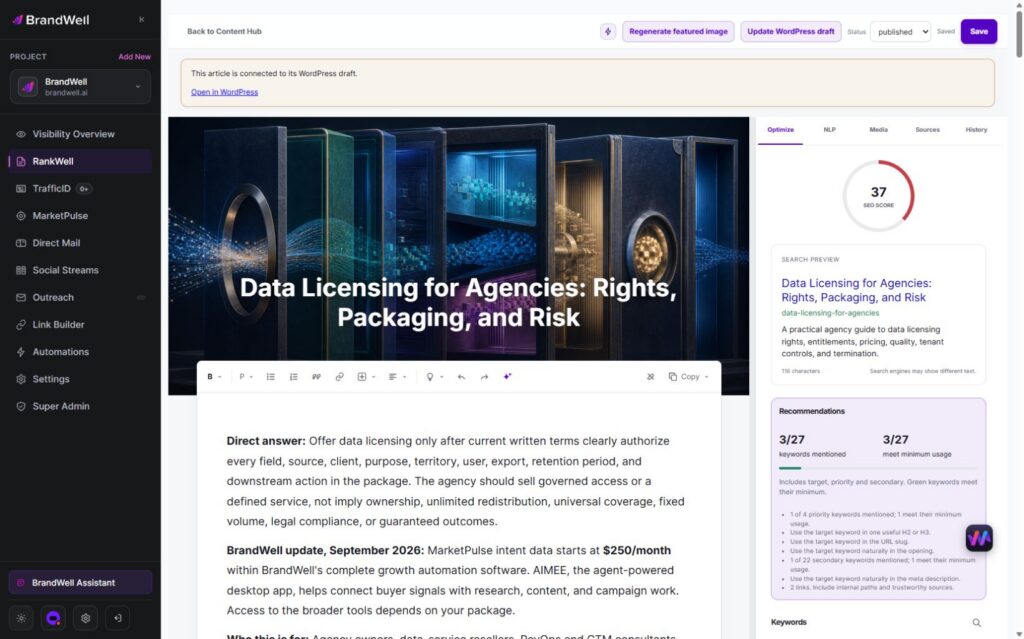
RankWell’s Content Hub organizes article, strategy, queue and calendar work. Its editor combines the draft with search preview, recommendations, NLP, media, sources and history. Check the finished article and approve it before configured publication.
4. Create ad-copy variations without changing the claim
A useful creative brief specifies the audience, actual benefit, destination and constraints. Generate variations around a supported message rather than asking for “profitable keywords” or guaranteed clicks.
Create three ad-copy concepts for the approved offer below. Keep the price, scope and qualifications unchanged. One version should explain the problem, one the workflow and one the next step. Do not promise guaranteed leads or revenue. List any claim that needs substantiation before use.
Check each variation against the landing page and platform requirements. Research demand separately and evaluate actual campaign data. A persuasive sentence does not demonstrate that a keyword is profitable or that a targeting decision will work.
5. Prepare a sales handoff from known information
Separate observed activity, explicit requests and inferred fit. A topic signal or website visit can guide research but does not prove someone wants to buy. Use agreed criteria and preserve the evidence behind the handoff.
Prepare a sales handoff from these approved records. Show the known company information, explicit request, relevant activity, unresolved questions and suggested next action. Keep observations separate from assumptions. Do not invent budget, timeline or purchase intent. Flag missing contact permission.
MarketPulse provides intent-topic data with plans starting at $250/month. TrafficID provides identification for available website visitors, with coverage that varies. Review fit and permitted use before outreach; neither source makes a lead automatically qualified.
6. Prepare support replies from current policies
Give the workflow approved product information and a defined escalation route. A draft reply should explain the known answer and identify what needs a person to resolve. Access to an order, account or refund action requires the appropriate connection and authorization.
Draft a reply to this customer using only the current policy and product notes below. State what is known, what needs checking and the next step. Do not invent account status, promise a refund or claim an action was completed. Escalate questions outside the supplied information to the support owner.
Review the message before use. Account-specific information must come from an authorized record, not a plausible generated answer. Track whether the issue was actually resolved rather than counting every reply as success.
Connect the work through configured Automations
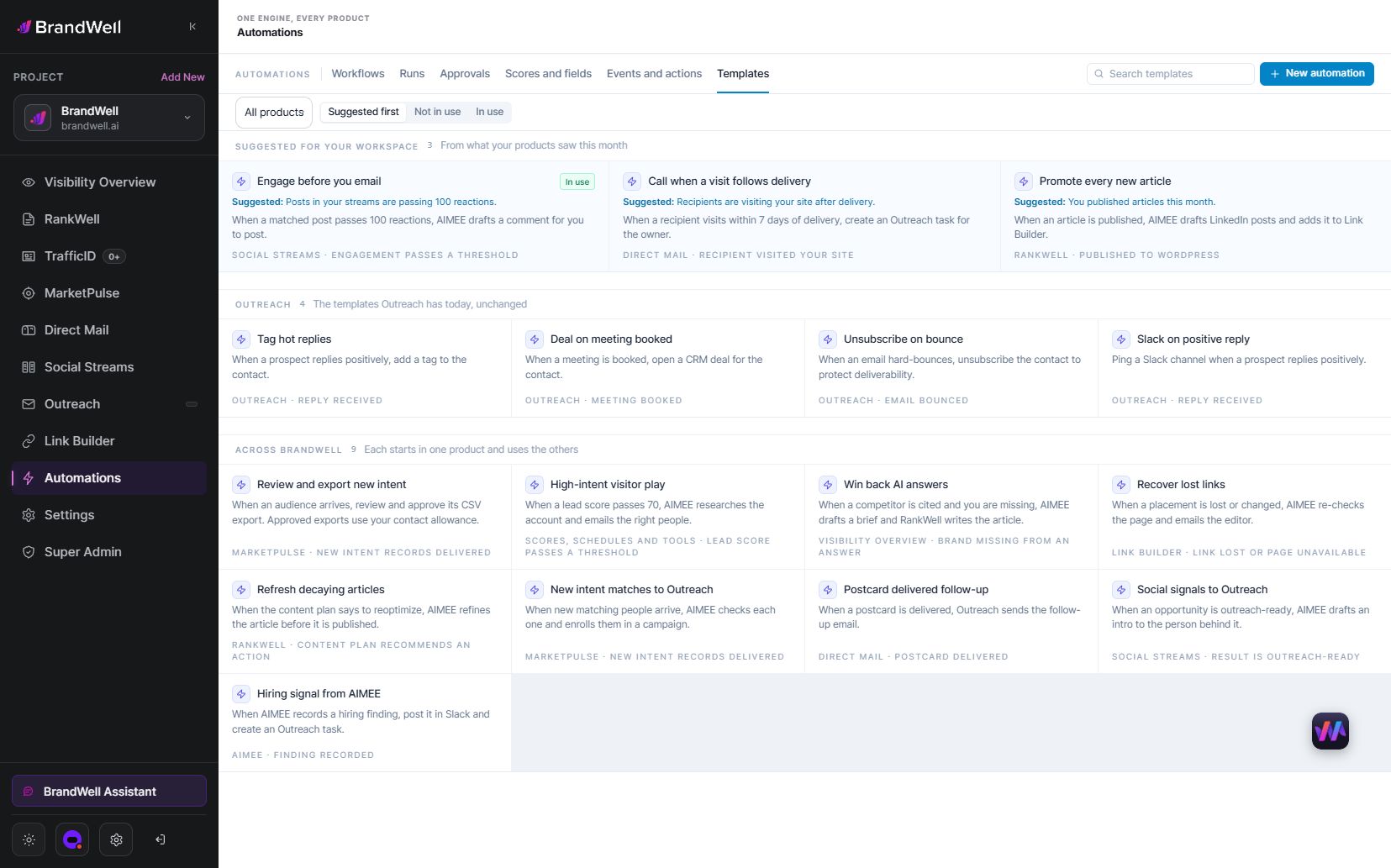
BrandWell Automations coordinates configured tools, triggers, owners and approval steps. Available actions depend on the workspace’s connections and permissions. Confirm what the workflow can read and change before running it.
Keep drafting, approval and execution visible as separate states. A generated email is not a sent email. A proposed record update is not a confirmed update. Retain the source and destination so a reviewer can trace what happened.
Evaluate outputs and outcomes
NIST’s Generative AI Profile is a voluntary resource for incorporating trustworthiness considerations into the use and evaluation of AI systems. Apply that principle by setting acceptance criteria and assigning review ownership.
Hypothetical example: A workflow produces 20 email drafts. Six need factual corrections, four need tone edits and ten pass the agreed review unchanged. Record those categories alongside drafting and review time. Do not report “20 successful customer follow-ups” unless the approved messages were actually sent and the relevant outcome was measured.
For each use case, define the result that matters: accurate theme extraction, approved copy, a useful article, qualified sales handoff or resolved support issue. Keep business results separate from output volume and test comparable work before claiming an improvement.
Frequently asked questions
Will AI automatically research and send everything?
Tools, connections, permissions and approval settings determine what can happen. Define the authorized task and verify execution in the configured workflow.
Can a draft prove a lead is qualified?
No. Apply agreed criteria to known facts and explicit requests, and flag missing information.
Where should I start?
Choose one repeatable task with approved sources, a clear owner and a reviewable result. Expand after the workflow meets its acceptance criteria.
Reviewed and updated October 3, 2026.

Written by
Julia McCoy has contributed articles to BrandWell on content marketing, writing, and search engine optimization. This archive retains her original bylines; individual articles may be updated by the BrandWell editorial team.

 Justin McGill