


On this page
- What are you actually buying with PPC?
- Separate ROAS, ROI and profit
- Work backward from the economics
- When a PPC test is more promising
- Quality Score is a diagnostic, not your profit metric
- Plan a bounded test before spending
- Improve the landing-page and follow-up workflow in BrandWell
- PPC versus organic search
- Frequently asked questions
PPC is worth testing when the customers it acquires contribute enough margin to cover advertising and related acquisition costs. It can also support a defined awareness or learning objective, but those outcomes should be measured separately from profitable sales. More clicks alone do not establish that the investment is worthwhile.
The answer depends on your offer, audience, landing page, sales process and measurement. This guide shows how to calculate the economics, plan a bounded test and identify why a campaign might fail. The worked numbers are hypothetical examples, not expected returns.
What are you actually buying with PPC?
Pay-per-click describes an advertising pricing model in which clicks are charged. A click is a visit opportunity, not a purchase or a qualified lead. Advertising platforms also offer other campaign and billing models, so confirm the actual configuration rather than assuming every paid campaign works identically.
Ads can reach people sooner than waiting for a new article to attract organic search traffic, but eligibility, review, competition and audience demand affect whether they show. Launching a campaign does not guarantee immediate sales, a top position or exact audience identification.
Separate ROAS, ROI and profit
- ROAS: attributed revenue divided by advertising spend.
- Cost per acquisition: the costs included in your calculation divided by acquired customers.
- Profit contribution: revenue remaining after the relevant delivery and variable costs, then acquisition costs.
- ROI: net return compared with the investment being evaluated, using a clearly stated cost scope.
If an illustrative campaign spends $1,000 on ads and records $2,000 in attributed revenue, its ROAS is 2x, or 200%. That is not automatically a 200% ROI. If delivery and variable costs are $1,200, only $800 remains before the advertising cost. Subtracting the $1,000 ad spend leaves a $200 loss before other costs.
Reported attribution is also not proof of incremental revenue. Some customers may have bought without seeing the ad, and several channels can claim credit for the same sale. Explain the reporting rule and use an appropriate experiment when you need to estimate incremental impact.
Work backward from the economics
A simple ecommerce example
Suppose an order brings $100 in net revenue and $40 in contribution before advertising after the variable costs you have included. If 2% of ad clicks produce such an order, the contribution available per click is $0.80: $40 multiplied by 0.02.
Under those assumptions, a $1 click costs more than the expected contribution it generates. A $0.60 click leaves $0.20 per click before any costs omitted from the model. The 2% rate and cost figures are illustrative; use verified account and sales data for your own decision.
A service-business example
A hypothetical IT service campaign costs $1,500 in ads and $500 in production and management. It produces 20 inquiries, eight qualified opportunities and two customers. Ad-only cost per inquiry is $75. Including the stated $2,000 acquisition cost, cost per qualified opportunity is $250 and cost per customer is $1,000.
If the business can support $1,200 in contribution per acquired customer within the chosen payback period, two customers contribute $2,400. After the stated acquisition cost, $400 remains before other omitted costs. If only one customer closes, the same campaign does not cover those costs. Track sales outcomes and qualification instead of valuing every form equally.
Be careful with projected recurring revenue
A recurring subscription can contribute revenue over time, but future renewals are assumptions until observed. Model churn, refunds, support and delivery costs, and report initial purchase results separately from realized recurring revenue. A large projected lifetime value does not solve a cash-flow problem today.
When a PPC test is more promising
- The offer addresses a real need and the business can serve the target audience.
- The ad and landing page explain the same service, price and important conditions.
- The business can respond to inquiries and record which ones become customers.
- Purchase values, refunds and qualification can be measured reasonably well.
- The budget supports a defined learning period without relying on guaranteed returns.
A test is less useful when the offer is unclear, the page is unusable on mobile, form submissions are mostly unsuitable or there is no way to join advertising data with outcomes. Fix those bottlenecks before treating additional traffic as the solution.
Quality Score is a diagnostic, not your profit metric
Google says Quality Score is diagnostic, not an auction input or KPI. Use it to investigate relevance and experience rather than treating the displayed score as a profitability guarantee.
Google’s Ad Rank explanation describes eligibility and placement using multiple auction factors, including bids, quality, context, thresholds and assets. The highest bid alone does not guarantee the desired placement. Your business still needs suitable customers at acceptable costs.
Plan a bounded test before spending
- Define the objective. Specify a purchase, qualified request or another meaningful outcome.
- Set the cost scope. Include ads, creative, management, landing-page work and follow-up where relevant.
- State the assumptions. Document margin, conversion rate, qualification, close rate and payback period.
- Check measurement. Verify events, values, deduplication and the connection to sales records before launch.
- Limit the test. Set a budget, review date and conditions for pausing or extending it.
- Inspect traffic quality. Review actual search terms or audience delivery, geography and invalid or duplicate requests.
- Review outcomes. Compare costs with qualified opportunities, collected revenue and contribution, noting attribution limits.
A small sample can be inconclusive. Do not declare a winner from one sale or keep spending indefinitely because success might arrive later. Decide what evidence would justify the next investment.
Improve the landing-page and follow-up workflow in BrandWell
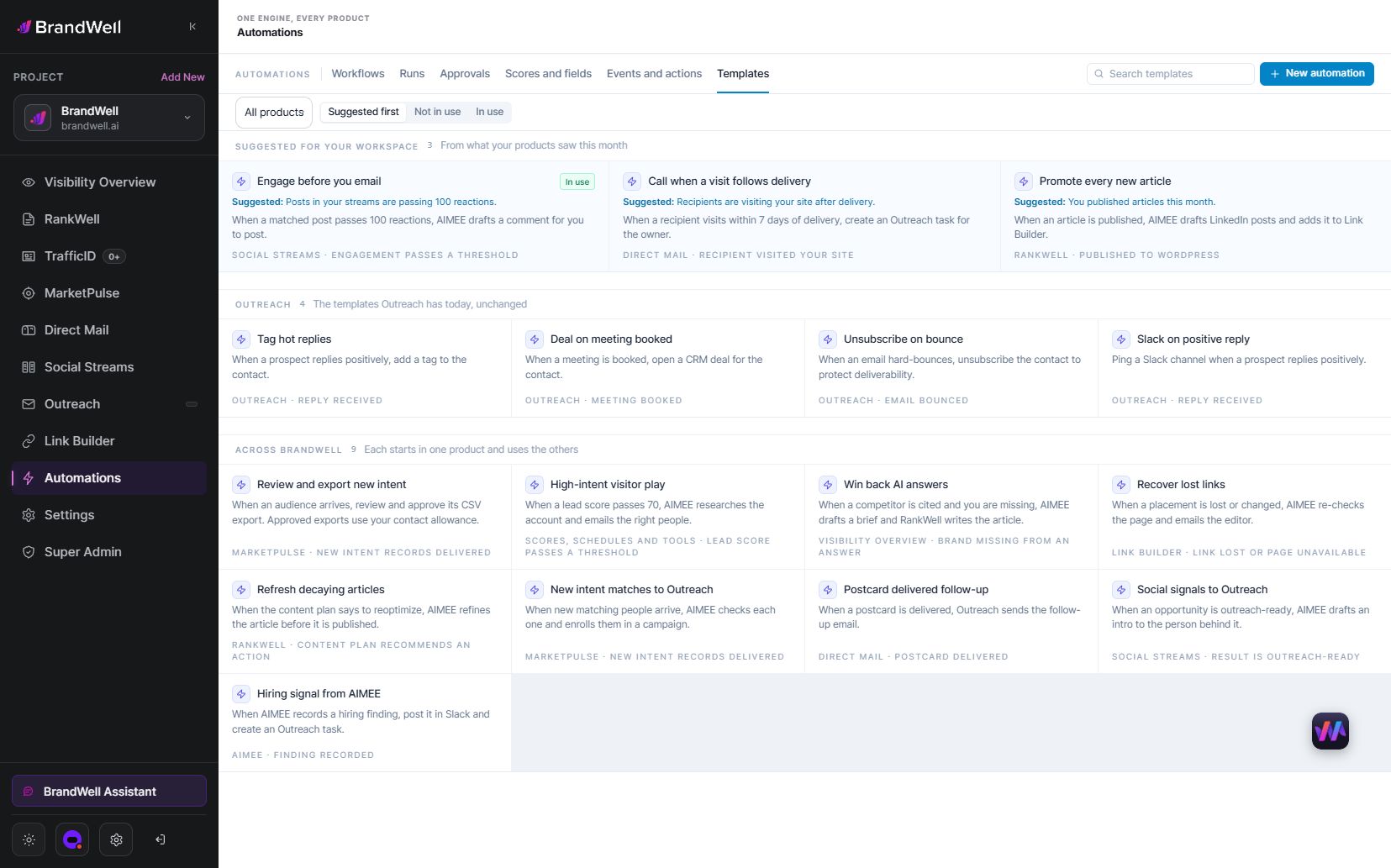
Use keyword research in Visibility to inform relevant topic planning. RankWell supports preparing and reviewing content that answers the audience’s questions. Verify product details, pricing and claims before publishing a landing-page explanation.
Automations can support configured handoffs and follow-up with permissions, owners and approvals. AIMEE’s actions depend on configured tools and access. These workflows do not replace the advertising platform’s measurement or prove campaign incrementality.
If recent topic research is useful, MarketPulse plans are starting at $500/mo. Evaluate available data, fit and permitted use separately from ad performance. Topic interest does not guarantee a purchase or authorize contact. Include the product cost in your campaign economics if you use it for the campaign.
PPC versus organic search
Paid and organic activity can serve different needs. Advertising buys eligible exposure under the campaign’s rules. Useful organic content can answer questions beyond a paid campaign’s lifetime, but research, production and maintenance still cost money and rankings are uncertain.
Compare the work using the same outcome definitions where possible. Avoid calling organic traffic free or assuming that paid traffic is always more likely to convert. Audience, query, offer and customer stage can explain substantial differences.
Frequently asked questions
Is PPC worth it for a small business?
It can be, if the offer, margin and acquisition costs support it. Start with a defined test and enough operational capacity to handle the response. A limited budget does not guarantee a viable campaign.
What is a good ROAS?
There is no universal target. A campaign’s required revenue depends on margin, costs, refunds and the payback period. Calculate what covers your actual economics instead of copying another business’s ratio.
What is the main downside?
You can spend money on clicks that never produce suitable customers. Weak measurement, unsuitable traffic and a poor offer can make that difficult to diagnose.
When should I stop a test?
Use the budget and evidence rules defined before launch. Pause when measurement is broken or traffic is clearly unsuitable. Review sales-cycle timing and sample size before interpreting an absence of purchases.
Decide whether PPC is worthwhile from your measured customer economics. Use BrandWell Automations to support configured follow-up and RankWell for reviewed content that explains the offer.
Reviewed and updated October 3, 2026.

Written by
Julia McCoy has contributed articles to BrandWell on content marketing, writing, and search engine optimization. This archive retains her original bylines; individual articles may be updated by the BrandWell editorial team.


1 comments