On this page
Positioning in marketing defines how you want a particular audience to understand your offering and why it matters to them. A useful position connects a real customer need to a benefit you can demonstrate.
Positioning should guide product explanations, sales conversations and content. It needs more substance than describing your business as innovative, high-quality or the best.
Start with the audience and its alternatives
OpenStax’s marketing text places positioning after segmentation and target selection. It describes positioning as deciding and communicating how a market should think and feel about an offering.
Begin with a specific customer situation. A small employer preparing to move payroll systems has different questions from a large company replacing several connected systems. The same product may need different explanations for each.
- What task is the customer trying to complete?
- What makes the current approach difficult?
- What alternatives are available, including doing nothing?
- Which benefit matters enough to influence a decision?
- What evidence can you show?
Choose a defensible basis for the position
There is no requirement to force every business into one fixed list of five positioning types. Choose the basis that fits your customer and evidence.
| Possible basis | Question to answer | Evidence to review |
|---|---|---|
| Specific customer need | Whose problem do we solve? | Interviews and observed tasks |
| Use case | When is the offering useful? | Actual workflow demonstration |
| Service model | What help is included? | Documented scope and delivery |
| Value | What does the buyer receive for the cost? | Current offer and full-cost comparison |
Swipe the table to see all columns.
A benefit should survive a product check. If onboarding support is your main difference, document what that support includes and where its limits are. If the claim depends on a particular package, make that condition clear.
Write a positioning statement you can test
OpenStax’s examples connect the target audience, offering, differentiated benefit and supporting evidence. Use those components to make your own internal statement.
Working template: For [specific audience] trying to [task], [offering] provides [relevant benefit], supported by [demonstrable evidence].
Fictional example: For small employers preparing to migrate payroll, our guided implementation service provides a reviewed preparation plan, supported by a documented checklist and named implementation contact.
This is a hypothesis until the company verifies the service and tests whether the intended customers value it. Avoid adding “fastest,” “safest” or “only” without appropriate evidence.
Use perceptual maps carefully
A perceptual map shows how customers perceive offerings along selected attributes. The attributes should matter to their buying decision, as OpenStax explains.
Distinguish a map based on actual customer responses from one built on the team’s assumptions. Label the population, sample, questions and date. If you have not collected responses, call it a working hypothesis.
An empty area on a chart does not prove demand. It may reflect a valuable unmet need, a poor attribute choice or an offer customers do not want. Follow up with customer research before committing a campaign.
Turn the position into useful content
For the fictional payroll service, useful content might include a preparation checklist, a clear explanation of the implementation scope and a demonstration of the review process. Each page should answer a distinct reader question.
Use RankWell to connect that positioning context to the content plan. Supply approved product facts, sources and customer language. Inspect existing coverage before choosing to create, improve or merge.
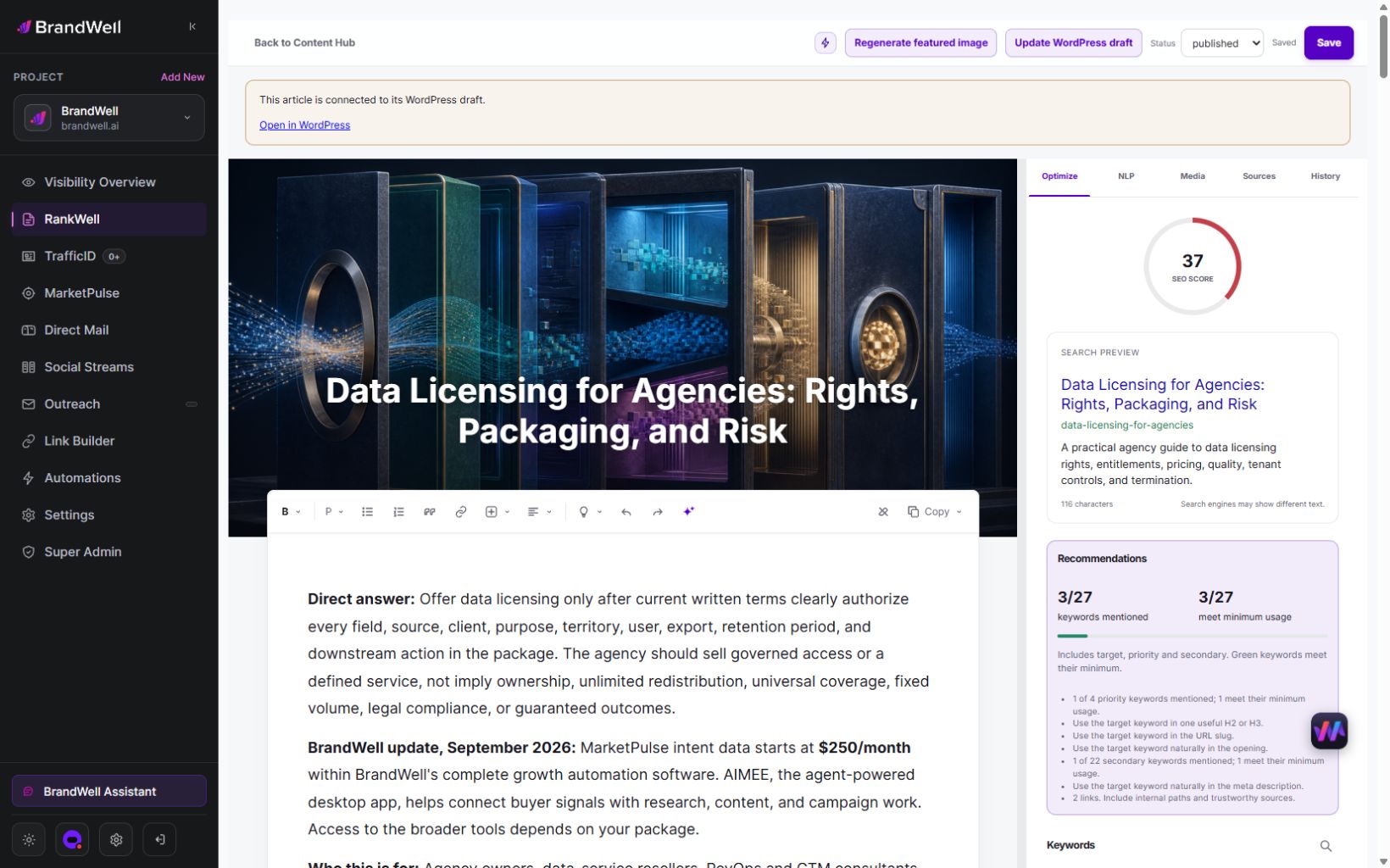
Review the draft, media and search presentation before publishing through a configured destination. Keep the same factual scope across the article, product page and sales material.
Test understanding before declaring success
Ask intended customers to explain what the offer does, who it serves and which benefit they remember. Record actual responses rather than prompting them toward your preferred wording.
Fictional example: 20 people review a message. Twelve correctly describe the intended use case, five give another interpretation and three do not answer. Correct understanding is 60% of all participants, or 70.6% of the 17 who answered. Report the unanswered responses as well.
This small exercise does not prove a conversion increase. Use it to identify confusing language, then evaluate qualified inquiries, sales and delivery outcomes with an appropriate measurement plan.
Reposition when the evidence changes
Review positioning when the product, audience, service scope or customer needs change. Update the supporting pages and internal guidance together. Preserve a record of the previous message so results can be interpreted in context.
Frequently asked questions
Is positioning the same as a slogan?
A slogan expresses a message. Positioning defines the audience, benefit and evidence that should guide that message.
Can one product serve different positions?
It can serve different audiences or tasks, but each explanation must accurately reflect what the product delivers.
Does a perceptual map prove an opportunity?
No. Check how the map was built and validate the proposed need with customers.
Reviewed and updated October 6, 2026.

Written by
Julia McCoy has contributed articles to BrandWell on content marketing, writing, and search engine optimization. This archive retains her original bylines; individual articles may be updated by the BrandWell editorial team.