



On this page
- Branded and non-branded keyword examples
- Find branded queries in Search Console
- Match known-brand searches to the right page
- Use branded questions to inform discovery content
- Original example: classify four search tasks
- Measure demand without overstating causation
- Evaluate branded paid search separately
- Turn the findings into a reviewed BrandWell brief
Branded keywords are searches containing a company name, product name or a recognizable variation of that brand. Non-branded searches describe a need without naming the business. Separating the two helps you understand whether people are finding a known product or discovering your business through a broader question.
A branded search is not automatically a purchase signal. Someone may need pricing, support, login instructions or an explanation of a product. Match the destination to that task rather than sending every brand query to a sales form.
Branded and non-branded keyword examples
- Branded: BrandWell pricing, BrandWell login, RankWell content workflow or BrandWell MarketPulse.
- Non-branded: buyer intent data pricing, content planning workflow or website visitor identification.
- Ambiguous: a product word that is also used by unrelated businesses or in ordinary language.
These are illustrative classifications, not a claim that each phrase has a measured search volume. Review context before assigning ambiguous queries to a branded group.
Find branded queries in Search Console
- Choose a consistent reporting period and search type in the Performance report.
- Inspect the Queries dimension for your company and product names.
- Create a documented grouping rule covering relevant spellings and variations.
- Review matched queries manually for unrelated uses of the same words.
- Inspect the pages appearing for those queries and whether they serve the expected task.
- Repeat the analysis for non-branded queries, keeping the same period and filters.
Google’s Performance report documentation defines clicks, impressions, CTR and average position, and explains how dimensions affect aggregation. Keep the grouping method with the report so a later comparison uses the same rules.
Autocomplete and related searches can suggest language to investigate. They do not prove an exact query’s volume or show your business’s conversion rate. Customer questions and internal site searches can also reveal wording, but those are different datasets from Google organic queries.
Match known-brand searches to the right page
For pricing searches, provide current prices, inclusions and important conditions. For login searches, make the actual portal easy to find. For product explanations, use the current product name and describe its role plainly.
Within BrandWell, RankWell supports the content workflow, while MarketPulse provides buyer intent data with plans starting at $500/mo. Keep those roles distinct. Do not use an older content-product description as a substitute for the current portal and product information.
Use clear titles that reflect the page’s purpose. Google’s title guidance favors descriptive, distinct wording over repetitive keywords. Search titles may be generated from several page signals, so keep the visible heading and main content consistent with the title you specify.
Use branded questions to inform discovery content
A brand question may reveal an educational need you can also address for new readers. For example, recurring questions about MarketPulse Intent Scans could inform a general guide explaining how an Intent Scan works, what period it covers and how filters affect available records.
Explain the concept using verified product facts and useful examples. Do not create near-identical pages for every spelling variation. A helpful central resource can answer several related questions without multiplying thin pages.
Original example: classify four search tasks
This fictional worksheet shows how classification can change the destination and outcome you track:
- BrandWell login: known-brand navigation; provide portal access, not a new signup pitch.
- BrandWell MarketPulse price: known-product evaluation; show current plans and conditions.
- What is buyer intent data: non-branded education; explain the concept and limitations before offering a next step.
- How to plan a content calendar: non-branded task; provide a working method and show the relevant content workflow.
Review the query and destination together. Treating every branded click as a new lead would confuse existing-user navigation with acquisition.
Measure demand without overstating causation
Track branded clicks and impressions alongside position, country, device and landing page. A change may reflect advertising, publicity, existing customers, seasonality or changes in how your results appear. It does not isolate the effect of one branding campaign.
Search Console reports organic search performance; your configured analytics records on-site activity and business outcomes. Do not assume ordinary analytics acquisition reports reveal every organic keyword or that query data maps directly to an identified person’s purchase.
Evaluate branded paid search separately
Buying your own brand terms can be tested against a defined business objective and budget. It does not guarantee a particular ad position, lower costs or control over organic reviews and reporting.
Google Ads describes Quality Score as a diagnostic based on expected CTR, ad relevance and landing-page experience. It is not an auction input or a business KPI. Merely adding branded terms does not establish that the campaign has improved.
Separate paid and organic results and distinguish new acquisition from existing-user navigation. If you test branded ads, measure relevant outcomes rather than assuming all attributed purchases are incremental.
Turn the findings into a reviewed BrandWell brief
Use keyword research to investigate the language and task, then develop the relevant guide in RankWell. Include the correct current product, source links and a useful example. Review screenshots, pricing and calls to action before publishing.
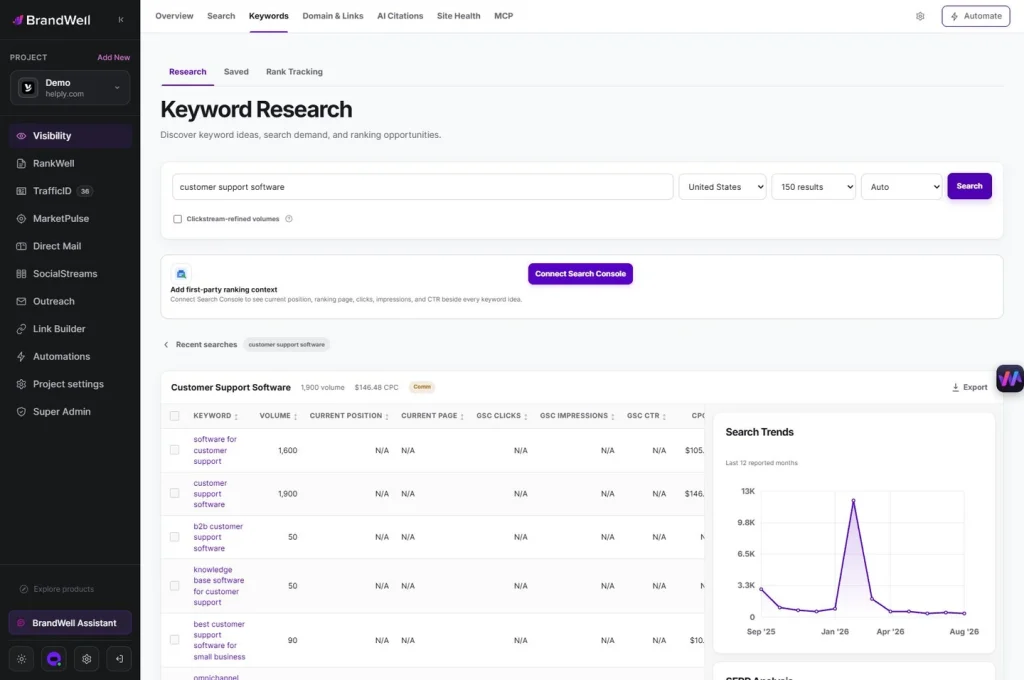
Revisit the query groups after a product rename or a new launch. Preserve the earlier grouping definitions so changes in classification are not mistaken for changes in demand.
Reviewed and updated October 2, 2026.

Written by
Julia McCoy has contributed articles to BrandWell on content marketing, writing, and search engine optimization. This archive retains her original bylines; individual articles may be updated by the BrandWell editorial team.

