On this page
- What lead qualification means
- Define your stages before assigning scores
- A seven-part qualification checklist
- Ask questions that move the conversation forward
- Use scoring as triage, not a buying prediction
- How current BrandWell signals support the review
- Make a usable handoff record
- What to do when a lead is not ready
- Measure the qualification process
- Frequently asked questions
Qualify sales leads by checking business fit, the problem to solve, the buying process, timing, and an agreed next step. Record what the prospect has confirmed separately from what you infer. A website visit, topic-research signal, or contact record can help you prioritize investigation; none proves that someone has budget or intends to buy.
This guide provides a practical checklist, discovery questions, and an example handoff record. Use them to make the next action clear rather than label every engaged visitor sales-ready.
What lead qualification means
Lead qualification is your team’s process for deciding whether a person or account is suitable for a sales conversation and what should happen next. The criteria should reflect the product you actually deliver, the customers you can serve, and the stage of the relationship.
A qualified lead is not a guaranteed customer. An unsuitable lead is not necessarily a bad business: it may need a different capability, operate outside your service area, or have no relevant project. Keep a reason for the decision so your team can distinguish missing information from a confirmed mismatch.
Define your stages before assigning scores
| Stage | Example working definition | Evidence still needed |
|---|---|---|
| Research candidate | A person or account appears relevant enough to investigate | Current role, fit, contact eligibility, and actual need |
| Marketing-qualified lead | Meets your agreed fit and engagement criteria for marketing follow-up | Whether a sales conversation is wanted or appropriate |
| Sales-qualified lead | Sales has reviewed the evidence and accepted a relevant next conversation | Remaining purchase requirements and stakeholders |
| Product-qualified lead | Meets defined product-usage criteria relevant to a paid use case | Whether the usage supports a real evaluation and purchase path |
| Opportunity | A specific potential deal is being evaluated with an owner and next action | Decision criteria, commercial details, and outcome |
Swipe the table to see all columns.
These are example definitions, not universal industry standards. Agree on your own with marketing and sales. A newsletter signup should not automatically become an opportunity, and a job title should not automatically establish purchasing authority.
A seven-part qualification checklist
- Business fit: Can you serve the company’s use case, size, location, and technical requirements?
- Problem: What is the prospect trying to improve, and how do they handle it now?
- Capability fit: Does your current product address that problem? Document any gaps rather than promising an unbuilt feature.
- Buying participants: Who evaluates, uses, approves, and signs? The initial contact may be a valuable advocate without final authority.
- Commercial process: What budget range, procurement requirements, or funding decision applies? Ask rather than infer from page activity.
- Timing: Is there an event or deadline driving the decision? “Not now” is different from “never.”
- Next step: What action is appropriate, who owns it, and when should it occur?
For each item, use Confirmed, Unconfirmed, or Mismatch, plus a dated note. Unconfirmed is not a reason to invent a favorable answer, but it also need not mean automatic rejection.
Ask questions that move the conversation forward
- What prompted you to look at this now?
- Which part of the current process is creating the most work or risk?
- What would a successful result look like for your team?
- Which capabilities are required, and which are optional?
- Who else needs to evaluate the workflow or approve the purchase?
- Is there a budget range or procurement process we should plan around?
- Would a product walkthrough, written answer, or later follow-up be most useful?
Share relevant product scope and pricing early enough for an informed conversation. Avoid treating qualification as an interrogation. A contact who cannot answer procurement questions may still be able to introduce the right colleague.
Use scoring as triage, not a buying prediction
A score can organize your queue, but its meaning comes from your rules. Distinguish fit signals from engagement signals. A repeated visit might justify reviewing an account; it does not reveal its budget. A form submission requesting a demo gives different evidence from an email open.
If you use points, label them internal prioritization rules and test whether they improve handoffs. Document exclusions, duplicate handling, and recency. Do not call a score a probability of purchase unless it is a separately validated predictive model with the relevant limitations.
How current BrandWell signals support the review
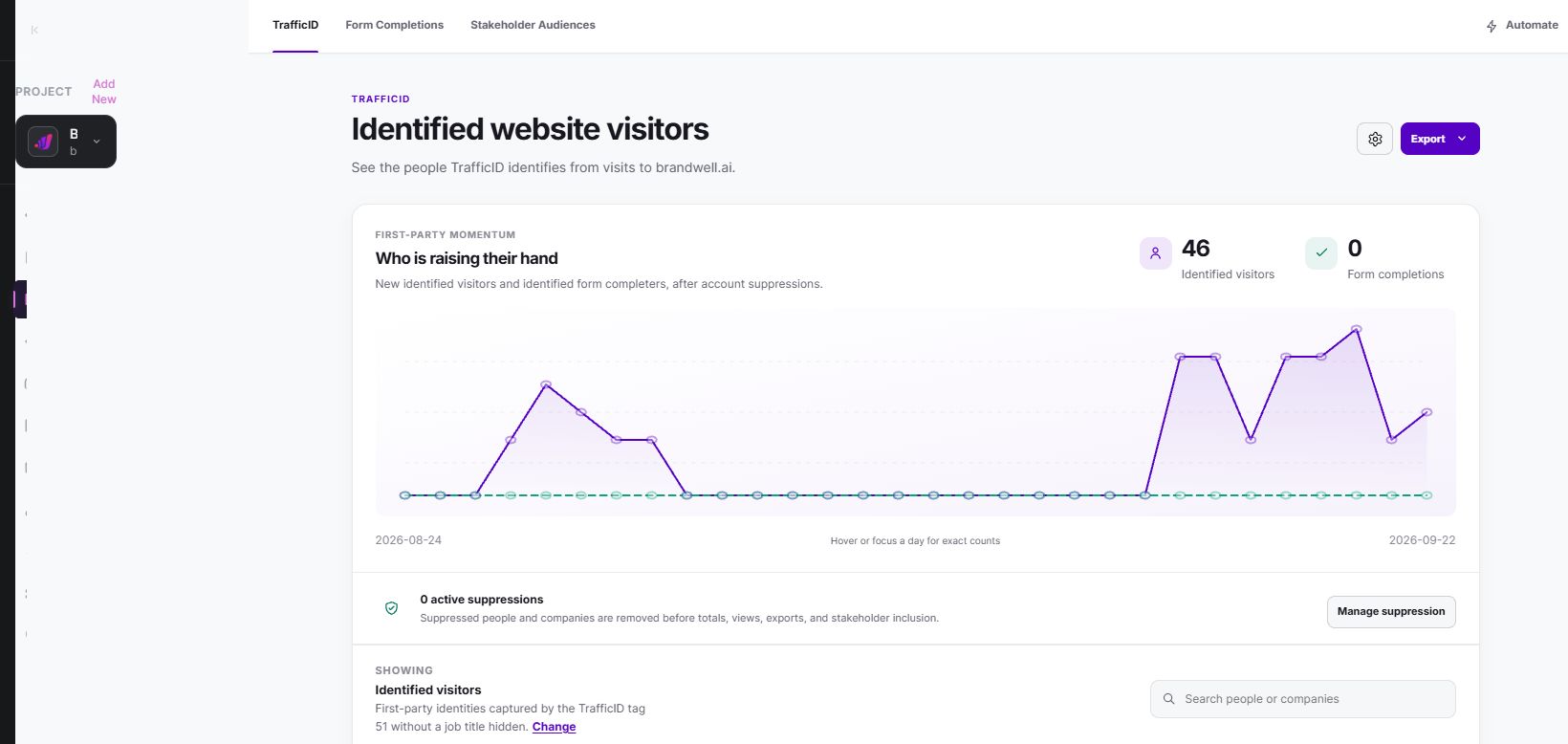
TrafficID surfaces identified website visitors and available profile or activity fields. Coverage varies. Use the current project to inspect the available evidence and review suppression before deciding on follow-up. Identification is not confirmation of a project, budget, or contact permission.
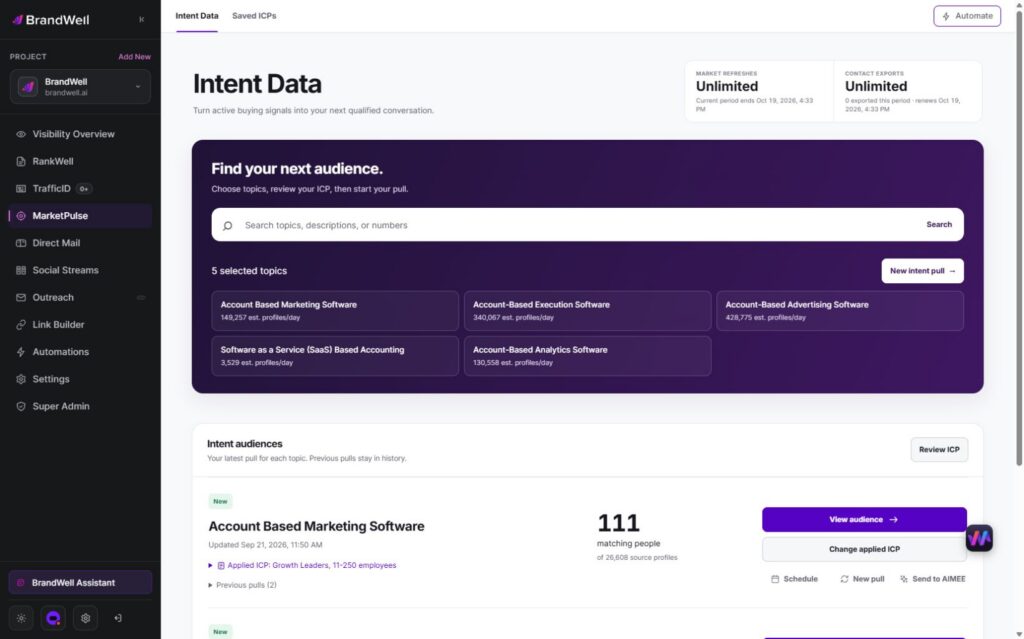
MarketPulse provides available topic-research data for prospect discovery. Standard plans are starting at $500/mo. A relevant research signal helps select what to investigate; it is not proof that the person is seeking your specific product or has approved outreach.
In the BrandWell portal, RankWell supports educational content and reviewed answers for the prospect’s questions. AIMEE can assist with authorized, configured tasks. Check the proposed message and destination before executing follow-up; do not assume an identification event should automatically enroll someone in every campaign.
Make a usable handoff record
Here is an illustrative record for a payroll-software inquiry. It is not a customer case study or a conversion result.
| Field | Example note |
|---|---|
| Source | Demo form from the migration guide; original campaign parameters retained |
| Confirmed need | Contact wants to migrate before the next payroll cycle |
| Fit | Company size appears suitable; supported payroll regions still need checking |
| Buying process | Finance lead evaluates; signer and budget remain unconfirmed |
| Next action | Assigned representative sends a supported-region answer and offers a walkthrough |
| Stop condition | Contact declines, opts out, or requirements cannot be supported |
Swipe the table to see all columns.
Include the source and date of each important fact. Do not turn an enriched role or inferred industry into a prospect-confirmed statement.
What to do when a lead is not ready
Route according to the reason. A timing mismatch can justify an agreed later follow-up. A missing capability calls for an honest answer. An opt-out means stop the applicable communication. Where follow-up is appropriate, send the resource that answers the actual question rather than an unrelated sequence.
Apply channel eligibility and your suppression rules. For US commercial email, the FTC’s CAN-SPAM guidance covers truthful sender information and subject lines, the required address and opt-out mechanism, and honoring opt-outs. A database field does not establish SMS consent; use documented consent for the specific texting program.
Measure the qualification process
Track accepted handoffs, meetings that actually occur, disqualification reasons, opportunity progression, and customer outcomes. Keep the source visible, but do not assume a referral or organic visit is always higher quality than a paid visit. Compare similar cohorts and review the actual fit.
Count conversion stages with clear denominators. For example, accepted handoffs divided by reviewed leads measures acceptance; purchases divided by accepted handoffs measures a different outcome. Mark attribution limits and avoid claiming that one visit or reminder caused a sale.
Frequently asked questions
Does a pricing-page visit make someone sales-qualified?
No. It can justify investigation, but it does not confirm need, budget, authority, or willingness to speak with sales.
What if the contact is not the signer?
Learn their role in the evaluation. A user, evaluator, or advocate can be valuable; ask who else participates rather than dismissing the contact.
Can intent data replace qualification?
No. Use available signals to prioritize research, then confirm fit and the next step with appropriate evidence.
Reviewed and updated October 2, 2026.

Written by