


On this page
- Use a clear lead record
- Separate source, activity and qualification
- Assign an owner and a useful next action
- Interpret tracking signals cautiously
- Keep analytics and private lead details separate
- Original example: a demo request and a page visit
- Use TrafficID in the current BrandWell workflow
- Measure the funnel with consistent definitions
Track sales leads by recording their source, qualification evidence, current stage, responsible owner and next action. Keep that record separate from raw website activity. An identified visit, email open or enriched contact field does not by itself mean a person is qualified or has asked for outreach.
Use a clear lead record
A practical record should answer who the prospect is, why the opportunity fits and what should happen next. Define the stages with your team so a “qualified lead” means more than somebody appearing in a list.
- Contact and account identity, with the source of each field.
- Original acquisition source and subsequent meaningful interactions.
- Qualification evidence and any missing information.
- Current stage, owner and next-action date.
- Channel permissions, preferences and suppression status.
- Final outcome and the reason for it.
Collect what the workflow needs. More data is not automatically better evidence, and guessed fields should not be presented as confirmed facts.
Separate source, activity and qualification
A form submission is different from an identified visit. A request for a demo is different from viewing a pricing page. Record the actual event instead of upgrading every interaction to a buying signal.
Qualification should use criteria relevant to your offer, such as the business problem, scope, fit and the next step the prospect agreed to. Labels such as MQL or SQL need an operational definition rather than a universal assumption.
Assign an owner and a useful next action
Choose one accountable owner for the next step. Record the reason for the action and when it is due. A shared list with no responsibility can lead to duplicate contact or an unanswered request.
Use explicit outcomes: information requested, meeting scheduled, waiting on the prospect, disqualified or closed. Keep closed and suppressed contacts out of inappropriate active sequences.
Interpret tracking signals cautiously
A longer visit can reflect investigation, an open tab or other behavior. It is not a confirmed budget or buying timeline. Look for direct requests and replies before drawing conclusions about the person’s intention.
Apple’s Mail Privacy Protection guidance explains that the feature prevents senders from seeing whether a recipient opened a message. Treat open metrics as limited signals rather than proof a person read or considered the offer.
Keep analytics and private lead details separate
Google Analytics’ PII guidance addresses information that must not be sent to Analytics. Check event parameters, page URLs and form tracking so names, email addresses and phone numbers are not accidentally included.
Keep identifiable lead records in the appropriate authorized system. Review access, integrations and retention instead of sending every field to every destination.
Original example: a demo request and a page visit
A fictional company receives a demo request from an operations manager and separately sees an identified visit to its pricing page. The first record has a stated request and can be assigned a response. The second needs fit and eligibility review before a next action is prepared.
The team records each source accurately and does not count both as sales-qualified opportunities automatically. This is an original process example, not a reported conversion result.
Use TrafficID in the current BrandWell workflow
TrafficID surfaces identified website visitors and available person, role, company and activity fields. Coverage varies. Review the correct project, installation status, filters and suppression controls before using the records.
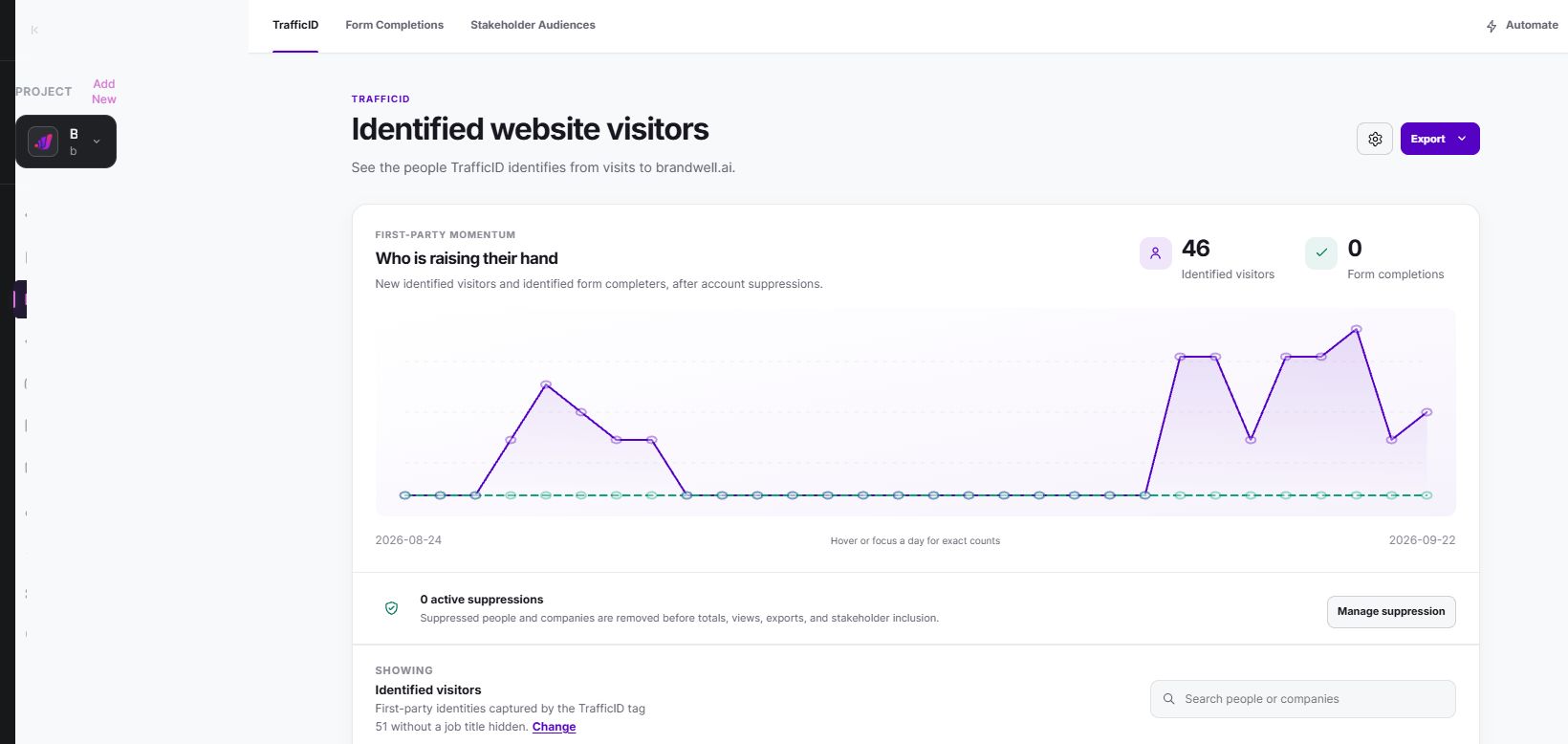
Use the available evidence to prepare a relevant next step. Configured integrations and approved workflows determine which destinations and actions are available. AIMEE can help prepare approved tasks through configured tools.
MarketPulse provides topic-based intent data with public plans starting at $500/mo. Those research signals are separate from visits to your own site and from a prospect’s direct request.
Measure the funnel with consistent definitions
Count eligible records, qualified opportunities, meetings and purchases separately. Define the denominator and observation period for each conversion rate. Record actual revenue and outcome dates rather than assigning revenue to a visit.
For commercial email, review the FTC’s CAN-SPAM guidance, including accurate sender information, subject lines and opt-out handling. Maintain suppression across the tools executing the workflow.
Reviewed and updated October 2, 2026.

Written by
Jeff Joyce has been helping brands grow online since the Myspace era, when custom HTML layouts were still a competitive advantage. What started in design quickly evolved into a career spanning social media, content strategy, video, agency ownership, and growth marketing. After building his own agency and testing countless AI tools, Jeff joined BrandWell with a clear focus: helping marketers understand how AI can actually improve the way they create, optimize, and scale content. Today, Jeff brings a CMO-level perspective to BrandWell's marketing strategy, blending brand positioning, content, video, customer education, and growth. His work centers on turning complex AI concepts into clear, practical marketing that helps brands move faster, create better content, and stay competitive without losing their voice.

 Farnaz Kia