On this page
- Who this is for
- The five-gate niche selection framework
- Five B2B niche archetypes to test
- A niche scorecard you can use
- The niche validation workflow
- Manual, automated, and white-label niche research
- Cost, setup fee, and niche economics
- Metrics that tell you whether the niche is working
- Where BrandWell fits in niche selection
- Frequently asked questions
- A fictional niche comparison
- Test actual topic availability in MarketPulse
The best niche for a B2B intent data agency is not simply the industry with the largest market or longest sales cycle. It is the narrowest market where five conditions overlap: clients can afford a recurring service, buyers research recognizable topics, signals resolve into usable accounts or contacts, a team can act before the evidence goes stale, and outcomes can be recorded. Choose the niche with a scorecard and a live sample – not a generic “hot industries” list.
Current MarketPulse offer: intent-data plans start at $500/mo. See the product, demo, and current plans. Updated October 1, 2026.
Who this is for
- Agency founders deciding where to specialize an intent-data, lead generation, paid-media, or GTM service.
- RevOps and demand generation consultants testing a repeatable vertical offer.
- Resellers that want one market map, report, playbook, and workflow to work across several clients.
- Existing agencies adding buyer intent to a niche they already understand.
The five niche archetypes below are hypotheses to validate, not a universal ranking. Market conditions, topic coverage, identity yield, client economics, data rights, and destination readiness can change the result. Intent signals do not prove that a company or person is ready to buy.
The five-gate niche selection framework
Use the following author-proposed scorecard as a structured comparison. Score each gate from zero to five and attach evidence and unknowns. It is not a validated prediction model. A high total cannot compensate for an impermissible use or missing action owner.
1. Economic fit
Estimate reachable organizations, size mix, economic stakes, service budget and buying recurrence. Test your assumptions with client interviews and actual service costs. A public industry count is not a count of qualified prospects or proof that buyers will pay.
Census County Business Patterns describes employer establishments, employment and payroll by industry and geography. Its API requires a key. SUSB adds firm and establishment information by enterprise size. BLS QCEW provides employment and wage context by industry and region. Check period, units, coverage and suppression; these are market structure, not current buyer intent or agency budgets.
2. Signal fit
Ask whether buyers use stable, distinguishable language while researching the problem, category, alternatives, competitors, compliance issues, and adjacent technologies. Then test actual topic availability, volume, freshness, geography, account resolution, identity/enrichment yield, duplication, and noise.
A broad phrase such as “AI” may produce volume but little decision value. A narrow product code may be precise but too sparse. Favor a topic cluster that separates problem discovery, category research, solution comparison, and named alternatives without pretending those stages are certain.
3. Activation fit
Identify the action that follows an accepted signal and who owns it. Examples include a seller research task, a reviewed account brief, an ad audience, a customer-risk review, an event invitation, or a content response. The action must be timely, permitted, useful, and within team capacity.
If a client cannot act differently after seeing the signal, the service is a report subscription rather than a growth system. That can still be valuable, but it needs advisory pricing and acceptance criteria instead of a pipeline promise.
4. Repeatability
Test whether the agency can reuse market taxonomy, qualification rules, signal schema, play cards, report layout, client onboarding, destinations, approvals, and evidence model across clients. Count exceptional topics, custom fields, manual research, and integration repair.
Repeatability does not mean identical output. It means a stable operating system with client-specific configuration. A niche loses attractiveness when every account needs a new data model and every client needs a bespoke explanation of value.
5. Proof and risk
Define a baseline, leading indicator, outcome, time window, and evidence method. Assess permitted use, privacy roles, security, suppression, channel policy, sensitive contexts, geography, and client claims. Use the NIST Privacy Framework to structure processing, purpose, roles, risk, and control questions; it is a voluntary framework, not a legal certification.
Reject niches where the business case requires an intent signal to become a high-consequence eligibility, employment, credit, health, housing, or similar decision. The agency should provide decision context and bounded workflow, not opaque consequential scoring.
Five B2B niche archetypes to test
Use identical criteria for all five: reachable firm economics, topic clarity, signal and identity coverage, action path, repeatability, measurable outcome, data-use risk, sales cycle, and agency advantage. Score actual subsegments; do not select the entire category at once.
1. High-value B2B software with a defined category
Why it can fit: Software buyers often research problems, categories, comparisons, integrations, security, and named competitors. A qualified account can support seller prioritization, ABM audiences, competitive campaigns, and renewal-risk workflows. Opportunity economics may support a recurring service.
Narrow it: Choose a category, buyer role, company-size band, geography, and use case – for example, workflow software for multi-location operators rather than “SaaS.”
Validate: Confirm that selected topics produce enough new, relevant accounts; that category language is not dominated by consumers, students, or existing users; and that sales can act within the signal window.
Limitation: Crowded categories create noisy, overlapping topics. Software companies may already own intent, ABM, and sales-intelligence tools, so the agency must sell an operated decision workflow rather than another feed.
2. Cybersecurity, cloud, data, and IT infrastructure
Why it can fit: Purchases can have high economic and risk stakes, technical research is topic-rich, and buying groups span technical, security, finance, and executive roles. Content, events, seller research, and account-based advertising can respond to specific problem and compliance themes.
Narrow it: Select one environment and problem, such as security for mid-market cloud teams, data governance for regulated enterprises, or infrastructure optimization for a defined stack.
Validate: Test whether topics distinguish buyer research from news consumption, career learning, incident curiosity, and vendor documentation. Require precise account fit and an approved message that does not exploit fear or imply knowledge of a specific breach.
Limitation: Security claims and outreach can create trust risk. Technical buyers detect shallow personalization, and ambiguous incident-related signals should not trigger aggressive contact.
3. Industrial technology and complex commercial equipment
Why it can fit: Deals can be valuable, buying cycles are research-heavy, and topic clusters may include equipment categories, applications, standards, replacement, efficiency, and service. An agency can combine market mapping with territory, firmographics, facility or company context, and sales follow-up.
Narrow it: Focus on one equipment or technology family, buyer environment, company size, and region. Verify whether the relevant research happens digitally and whether account resolution works for plants, branches, remote locations, and corporate domains.
Validate: Compare signal accounts with known territories, channel conflicts, installed-base data, and distributor relationships. Define whether the action belongs to direct sales, a partner, or an account manager.
Limitation: Industry taxonomies, corporate hierarchies, offline buying behavior, and long replacement cycles can reduce volume or misroute accounts. Person-level identity may be sparse even when account-level research is useful.
4. Specialized professional and technology-enabled services
Why it can fit: Consulting, compliance, managed IT, logistics, staffing technology, and other specialized services often sell expertise around recognizable problems. Agencies can turn topic signals into account research, educational content, executive events, and carefully reviewed outreach.
Narrow it: Define the buyer problem, service scope, client size, trigger environment, and geography. “Professional services” is not a niche; “managed cloud cost governance for multi-entity healthcare-adjacent businesses, excluding clinical data uses” is closer to a testable segment.
Validate: Confirm that clients have a clear offer and proof, that signal topics align to that offer, and that sales capacity exists. Measure qualified conversations rather than list volume.
Limitation: Offers can be bespoke and difficult to standardize. If every client has different delivery, pricing, and proof, the agency’s intent workflow may not be the limiting factor.
5. Private-equity portfolios, multi-brand operators, and channel ecosystems
Why it can fit: One commercial relationship may expose several portfolio companies, territories, brands, or partners to a shared operating model. The agency can standardize market maps, topic reports, qualification, governance, and executive reporting while keeping data and permissions separated.
Narrow it: Choose a portfolio thesis or ecosystem with similar customers and motions. Define which entity contracts, which receives data, which team acts, and whether topics or territories overlap.
Validate: Pilot with one operating company or partner cohort. Test tenant separation, account ownership, conflicts, reporting, and the ability to compare operations without leaking data.
Limitation: Stakeholder and permission complexity can overwhelm any efficiency gained from scale. Shared reporting must not become cross-client disclosure, and centralized sponsors may not control local adoption.
A niche scorecard you can use
| Criterion | Weight | Evidence to collect |
|---|---|---|
| Reachable buyer economics | 15 | firm counts, size mix, current client pricing, ACV/economic stakes |
| Topic clarity | 15 | topic map, ambiguous terms, stage clusters, competitor/product language |
| Usable signal volume | 15 | unique accounts, recency, geography, duplicates, variance over time |
| Identity and enrichment fit | 10 | account resolution, relevant contacts where permitted, validation, confidence |
| Action readiness | 15 | owner, SLA, capacity, channel, offer/content, destination |
| Repeatability | 15 | reusable rules, reports, workflows, integrations, exception rate |
| Evidence path | 10 | baseline, outcome fields, cohort, time window, decision rule |
| Privacy, security, and trust | 5 | permitted purpose, sensitive exclusions, suppressions, access, retention |
Swipe the table to see all columns.
The proposed weights total 100. For a score from zero to five, compute each weighted contribution as score / 5 × weight; the total then ranges from zero to 100. Choose and document gating requirements before reviewing candidates. Test sensitivity to lower usable volume and higher review cost instead of treating a one-point difference as decisive.
The niche validation workflow
Step 1: Build a market map
Define NAICS or another industry classification, firm-size bands, territories, business models, target roles, disqualifiers, and a sample account list. Combine government and first-party evidence with interviews; database counts can be stale or include branches and inactive entities.
Step 2: Build the topic map
Create problem, category, solution, integration, competitor, compliance, and adjacent-topic clusters. Mark ambiguous and sensitive terms. Ask subject-matter experts how buyers actually describe the problem.
Google Trends can help compare relative patterns, but Google explains that Trends data is sampled and normalized from 0 to 100. It is not absolute demand, a scientific poll, or a substitute for the live signal sample.
Step 3: Sample signals and identity
For a defined window, inspect unique accounts, fit, timestamps, topics, geography, account hierarchy, identity/enrichment yield, duplicates, and false positives. Do not cherry-pick attractive records. Preserve rejected examples.
Step 4: Simulate the action
For each accepted event, create the exact deliverable: research brief, CRM task, report row, audience candidate, or reviewed message draft. Ask the real owner to accept, edit, reject, or defer it. Measure manual minutes and time to action.
Step 5: Test willingness to pay
Use the output in sales conversations. A seven-day report pilot can reveal whether an agency can explain the niche, produce a credible branded artifact, and secure a next decision. It does not prove full-term ROI.
Step 6: Commit or reject
Choose one niche for a bounded period. Record the decision thesis, assumptions, disqualifiers, offer, price floor, capacity, evidence, and re-evaluation date. Rejecting a niche is a useful result when it prevents six months of custom delivery.
Manual, automated, and white-label niche research
| Approach | Best use | Advantage | Main risk |
|---|---|---|---|
| Manual research | first two or three candidate niches | exposes language and exception types | slow and analyst-dependent |
| Automated sampling | known schema and several topics | tests volume and patterns repeatedly | scales bad taxonomy quickly |
| Client-owned tools | established agency niche and mature client | deeper client control | fragmented licensing and support |
| White-label engine | agency committing to repeatable reseller delivery | reusable portal, reports, topics, and workflow | premature standardization or unused capacity |
Swipe the table to see all columns.
Start manually enough to learn. Automate normalization and sampling after fields and exclusions stabilize. Adopt a white-label model when the agency has a repeatable sales artifact and delivery path – not because it wants to appear like a software company.
Cost, setup fee, and niche economics
The agency should model:
monthly niche cost = platform/usage + direct service labor + shared ops allocation + integrations + support + sales cost + risk reserve
Setup covers market and topic maps, sample data, qualification, report/portal, play cards, destinations, approvals, baseline, and training. The client fee must absorb variation in signal volume and exception labor without making the service feel arbitrary.
Estimate break-even client count at realistic utilization, not maximum capacity. Run low, base, and high cases for usable signal yield, support time, and client churn. Track acquisition payback separately from delivery contribution margin.
For selecting individual clients after the agency niche is chosen, use BrandWell’s guide to the best agency clients for buyer intent data. For service-launch mechanics, use the guide to starting a buyer intent data agency.
Metrics that tell you whether the niche is working
- Time-to-value: days to first useful report, accepted event, and completed action.
- Quality: unique eligible account rate, topic precision sample, freshness, identity yield, duplicates, suppressions, and exceptions.
- Adoption: report use, accepted recommendations, action completion, and time to action.
- Outcome: qualified responses, meetings, opportunities, pipeline, or retained revenue with evidence method and denominator.
- Repeatability: configuration hours, manual minutes per accepted event, reuse of topics/plays, error rate, and onboarding cycle.
- Economics: sales cycle, close rate, setup recovery, utilization, contribution margin, retention, and expansion.
Compare cohorts inside the niche before comparing different industries. A large enterprise cybersecurity client and a small managed-services firm can have radically different economics even if both sit in “IT.”
Where BrandWell fits in niche selection
A MarketPulse subscription provides the documented topic-research scope, not a native white-label portal, topic exclusivity or partner resale rights. Confirm actual access, licenses and permitted client uses before including product-dependent deliverables in an agency offer.
A MarketPulse subscription provides the documented topic-research scope, not a native white-label portal, topic exclusivity or partner resale rights. Confirm actual access, licenses and permitted client uses before including product-dependent deliverables in an agency offer.
Use AIMEE through configured tools to prepare a bounded, sourced market brief. Supply approved inputs and explicitly retain unavailable data. Verify actual tool access before execution.
No feature, pilot, topic protection, or automation can guarantee that the niche will close clients or produce revenue. The niche wins only if the sample, sales conversations, adoption, outcomes, and margin all support it.
Frequently asked questions
What is the best niche for an intent data agency?
The best niche is a specific market with sufficient economics, clear research language, usable signal and identity coverage, a timely action owner, repeatable delivery, and measurable outcomes. Validate the intersection with real data and buyers.
How should an agency choose among several niches?
Use one weighted scorecard, require a minimum in signal, action, and risk, then run the same sample workflow for the top two or three. Choose one for a bounded selling period and record rejection reasons for the others.
Which tools and data sources support selection?
Use the linked Census and BLS sources for market structure, then add buyer interviews, current client costs, topic samples, review decisions and action tests. Trends is directional context, not an absolute buyer count.
How do manual, automated, and white-label approaches compare?
Manual work finds language and exceptions; automation repeats a stable test; client-owned platforms increase client control; white-label delivery supports agency standardization. Move in that order unless the agency already has verified expertise and demand.
What setup fee should the agency charge?
Price the actual work: market and topic mapping, sample analysis, qualification rules, portal/report setup, destinations, approvals, QA, baseline, and training. Do not invent a universal amount; connect the fee to hours, expertise, risk, and reusable assets.
What risks should disqualify a niche?
Disqualify uses that require certain person identity, sensitive consequential decisions, impermissible outreach, no action owner, no outcome capture, weak economics, chronically ambiguous topics, or bespoke work that destroys repeatability.
How should niche selection vary by client maturity?
For an early-stage client, favor a small market map, manual report, and one reviewed action. A client with a stable ICP and CRM can add qualification and routing. A mature ABM team may support multiple sources, audiences, experiments, and outcome feedback. The agency niche should be capable of serving a repeatable maturity band rather than promising every operating model.
Which signal and identity checks matter most?
Inspect the original source and timestamp, topic ambiguity, account resolution, parent/branch structure, geography, fit, freshness, relevant person coverage where permitted, validation, duplicates, and suppressions. Match the required identity level to the action: account-level advertising does not require the same fields as person-level outreach.
What should a recurring white-label niche service include?
Define the market map, approved topics, qualification rules, reports, client access, approvals, outcome fields and support boundary. These are agency-designed deliverables; product access and licensing must be verified separately.
How long should a niche validation take?
Use enough time to observe real variation in signal supply and complete several buyer conversations, but set a fixed decision date. A seven-day report pilot can test the artifact and early coverage; it cannot establish long-cycle revenue. Extend only when a named missing variable can be resolved, not because the agency is reluctant to reject the idea.
What makes an intent-data niche defensible?
Differentiation can come from market expertise, documented exclusions, evaluated topic usefulness, client evidence, delivery discipline and trust. Do not infer protected topics or exclusivity from a vertical label or an ordinary product subscription.
A fictional niche comparison
Suppose a candidate segment receives 200 eligible records, accepts 90 for relevance, identifies 45 new accounts after deduplication and completes 22 reviewed actions. Record acceptance is 90/200, or 45%; new accounts are 45/90, or 50% of accepted records under this example’s mapping; completed actions are 22/45, or 48.9% of those accounts. These invented counts are not niche benchmarks or proof of revenue.
Review why records were rejected and whether several records describe the same account. Distinguish reviewer-labeled topic relevance from true purchase plans. Use enough variation and buyer feedback to test the economics before committing to a vertical.
Test actual topic availability in MarketPulse
MarketPulse standard plans are starting at $500/mo for one topic with weekly refreshes. Growth includes three topics with daily pulls; Scale includes ten topics with daily pulls. Available fields, audience sizes and overlap vary.
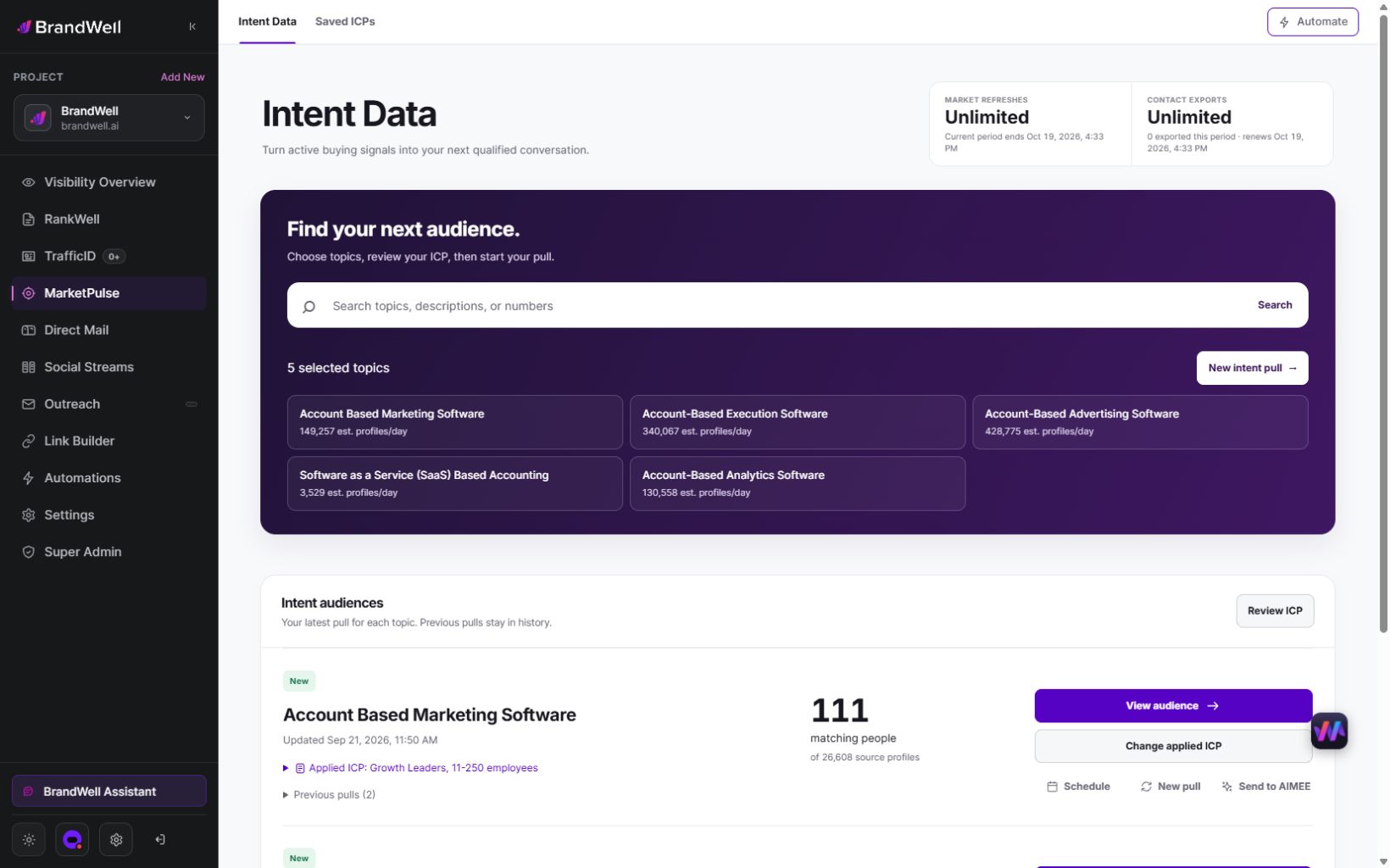
Search for a topic, apply a defined ICP and inspect a representative set of available records. Keep own-site visits from TrafficID distinct from external topic research. Record mismatches, duplicates and missing fields as well as useful examples. Watch the demo and review current plans before designing a separate service around the research.
Reviewed and updated October 3, 2026.

Written by