On this page
- Choose whether to engage, wait, or suppress
- Which B2B social selling signals merit attention
- Build the human-review workflow
- Use MarketPulse to add topic research to the review
- Compare cost and operating effort
- Measure conversations and pipeline without rewarding spam
- Best-fit, no-fit, and platform-policy checks
- Run a weekly triage practice, not an always-on message machine
- Package a recurring agency signal desk
- Turn a public event into a useful contribution
- Check platform rules before automating
- Measure decisions and full operating cost
- Social-selling signal questions
- Put buyer intent to work with MarketPulse
The most useful social selling signals tell a seller where to investigate, not when to auto-message. Monitor account research, job changes, hiring, public company events, relationship changes, relevant posts or comments, first-party visits, and opportunity context. Then use an engage/wait/suppress decision with human review. A public interaction or intent signal is not consent to a pitch and is not proof of purchase intent.
Who this is for: B2B founders, SDR leaders, account executives, social-selling leaders, RevOps teams, and agency owners building social selling signal monitoring with buyer intent data while protecting authentic human participation.
Current MarketPulse offer: intent-data plans start at $500/mo. See the product, demo, and current plans. Updated October 1, 2026.
Choose whether to engage, wait, or suppress
A decision to engage needs relevance, recency, fit, a legitimate relationship or useful context, and a human-written next step. Wait means the signal is interesting but weak, duplicated, stale, outside the seller’s role, or better served by observation. Suppress applies to opt-outs, privacy requests, active complaints, sensitive contexts, existing owner conflicts, competitors, students, customers needing support, or any source/use that is not permitted.
The decision should not expose hidden tracking. “I saw your team researching our category on other sites” is rarely an appropriate opener. Use the signal to perform better research, then engage around public or directly shared context. A thoughtful response to a prospect’s post, a useful resource after a relevant public announcement, or an introduction through a known relationship can be appropriate when it adds value. Automated praise, scraped personal details, or fabricated familiarity damages trust.
Which B2B social selling signals merit attention
Group signals by what they can reasonably support:
- Account change: funding, expansion, hiring, leadership change, product launch, regulatory event, or new market. These create context, not necessarily demand.
- Stakeholder change: a champion changes role, a buyer joins the company, or a relationship moves. Verify identity and current responsibility.
- Public engagement: a post, comment, event participation, or community question directly relevant to the problem. Read the content before responding.
- First-party behavior: a known form, email, event, logged-in action, or repeat high-value page visit. Respect the source’s notice and permissions.
- Offsite research: account- or topic-level evidence from an eligible provider. Keep it at the account level unless person identity is independently supported.
- Relationship evidence: mutual connection, previous conversation, open opportunity, customer history, or partner context. Check the CRM owner.
- Negative evidence: recent rejection, no current fit, support issue, opt-out, closed-lost reason, or sensitive event. Negative signals often matter more than a positive one.
No universal real-time intent signal should trigger outreach by itself. As a proposed internal review rule, seek at least two independent context types before high-friction engagement, and use a recency window appropriate to the event. A job change can remain relevant for weeks; a public request for help may be relevant for hours; an account surge may require corroboration.
Build the human-review workflow
Create a watchlist of named accounts, accepted signal sources, excluded sources, roles, topics, geography, relationship owners, and suppression rules. Normalize every event into source, event type, timestamp, account, person candidate, identity confidence, public/private status, permitted use, evidence excerpt or link, and expiry. Deduplicate repeated mentions and separate the observed fact from the inferred opportunity.
The triage card should show why the item matters, what is uncertain, the last relationship event, current owner, recommended engage/wait/suppress decision, and a short context brief. It should never generate a final public post or message without human judgment. Route sensitive, ambiguous, or person-level cases to privacy or manager review.
After engagement, record whether the action was accepted, ignored, corrected, or rejected. Capture qualitative reasons: wrong person, stale event, irrelevant topic, too early, useful contribution, or existing project. The feedback updates the rule, but it should not reward higher message volume.
Use MarketPulse to add topic research to the review
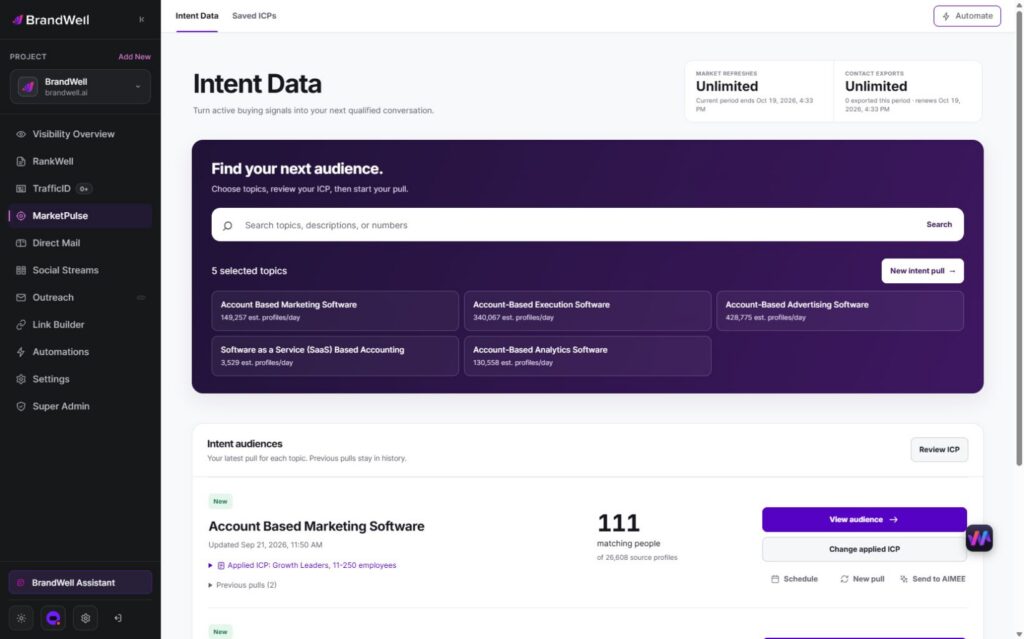
BrandWell MarketPulse: intent data starting at $500/mo. Find people researching topics relevant to what you sell, apply saved ICP filters, and review available contact details before taking action.
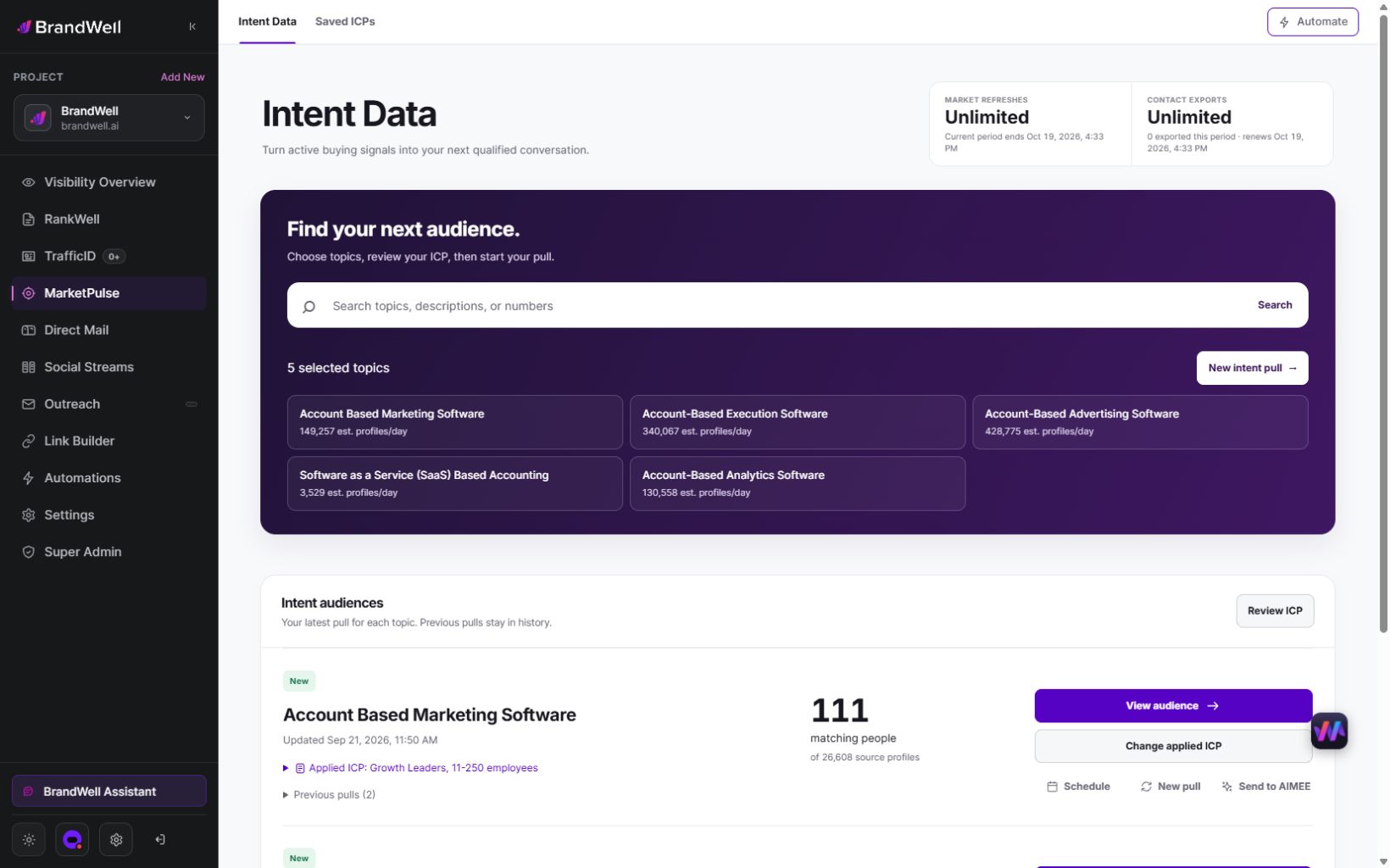
MarketPulse plans are starting at $500/mo. Verify current package scope and offers on the product page.
| Plan | Topics and refreshes | Monthly exports |
|---|---|---|
| Starter | 1 topic, weekly | 25,000 contacts |
| Growth | 3 topics, daily | 100,000 contacts |
| Scale | 10 topics, daily | Unlimited contacts |
Swipe the table to see all columns.
A pull retrieves available data from the previous 24 hours for one topic. Daily use across all included topics provides 90 Growth pulls or 300 Scale pulls in a 30-day month. Weekly Starter pulls vary by calendar month. Available audience size and contact fields vary, and audiences may overlap. Refreshes stop at the plan limit without overage charges.
- Find and qualify: search the topic catalog, save your ICP, and review the people and companies that match.
- Act on the research: export qualified contacts or prepare an Outreach or Direct Mail workflow. Connected products, channel usage, and fulfillment may cost extra.
- Get help from AIMEE: Growth and Scale include AIMEE for the initial user to research accounts and prepare the next step through connected tools.
Agencies and other service businesses can build client deliverables around their available Intent Scans and exports. Keep each client’s scope, permissions, and service fees clear. A subscription is not a promise of a white-label platform or exclusive access to a market.
Explore MarketPulse and watch the demo or compare plans starting at $500/mo. Any early-access discount is a separate, time-limited offer shown to an eligible recipient.
Compare cost and operating effort
Total cost includes software or data access, users, credits, source connectors, enrichment, CRM or engagement integrations, workflow maintenance, seller research time, manager review, privacy or platform review, and reporting. A low-priced signal tool can become expensive if most alerts are irrelevant. A broader platform can be wasteful if the team lacks sources, volume, or operators.
For agencies, price a defined watchlist, source set, review cadence, number of client users, context briefs, and outcome review. Keep public posting, direct messaging, sequence execution, and content creation as separate scopes. Add a reserve for platform/source changes and disputed identity or suppression cases.
Measure conversations and pipeline without rewarding spam
Use supply metrics such as active watchlist accounts, valid signals, duplicates, and expired events. Use quality metrics such as triage acceptance, correct owner, relevant context, and correction rate. Use engagement metrics such as meaningful public contribution, accepted introduction, or genuine conversation – not generic replies. Use commercial metrics such as qualified meetings, opportunities, progression, and client retention. Add risk metrics for complaints, blocks, opt-outs, policy issues, and unauthorized actions.
A seller who chooses “wait” or “suppress” can be performing well. The service should reward judgment, not throughput. Compare outcomes with similar accounts lacking the signal or use a phased rollout. State attribution limits because social touches often combine with existing relationships and other channels.
Best-fit, no-fit, and platform-policy checks
Strong-fit teams have a defined account market, active sellers or founders, useful public participation, clean CRM ownership, and a culture that values research. Strong-fit agencies can combine signal monitoring with executive social, ABM, RevOps, or sales enablement while preserving client voice. Weak-fit teams want fully automated posting, scraping, mass connection requests, or messages without human review.
Check each platform’s current terms before collecting or automating. Minimize data, preserve source context, honor opt-outs and deletion, secure client separation, and avoid sensitive inferences. Do not combine a public comment, job change, and account surge into a claim about a person’s private intentions. If the context would feel deceptive when explained to the prospect, do not use it.
Run a weekly triage practice, not an always-on message machine
Begin the review by expiring old events and applying suppressions. Next, group duplicates so one announcement does not become ten apparent signals. Assign an account owner, check the CRM and current relationship, and read the original public context. The reviewer then records engage, wait, or suppress plus a reason. Only engage decisions proceed to a seller, and the seller can still decline.
For an engage decision, the brief should contain the public fact or directly shared context, the account relevance, uncertainty, previous relationship, and one useful contribution the seller can make. It should not include hidden-source details that the seller is expected to conceal. The seller writes the final comment, introduction request, or message in their own voice. A manager samples accepted and rejected briefs each week for relevance and policy quality.
At the end of the week, inspect not only replies but corrections, silence, opt-outs, and wait accuracy. A useful monitoring program may generate very few actions during a quiet period. Capacity planning should be based on reviewed cases and research time, not a promised volume of leads. This keeps the service aligned with social participation rather than turning every signal into premature outreach.
Package a recurring agency signal desk
A recurring service can provide a weekly watchlist review, deduplicated context briefs, owner routing, engage/wait/suppress recommendations, public-content opportunities, suppression maintenance, and a monthly outcome learning session. The client retains final judgment and public voice. The agency documents why an action was suggested and what evidence was uncertain.
Use MarketPulse for topic research and available contact context. Prepare a client report from reviewed findings; confirm any required export, reporting or connector capability in the actual package. Do not assume a native social-listening feed or white-label reporting product. Start with ten accounts, two approved source types, one seller, and a two-week review. Quality is demonstrated when the seller receives fewer, better context packets – not when the system produces more alerts.
Reviewed and updated October 3, 2026.

Written by