Use search-derived intent data for B2B sales as an account-research trigger. First confirm that the account fits, then preserve how recent and reliable the research evidence is, identify plausible buying-group roles without claiming who performed the search, and require a seller to choose whether to research, contact, nurture, wait, or suppress. Measure accepted actions and qualified pipeline against the existing prospecting process.
Who this is for: sales leaders, SDR and BDR managers, RevOps, demand generation, account executives, and agencies evaluating search intent data for B2B sales prospecting. Here, “search intent” means research-topic evidence associated with an account or candidate – not SEO keyword intent, paid-search targeting, or a transcript of a named person’s queries.
Keep the research claim narrower than the sales action
Search-derived evidence can indicate that activity associated with an account is elevated around a topic. Depending on the source, the signal may rely on publisher content, observed research behavior, a baseline, an account association, or another methodology. It may help answer “Which accounts deserve investigation?” It does not answer “Who searched?”, “Who owns the budget?”, or “Will they buy?”
That distinction changes the workflow. A seller should receive the topic, source class, observed time, recency, account association, confidence or quality state, fit context, prior relationship, and an approved action menu. The seller should not receive only a “surging” label or a synthetic score.
Use explicit hand raises as stronger evidence. A demo request, reply, pricing inquiry, meeting, or product action should not be demoted because an inferred score is low. Search research can add context to the hand raise or reveal accounts that have not engaged directly, but it remains probabilistic.
Identify which B2B companies get value from search intent
The strongest fit has a considered purchase, a defined account market, topics closely connected to a problem the company solves, enough addressable accounts to prioritize, and sellers who can act before signals expire. Higher deal values can justify account research even when only a small portion of records become sales actions.
Enterprise and mid-market sales teams can use account-level research to focus territories. Multi-product companies can route different topics to specialists. Agencies can maintain topic policy, evidence review, and client reporting. Customer teams can use research themes to prepare an expansion or enablement hypothesis when customer status is visible.
Weak fit includes low-consideration products, tiny markets, vague topics, poor account data, no outcome capture, or a sales team that cannot respond quickly. A small founder-led company may get more value from explicit first-party signals and direct customer research. A team seeking a ready-to-contact list of named buyers is asking the signal to prove more than it can.
Use a supply forecast before purchasing. Estimate the number of on-fit accounts, likely signal frequency, refresh, geography, identity or account match loss, suppression, seller capacity, and expected review rate. A large theoretical data set can become a very small operational queue.
Build the five-stage prospecting chain
Evaluate every stage on best fit and exclusions, inputs, implementation effort, governance, cost, measurement, and a meaningful limitation. The chain is only as defensible as its weakest required stage.
1. Account-level research signal
Best fit and exclusions: Use the signal to prioritize account investigation when topics are specific to the business problem and the evidence is recent. Exclude irrelevant, sensitive, stale, or poorly defined topics.
Inputs and ownership: Keep topic definition, source class, account unit, baseline, observed time, recurrence, refresh, expiry, and known coverage gaps. Marketing or data operations owns the taxonomy; sales agrees on the use.
Cost and measurement: Costs can vary with topics, history, delivery, volume, and service. Measure usable on-fit supply, review completion, seller acceptance, and rejection reasons.
Meaningful limitation: Account research evidence does not establish a named researcher, buying committee, project, or purchase decision.
2. Firmographic-fit qualification
Best fit and exclusions: Apply fit when the product has clear account, industry, size, geography, technology, lifecycle, and territory requirements. Do not let strong activity rescue an account the business cannot serve.
Inputs and ownership: Enrichment, account hierarchy, customer and partner state, territory, disqualifiers, and exception rules belong in the record. RevOps owns the fit policy with sales leadership.
Cost and measurement: Include data enrichment, account cleanup, hierarchy work, and exceptions. Measure missing fields, fit exclusions, overrides, seller acceptance, and qualified outcomes by fit tier.
Meaningful limitation: Fit is relatively stable context, not timing. A strong-fit account can be inactive, and a nonstandard account can still warrant human review.
3. Contact identity and role verification
Best fit and exclusions: Use this stage only when the next action needs a person. Account research and advertising may not require the same identity confidence as direct outreach.
Inputs and ownership: Keep contact source, role hypothesis, employment recency, business email or phone validation, prior relationship, contact permissions, and no-match state. Sales research owns role relevance; data operations owns validation.
Cost and measurement: Add enrichment, validation, research time, CRM hygiene, and correction. Track valid contacts, role acceptance, bounced or invalid data, and qualified conversations.
Meaningful limitation: A plausible contact at the account is not proof that the person generated the research signal or participates in the buying process.
4. Sales timing and relevance review
Best fit and exclusions: A seller reviews the evidence when a tailored, respectful action is possible. Wait or suppress when the topic is too weak, the relationship is sensitive, the account is already covered, or the message would reveal an inappropriate inference.
Inputs and ownership: The evidence card should show topic, age, fit, identity state, CRM history, customer status, open opportunity, prior contact, opt-out, and suggested action choices. Sales management owns quality and capacity.
Cost and measurement: Include seller research, enablement, message development, sequencing, coaching, and review time. Measure time to action, accepted timing, positive replies, qualified meetings, and complaints.
Meaningful limitation: Good timing cannot fix a poor offer, irrelevant message, invalid contact, or lack of real demand.
5. Accepted-action and pipeline feedback
Best fit and exclusions: Every recurring program needs outcome return. Include no-action and rejected records so the workflow does not learn only from visible successes.
Inputs and ownership: Capture reviewed, accepted, researched, contacted, nurtured, suppressed, replied, qualified, opened, won, lost, and rejection reasons. RevOps owns fields; managers audit label quality.
Cost and measurement: Budget for CRM configuration, seller compliance, analysis, rule changes, and client reporting. Compare qualified outcomes and operating cost with the prior process.
Meaningful limitation: Pipeline outcomes contain many influences. A won account that had intent evidence does not prove the signal caused the win.
Operationalize search intent data for sales prospecting
A search intent data for B2B sales implementation guide should produce a seller-ready queue, not a database export.
- Write a topic card. Define included and excluded concepts, problem relevance, expected buying stage, source class, refresh, and expiry.
- Create the account universe. Load the ICP, territories, customers, partners, competitors, and disqualifiers before joining signals.
- Normalize account identity. Resolve domains, parents, subsidiaries, duplicates, and ambiguous associations without deleting provenance.
- Apply recency and recurrence. Separate fresh repeated activity from old or isolated evidence, but do not equate repetition with commercial certainty.
- Add lifecycle context. Route customers, open opportunities, former customers, and net-new accounts to different decisions.
- Find plausible roles only when required. Validate current employment and contact data; label each person as a candidate rather than the researcher.
- Synchronize suppressions. Honor prior opt-outs, do-not-contact states, invalid contacts, active ownership, and jurisdiction or client restrictions.
- Generate an evidence brief. Show why the account is present, what is unknown, and which actions are permitted.
- Require seller disposition. Research, act, wait, suppress, or reject with a reason.
- Return outcomes and age out the signal. A stale record should not remain at the top of the queue because it once scored highly.
The minimum team is a sales owner, RevOps or data operator, account researchers or sellers, an analytics partner, and privacy or legal review for data and channel use. Agencies also need client-specific approval and separation.
Use tools and templates that preserve evidence
The best tools and workflows for B2B search intent data are those that can expose the research unit, source class, topic, recency, account association, confidence, fit result, identity state, suppression, action, and outcome. A feed can work for a sophisticated RevOps team. A point tool can solve topic monitoring, identity, enrichment, validation, or alerting. A suite can coordinate account scoring and activation. A managed service can provide policy, operations, reporting, and support.
Useful search intent data for B2B sales templates include:
- topic-definition and exclusion card;
- representative account sample;
- account hierarchy and identity map;
- fit and lifecycle decision matrix;
- contact-role research guide;
- seller evidence card;
- suppression and correction register;
- routing and escalation runbook;
- disposition taxonomy;
- pipeline feedback scorecard;
- cost and capacity model;
- renewal or exit checklist.
Require a sample that includes known customers, competitors, employees, subsidiaries, shared domains, remote-work ambiguity, stale records, repeated events, duplicates, invalid contacts, opt-outs, and expected no-matches. A list of attractive accounts is not a quality test.
Compare search intent with fit scoring and website engagement
Firmographic fit answers whether an account belongs in the market. It is good for territory design, market sizing, and stable prioritization. Website engagement shows activity on owned properties. It can be close to a product or offer, but it misses accounts that have not visited or cannot be identified. Search-derived research intent can reveal earlier external interest, but it introduces source and association uncertainty.
Use each where it is strongest:
- Fit-only: build the eligible account universe.
- Website engagement: respond to owned activity with clear first-party context.
- Search research: decide which additional accounts deserve investigation now.
- Combined model: require fit, use research for timing, use first-party evidence for corroboration, and keep identity separate.
A broad prospect list remains a legitimate control. It may provide more reach for a market test and avoid unstable signals. Search intent data for B2B sales alternatives also include seller account plans, customer interviews, direct publisher research, event participation, and first-party product signals. The right comparison is the decision improvement after labor and risk, not the number of data fields.
Work through a bounded implementation example
Suppose a cybersecurity sales team has two thousand named accounts and capacity to research fifty accounts each week. It selects one problem-focused topic family, excludes job-seeking and general technical-education terms, and freezes the account list. The signal feed returns one hundred and twenty associated accounts. Fit and lifecycle rules remove customers, partners, unsupported regions, and off-segment firms. Freshness and duplicate rules remove older or repeated copies. Forty-two accounts remain for review.
RevOps routes those accounts with the topic, last-observed time, account association, fit reason, existing CRM relationship, and identity state. Sellers can research, wait, suppress, or choose an approved outreach action. They are not told that a named contact searched. Contact candidates are researched and validated only after the account merits action. Every disposition and qualified result returns to the queue.
The existing process continues for a comparable set of eligible accounts. After an agreed operating window, the team compares acceptance, research time, valid contacts, positive replies, qualified opportunities, and cost. It also reviews accounts the workflow rejected to look for missed demand. This example does not forecast a result; it shows how to preserve denominators and uncertainty while testing whether research intent improves a real prospecting decision.
Calculate pricing and total operating cost
Search intent data for B2B sales pricing is usually quote-based and scope-dependent. Quotes can differ by topic count, history, records, users, destinations, workspaces, activation, services, or support. Ask for the exact unit and a current matched proposal rather than importing a generic market estimate.
Build search intent data for B2B sales cost across six buckets:
- research-signal access and history;
- firmographic, identity, contact, email, and phone data;
- CRM and workflow implementation;
- seller research, enablement, and management;
- privacy, suppression, correction, and support operations;
- renewal, additional topics, overage, export, deletion, and migration.
Model usable supply rather than purchased volume. Begin with observed accounts, then subtract off-ICP, stale, duplicate, customer or competitor exclusions, ambiguous identity, invalid contacts, and records sellers cannot review. Divide total cost by accepted actions and qualified outcomes, not raw signals.
Measure contribution to sales pipeline
Search intent data for B2B sales KPIs should follow the workflow: usable on-fit account supply, queue age, seller review completion, acceptance, research action, contact validity, positive reply, qualified meeting, opportunity creation, stage progression, win or loss, and cost. Segment results by topic, source, recency, fit, identity state, and seller team.
Search intent data for B2B sales ROI cannot be established by summing pipeline associated with signaled accounts. Those accounts may already have been more likely to convert. Compare the intent-informed process with the existing workflow. NIST describes experimental design as a plan that deliberately changes factors and observes responses so the data can support valid conclusions (NIST experimental-design guidance).
Where practical, randomize eligible accounts between an intent-informed queue and the existing prioritization process. Keep the sales offer, time window, capacity, and outcome definition comparable. If sellers can see both groups, record contamination. When randomization is not feasible, use a staged rollout or matched comparison and disclose selection bias, seasonality, and other campaign changes.
The most useful search intent data for B2B sales benchmarks are internal: the prior queue’s acceptance, time to action, qualified opportunity rate, and cost. External figures with different topics, sources, markets, or pipeline definitions are not a defensible renewal standard.
Reduce accuracy, privacy, and outreach risk
Search intent data accuracy is not one number. Separate topic classification, event validity, account association, account fit, person-candidate quality, contact validation, and commercial outcome. Test each at the action boundary. A technically valid account-topic event can still be inappropriate for outreach.
Common search intent data for B2B sales mistakes include vague topics, old events, account-person conflation, duplicate amplification, missing lifecycle context, seller messages that reveal inferred observation, unverified contact data, automatic enrollment, and pipeline association reported as causation.
Govern the data before activating it. The NIST Privacy Framework offers a voluntary structure for identifying and managing privacy risk. FTC guidance recommends limiting personal-data collection and retention, controlling access, and overseeing service providers (FTC business guidance). For relevant EU processing, the European Commission describes purpose limitation, data minimisation, accuracy, storage limitation, security, and accountability (GDPR principles). Obtain qualified advice for the actual laws, parties, territories, and uses.
An intent signal does not create permission to contact someone. The FTC states that CAN-SPAM covers commercial messages and has no B2B exception (FTC CAN-SPAM guide). Honor accurate sender information, opt-out, suppression, and applicable channel rules. Legal compliance is a floor; relevance and respect still require human judgment.
Deliver search intent data as a recurring agency service
An agency can package topic and ICP design, weekly evidence review, account and contact validation, a seller-ready queue, approved workflow instructions, disposition analysis, and a monthly client report. Keep setup, custom integration, outreach execution, media, creative, and sales development separately scoped. The agency should report rejected and expired records instead of padding delivery volume.
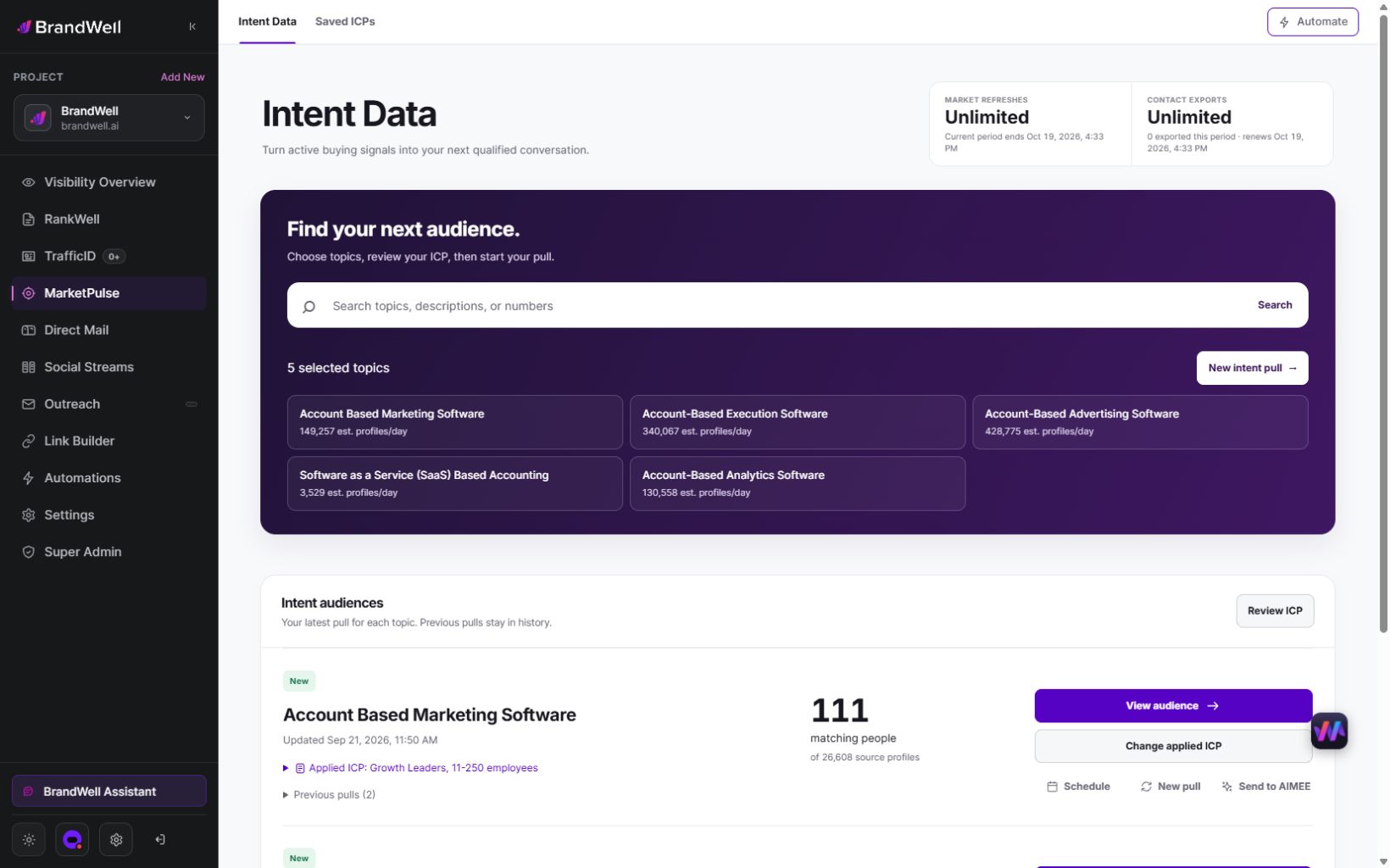
BrandWell’s distinct agency-reseller intent-data offer may fit this service model. BrandWell agency plans range from $2,500 to $5,000 per month, depending on topic count, term, and available contractually scoped topic exclusivity. The current written quote and Order Form control. Public pricing remains quote-based. Before operational use, complete product, pricing, privacy, security, compliance, legal, and platform-policy review.
The intended offer includes agency-controlled retail pricing and client billing, a complete white-label sales-and-delivery engine, a $70 seven-day reseller pilot for branded topic reports, and agent-ready automation instructions for Claude and ChatGPT. Moxby is a separate browser-first product that may be an optional execution path, not an included BrandWell module. Confirm current entitlements, pilot terms, instruction artifacts, data rights, support, client separation, and the controlling Order Form. A report pilot cannot prove contact identity, pipeline, or production outcomes.
The meaningful limitation is incomplete public documentation for the full reseller and enterprise-control set. When access controls, audit evidence, retention, continuity, or uptime commitments are mandatory, select a provider that documents them contractually now.
Start with a research queue, not an outreach sequence
Select one topic family, one ICP segment, and a seller capacity the team can actually review. Run positive, negative, ambiguous, and no-match cases. Preserve account and person boundaries. Let sellers disposition every record. Compare downstream quality with the existing process, then decide whether to expand.
Document the exit before the first import. The team should know which topics, configuration, suppressions, outcomes, corrections, and account history can be exported; which licensed fields must be deleted; and how CRM tasks or audiences will be disabled. A usable search intent data for B2B sales checklist therefore covers implementation and removal. This protects the sales process from depending indefinitely on a score it can no longer explain.
That is the central search intent data for B2B sales best practice: use research evidence to earn a better investigation, not to invent certainty about a buyer.
Check the economics before a full plan
For a $70 pilot fee, agencies get seven days to validate the reseller offer. BrandWell supplies agency-branded topic reports and the complete sales playbook for presenting the service and seeking client commitments before any full-plan enrollment.
The agency can use the pilot evidence to assess demand, compare expected commitments against costs, and decide whether the service can become a profit center. Commercial and financial outcomes are not guaranteed. Review the $70 seven-day reseller pilot.