On this page
- What funding signals tell you – and what they do not
- Seven ways to operationalize funding intent signals
- A practical funding evidence ladder
- Workflow, data, integrations, and team required
- Funding signals compared with fit, engagement, and broad lists
- Pricing, cost, and total operating model
- Measure ROI without giving the trigger all the credit
- Best-fit and poor-fit use cases
- Funding intent signals mistakes, privacy, and governance
- How agencies can package a recurring funding-signal service
- Funding intent signals implementation checklist
- A funding event should open a research question
- Use stage-specific denominators
- Review related research with MarketPulse
Short answer: A funding announcement is evidence that a company’s resources and priorities may be changing – not proof that it is buying your category. The useful play is to treat funding intent signals as a reason to investigate, then require account fit, a relevant business initiative, fresh research behavior, and verified people before sales acts.
Who is this for? B2B revenue teams and agencies that want to turn funding events into a measured prospecting service without flooding sellers with every newly funded company.
Funding events are attractive because they are visible and easy to explain. A company raises capital; a seller assumes budget exists; outreach begins. That sequence skips the decision that matters. Capital may support hiring, product development, debt repayment, expansion, or simply a longer runway. Even when a vendor’s category is relevant, the purchase may be months away – or never happen.
A responsible funding-signal strategy separates capacity from demand. Ask whether the event changes the company’s ability to act, whether its stated plan connects to your offer, and whether separate, relevant behavior supports further research. A verified event can establish an observed fact; a conclusion about buying remains an inference. Neither proves a named person’s purchase plan or guarantees an opportunity.
Current MarketPulse offer: intent-data plans start at $500/mo. See the product, demo, and current plans. Updated October 1, 2026.
What funding signals tell you – and what they do not
Verify the event against a dated primary source. SEC filing search can help locate relevant US securities filings. A Form D is a notice of an exempt offering, not a complete inventory of all financing or proof of a buying project. Record what the document actually states and distinguish a filing from an independently verified operating outcome.
The signal does not establish that the money is available for your product, that procurement has begun, or that a specific employee is evaluating you. It can even point in opposite directions: a growth round may expand operating capacity, while a bridge round may heighten scrutiny and preserve cash. That ambiguity is why a funding intent signals framework needs corroboration and explicit decay rules.
- Capacity evidence: Was capital actually raised, and is the source reliable?
- Change evidence: What initiative, market, team, or operating model may change?
- Fit evidence: Does the account and initiative match the problem your offer solves?
- Behavioral evidence: Is the account researching relevant topics, competitors, or implementation questions?
- Identity evidence: Can the team verify relevant roles without treating an identity match as certainty?
- Outcome evidence: Do similarly qualified signals create accepted meetings and pipeline in your own CRM?
Seven ways to operationalize funding intent signals
The following funding intent signals checklist is a method listicle, not a vendor ranking. Each method uses the same operating criteria: source quality, relevance, freshness, identity confidence, actionability, governance, and measurable outcomes.
1. Verify the event before enriching the account
Start with the company’s own newsroom, an official filing when applicable, or another source that preserves the event date and original context. Record the source, observed date, event type, and verification status. De-duplicate repeated stories about the same round before they enter scoring.
Best fit: teams that currently buy broad funding lists and spend seller time checking them manually. Limitation: official evidence can lag, omit detail, or use language too broad to reveal the actual operating plan.
2. Form a use-of-funds hypothesis
Convert “international expansion,” “enterprise growth,” or “product investment” into a testable operating hypothesis. International expansion might create hiring, localization, compliance, support, or data needs; it does not automatically create demand for every GTM tool. Attach the hypothesis to the account record so a reviewer can see why it was scored.
Best fit: specialized vendors with a clear link between a company initiative and their category. Limitation: company statements are high-level plans, not purchase orders, and their language can support multiple interpretations.
3. Apply a hard ICP and exclusion gate
Require the account to meet non-negotiable fit rules before funding adds any priority. Useful gates may include geography, business model, employee band, regulated-industry capability, technical environment, and minimum deal economics. Add exclusions for customers, active opportunities, suppressed accounts, and companies whose funding type or stage is incompatible with the offer.
Best fit: companies with defined ideal-customer criteria and enough market volume to exclude poor fits. Limitation: an overly rigid ICP can miss emerging segments; review exclusions against actual outcomes rather than treating them as permanent truth.
4. Find the relevant role
Identify the roles that would plausibly own the announced initiative, then validate current employer, title, and contact information before routing. A product expansion may involve product, operations, finance, security, or go-to-market leadership depending on the offer. The evidence brief should explain the role connection instead of choosing the most senior title by default.
Best fit: teams with clear buying-role maps and SLAs between RevOps and sellers. Limitation: identity resolution and contact validation reduce uncertainty; they do not establish consent, authority, budget, or purchase intent.
5. Set a timing window
Define when the signal becomes actionable, when it should be monitored, and when it expires. Use public changes – such as a new office, role cluster, product launch, leadership appointment, or stated build plan – to determine whether the initiative is moving. Do not manufacture urgency from the funding date alone.
Best fit: complex offers where a visible project phase must exist before outreach is useful. Limitation: public activity can be incomplete, delayed, or unrelated to an active buying process, so timing remains an operating hypothesis.
6. Require behavioral corroboration
Research activity on relevant topics or competitor categories is closer to the problem than funding alone. Combine it with the event only when the topic is specific enough to the offer, the activity is fresh, and the signal unit is understood. Account-level research does not prove that a named decision-maker performed the activity. AI can prepare a research summary, but a person should approve consequential outreach, audience activation, or record changes.
Best fit: categories with recognizable research patterns and sufficient topic coverage. Limitation: inspect how the provider observes or infers each signal and resolves identity. Topic activity may come from students, partners, job seekers or unrelated teams; it does not establish the funded company’s purchase intent.
7. Calibrate the score with pipeline outcomes
Store the full signal chain alongside outcomes: accepted or rejected by sales, meeting held, opportunity created, stage progression, revenue, and disqualification reason. Compare funding-only accounts with accounts that also show fit, initiative, and research evidence. Adjust weights only after a meaningful cohort has matured.
Best fit: teams that can preserve source and cohort data in CRM. Limitation: small samples, long sales cycles, routing changes, and seller selection bias can make early results look stronger or weaker than the underlying signal.
A practical funding evidence ladder
A useful funding intent signals decision guide has states rather than one opaque score:
- Observed: a funding record exists, but the source or company match is unverified.
- Verified: the company and event are confirmed with a credible, timestamped source.
- Relevant: the event or stated plan plausibly connects to a defined customer problem.
- Corroborated: fresh initiative or research evidence supports the problem hypothesis.
- Actionable: the account fits, relevant roles are verified, suppression checks pass, and an owner accepts the play.
- Evaluated: outcomes have been compared with a stated baseline. Report the design and limitations; better observed performance is not automatically proof of causal lift.
The ladder makes false positives visible. A funding event can be verified but irrelevant. A relevant event can lack behavioral evidence. A corroborated account can still fail contact or governance checks. Sellers should see the state and evidence, not just “intent: high.”
Workflow, data, integrations, and team required
A funding intent signals implementation guide should define ownership before automation. Data operations verifies and normalizes the event. RevOps applies ICP, territory, suppression, and deduplication rules. Marketing or research operations maps the initiative to topics and messages. Sales accepts or rejects the play with a reason. Privacy, security, compliance, and legal reviewers approve data sources and permitted uses before activation.
The minimum data model should preserve company identifier, event type, source URL, event and observation dates, verification status, use-of-funds summary, relevance hypothesis, fit result, research topics, signal freshness, identity-confidence state, owner, next action, approval state, and outcome. Send only the fields needed for the workflow to CRM or a client portal. Do not turn a spreadsheet into an uncontrolled replica of personal data.
Useful integrations include a funding source or authorized feed, enrichment and identity validation, CRM, marketing automation, an intent-topic feed, and a reporting layer. An AI assistant can convert evidence into a concise brief, but it should cite the source fields it used and stop at configured approval boundaries.
Funding signals compared with fit, engagement, and broad lists
Fit-only targeting answers whether an account could become a customer. It is stable and useful for market coverage, but says little about timing. Website engagement shows activity on properties you control, but may arrive late and can include customers, candidates, or researchers. Broad lists maximize coverage but impose heavy verification and personalization costs. Funding signals add change and possible capacity, but remain weak without relevance. Topic research adds problem-focused behavior but usually requires careful source and identity interpretation.
The best funding intent signals examples combine these layers rather than declaring one winner. A strong operational pattern is: ICP fit + verified event + relevant initiative + fresh research + verified role + approved action. If any layer is absent, route the account to monitoring or nurture rather than forcing immediate outbound.
Pricing, cost, and total operating model
Funding intent signals pricing is rarely just the fee for an event feed. Total cost includes data access, enrichment, identity and email validation, intent-topic coverage, integrations, CRM administration, analyst review, seller time, compliance review, and the cost of bad routing. A low-cost list can become expensive when most records need manual correction or trigger irrelevant outreach.
Build a planning model with five lines: fixed platform cost, usage-based data cost, implementation and integration labor, ongoing review labor, and activation cost. Then calculate cost per verified relevant account, cost per accepted signal, cost per held meeting, and cost per qualified opportunity. Those denominators are more informative than cost per raw alert.
Use current written vendor quotes for the exact data, usage, integration, support, term, and renewal configuration under review. Compare those quotes with the full operating model rather than treating a public entry price or record allowance as total cost.
Measure ROI without giving the trigger all the credit
Compare like-for-like eligible accounts and preserve territory, segment, seller and timing differences. A before/after or matched observational comparison can reveal associations, but it does not by itself establish incremental impact. When feasible, use a properly designed randomized holdout and account for allocation, contamination and sample size. Do not attribute a deal to funding merely because funding came first.
Practical funding intent signals KPIs include verification rate, relevance rate, sales acceptance rate, time to first action, held-meeting rate, qualified-opportunity rate, pipeline per accepted signal, win rate, sales-cycle length, and unsubscribe or complaint rate. Report both numerator and denominator. Pipeline influenced is not cash collected, and an open opportunity is not revenue.
A simple planning equation is:
Signal program value = incremental contribution from qualified outcomes − platform, data, labor, and activation costs.
The word incremental matters. If the account was already in an active opportunity, the signal may have improved timing without creating the pipeline. Record that distinction.
Best-fit and poor-fit use cases
Funding intent signals work best when an offer is logically connected to post-funding change, average contract value can support research and verification, the team has a narrow ICP, and enough events occur to measure. Examples include services tied to expansion, recruiting capacity, financial operations, security maturity, data infrastructure, or a newly announced product initiative – provided the relationship is verified rather than assumed.
They fit poorly when the category is unrelated to the use of funds, deal value cannot support human review, the market has very few events, the company sells to individuals rather than organizations, or outreach would expose sensitive inferences. They are also a poor standalone trigger for teams that cannot suppress customers, active opportunities, or recently contacted accounts.
Funding intent signals mistakes, privacy, and governance
- Treating the round amount as available category budget.
- Using an aggregator timestamp as the event date without checking the source.
- Scoring every funded company before applying ICP and relevance.
- Assuming account-level research identifies a specific person.
- Generating invasive copy that reveals hidden data collection.
- Letting AI send, suppress, or change records without approval and audit logs.
- Ignoring opt-outs, channel rules, permitted-use restrictions, retention, and deletion.
Have the appropriate owner review the actual source, jurisdiction, purpose, recipients and channel before activation. Record suppression, retention, access and escalation responsibilities. A funding announcement or contact record is not permission to send a message.
How agencies can package a recurring funding-signal service
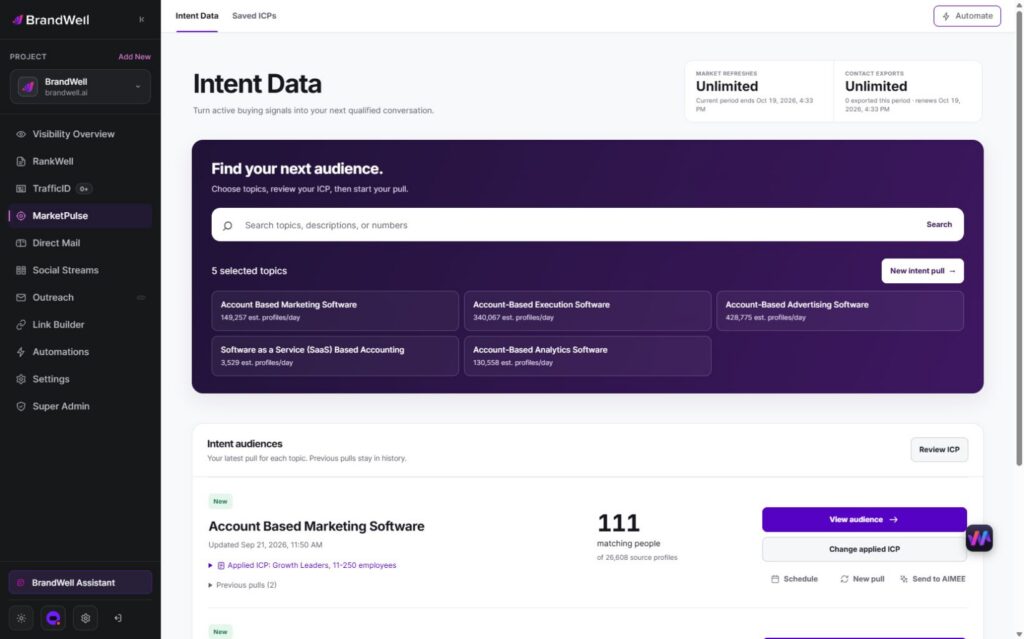
An agency can scope verification, account research and a reviewed brief as a service. MarketPulse topic research is separate from a funding-event feed; confirm any required data integration rather than assuming the product supplies one. Agree client responsibilities and deliverables separately.
An agency should sell the operating loop, not a weekly dump of funded companies. A recurring service can include client-specific event rules, verification, relevance tagging, topic monitoring, role validation, a branded evidence report, approved CRM routing, a weekly review, and a monthly outcome calibration. The deliverable should show why each account appears and what evidence is missing.
Review a relevant MarketPulse topic and ICP alongside the verified funding event. Keep those sources distinct and mark absent evidence. Configured tools can support a draft next step; a named owner must check the record and permitted action.
Use AIMEE through configured tools for a bounded research brief, with references, unknowns and review requirements. Do not infer native funding feeds, API access or client-branding entitlements from this example.
Funding intent signals implementation checklist
- Lock the qualified outcome, ICP, exclusions, and no-action state.
- Verify the event source, company, event date, and use-of-funds context.
- Write the relevance hypothesis and record what would disconfirm it.
- Define freshness, timing, evidence states, expiry, and re-verification.
- Validate relevant roles and channels; enforce suppression and approvals.
- Run a bounded pilot against a fit-only baseline.
- Expand only after qualified outcomes justify the full operating cost.
A funding event should open a research question
Funding is a useful change signal when it opens a research question, not when it closes one. Verify the event, connect it to a specific operating hypothesis, require fit and fresh behavioral evidence, validate identities, and measure outcomes against a baseline. That is how funding intent signals become a defensible workflow instead of another noisy list.
Use stage-specific denominators
In a fictional pilot, 20 funding alerts yield 10 verified, relevant accounts, four accepted plays and two held meetings. The rates are 50% verified relevance per alert, 40% accepted plays per verified account and 50% held meetings per accepted play. These invented figures are not benchmarks, buying probabilities or ROI.
Log the account, event date, original source, reviewer and rejection reason. A duplicated announcement is not independent corroboration. A performance-weighted score is an author-defined ranking unless a documented validation process establishes something more. Keep revenue, contribution margin, fully loaded costs and incremental impact separate.
Review related research with MarketPulse
MarketPulse standard plans are starting at $500/mo for one topic with weekly refreshes. Growth includes three topics with daily pulls; Scale includes ten topics with daily pulls. Available fields, audience sizes and overlap vary.
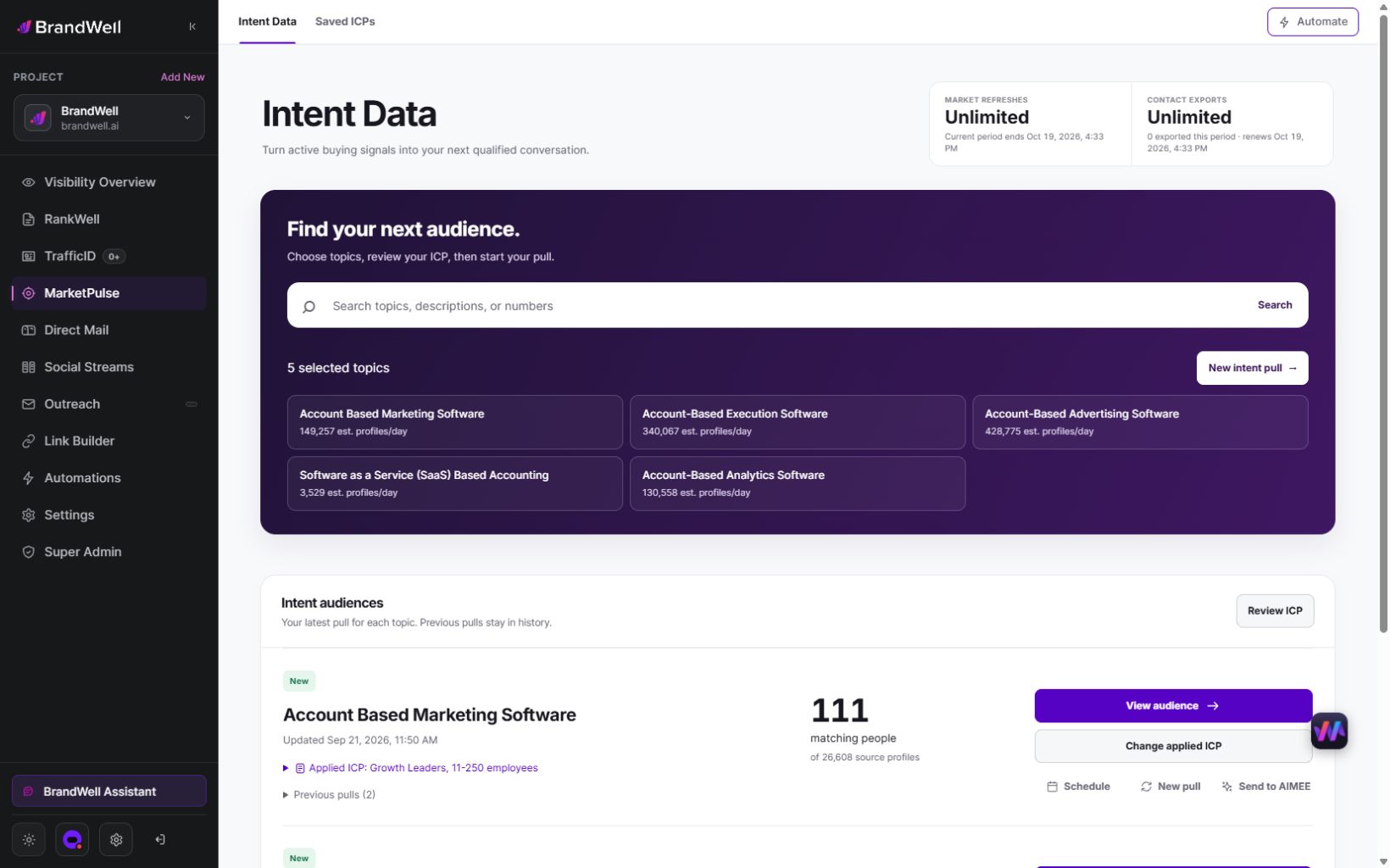
Inspect one relevant topic and ICP, verify the available record and retain separate evidence for the funding event. Watch the demo and review current plans.
Reviewed and updated October 3, 2026.

Written by