On this page
- Current MarketPulse research workflow
- Define the client problem first
- Use seven pilot-to-scope steps
- Evaluate seven cross-sell plays
- Compare add-ons and managed services
- Price five actual cost layers
- Measure adoption and observed outcomes
- Check prerequisites before expanding
- Separate evidence from approved actions
- Document expectations and permitted use
- Write renewal and change conditions
- Copyable existing-client pilot charter
- Frequently asked cross-sell questions
The short answer: cross-sell buyer intent data by attaching one observable client problem to one bounded workflow – not by adding a generic “intent” line item to every retainer. Use the client’s existing growth goal, prove that the team can act on a small signal set, and expand only when adoption and economics support it.
Who is this for? Agency owners, account directors, client-success leaders, paid-media teams, outbound specialists, and RevOps consultants who already have trusted client relationships.
AIMEE can prepare a review brief through configured connected tools. Keep proposed actions separate from actual approvals and destination acknowledgements. Confirm the implementation and permissions before execution.
Research, identity, enrichment, and visitor matches are probabilistic evidence rather than proof of a buyer. Keep a person in control before outreach, advertising spend changes, CRM overwrites, or anything posted publicly.
Current MarketPulse offer: intent-data plans start at $500/mo. See the product, demo, and current plans. Updated October 3, 2026.
Current MarketPulse research workflow
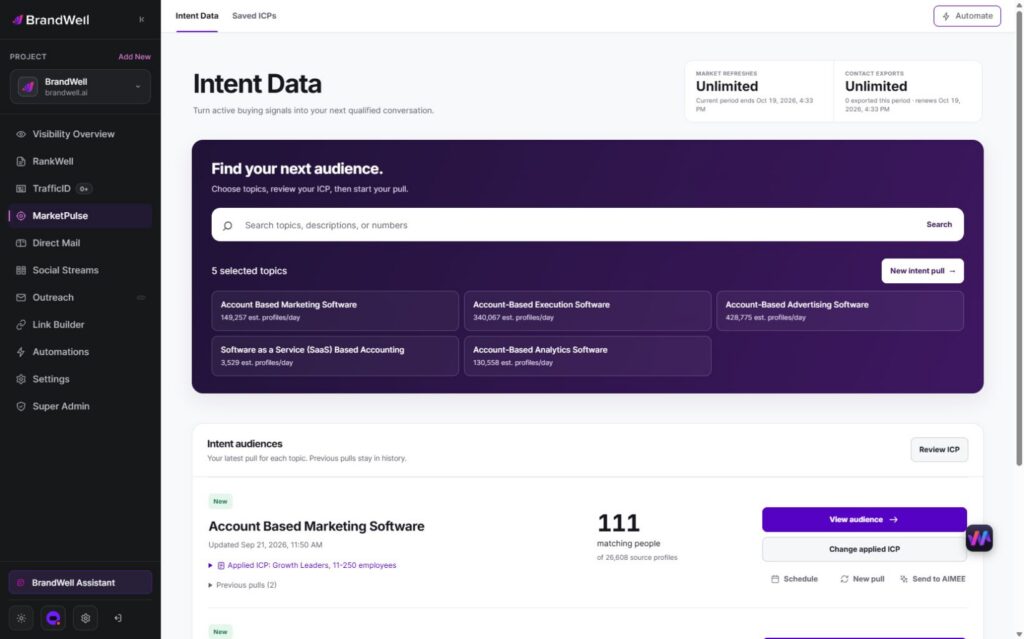
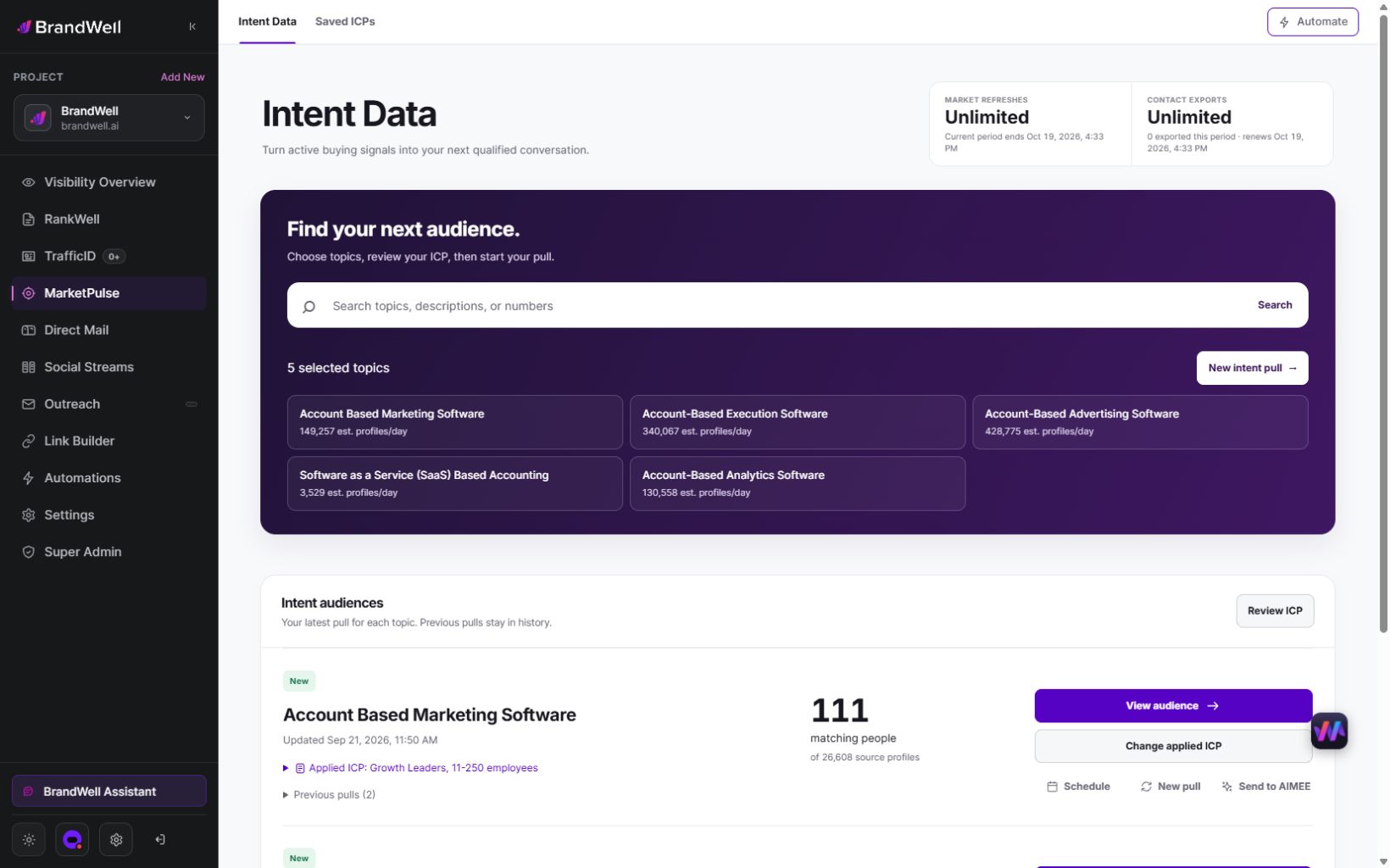
BrandWell MarketPulse: intent data starting at $500/mo. Find people researching topics relevant to what you sell, apply saved ICP filters, and review available contact details before taking action.
MarketPulse plans are starting at $500/mo. Verify current package scope and offers on the product page.
| Plan | Topics and refreshes | Monthly exports |
|---|---|---|
| Starter | 1 topic, weekly | 25,000 contacts |
| Growth | 3 topics, daily | 100,000 contacts |
| Scale | 10 topics, daily | Unlimited contacts |
Swipe the table to see all columns.
A pull retrieves available data from the previous 24 hours for one topic. Daily use across all included topics provides 90 Growth pulls or 300 Scale pulls in a 30-day month. Weekly Starter pulls vary by calendar month. Available audience size and contact fields vary, and audiences may overlap. Refreshes stop at the plan limit without overage charges.
- Find and qualify: search the topic catalog, save your ICP, and review the people and companies that match.
- Act on the research: export qualified contacts or prepare an Outreach or Direct Mail workflow. Connected products, channel usage, and fulfillment may cost extra.
- Get help from AIMEE: Growth and Scale include AIMEE for the initial user to research accounts and prepare the next step through connected tools.
Agencies and other service businesses can build client deliverables around their available Intent Scans and exports. Keep each client’s scope, permissions, and service fees clear. A subscription is not a promise of a white-label platform or exclusive access to a market.
Explore MarketPulse and watch the demo or compare plans starting at $500/mo. Any early-access discount is a separate, time-limited offer shown to an eligible recipient.
Define the client problem first
Begin with a goal already present in the account plan: reduce wasted media, prioritize outbound, identify high-interest website traffic, improve sales follow-up, find cross-sell demand, or give leadership better market evidence. Connect the proposed pilot to that goal and the operational gap it will test.
Do not lead with topic counts or records. Lead with a decision: “Which accounts deserve research this week?” “Which paid audiences should receive a controlled test?” “Which anonymous visits meet the threshold for review?” The client can evaluate a decision more easily than an abstract data feed.
Use a three-part qualification. First, confirm relevance: the topic and audience must match the client’s ICP and offer. Second, confirm readiness: the client needs an owner, a response channel, and outcome data. Third, confirm commercial fit: anticipated delivery work and platform usage must support a healthy agency margin.
Test whether the scoped workflow changes actual client decisions, adoption and defined outcomes. A new dashboard or contract line does not establish better retention or expansion. Hold the pilot when data quality, capacity or permitted use is unresolved.
Use seven pilot-to-scope steps
A disciplined cross-sell workflow prevents a promising idea from becoming an unpriced custom project:
- Detect an expansion trigger. Use QBR notes, campaign waste, missed follow-up, new segments, a product launch, sales-capacity changes, or explicit client requests.
- Write a problem statement. Name the current decision, baseline, constraint, and owner. Avoid “the client needs more intent.”
- Run discovery. Confirm ICP, eligible topics, exclusions, identity level, systems, response capacity, privacy constraints, and desired evidence.
- Design a bounded pilot. Select one cohort, one workflow, one channel, one evaluation window, and a maximum volume or spend.
- Agree on acceptance. Define what makes a signal usable and who can reject it. Add suppression and duplicate rules before delivery.
- Activate with approval. Prepare the recommended action, but require the channel owner to approve consequential outreach, spend, or CRM changes.
- Review evidence and scope. Compare baseline, adoption, outcomes, labor, and client value. Continue, change, or stop; do not auto-renew an unproven workflow.
Give the client a one-page pilot charter with inputs, outputs, responsible people, service level, data handling, cost, and stop conditions. Keep an exception log and a decision register. That creates a reusable template without pretending every client has the same stack or risk.
Evaluate seven cross-sell plays
Evaluate each play with the same criteria: the client problem, minimum data, required action, evidence, delivery effort, and limitation.
1. Paid-media audience refinement
Use accepted account or topic signals to create a controlled audience test, adjust exclusions, or prioritize creative research. Possible use: an agency already managing media with enough audience scale and conversion data. Limitation: small cohorts may not meet platform thresholds, and a signal alone should not trigger an automatic budget shift.
2. Outbound account prioritization
Rank research-ready accounts after ICP, suppression, identity, and freshness checks, then prepare context for a salesperson. Possible use: a client with a defined outbound motion and capacity to work the queue. Limitation: intent does not create message-market fit, and account-level activity must not be misrepresented as named-person certainty.
3. High-intent website-visitor review
Create a review lane for visits that meet page-depth, fit, recency, and match-confidence rules. Possible use: a client with meaningful traffic and a fast follow-up owner. Limitation: visitor identification is probabilistic, coverage varies, and legal or consent requirements can limit the workflow.
4. Competitive or category research brief
Aggregate eligible topics into a branded report that helps the client understand where research is concentrating. Possible use: a strategy, content, or demand-generation retainer. Limitation: a research spike is directional context, not proof of market share, buyer identity, or future revenue.
5. Buying-committee enrichment
Enrich accepted accounts with relevant roles, validate contact fields, and produce a research brief before sales acts. Possible use: complex B2B sales where multiple roles influence a decision. Limitation: enrichment can be incomplete or stale; it should support research rather than authorize indiscriminate contact.
6. CRM routing and service-level monitoring
Route reviewed signals into an approved queue, timestamp ownership, and monitor whether they were worked. Possible use: RevOps retainers with clear fields and lifecycle rules. Limitation: automated overwrites can corrupt source-of-truth records, so field ownership, rollback, and human approval are essential.
7. Separately scoped managed research service
Scope supplied research, separately implemented reports or interfaces, operating instructions, exceptions and decision reviews. Verify actual branding and product rights before promising them. Possible use: an agency ready to sell and deliver a distinct recurring service. Limitation: it requires scope discipline, client billing operations, capacity, governance, and verified platform terms – not just a reseller logo.
Compare add-ons and managed services
Evaluate an intent add-on against a specific gap in an existing paid-media, outbound, content or RevOps service. Existing owners and systems may reduce implementation work, but verify the actual handoffs. An add-on can become an underpriced custom project; it is not inherently the fastest adoption path.
A separately scoped lead-generation service needs explicit research, qualification, review, activation and reporting responsibilities. Do not infer that the agency controls every outcome. Define buyer evidence, client duties, permitted channels and uncertainty without guaranteeing meetings or revenue.
A broader retainer may coordinate multiple channels under named ownership. Measure actual operating cost, client use and outcomes; neither strategic value nor improved retention follows automatically. Record channel overlap, attribution limits and which owner approves each decision.
Compare a client-requested expansion, a diagnosed recommendation and a small evidence-led pilot against the actual account context. None is universally most credible. Permission, prerequisites, explicit scope and an agreed decision rule are necessary checks before presenting the offer.
Price five actual cost layers
Separate five cost layers: discovery and setup, enabled data modules, usage, recurring management, and exceptions. Add client-specific integration work, security review, reporting, and channel execution where applicable. A single blended price hides which change will damage margin.
Estimate defined monthly service costs from actual subscription/usage, allocated setup, measured labor, exceptions and stated overhead. Do not assume wholesale rates or native reseller terms. Defined incremental remainder equals added client fees minus added stated costs; divide by added fees for its percentage. Name exclusions before calling the result gross margin or company profit.
The agency controls its retail pricing and client billing. Protect margin with included volumes, a defined review cadence, response SLAs, separately agreed service-change rules, and clear client dependencies. If the account requires weekly strategy, custom CRM logic, and multi-channel activation, price those as delivery – not as “free” data support.
Measure adoption and observed outcomes
Cross-selling succeeds when the client uses the module and makes better decisions – not when the agency adds contract value. Track pilot participation, accepted-signal rate, time to review, time to action, activated share, and completion of the client’s assigned tasks. These are early warnings for an expansion that exists only on paper.
Then track qualified responses, opportunities, pipeline progression, media efficiency within controlled tests, and other workflow-specific outcomes. Commercial measures include added recurring contract revenue, setup recovery, gross margin, expansion retention, module renewal, and the effect on the core retainer.
Define every formula. Expansion adoption can be active users or teams divided by expected users or teams. Signal activation is approved actions divided by accepted signals. Expansion gross margin must include exception labor, account management, and allocated platform cost. Do not credit the module for all revenue from an account that was already likely to buy.
Where feasible, use a holdout, staggered activation, matched accounts, or an agreed baseline. Record external changes such as offer launches, territory shifts, and sales staffing. The goal is decision-useful evidence with stated limitations, not an artificial claim of causality.
Check prerequisites before expanding
Check the actual client problem, documented ICP, stable source systems, available action owner and outcome feedback. Renewal planning, a new segment or changing acquisition costs can prompt discovery, but none alone establishes readiness or a need for this service.
Use a fit checklist: Does the client have enough relevant volume? Can it share CRM and outcome data? Are topics specific enough to guide a decision? Are exclusions documented? Is a channel owner available? Can the team respond inside the signal’s freshness window? Has the intended data use passed privacy and contractual review?
Do not cross-sell to repair a failing relationship, distract from missed core deliverables, or force expansion before the client adopts existing work. Poor-fit clients include those with tiny markets, no response capacity, unreliable CRM states, unacceptable data-use constraints, or a demand for guaranteed meetings. Solve prerequisites or recommend a simpler research process.
Separate evidence from approved actions
Treat each stage as a different decision. An intent source suggests research. Identity resolution estimates an account or person. Enrichment checks role and firmographic fit. Validation checks a contact field. Routing assigns an owner. Only then does an approved playbook suggest an action.
For every play, record source, topic, observed window, confidence, fit result, suppression result, permitted purpose, action, owner, and outcome. If a stage fails, send the record to an exception lane or stop. Do not let “AI confidence” replace the client’s acceptance rule.
MarketPulse supplies topic research and available match details. AIMEE can organize supplied context through configured tools. A branded client service, custom portal, report, routing system or synchronization requires separately verified implementation, rights, scope and fees. A subscription does not establish white-label delivery.
When the client uses several channels, choose one system of record and one decision owner. Duplicate activations can create inconsistent messaging, audience overlap, and attribution confusion. Return outcomes to the service so the next QBR can tighten thresholds or stop low-value work.
Document expectations and permitted use
Expansion changes the service’s data flow, so update the contract and data map. Document controller and processor roles where applicable, permitted purpose, sources, access, retention, deletion, subprocessors, exports, and incident handling. Get qualified legal advice for the jurisdictions and channels involved.
Keep objective claims within actual supporting evidence and current product terms. A topic or contact record does not establish a buyer, meeting, revenue, compliance outcome or automatic advertising performance. Preserve limitations and avoid invented typical results.
Control expectation risk in the pilot charter. State that intent and identity are probabilistic, which steps the agency controls, which steps the client controls, and what result would justify expansion. Give the client a rejection path. Preserve unresolved evidence rather than turning a directional signal into a sales claim.
Technically, test permissions, deduplication, field mapping, suppression, rollback, and failed syncs. Operationally, require human approval before any external outreach, media change, CRM overwrite, or public post. Preserve actual approvals, outcomes, exceptions and an accountable incident response.
Write renewal and change conditions
A recurring scope should state modules, topics, eligible markets, identity level, volume, operating cadence, SLA, outputs, client duties, measurement, change control, and exit. Offer tiers based on work and decision complexity rather than vague labels. The agency retains control of its client pricing and billing.
MarketPulse supplies topic research and available match details. AIMEE can organize supplied context through configured tools. An agency operating service, branded weekly report, CRM synchronization or custom client interface needs separately verified implementation, rights, scope and fees. The research subscription does not establish those delivery capabilities.
Review an available MarketPulse topic, saved ICP and actual preceding-24-hour matches for the approved research purpose. Keep uncertain company context visible. AIMEE can organize supplied context through configured tools; named owners approve actual exports, messages, audience uploads and CRM writes.
Copyable existing-client pilot charter
Problem: [Actual client decision and baseline.] Input: [Topic, saved ICP, unique unit and available fields.] Prerequisites: [Permitted purpose, owner, capacity and outcome access.] Scope: [Review volume, channel, period, exclusions and deliverables.] Price: [Subscription, labor, implementation, exceptions and fees.] Evidence: [Adoption, actual actions, buyer outcomes and unknowns.] Decision: [Renew, repair, expand or stop under an agreed rule.]
Added fees and collected cash are different
SBA business-finance guidance distinguishes cash recording on payment from accrual recording at the sale. A signed pilot, invoice and collected cash are different states; apply the actual accounting policy consistently. This general guidance is not a BrandWell service-margin or retention benchmark.
Do not call every client opportunity a sale
Suppose a fictional agency has 20 existing clients, eight meeting the pilot prerequisites, five agreeing to a pilot and three signing an added service. Signed expansion is 37.5% of the eight eligible clients, 60% of pilot agreements or 15% of all clients. If only two have paid by the cutoff, collected-client count is two. These invented descriptive counts are not BrandWell sales results or proof that the pilot caused retention.
Shared subscription costs still need allocation
A fictional pilot adds $1,000 in client fees, $200 in allocated Growth subscription cost, $300 review labor and $200 setup. Defined added costs are $700 and the remainder is $300, or 30%. The actual Growth subscription is $500 monthly; the $200 allocation is an internal example, not a purchasable BrandWell plan. Allocate the remaining subscription cost consistently and avoid counting the same expense twice. Another $400 correction makes the pilot remainder negative $100. Acquisition, general overhead, tax and financing are excluded.
Preserve stage-specific denominators
A fictional 50-account research cohort produces 30 accepted briefs, 20 approved actions and ten actual destination acknowledgements. Acceptance is 60% of reviewed accounts, approval is 66.7% of accepted briefs, and acknowledgement is 50% of approved actions. Acknowledgement is not buyer engagement. If feedback exists for eight acknowledged accounts and two have confirmed opportunities, those opportunities are 25% of reported accounts or 4% of all reviewed accounts; two acknowledged accounts remain unresolved.
Renewal comparisons need a credible alternative
In a fictional portfolio, four of five expanded clients renew and seven of ten non-expanded clients renew. The descriptive rates are 80% and 70%, but the ten-percentage-point gap does not prove the add-on improved renewal. Account selection, prior satisfaction, contract maturity, spend, sales attention and other changes may differ. Preserve the actual comparison design and small sample rather than presenting a causal uplift.
Prepare a client research brief in the current app
Search an available MarketPulse topic, apply a saved ICP and inspect actual preceding-24-hour matches. Record variable contact fields, public company context and uncertainty before proposing a next step. TrafficID separately supports own-site visitor review. AIMEE can organize supplied research through configured tools; named owners approve actual recipients, exports, messages, audience uploads and CRM writes. Custom client reports, portals and managed delivery are separately scoped work with verified implementation and rights.
Frequently asked cross-sell questions
Should every existing client receive the same add-on?
No. Check the actual problem, prerequisites and operating capacity.
Is a signed expansion collected revenue?
Not necessarily. Preserve contract, invoice, payment and accounting states.
Is a subscription allocation a separate plan price?
No. It is an internal cost allocation; reconcile the full subscription.
Does higher renewal in expanded accounts prove impact?
No. Preserve selection, maturity and comparison limits.
Review the research product: explore MarketPulse and current plans.
Reviewed and updated October 3, 2026.

Written by