On this page
- Current MarketPulse research workflow
- Map topics to actual buyer decisions
- Define page production and fallback rules
- Use seven substantive page patterns
- Compare static, dynamic and shared pages
- Count production and maintenance costs
- Measure qualified outcomes and overlap
- Check actual topic distinction
- Keep topic evidence separate from visitors
- Maintain privacy and page ownership
- Scope separate page operating work
- Copyable shared-page test brief
- Frequently asked landing-page questions
Build a separate topic landing page only when it serves a distinct buyer decision with substantive information or a useful asset. Otherwise, use a shared page with bounded relevant personalization and a dependable generic fallback. A topic is a content hypothesis, not proof that a particular visitor wants personalization.
Who is this for? B2B performance marketers, conversion agencies, demand-generation leaders, and content teams that want more relevant paths for in-market accounts without producing thin pages or surveillance-like experiences.
Current MarketPulse offer: intent-data plans start at $500/mo. See the product, demo, and current plans. Updated October 3, 2026.
Current MarketPulse research workflow
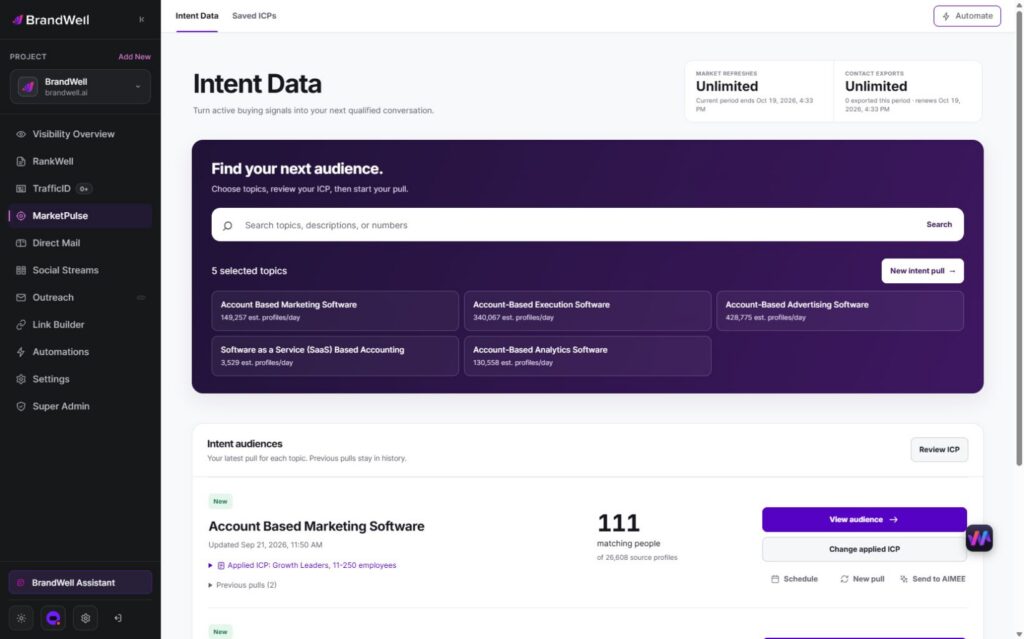
BrandWell MarketPulse: intent data starting at $500/mo. Find people researching topics relevant to what you sell, apply saved ICP filters, and review available contact details before taking action.
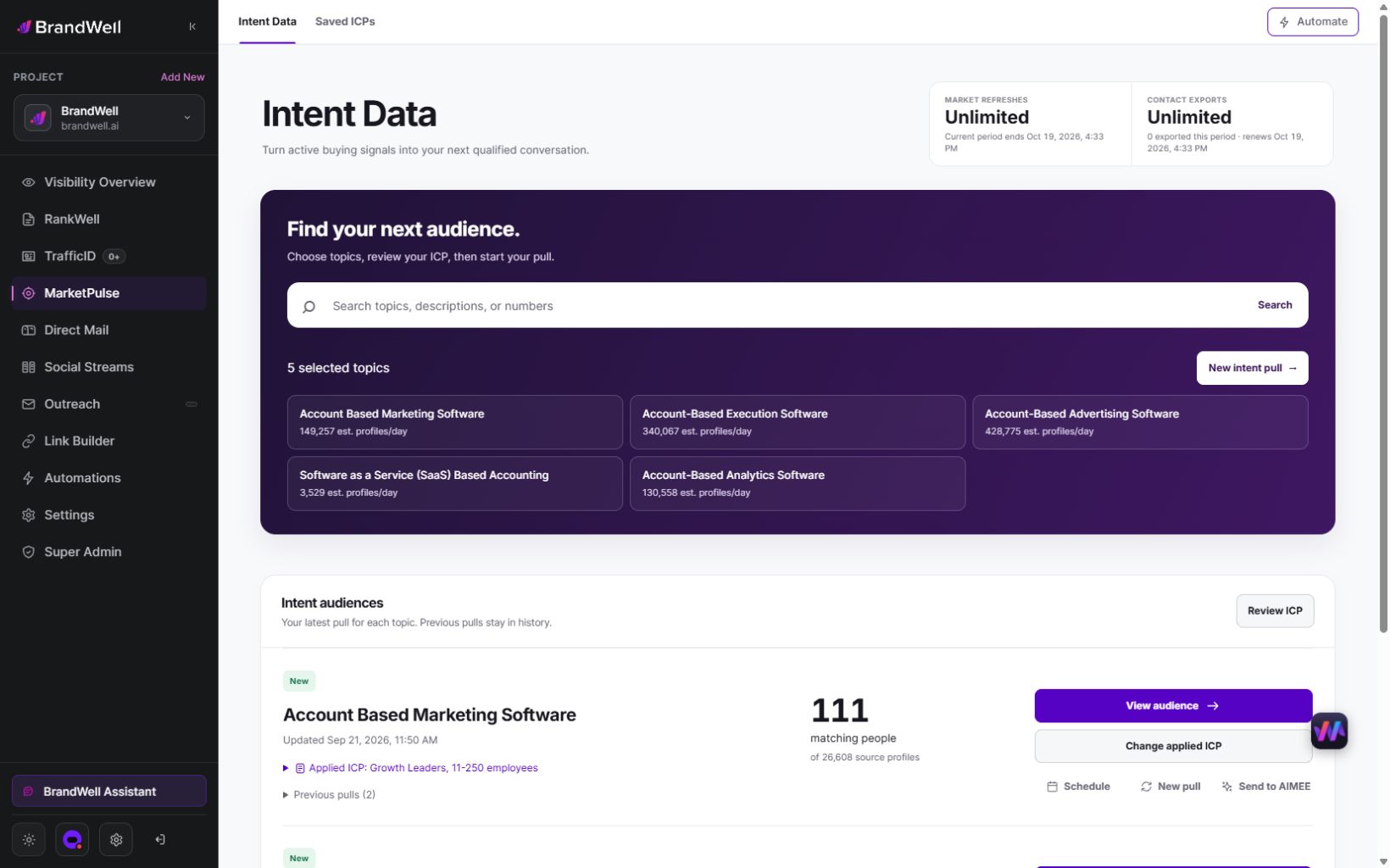
MarketPulse plans are starting at $500/mo. Verify current package scope and offers on the product page.
| Plan | Topics and refreshes | Monthly exports |
|---|---|---|
| Starter | 1 topic, weekly | 25,000 contacts |
| Growth | 3 topics, daily | 100,000 contacts |
| Scale | 10 topics, daily | Unlimited contacts |
Swipe the table to see all columns.
A pull retrieves available data from the previous 24 hours for one topic. Daily use across all included topics provides 90 Growth pulls or 300 Scale pulls in a 30-day month. Weekly Starter pulls vary by calendar month. Available audience size and contact fields vary, and audiences may overlap. Refreshes stop at the plan limit without overage charges.
- Find and qualify: search the topic catalog, save your ICP, and review the people and companies that match.
- Act on the research: export qualified contacts or prepare an Outreach or Direct Mail workflow. Connected products, channel usage, and fulfillment may cost extra.
- Get help from AIMEE: Growth and Scale include AIMEE for the initial user to research accounts and prepare the next step through connected tools.
Agencies and other service businesses can build client deliverables around their available Intent Scans and exports. Keep each client’s scope, permissions, and service fees clear. A subscription is not a promise of a white-label platform or exclusive access to a market.
Explore MarketPulse and watch the demo or compare plans starting at $500/mo. Any early-access discount is a separate, time-limited offer shown to an eligible recipient.
Map topics to actual buyer decisions
Start with the buyer’s decision, not the keyword. For each topic, document the likely job, existing page that addresses it, missing decision support, appropriate proof, and next useful action. Several closely related topics may belong on one strong page. A page earns its own URL only when it serves a distinct decision and can carry substantive information or a useful asset.
Separate topic evidence from visitor certainty. Off-site research may be modeled at an account level; first-party behavior may be anonymous or shared; identity matching may be probabilistic. None proves that a specific person wants a tailored experience. Phrase the page for anyone with the problem and use intent only to select a plausible path under governed rules.
The offer should fit the job: a diagnostic for problem framing, a calculator for economics, a methodology guide for evaluation, an implementation plan for execution, or a demo for a defined product decision. “Book a call” is not a differentiated asset.
Define page production and fallback rules
Create a topic brief with evidence source, entity level, freshness, baseline, eligible segments, excluded segments, buyer job, page owner, primary question, unique asset, CTA, privacy rule, and measurement plan. Run a collision review against live pages and planned topics. Then draft an answer-first page, expert-review its claims, design the asset, implement analytics, test routing and fallbacks, and approve publication.
For dynamic delivery, add an eligibility service that returns only the content variant ID and reason code needed by the page. Keep raw intent and identity details outside the browser. Define a generic fallback for missing, conflicting, stale, or prohibited signals. Test signed-out, unknown, customer, employee, and mobile states.
MarketPulse supports topic research, saved ICP filters and available match review. TrafficID separately supports own-site visitor review. Neither a topic match nor an identified visit establishes that a visitor requested personalized public copy. Custom page routing, eligibility, caching, analytics and client interfaces require separately verified implementation, rights, scope and fees.
Use seven substantive page patterns
1. Decision guide page
Answer a specific choice with criteria, scenarios, risks, and a clear next step. Pair it with a downloadable worksheet or interactive decision aid. Limitation: a guide becomes thin when it merely repeats product copy without evidence or genuine tradeoffs.
2. Cost and business-case page
Explain cost components, assumptions, denominators, and sensitivity. Offer a calculator that lets the buyer supply inputs instead of asserting universal ROI. Failure mode: unsupported savings or conversion claims can mislead and undermine trust.
3. Implementation blueprint
Show prerequisites, roles, data flow, approvals, milestones, QA, and rollback. Provide a reusable checklist or workflow instruction. Limitation: the blueprint must state where platform, integration, or legal requirements vary.
4. Diagnostic or maturity assessment
Help the visitor identify gaps and receive a useful result with minimal fields. Explain scoring logic and avoid collecting data that is not needed. Failure mode: a disguised lead form with a vague score provides no decision value.
5. Evidence and methodology page
Publish definitions, data lineage, validation method, denominators, limitations, and update process for a material capability. Limitation: methodology cannot substitute for product-specific proof or a representative customer test.
6. Comparison or alternative page
Compare approaches using identical criteria, supported use-case tradeoffs, switching costs, and non-fit cases. Disclose ownership when the publisher has an option in the comparison. Failure mode: forcing the owned product into every first slot damages credibility and may not answer the buyer’s actual decision.
7. Branded topic report page
Turn a validated topic into a client-branded report with an explanation, relevant evidence, recommended workflow, and next action. Keep account evidence private unless the recipient is authorized. Limitation: a generic auto-generated report does not justify a new page or a buying claim.
Compare static, dynamic and shared pages
Static intent-topic landing pages are crawlable, reviewable, shareable, and easier to govern. They work when a topic owns a durable buyer decision. Dynamic content can adapt a headline, proof block, or offer, but it requires reliable eligibility, consent, cache behavior, QA, and a safe fallback. One generic page is easier to maintain and may be better when buyer jobs overlap or evidence is weak.
Choose static pages for distinct evergreen decisions and substantive assets. Add a small dynamic component only to test a defined action and can fail safely. Use a generic page when volume is low, the topic taxonomy changes rapidly, or the team cannot maintain unique value. Avoid long static forms as the default; ask only for information needed to deliver the promised next step.
Count production and maintenance costs
Total cost includes topic validation, search and buyer research, subject review, copy, design, development, analytics, permissions, personalization logic, data, media, sales enablement, monitoring, refresh and retirement. Dynamic variants require separately tested implementation, QA and debugging. Count initial and ongoing work rather than assuming a lower-cost delivery model.
Model cost per maintained page family, including initial production, overlap review, routing repairs and claim refresh. Test a bounded page or shared-page variant against an actual buyer decision before expanding. More pages alone do not establish value, rankings or revenue.
Measure qualified outcomes and overlap
Measure eligible sessions, rendered experience, fallback rate, engagement with the unique asset, qualified conversion, sales acceptance, opportunity, pipeline, and revenue. Preserve the denominator at every stage. Separate all traffic from the eligible intent cohort and disclose identity-match or routing gaps. Track form completion quality rather than raw lead volume.
Monitor organic cannibalization with query, landing page, internal-link, and duplicate-intent reviews. For personalization, compare an eligible control with the tailored variant when feasible. Platform or analytics attribution is not incrementality. State assignment, exposure, outcome window, contamination, and uncertainty. A null result can justify simplifying the system.
Check actual topic distinction
Evaluate whether a topic maps to an actual durable buyer decision, has supportable evidence, can sustain a useful asset and offers an appropriate next step. A service team can test implementation, pricing, risks or measurement content against actual buyer questions; topic labels alone do not justify separate pages.
A topic is a poor candidate when it differs only by wording, carries sensitive implications, has no supporting expertise, or cannot offer anything beyond a generic CTA. Consolidate near-duplicates and use sections or anchors. Do not create a page simply because an intent provider supplies a topic label.
Keep topic evidence separate from visitors
Create a topic-to-action map. Fit determines eligibility; topic and stage suggest the buyer job; identity determines whether permitted activation is possible; freshness limits how long the hypothesis remains useful; the page delivers a report, calculator, guide, or demo; outcomes return to the topic model. Every transition needs a reason code and owner.
Keep the experience useful without personalization. A visitor should receive value even when no signal exists. Never insert a company name or research detail merely because it is available. An intent-topic landing pages strategy should reduce the distance between a question and an answer – not announce that the business has profiled the visitor.
Maintain privacy and page ownership
Minimize collected fields, define retention, isolate client context and maintain actual correction, deletion and suppression routes. Keep raw private research out of public HTML and analytics labels. Verify source, recipient, purpose, jurisdiction and destination before using a page cohort for an audience or message.
Maintain a page registry with owner, buyer decision, canonical URL, evidence source, asset, internal links, experiment status, and retirement trigger. Run scheduled duplicate-intent and claim checks. Human approval is required for new pages, personalization rules, CRM writes, audience activation, material spend changes, and public claims. Automated generation without editorial review is a direct route to thin content and drift.
Scope separate page operating work
An agency service can combine topic selection, page architecture, useful asset production, governed activation, experiment design, and monthly pipeline learning. Define the number of active topics, refresh cadence, client approvals, hosting and analytics ownership, media scope, and retirement policy. Report page utility and qualified outcomes rather than page count.
AIMEE can prepare a review brief through configured connected tools. Keep proposed actions separate from actual approvals and destination acknowledgements. Confirm the implementation and permissions before execution.
Run the service from a page registry rather than a content calendar alone. For every candidate, record the canonical buyer decision, nearest live page, unique asset, topic eligibility, evidence owner, internal-link plan, CTA, analytics event, maintenance owner, and retirement rule. A proposal should fail the gate if it lacks a distinct decision or if an existing page can answer it with a substantive new section. This is how the program avoids turning topic coverage into doorway pages.
A monthly review should compare planned, drafted, live, personalized, tested, consolidated, and retired pages. Investigate pages with traffic but no asset use, conversions without sales acceptance, high fallback rates, or organic query overlap. Record whether the next action is improve the offer, change routing, consolidate, remove personalization, or retire the page. Page production volume is not a success metric.
For client handoff, deliver the topic map, briefs, source ledger, design files, analytics dictionary, eligibility and fallback rules, experiment history, and access instructions. Define what happens when the agency relationship ends and how private intent data is deleted or exported under applicable terms. A durable system remains understandable without the original strategist and can be audited before any future automation changes the public experience.
Finally, give every page a stop rule. Retire or consolidate it when the buyer decision no longer differs, the evidence expires, the offer disappears, maintenance ownership lapses, or another page consistently serves the job better. Redirect intentionally, update internal links, preserve measurement history, and remove obsolete personalization rules. Pruning is part of the growth system: it concentrates authority and review effort on pages that still help buyers make a real decision.
Copyable shared-page test brief
Decision: [Actual buyer question and useful offer.] Page: [Shared canonical page and nearest existing answer.] Variant: [Verified public company context, allowed fields and approved copy.] Fallback: [Unknown, stale, conflicting or unavailable context.] QA: [Keyboard, mobile, validation, caching and unknown states.] Measurement: [Assignment, actual exposure, qualified outcome and overlap.] Owner: [Review, full costs, maintenance and stop rule.]
Make the form outcome explicit
W3C’s form-notification guidance calls for clear success feedback and understandable error messages with correction instructions. Applied to a website lookup, distinguish a successfully submitted request from unavailable research. Preserve the submitted URL when correcting an input error. Offer a useful generic topic search when company context is unavailable rather than displaying invented recommendations. Verify the actual implementation; these are design recommendations, not a claim of included page-building features.
A shared page can support distinct contexts
A fictional company lookup confirms publicly described digital marketing services, IT services or payroll software. A bounded variant can reflect that confirmed offering in the hero, use an approved relevant video when available and retain the same pricing and page structure. An unavailable website falls back to generic language and topic search. Do not infer the business solely from an ad click or display private research behavior in the hero.
Track assignment and actual rendering separately
In a fictional 1,000-session test, 600 sessions are eligible for a variant but only 500 render it; 100 use the fallback. Rendering coverage is 83.3% of eligible sessions. If 20 qualified outcomes occur among the 500 rendered sessions, their observed rate is 4%. The assigned-cohort rate requires actual outcomes for all 600; do not drop fallback outcomes or compare selected rendered sessions as though they were randomized. Preserve assignment, unique units, exposure, maturity and uncertainty.
Do not count repeated visits as new buyers
Two fictional topic pages receive 100 visits each with 40 sessions appearing in both. The union is 160 sessions if the overlap unit is consistent. That is not necessarily 160 people or accounts. A single lead submitting twice remains one lead only when the actual identity and deduplication rules support that conclusion.
Include maintenance in the page decision
A fictional page test has $600 research, $900 production and $300 implementation: $1,800 setup. Another $200 monthly review makes first-period defined cost $2,000. At ten qualified outcomes, that is $200 each before media, research subscriptions, acquisition, general overhead, tax and financing. These invented inputs are not BrandWell page-service fees or typical results. Compare the same cost boundary for a shared page and any proposed additional page.
Use current products for research and content review
Review available MarketPulse topic matches and saved ICP filters without treating a topic label as a visitor identity. RankWell can help prepare article briefs and drafts; verify public claims and the actual offer before publication. AIMEE can organize supplied context through configured tools. Owners approve public copy, exports, messages, audience uploads and CRM writes. Custom page personalization, routing and analytics need separately verified implementation and rights.
Frequently asked landing-page questions
Does every topic need its own URL?
No. Use a distinct page only for a substantive distinct decision.
Does a topic match establish visitor consent?
No. Verify actual context and permitted use.
Should missing website context produce invented topics?
No. Provide a useful generic fallback.
Is a rendered-variant rate the assigned-cohort rate?
No. Include fallback outcomes and retain assignment.
Review the research product: explore MarketPulse and current plans.
Reviewed and updated October 3, 2026.

Written by