On this page
- Current MarketPulse research workflow
- Preserve incomplete evidence and its meaning
- Test nine research-to-action steps
- Compare six evidence patterns
- Compare research, lists and declared demand
- Count full data and review costs
- Keep association separate from causality
- Check actual client operating capacity
- Require purpose and action gates
- Review access, messaging and claim risks
- Scope separate agency evidence work
- Copyable incomplete-evidence review
- Frequently asked dark-funnel questions
Use dark-funnel activity as incomplete research context. Keep source, fit, uncertain identity, freshness, purpose and action eligibility separate before routing a bounded review queue. A visit, ad view, topic appearance or missing referrer does not establish purchase intent or permission for a sales message.
Who is this for? B2B founders, marketers, RevOps teams, sales leaders, and agencies with a defined ICP, several observable channels, reliable CRM outcomes, and the capacity to review a limited queue. It is not for teams looking for a pretext to turn every anonymous behavior into automated outbound.
Current MarketPulse offer: intent-data plans start at $500/mo. See the product, demo, and current plans. Updated October 3, 2026.
Current MarketPulse research workflow
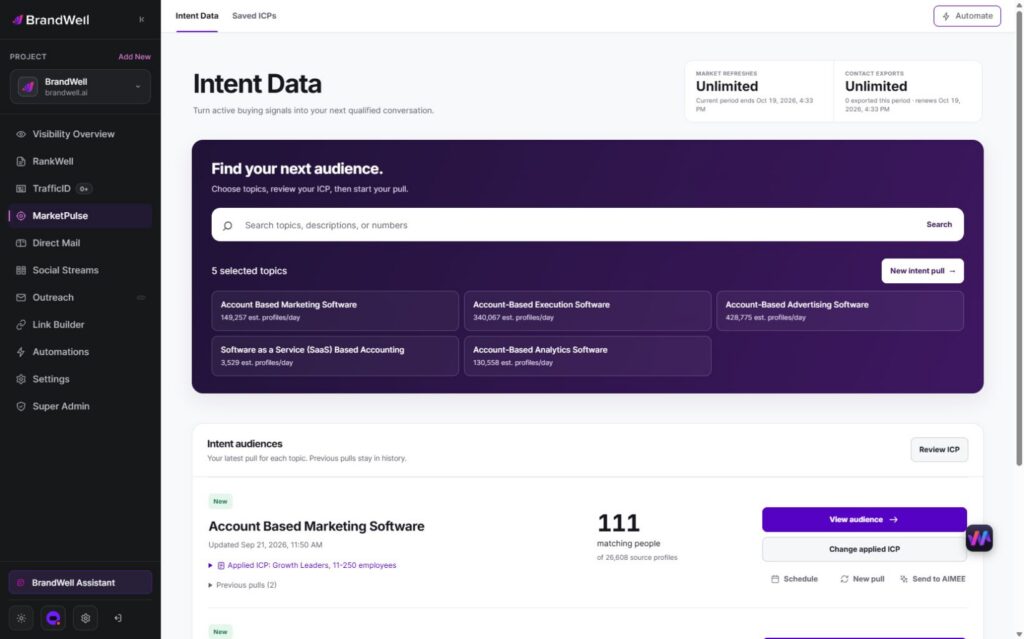
BrandWell MarketPulse: intent data starting at $500/mo. Find people researching topics relevant to what you sell, apply saved ICP filters, and review available contact details before taking action.
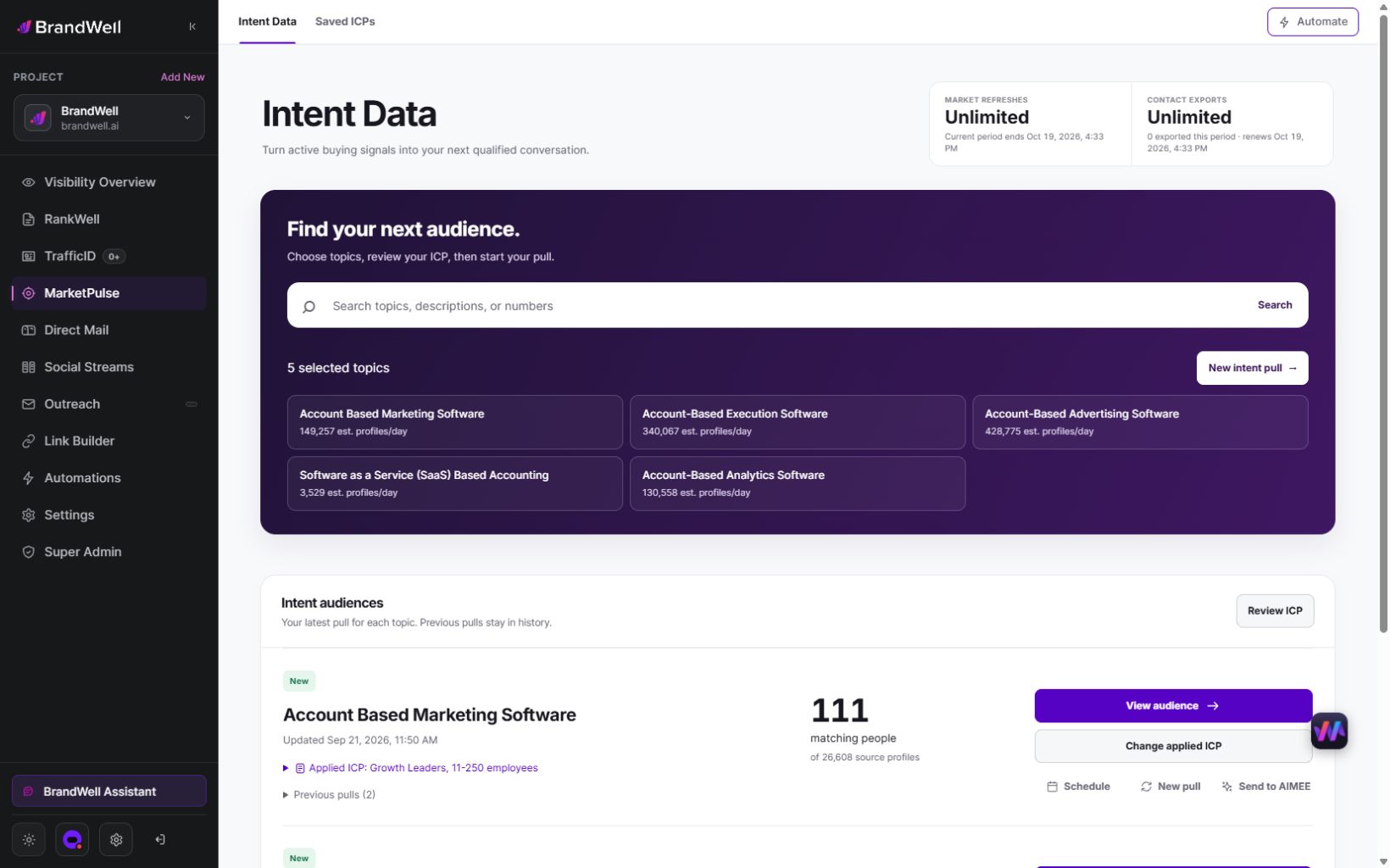
MarketPulse plans are starting at $500/mo. Verify current package scope and offers on the product page.
| Plan | Topics and refreshes | Monthly exports |
|---|---|---|
| Starter | 1 topic, weekly | 25,000 contacts |
| Growth | 3 topics, daily | 100,000 contacts |
| Scale | 10 topics, daily | Unlimited contacts |
Swipe the table to see all columns.
A pull retrieves available data from the previous 24 hours for one topic. Daily use across all included topics provides 90 Growth pulls or 300 Scale pulls in a 30-day month. Weekly Starter pulls vary by calendar month. Available audience size and contact fields vary, and audiences may overlap. Refreshes stop at the plan limit without overage charges.
- Find and qualify: search the topic catalog, save your ICP, and review the people and companies that match.
- Act on the research: export qualified contacts or prepare an Outreach or Direct Mail workflow. Connected products, channel usage, and fulfillment may cost extra.
- Get help from AIMEE: Growth and Scale include AIMEE for the initial user to research accounts and prepare the next step through connected tools.
Agencies and other service businesses can build client deliverables around their available Intent Scans and exports. Keep each client’s scope, permissions, and service fees clear. A subscription is not a promise of a white-label platform or exclusive access to a market.
Explore MarketPulse and watch the demo or compare plans starting at $500/mo. Any early-access discount is a separate, time-limited offer shown to an eligible recipient.
Preserve incomplete evidence and its meaning
“Dark funnel” is a useful label for buyer activity that is difficult to attribute to one tracked conversion path: independent research, return visits, ad views, content engagement, events, communities, peer conversations, and activity across devices or people in an account. The operational mistake is treating invisibility as certainty.
A defensible lead generation from dark funnel activity strategy has four rules:
- Fit precedes intent. Do not spend seller attention on an account that cannot buy, even if its apparent activity is high.
- Signals keep their meaning. A pricing-page return is different from an ad impression or a broad topic signal. Store source, timestamp, scope, and confidence.
- Keep account, person, device and aggregate evidence distinct. Preserve the actual matching unit, method, uncertainty, source and review evidence. A matched account is not automatically an identified individual.
- Actions are proportional. Weak evidence can trigger audience research or advertising. Stronger corroborated evidence may justify human-reviewed outreach to a known, relevant contact.
The goal is a measurable queue of eligible accounts with an evidence trail, not a larger lead count.
Test nine research-to-action steps
Use this implementation guide as an operational checklist:
- Define the revenue decision. Choose one outcome, such as which accounts receive SDR research, which enter a nurture audience, or which get a partner report.
- Map sources. Document first-party website events, CRM history, campaign engagement, event records, topic activity, and public business context. Record whether each signal is person-, device-, household-, or account-level.
- Set evidence weights and decay. High-specificity actions receive more weight than passive exposure. Set and test a dated validity rule for each source rather than assuming a universal decay rate.
- Resolve and enrich carefully. Attempt company resolution before person selection; retain match type and confidence; append only attributes needed for the decision.
- Apply gates. Require ICP fit, minimum corroboration, identity confidence appropriate to the action, freshness, permitted use, and channel eligibility.
- Suppress before activation. Exclude customers, employees, competitors, active opportunities when outreach would interfere, opt-outs, sensitive categories, and unsupported geographies.
- Route to an owner. Create a reason code, evidence summary, suggested next step, expiry, and maximum queue size. A human approves outreach and spend changes.
- Capture outcomes. Write delivery, reply, qualification, opportunity, loss reason, and revenue back to the source record.
- Recalibrate. Remove signals that create false positives, shorten stale windows, and compare activated records with an eligible holdout.
The team normally includes demand generation, RevOps, CRM or data engineering, sales leadership, an analyst, privacy or legal counsel, and security. Required integrations are the event layer, CRM, identity/enrichment process, consent and suppression systems, approved activation channels, and outcome reporting. Start in batch mode; “real time” is useful only when the downstream team can act responsibly at the same speed.
Compare six evidence patterns
Evaluate every pattern on the same criteria: signal specificity, identity level, freshness, coverage, permitted use, false-positive risk, action, and measurable outcome.
1. Repeat first-party solution behavior
Prioritize a high-fit account that returns to a solution cluster, evaluates implementation content, or revisits a commercial page. Use account-level advertising or owner research before person-level outreach.
Failure mode: Shared networks, bots, customer support use, and internal traffic can mimic research. Page views do not reveal who visited or why.
2. Topic activity plus ICP fit
Use recent topic activity to narrow a large market to accounts that may be researching a relevant problem, then require fit and another independent signal before activation.
Failure mode: Topic taxonomies can be broad, account attribution may be indirect, and research can be academic, operational, or competitor-led rather than commercial.
3. Paid-media engagement with downstream evidence
Use only actual supported and permitted campaign engagement sources. Verify the audience boundary, account, region, purpose and eligibility before sequencing. A platform total does not establish a named buyer or a unique matched member.
Failure mode: An impression, click, form open, or video view is not a unique buyer. Platform totals do not always equal matched audience counts, and engagement optimization can reward curiosity rather than commercial fit.
4. Known-contact reactivation
Prioritize an existing, eligible CRM contact when new account-level activity aligns with a previous problem, opportunity, event, or content request. Frame the message around useful current context, not a claim that the contact was watched.
Failure mode: The contact may have changed roles, the account activity may belong to someone else, and an old lawful relationship may not permit every new channel or purpose.
5. Buying-group corroboration
Elevate an account when several relevant roles engage across independent sources within a short window. Keep each person’s evidence separate and let the pattern raise the account score.
Failure mode: Multiple weak events can create false confidence. A large account naturally produces more activity and can dominate scoring unless normalized.
6. Public trigger plus private signal
Combine a relevant public business event – such as a product launch, hiring pattern, expansion, or technology change – with a permitted private intent signal. Give a researcher both sources and require relevance to the offered outcome.
Failure mode: Public triggers can be outdated or misinterpreted, while private signals may be probabilistic. The combination still does not prove budget, authority, or timing.
Keep an evidence map, signal dictionary, confidence rubric, eligibility checks, suppression records, bounded review queue and outcome ledger. Verify actual tool behavior against the specific gap.
Compare research, lists and declared demand
Undifferentiated lead lists offer coverage and predictable volume but no behavioral reason to prioritize one record. Broad demand generation builds awareness and future demand but may not tell sales where to act now. Channel-only tactics make optimization simple inside one platform, yet miss account activity across channels. Dark-funnel evidence can focus attention across sources, but it carries heavier identity, data-rights, and measurement work.
Use each when its job is clear:
- Use broad demand generation to educate a market and create mental availability.
- Use lists for a tightly defined, lawful account universe when relevance can be established without pretending intent.
- Use channel-native retargeting for continued education when direct identification is unnecessary.
- Use dark-funnel prioritization when several permitted sources exist and the team can validate, suppress, route, and measure a limited queue.
- Use declared forms and inbound response when the buyer is ready to identify themselves.
These are complementary. Dark-funnel lead generation should help allocate demand and sales resources; it should not replace brand building, content, forms, referrals, or seller judgment.
Count full data and review costs
Lead generation from dark funnel activity pricing can involve data licenses, event collection, identity/enrichment usage, CRM integration, consent and suppression infrastructure, data engineering, analyst time, media, sales research, content, and agency operations. Total cost rises with the number of sources, countries, identities, clients, actions, and promised service levels – not simply the number of exported contacts.
Build three scenarios using the same funnel:
- eligible accounts observed;
- accounts clearing fit and signal gates;
- identity-confidence and policy-eligible records;
- human-approved activations;
- delivered touches;
- qualified conversations;
- accepted opportunities and revenue.
Calculate cost per eligible account, approved activation, qualified conversation, and accepted opportunity. Add actual implementation, QA, governance and seller labor costs to the cost numerator. Keep the denominator as the defined accepted outcome count. Never convert a provider-reported match or topic-coverage figure directly into pipeline ROI.
Keep association separate from causality
The core KPIs are signal-to-review rate, suppression rate, match confidence, time to review, activation rate, delivery, relevant reply, qualified-conversation rate, accepted-opportunity rate, pipeline, revenue, and full cost per qualified outcome. Track false positives and complaints as first-class quality metrics.
Use an eligible holdout whenever volume permits. Compare like accounts over the same window, preserve source cohorts, and avoid letting the most active accounts receive every channel simultaneously without a test. “Touched pipeline” is descriptive; it is not proof that the dark-funnel program created the opportunity.
Use internal benchmarks by ICP tier, signal combination, identity level, channel, and client. A signal that performs for mid-market software accounts may fail for regulated enterprise buyers. Recalibrate on qualified outcomes, not clicks or raw lead totals.
Check actual client operating capacity
Evaluate actual account scope, maintained outcome definitions, permitted sources and capacity to review a limited queue. Possible tests include account research, known-contact reactivation and separately scoped client reporting; industry or traffic alone does not establish usefulness.
Poor-fit cases include low traffic, undefined ICP, weak CRM hygiene, consumer or sensitive-use exposure, unclear data rights, no suppression system, very short sales cycles, or a sales team that already has more qualified demand than it can handle. If one signal and a spreadsheet are the entire system, call it a test – not a dark-funnel engine.
Require purpose and action gates
Test whether relevant topic research changes useful account-review decisions. Count actual fit, matching uncertainty, freshness, eligibility, operating capacity, costs and buyer outcomes. Topic context alone does not establish improved profits or demand.
Use a simple gate:
- Tier A: strong fit, multiple recent independent signals, known or high-confidence identity, eligible channel, and an assigned owner;
- Tier B: strong fit and meaningful account-level evidence, but identity or corroboration is insufficient for one-to-one outreach – use research or paid nurture;
- Tier C: broad or stale signal, weak fit, or unresolved identity – observe, aggregate, or suppress;
- Blocked: sensitive, opted out, unsupported jurisdiction, conflict, or prohibited use – do not activate.
“In-market buyer” should remain a working hypothesis until the buyer declares interest or downstream evidence supports it. Store the score components so sellers and clients can see why a record advanced.
Review access, messaging and claim risks
Keep actual source, purpose, matching uncertainty and buyer evidence visible. Avoid invented certainty, account-to-person inference and claims of caused revenue from associated pipeline. Assign necessary fields, access, retention, correction, deletion, suppression and incident owners. Keep implementation and testing evidence rather than treating a framework as certification.
Verify actual recipient, source, purpose, jurisdiction and channel requirements before messages. A research match or event does not establish contact permission. Hold unresolved checks and obtain qualified advice where needed.
Apply data minimization, role-based access, encryption, retention, deletion, consent and opt-out propagation, identity-confidence labels, source provenance, audit logs, message-frequency limits, and incident response. Consequential outreach or spend changes always require human approval. Before operational use, complete product, pricing, privacy, security, compliance, legal, and platform-policy review.
Scope separate agency evidence work
An agency can sell a recurring service with clear modules: source mapping, intent-topic configuration, identity and fit scoring, suppression, weekly evidence queues, approved activation playbooks, monthly pipeline readouts, and periodic threshold recalibration. The client controls channel approvals and retains visibility into excluded records, match confidence, and outcome definitions. Price the service around coverage, sources, cadence, client complexity, activation work, and human QA – not a guaranteed number of buyers.
Review an available MarketPulse topic, saved ICP and actual preceding-24-hour matches for the approved research purpose. Keep uncertain company context visible. AIMEE can organize supplied context through configured tools; named owners approve actual exports, messages, audience uploads and CRM writes.
BrandWell is not a replacement for the client’s CRM, consent system, ad platforms, sales process, or legal judgment. Before operational use, complete product, pricing, privacy, security, compliance, legal, and platform-policy review.
Copyable incomplete-evidence review
Question: [Actual research decision.] Source: [Observed event, unit, date and limitations.] Corroboration: [Independent evidence or repeated source.] Fit: [Verified account context and unresolved fields.] Action: [Purpose, eligibility, owner and queue limit.] Outcome: [Actual disposition, buyer evidence and missingness.] Decision: [Full costs, comparison, repair or stop.]
Unknown referral does not establish hidden demand
Google Analytics’ direct-traffic guidance describes traffic without a clear referrer, including missing tracking information. That classification does not establish a buyer or a private recommendation.
Assume a fictional site records 1,000 sessions, 300 classified direct. A tagging audit associates 100 of those sessions with existing campaign links, leaving 200 with unresolved source. Do not relabel the 200 as known peer referrals or qualified demand. A better source label changes measurement, not necessarily the underlying traffic. These invented counts are not BrandWell performance results.
Repeated signals may share one origin
A topic event appearing in a research export and then a CRM report can be the same observation twice. Keep a common evidence ID, original source and collection time. Two downstream appearances are not two independent confirmations. A separately verified public rollout notice may add a different kind of context, but still does not prove budget, authority or purchasing intent.
Name the review and feedback denominators
Assume 100 unique accounts enter research, 60 pass fit, 40 pass required action checks and 20 receive seller acceptance. Acceptance is 50% of eligible accounts or 20% of the original pool. If feedback exists for 15 accepted accounts, coverage is 75%, with five unresolved. Three qualified opportunities are 20% of reported accounts, 15% of accepted accounts or 3% of the original pool. Preserve missing outcomes and actual opportunity IDs.
Keep operating costs in the numerator
A fictional first-period test using the standard $500 Growth subscription, $400 setup and $600 review costs $1,500. Three accepted opportunities give $500 each. An extra $300 in correction work makes defined cost $1,800 and $600 per opportunity. Do not add labor dollars to the opportunity count. Media, acquisition, general overhead, tax and financing are excluded; these invented service inputs are not BrandWell fees or typical returns.
Use approved research rather than inferred certainty
Review an available MarketPulse topic, saved ICP and actual preceding-24-hour matches for the approved purpose. Preserve source limits and uncertain company context. TrafficID is separately scoped own-site visitor work. AIMEE can organize supplied research through configured tools. Owners approve exports, messages, Outreach enrollment, uploads and CRM writes. Custom reports, scoring, client interfaces and routing require separately verified implementation, rights, scope and fees.
Frequently asked dark-funnel questions
Does direct traffic identify a private recommendation?
No. The referral source can remain unknown.
Are two copies of one event independent corroboration?
No. Preserve original evidence IDs and sources.
Do labor costs belong in the opportunity denominator?
No. Put defined costs in the numerator.
Does a topic appearance establish permission to contact?
No. Verify actual action eligibility separately.
Review the research product: explore MarketPulse and current plans.
Reviewed and updated October 3, 2026.

Written by