On this page
- Current MarketPulse research workflow
- Check the actual scheduling question
- Require three scheduling-test gates
- Define timestamps, owners and workflow
- Use seven scheduling operating assets
- Compare schedules and handoff options
- Count full test and operating costs
- Measure qualified outcomes and maturity
- Check actual scheduling feasibility
- Trace fit, time and outcome evidence
- Check clock, mix and action risks
- Scope separate agency scheduling work
- Copyable local-time schedule test
- Frequently asked dayparting questions
Treat intent-informed ad dayparting as a bounded test. Verify account and audience timezones, exposure time, response lag, qualified outcomes and actual campaign support before changing hours. Compare one reversible schedule change against the baseline. Topic research does not establish that a named person is online or ready to respond.
Current MarketPulse offer: intent-data plans start at $500/mo. See the product, demo, and current plans. Updated October 3, 2026.
Current MarketPulse research workflow
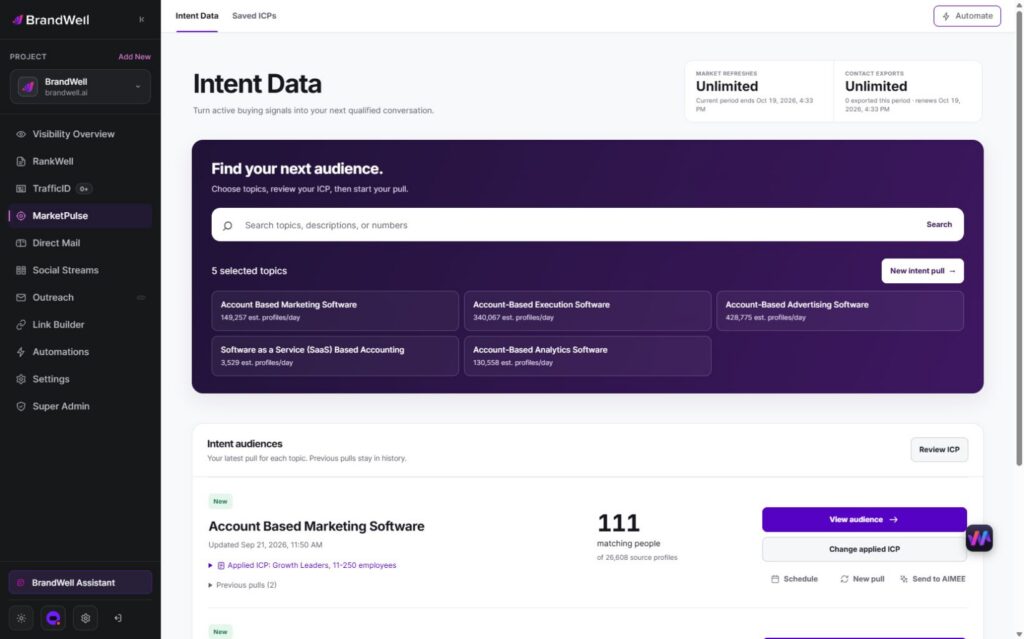
BrandWell MarketPulse: intent data starting at $500/mo. Find people researching topics relevant to what you sell, apply saved ICP filters, and review available contact details before taking action.
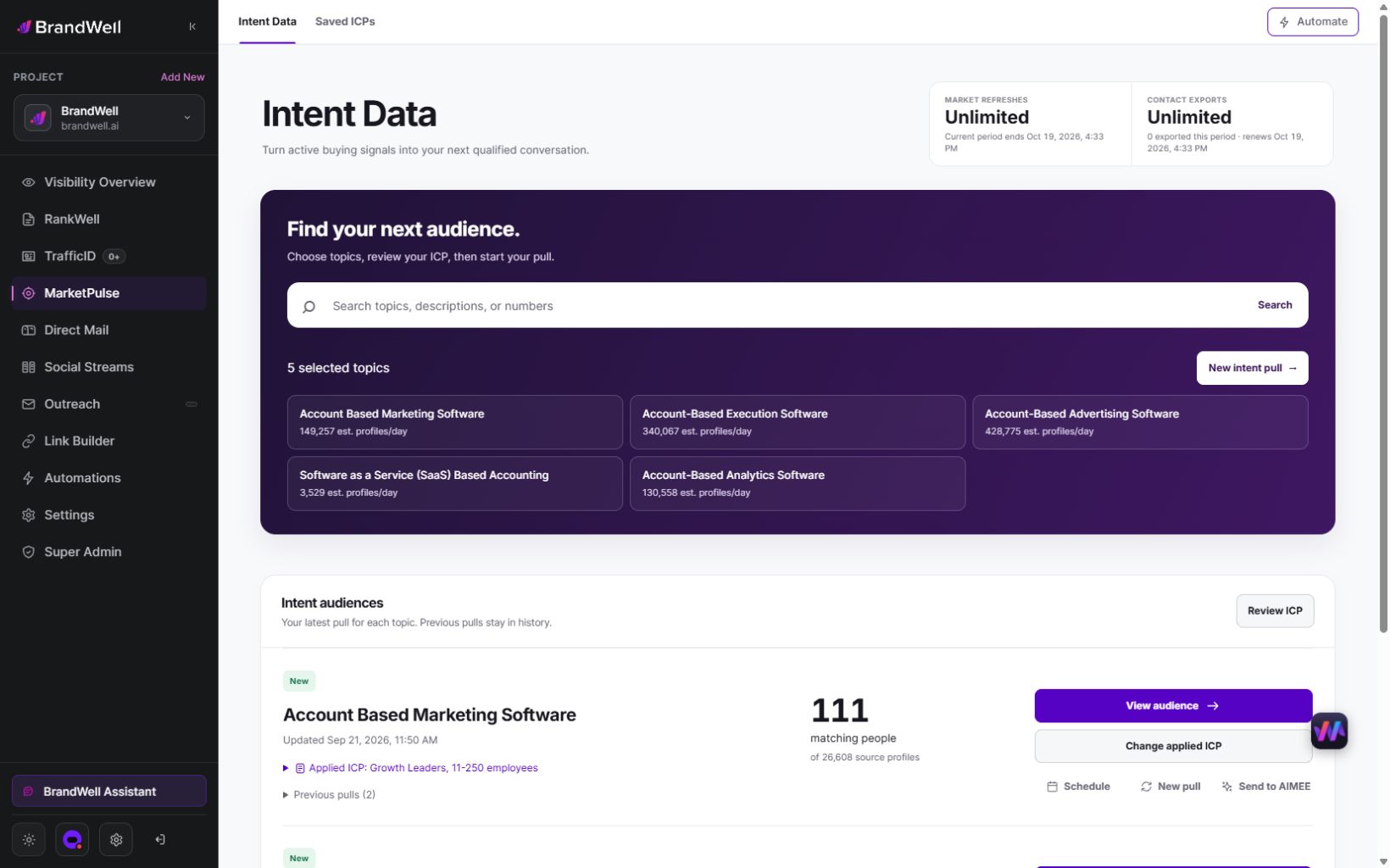
MarketPulse plans are starting at $500/mo. Verify current package scope and offers on the product page.
| Plan | Topics and refreshes | Monthly exports |
|---|---|---|
| Starter | 1 topic, weekly | 25,000 contacts |
| Growth | 3 topics, daily | 100,000 contacts |
| Scale | 10 topics, daily | Unlimited contacts |
Swipe the table to see all columns.
A pull retrieves available data from the previous 24 hours for one topic. Daily use across all included topics provides 90 Growth pulls or 300 Scale pulls in a 30-day month. Weekly Starter pulls vary by calendar month. Available audience size and contact fields vary, and audiences may overlap. Refreshes stop at the plan limit without overage charges.
- Find and qualify: search the topic catalog, save your ICP, and review the people and companies that match.
- Act on the research: export qualified contacts or prepare an Outreach or Direct Mail workflow. Connected products, channel usage, and fulfillment may cost extra.
- Get help from AIMEE: Growth and Scale include AIMEE for the initial user to research accounts and prepare the next step through connected tools.
Agencies and other service businesses can build client deliverables around their available Intent Scans and exports. Keep each client’s scope, permissions, and service fees clear. A subscription is not a promise of a white-label platform or exclusive access to a market.
Explore MarketPulse and watch the demo or compare plans starting at $500/mo. Any early-access discount is a separate, time-limited offer shown to an eligible recipient.
Check the actual scheduling question
This decision framework is for performance marketing directors, paid media managers, demand generation leaders, and agency owners who have enough B2B activity to compare response windows. It applies when response handling, sales availability, or auction economics may vary by time. It is not a generic bidding guide, a pacing playbook, or permission to build narrow audiences from sensitive behavior.
Require three scheduling-test gates
Start with the business mechanism. A schedule can matter because prospects respond at different local hours, a sales team can handle inquiries only during certain windows, or auction conditions change. An intent signal adds a hypothesis about which eligible accounts may deserve observation; it does not by itself identify the best hour. The goal is more qualified pipeline per unit of constrained spend, not a cosmetically lower click cost.
Use a three-gate decision:
- Feasibility gate: do you have correct timezones, event timestamps, stable opportunity definitions, and enough volume in each candidate window?
- Mechanism gate: is there a plausible, operational reason for different response quality rather than a coincidental historical pattern?
- Test gate: can you compare a proposed schedule with the current schedule without simultaneously changing creative, bids, audiences, and offers?
Only proceed when all three are credible. If response differences disappear after aligning local time or excluding one promotion, keep the baseline. Intent-informed ad scheduling is useful when it constrains a testable operational choice; it becomes misleading when a historical heat map is treated as a timeless rule.
Define timestamps, owners and workflow
Join five data layers at the least granular permitted level: eligible intent cohort, campaign exposure and cost, event timestamps, CRM qualification outcomes, and timezone. Preserve the original UTC timestamp, derive local time using a governed location field, and document daylight-time handling. Do not infer a person’s location from an unreliable IP and present it as fact.
The team needs a paid-media owner, marketing operations or analytics owner, sales-operations owner for accepted-opportunity definitions, and privacy/platform-policy reviewers. The workflow is:
- Freeze the current schedule and record delivery, spend, response, and qualified outcomes.
- Normalize timestamps and create a timezone matrix by region.
- Define response-hour cohorts before looking for a winner.
- Apply minimum-volume and freshness rules to eligible intent groups.
- Choose one schedule change and a rollback trigger.
- Run the control and treatment over comparable calendar patterns.
- Join accepted outcomes, review uncertainty, and approve keep, revise, or revert.
Google Ads supports specified hours and days, with an all-day default; its ad scheduling documentation excludes App campaigns. Verify actual campaign and bidding support separately. Scheduled eligibility does not create matching search demand.
Use seven scheduling operating assets
1. Feasibility scorecard
Score timestamp integrity, timezone coverage, accepted-opportunity volume, schedule controllability, and response-team readiness. Require an explicit pass before testing. Limitation: a high score shows that a test is possible, not that dayparting will improve results.
2. Local-time response matrix
Group exposures and outcomes by local hour band, weekday class, region, and intent cohort while retaining denominators. Limitation: many cells create unstable rates and false patterns; collapse sparse bands before interpretation.
3. Lag-to-response model
Measure the delay from exposure or click to meaningful response and from response to sales acceptance. This separates “ads ran at this hour” from “sales could act at this hour.” Limitation: observed sequences do not establish that the ad caused the response.
4. Fixed baseline schedule
Keep an all-day or established business-hours schedule as the comparison. Record its budget, bid rules, exclusions, and delivery. Limitation: a baseline can become non-comparable if auction conditions or campaign composition change materially.
5. Bounded schedule experiment
Test one approved schedule change against the comparable baseline. Record assignment, offer, campaign, cost, calendar mix, response lag, maturity and actual outcome. Keep insufficient evidence visible and preserve the rollback rule.
6. Rollback and exception register
Define spend, delivery, opportunity, and response-service thresholds that trigger review or reversion. Log holidays, launches, outages, and sales-coverage gaps. Limitation: rollback protects operations but cannot recover missed demand from an overly restrictive schedule.
7. Agent-ready analysis packet
AIMEE can prepare a review brief through configured connected tools. Keep proposed actions separate from actual approvals and destination acknowledgements. Confirm the implementation and permissions before execution.
Compare schedules and handoff options
Compare fixed business hours, all-day eligibility and a bounded intent-informed test against actual response coverage, audience size, qualified outcome volume and lag. State the mechanism and compare the same outcome and cost definitions rather than assuming a preferable schedule.
The comparison must use the same qualified outcome and cost denominator. A manual schedule is not “non-data”; it can be a sensible policy based on staffing. Likewise, intent-informed ad scheduling software is not automatically smarter than a spreadsheet. The important capabilities are correct timestamps, reproducible cohort rules, experiment support, outcome joins, exclusions, audit history, and rollback.
Alternatives include bid adjustments without hard exclusion, time-sensitive creative without audience narrowing, faster lead routing, improved sales coverage, or no schedule change. Check whether the operational handoff – not media timing – is the bottleneck.
Count full test and operating costs
Budget for data preparation, signal access, analytics, platform setup, media, CRM cleanup, monitoring, and review time. A dayparting with intent and response data cost model should separate one-time setup from recurring operation. Setup covers timestamp audit, timezone logic, opportunity definitions, baseline construction, and test design. Recurring cost covers signal refresh, schedule QA, exception handling, outcome joining, and client reporting.
Do not justify a schedule by click-cost savings alone. Restricting hours may concentrate spend, change auction mix, reduce reach, or impair learning. Model total economic impact with accepted opportunities, missed opportunity risk, service-level coverage, and analyst effort. There is no universal dayparting benchmark: volume, geography, campaign type, and sales lag determine feasibility.
Measure qualified outcomes and maturity
Predeclare the business metric and supporting diagnostics. A strong primary metric is cost per accepted opportunity by schedule arm, provided “accepted” is consistently applied. Secondary metrics include eligible reach, spend, qualified response rate, meeting acceptance, opportunity creation, time to first response, and sales coverage. Guardrails include lost impression share where available, frequency, audience size, policy errors, and overrides.
Keep experimental evidence separate from attributed or observational outcomes. Report actual counts, denominators, method, assignment, comparator, regional mix, mature outcome window, unresolved cases and limitations. Associated pipeline does not establish that the schedule caused it.
Use decision bands rather than a single magic threshold: keep the baseline when evidence is sparse, extend the test when operational conditions stayed comparable but precision is low, and roll back when delivery or qualified outcomes breach a predeclared guardrail.
Check actual scheduling feasibility
Evaluate reliable clocks, adequate qualified outcomes, actual schedule support, response-service constraints and a plausible mechanism. Industry alone does not establish test feasibility.
Do not use this approach when the addressable audience is tiny, conversions mature over long and irregular cycles, timestamps are overwritten, sales acceptance is inconsistently recorded, or most spend is controlled by campaign types that do not support the intended scheduling action. Check data integrity, controllability, and sufficient evidence.
Trace fit, time and outcome evidence
Use fit to establish economic relevance, intent to define an eligible observation cohort, identity to estimate the account or person association, freshness to limit how long the signal influences the cohort, activation logs to confirm delivery, and outcomes to evaluate the schedule. Each is a separate field. Do not turn them into an unexplained “in-market” label.
A useful record includes signal source, topic class, entity level, observed time, expiry, identity-confidence band, fit status, activation status, local-time derivation, and accepted outcome. BrandWell supports configurable qualification and routing into ads, CRM, dashboards, exports, and AI workflows; its workflow methodology illustrates why routing rules must be designed around the market. The existence of a routed record does not prove identity or intent.
Check clock, mix and action risks
Common dayparting with intent and response data mistakes include mixing UTC and local time, ignoring daylight changes, comparing unequal weekday mixes, using clicks as qualified outcomes, letting one large account dominate a cell, and mining many hour bands until one looks favorable. Signal decay, match errors, audience overlap, delayed conversions, and sales-coverage changes can all create false confidence.
Verify actual source, recipient, purpose, jurisdiction, campaign and destination eligibility before action. Keep approved coarse groups, necessary fields, retention, access and exclusions. A small combined location/identity/behavior audience or a record match does not establish permission for activation.
Scope separate agency scheduling work
Package a recurring evidence cycle: feasibility audit, timezone matrix, one controlled schedule test, weekly delivery review, response-quality join, exception register, decision memo, and rollback. State the service boundary clearly. It does not promise more pipeline, replace the media platform, or infer that named people are online because a signal appeared.
Review an available MarketPulse topic, saved ICP and actual preceding-24-hour matches for the approved research purpose. Keep uncertain company context visible. AIMEE can organize supplied context through configured tools; named owners approve actual exports, messages, audience uploads and CRM writes.
Keep the research subscription distinct from agency scheduling work. Verify actual access, configuration, branding, implementation, rights, approvals, delivery responsibilities and separate fees. A subscription does not establish every client interface or schedule integration.
Copyable local-time schedule test
Question: [Actual response or staffing constraint.] Clocks: [UTC source, account zone, audience zone and daylight handling.] Cohort: [Eligible unit, hour band, calendar mix and exclusions.] Test: [Baseline, one approved change and actual campaign support.] Outcome: [Qualified acceptance, lag, maturity and missingness.] Economics: [Spend, research, setup, review and forgone demand.] Decision: [Owner, threshold, rollback and retest.]
Translate audience hours into the account clock
Google’s schedule setup guidance uses the account timezone, allows up to six schedules per day and requires separate schedules for a window crossing midnight. Verify the actual zone and campaign before applying an audience-hour hypothesis.
Assume a fictional audience is at UTC-4 and the account clock at UTC-7 for the test dates. Audience 9 a.m. to 5 p.m. corresponds to account 6 a.m. to 2 p.m., not 9 a.m. to 5 p.m. Recheck dated offsets when daylight rules change. Preserve original UTC timestamps and the conversion rule. These invented inputs are not BrandWell performance results.
Exposure hour and response hour are different
An ad clicked at 4:55 p.m. followed by a qualified form at 5:20 p.m. has 25 minutes of observed lag. Keep the click in its exposure-hour cohort and the form in its response-hour diagnostic. Do not move the exposure into the later hour or claim that the observed sequence proves the ad caused the response.
Lower click cost can hide weaker outcomes
Assume fictional arm A spends $1,000 for 500 clicks and ten accepted opportunities: $2 per click and $100 media cost per opportunity. Arm B spends $800 for 800 clicks and four accepted opportunities: $1 per click and $200 per opportunity. Lower click cost does not establish improved qualified economics. The arms still need comparable assignment, calendars, offers and outcome maturity before causal interpretation.
Account for schedule-testing work
A fictional first-period test with $1,000 media, the standard $500 Growth subscription, $300 setup and $400 review has $2,200 defined costs. Ten accepted opportunities give $220 each, not the media-only $100. An extra $500 repair increases the ratio to $270. Acquisition, general overhead, tax and financing are excluded; these invented service inputs are not BrandWell scheduling fees or typical results.
Use approved research and scheduling actions
Review an available MarketPulse topic, saved ICP and actual preceding-24-hour matches for the approved purpose. A recent topic appearance is not a live online-presence signal. AIMEE can organize supplied context through configured tools. Owners approve actual schedule changes, exports, messages, Outreach enrollment, uploads and CRM writes. Custom scheduling and routing require separately verified implementation, rights, scope and fees.
Frequently asked dayparting questions
Does a recent topic appearance prove someone is online now?
No. Keep topic context separate from live presence.
Are schedules automatically based on audience local time?
No. Verify the account timezone and dated conversion.
Does lower click cost prove better opportunity economics?
No. Compare qualified outcomes and full costs.
Does MarketPulse include every scheduling integration?
No. Verify actual implementation, rights and scope.
Review the research product: explore MarketPulse and current plans.
Reviewed and updated October 3, 2026.

Written by