The best intent data platform is the one whose signal unit, provenance, coverage, identity model, activation path, controls, and total cost fit a specific buying job. There is no universal winner. An agency that needs branded client delivery has a different decision from an enterprise team that wants a broad ABM suite or a software vendor that values marketplace comparison activity.

Shortlist by use case, apply the same disclosed scorecard to every provider, and test finalists against the same accounts, topics, time window, destination, quality threshold, and cost model. Dashboard volume is not proof of accuracy or pipeline.

Intent and identity signals are probabilistic evidence. They do not prove a person’s identity, consent, need, authority, buying stage, or future outcome.

Who is this for?

This guide is for:

  • agencies and resellers selecting white-label intent infrastructure;
  • demand-generation and growth teams selecting signal sources;
  • RevOps and data teams responsible for integration and evidence; and
  • procurement, privacy, security, compliance, legal, and platform reviewers.

It is not a substitute for a scope-matched product test, security review, data-use assessment, or written quote. It is a decision framework for making those reviews comparable.

Disclosure

Disclosure: BrandWell owns and publishes this article. BrandWell appears first because it is our product; every option is evaluated using the same disclosed criteria, and another provider may be a better fit for some buyers.

How to evaluate intent data platforms

Use these nine criteria for every provider:

  1. Signal unit and provenance: What activity is observed, modeled, inferred, or supplied by a partner? Is the output an account, domain, contact, topic, visit, comparison event, or score?
  2. Coverage, granularity, and freshness: Which topics, markets, geographies, languages, accounts, contacts, and time windows are included? What happens when there is no match?
  3. Identity and fit: How are accounts and people resolved? Are confidence, parent-child logic, exclusions, missing fields, false links, and missed links visible?
  4. Activation and integrations: Can accepted evidence reach the CRM, data warehouse, sales workflow, advertising audience, or report the buyer actually uses?
  5. Governance and privacy: Are source, permitted use, access, client separation, retention, suppression, correction, deletion, security, and incident responsibilities documented?
  6. Agency and reseller economics: Can an agency brand delivery, partition clients, set retail pricing, bill its customers, export evidence, and understand wholesale cost?
  7. Pricing visibility and total cost: Does the quote include data, modules, users, credits, services, media, implementation, support, term, renewal, overages, and exit?
  8. Evidence and testability: Will the provider accept a frozen, scope-matched test and return raw enough evidence to evaluate quality and destination usability?
  9. Best fit and meaningful limitation: Which buyer and use case benefit most, and when is another option better?

Missing public evidence should be labeled unknown, not treated as proof that a feature is absent. Provider capabilities below are based on current official provider materials retained for internal research. They are provider claims, not independent performance results. Recheck them before purchase.

One pricing caveat applies across the shortlist. Directional market research suggests that some enterprise alternatives may cost roughly $5,000 to $10,000 per month and often require annual contracts. This is not vendor list pricing; obtain a scope-matched written quote. This is not a vendor quote, is not verified public list pricing, and is not a universal range. Verify each current, scope-matched written quote and do not use the directional range when official pricing contradicts it.

Eight intent data platforms to shortlist

The order is not a universal quality ranking. BrandWell appears first for the disclosed ownership reason. The remaining options are organized to show distinct operating models.

1. BrandWell – best fit for agencies productizing a white-label intent-data service

BrandWell official homepage hero screenshot
Current official BrandWell homepage hero screenshot.

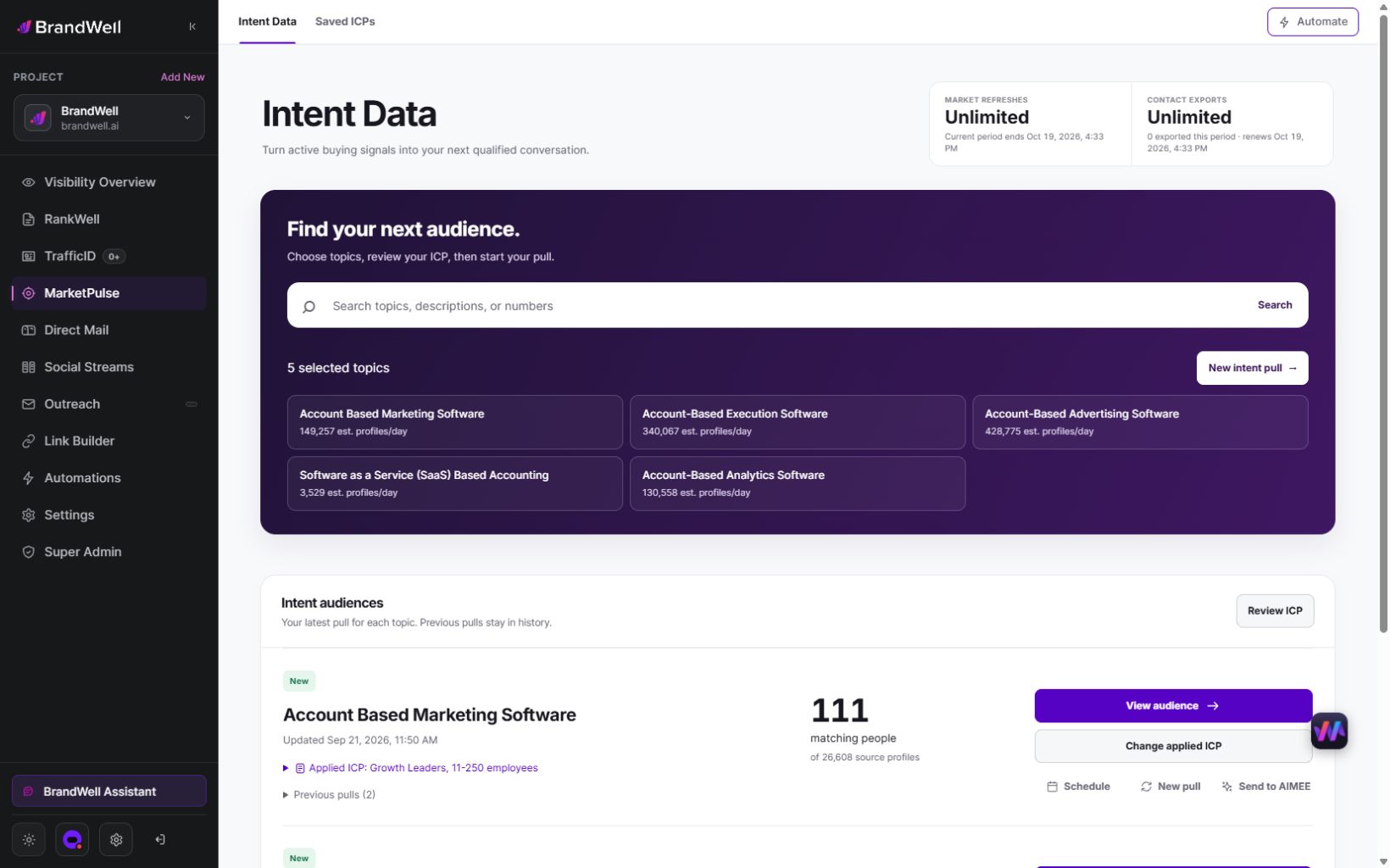
Signal unit and provenance. BrandWell’s official product material describes a flow from topic and market signals or eligible website activity through matching, enrichment, and activation. The buyer should still define each contracted source, signal unit, time window, and permitted use rather than treating all intent as one category.

Coverage, granularity, and freshness. The product can support account and, where coverage and evidence allow, person or contact enrichment. A written scope should define topics, markets, geographies, refresh, retention, history, confidence, and no-match behavior. Do not repeat a coverage number without a fresh, claim-specific check.

Identity and fit. BrandWell can connect signals to matching and enrichment, but the result remains probabilistic. Test account hierarchy, person-level evidence, current employment, field correctness, confidence, ICP exclusions, false links, and missed links. A visitor reveal is not proof that a named person performed an action.

Activation and integrations. BrandWell describes routing toward CRM, outbound, advertising, AI-assisted work, and export. Confirm the exact destination, connector, permissions, fields, error path, and human approval in the proposed package.

Governance and privacy. Require source and purpose records, client separation, access roles, suppression, correction, deletion, retention, security, audit evidence, and named responsibility. BrandWell does not create consent or replace legal and platform-policy review.

Agency and reseller economics. BrandWell is positioned as a complete white-label sales-and-delivery engine with branded portals, reports, modules, and automations. The agency controls retail pricing and client billing. This is the separate agency-reseller intent-data product, not the legacy BrandWell SEO writer.

Pricing visibility and total cost. A comparable public dollar list price for this agency-reseller scope was not found in the official page reviewed. BrandWell agency plans range from $2,500 to $5,000 per month, depending on topic count, term, and available contractually scoped topic exclusivity. The current written quote and Order Form control. It is not a universal public list price. A current scope-matched written quote controls.

Evidence and testability. BrandWell may offer a $70 seven-day reseller pilot. Confirm the current written pilot terms and operational readiness before making client-facing promises. Freeze the truth set, destination, costs, and acceptance criteria. The pilot is not an outcome guarantee.

Best fit and meaningful limitation. BrandWell fits agencies and GTM consultants that want branded recurring delivery, agency-controlled commercial packaging, and an explicit wholesale-versus-retail model. Topic exclusivity is conditional on availability, scope, purchase, and current written terms; it is not a universal uniqueness claim. BrandWell may be a weaker fit for a buyer seeking a broad native enterprise ABM suite or one consolidated enterprise vendor. Current entitlements and data coverage require written confirmation.

2. 6sense – best fit for enterprise teams seeking intent within broader revenue orchestration

6sense official homepage hero screenshot
Current official 6sense homepage hero screenshot.

Signal unit and provenance. Official product material describes intent based on custom search keywords, web activity, and other platform data. A buyer should separate first-party, third-party, modeled, and partner signals during evaluation.

Coverage, granularity, and freshness. The provider describes multilingual research and account/web signals. Ask for the exact geography, language, keyword, account, history, refresh, and no-match definitions in the contract.

Identity and fit. Evaluate account identification, hierarchy, confidence, fit fields, and contact-level claims on a labeled sample. Do not infer person-level accuracy from account-level coverage.

Activation and integrations. The platform is positioned as part of a broader revenue and ABM operating suite. Confirm which CRM, sales, marketing, advertising, and analytics connectors are included and what implementation services are required.

Governance and privacy. Request source rights, permitted uses, access roles, retention, suppression, correction, security documentation, and client separation if an agency will operate multiple accounts.

Agency and reseller economics. Enterprise orchestration can consolidate an internal stack, but the reviewed materials do not establish a complete white-label agency sales-and-delivery engine, agency-controlled retail billing, or topic exclusivity. Ask specifically about branding, client partitions, resale rights, and exports.

Pricing visibility and total cost. Clear public pricing for this specific full intent-platform scope was not found in the current official sources reviewed. Request a written quote that combines platform package, users, modules, data, integrations, services, term, renewal, overages, and exit.

Evidence and testability. Use the same frozen accounts, keywords, regions, time window, destination, and acceptance thresholds applied to other finalists. Do not accept a provider-selected success set as the full evaluation.

Best fit and meaningful limitation. 6sense fits mature enterprise teams that want intent inside broad revenue orchestration. Its limitation for a lean agency can be implementation breadth and unclear comparable public dollar pricing. White-label resale economics need separate confirmation.

3. Demandbase – best fit for enterprise account intelligence and ABM activation

Demandbase official homepage hero screenshot
Current official Demandbase homepage hero screenshot.

Signal unit and provenance. Official material describes account-level intent, custom keyword sets, contextual analysis, and integrations with other intent sources. Retain each source separately so the team knows what drove the account result.

Coverage, granularity, and freshness. Validate the contracted topics, accounts, regions, languages, historical depth, refresh, and partner-source coverage. “Intent coverage” is not one standard unit across vendors.

Identity and fit. Test parent and subsidiary matching, domain resolution, confidence, ICP fields, exclusions, false links, and missed links on the buyer’s own account structure.

Activation and integrations. Demandbase is positioned for account intelligence and ABM activation. Confirm CRM, advertising, sales, and partner integrations, along with implementation scope and required services.

Governance and privacy. Request provenance, rights, access, retention, correction, suppression, security, and agency client-separation controls. Ask how partner data responsibilities are divided.

Agency and reseller economics. The platform may fit an agency running sophisticated enterprise programs, but the reviewed materials do not establish a full white-label reseller portal, branded client delivery, or agency-controlled client billing.

Pricing visibility and total cost. The official pricing material describes customized pricing with platform and user components, but no clear comparable dollar amount for this scope was visible. Include modules, users, partner data, services, activation, term, renewal, and exit in the written quote.

Evidence and testability. Test custom keywords and the buyer’s actual account hierarchy. Require raw inputs, outputs, destination acceptance, and error adjudication.

Best fit and meaningful limitation. Demandbase fits enterprise account-based programs that need a broad account-intelligence and activation layer. Its limitation for a smaller reseller is the potential operating and implementation load, plus the need to confirm white-label rights and total cost.

4. Bombora – best fit for account-level topic intent from a B2B data cooperative

Bombora official homepage hero screenshot
Current official Bombora homepage hero screenshot.

Signal unit and provenance. Official material describes Company Surge account-level topic intent based on activity across a B2B data cooperative. Preserve the account, topic, observed period, baseline, score definition, and source category.

Coverage, granularity, and freshness. Ask which topics, regions, accounts, history, refresh, and threshold behavior are included. Test the actual niche rather than assuming broad B2B coverage equals buyer-specific coverage.

Identity and fit. Treat the core signal as account-level unless another contracted identity or enrichment layer supplies more. Evaluate domain and hierarchy resolution, fit, exclusions, and no-match handling.

Activation and integrations. The provider highlights ecosystem integrations. Confirm which destination or partner supplies enrichment, orchestration, advertising, sales workflow, and reporting – and add those costs to the comparison.

Governance and privacy. Request data-cooperative provenance and rights, account-identification method, permitted activation, retention, suppression, correction, and partner responsibility.

Agency and reseller economics. An account-topic feed can power an agency service, but the reviewed sources do not establish an end-to-end white-label engine with branded client portals and agency-controlled retail billing.

Pricing visibility and total cost. The official pricing path reviewed resolved to a product/data page rather than a comparable dollar-pricing page. Clear public pricing for this specific product scope was not found there. Quote topic and account coverage, integrations, enrichment, services, term, exports, and exit together.

Evidence and testability. Test known relevant and irrelevant accounts across selected topics and time windows. Measure accepted account precision, coverage, freshness, and downstream usefulness.

Best fit and meaningful limitation. Bombora fits teams that want an account-level topic signal to feed an existing GTM stack. Its limitation is that account activity does not prove a specific person or purchase. Buyers may need separate identity, orchestration, activation, and client-delivery tools.

5. G2 Buyer Intent – best fit for software vendors tracking marketplace evaluation activity

G2 Buyer Intent official product-page hero screenshot
Current official G2 Buyer Intent product-page hero screenshot.

Signal unit and provenance. Official material describes activity in the G2 software marketplace, including category, product profile, comparison, and competitor research. Retain the exact event type and time instead of reducing everything to “intent.”

Coverage, granularity, and freshness. Coverage depends on relevant categories, listed products, competitors, marketplace traffic, account identification, and refresh. Test whether the buyer’s niche produces enough accepted events.

Identity and fit. Evaluate account matching and ICP fit separately. Do not infer that a specific person performed the research unless another source provides support.

Activation and integrations. Confirm CRM, marketing, sales, advertising, and partner integrations and which package or add-on enables each workflow.

Governance and privacy. Request event provenance, account matching method, permitted use, retention, suppression, correction, and destination controls.

Agency and reseller economics. The reviewed sources describe seller data and add-on packaging rather than a complete white-label agency engine with client partitioning, branded portals, or agency-controlled retail billing.

Pricing visibility and total cost. Official plan material identifies Buyer Intent as an add-on for eligible packages, but a clear public dollar price for the add-on was not visible. Do not represent unrelated entry-package pricing as Buyer Intent pricing. Confirm prerequisites, add-on scope, users, integrations, term, and exports in writing.

Evidence and testability. Test whether the client’s categories, products, and competitors produce enough accepted activity and whether that activity reaches qualified opportunities.

Best fit and meaningful limitation. G2 Buyer Intent fits software vendors for whom category, comparison, and competitor research sits close to vendor evaluation. Its limitation is source specificity: marketplace research should not be generalized to every type of off-site intent or agency white-label use.

6. Informa TechTarget – best fit for enterprise technology research and permissioned prospects

Informa TechTarget official homepage hero screenshot
Current official Informa TechTarget homepage hero screenshot.

Signal unit and provenance. Official Priority Engine material describes directly observed research across technology content and prospect-level context within a permissioned audience. Ask for exact event, audience, and permission definitions.

Coverage, granularity, and freshness. Validate technology category, geography, audience, account and contact resolution, event history, and refresh against the buyer’s market.

Identity and fit. Test returned prospects and accounts for current employment, field correctness, confidence, ICP fit, exclusions, false links, and missed links.

Activation and integrations. Confirm CRM, sales, marketing, campaign services, seats, exports, and implementation support in the proposed scope.

Governance and privacy. Request audience permission and source details, use restrictions, retention, correction, suppression, security, and multi-client controls.

Agency and reseller economics. The reviewed sources do not establish a complete agency white-label portal, agency-controlled client billing, or conditional topic-exclusivity model.

Pricing visibility and total cost. The official pricing path reviewed returned a missing-page response. Clear public pricing for this specific product was not found through that path. A missing page does not prove no pricing exists elsewhere; request a scope-matched written quote.

Evidence and testability. Test coverage and correctness in the buyer’s exact technology categories and regions. Verify destination acceptance and outcome evidence rather than relying on a broad audience description.

Best fit and meaningful limitation. Informa TechTarget fits enterprise technology marketers who value publisher-observed research and permissioned prospect context. Its limitation is category dependence: relevance and scale depend on covered technology audiences, and pricing and reseller rights need direct confirmation.

7. Intentsify – best fit for teams seeking managed intent intelligence and activation support

Intentsify official homepage hero screenshot
Current official Intentsify homepage hero screenshot.

Signal unit and provenance. Official material positions a managed multi-source intent approach with persona or buying-group context. Require source-level provenance, weighting, and definitions rather than accepting one blended score.

Coverage, granularity, and freshness. Confirm topics, personas, buying groups, regions, accounts, contacts, source history, refresh, and no-match handling.

Identity and fit. Test persona, contact, and account resolution, current employment, confidence, ICP fit, exclusions, and ambiguous cases on a labeled sample.

Activation and integrations. The provider positions cross-channel audiences and activation support. Confirm exact deliverables, data versus managed services, media, integrations, exports, and client responsibilities.

Governance and privacy. Request multi-source provenance, permitted uses, consent or lawful-basis responsibilities where applicable, audience eligibility, retention, correction, suppression, and security.

Agency and reseller economics. Managed delivery can reduce internal workload, but an agency should verify branding, client separation, data portability, retail billing, and reseller rights before building a package around it.

Pricing visibility and total cost. The official pricing path reviewed returned a missing-page response, so clear public pricing for this specific product was not found there. Request a written quote that separates data, managed services, media, integrations, term, renewal, and exit.

Evidence and testability. Freeze source mix, personas, accounts, time window, services, destinations, and costs. Measure data quality separately from managed-campaign performance.

Best fit and meaningful limitation. Intentsify fits teams that want managed intent intelligence and activation support. Its limitation is operating-model fit: buyers wanting self-serve control or a complete agency white-label environment must verify rights, portability, scope, and total cost.

8. ZoomInfo – best fit for teams wanting intent inside a broad GTM data and workflow suite

ZoomInfo Marketing official product-page hero screenshot
Current official ZoomInfo Marketing product-page hero screenshot.

Signal unit and provenance. Official marketing-product material describes buyer intent and website account identification inside a broader GTM data platform. Require exact source, unit, modeling, and event definitions.

Coverage, granularity, and freshness. Validate topics, accounts, website coverage, contacts, regions, updates, history, and no-match behavior for the modules in the quote.

Identity and fit. Test account and person matching, current employment, field correctness, confidence, parent-child handling, fit, exclusions, false links, and missed links. Database breadth claims are not a substitute for the buyer’s test.

Activation and integrations. Official material describes advertising, enrichment, workflow, and GTM integrations. Confirm the exact modules, users, credits, permissions, destinations, and implementation.

Governance and privacy. Request source and provenance, permitted uses, privacy and security documentation, correction, suppression, deletion, retention, client separation, and export rights.

Agency and reseller economics. A broad suite may consolidate internal workflows, but the reviewed material does not establish a complete white-label reseller portal, conditional topic exclusivity, or agency-controlled client billing.

Pricing visibility and total cost. The official pricing path reviewed did not allow the retained capture to access comparable pricing. Clear public pricing for this specific scope was not found in that official capture. Request a written quote for modules, users, credits, data, services, term, overages, renewal, and exit.

Evidence and testability. Test the exact modules and records proposed with blinded truth, destination acceptance, policy eligibility, and total cost per correct usable outcome.

Best fit and meaningful limitation. ZoomInfo fits teams that want intent, data, enrichment, advertising, and workflow breadth in one GTM suite. Its limitation is that breadth can increase implementation and total cost. Comparable public pricing and agency white-label rights were not established by the reviewed sources.

What should buyers expect to pay?

Most providers in this shortlist do not present a simple, comparable public dollar price for the complete intent-platform scope. That makes the written quote – not a roundup estimate – the purchasing evidence.

Ask every provider to quote the same items:

  • signal sources and topic definitions;
  • account, contact, and website coverage;
  • history and refresh;
  • identity and enrichment fields;
  • users, seats, credits, and minimums;
  • integrations and implementation;
  • managed services and media;
  • reports, exports, and data rights;
  • support and security review;
  • contract term, renewal, overages, and price changes; and
  • termination, deletion, portability, and exit.

That directional market context is not universal for every provider, package, geography, workload, or contract. Do not apply it where current official pricing contradicts it, and never present it as a fact about an individual vendor.

BrandWell agency plans range from $2,500 to $5,000 per month, depending on topic count, term, and available contractually scoped topic exclusivity. The current written quote and Order Form control. Do not call it universally cheaper. Compare total cost at the same data, service, integration, term, and activation requirements.

Match the operating model to the buying job

Choose an enterprise ABM suite when a mature internal team values broad orchestration, many integrations, and consolidated governance enough to support implementation complexity.

Choose a point tool or data feed when the buyer knows the signal it needs and already has enrichment, routing, activation, evidence, and governance. The limitation is stack assembly and responsibility gaps.

Choose a managed intent service when internal capacity is constrained and the provider’s service model, source transparency, data rights, and measurement fit. The limitation is control and portability.

Choose agency-reseller infrastructure when an agency needs branded multi-client delivery, agency-controlled retail pricing and billing, repeatable modules, and explicit wholesale economics. The limitation is that it may not replace a client’s entire ABM, CRM, advertising, or analytics stack.

Build in-house only when the team has durable data rights, engineering, entity resolution, monitoring, security, privacy, policy, maintenance, and client-service capacity. Owning code is not the same as owning reliable data or lawful use.

Run a scope-matched platform test

Freeze these items before giving data to finalists:

  1. eligible accounts, topics, geographies, entity unit, and time window;
  2. known relevant and irrelevant cases;
  3. required fields and no-match state;
  4. destination and sandbox schema;
  5. identity, freshness, and fit thresholds;
  6. source and permitted-use requirements;
  7. reviewer and adjudication process;
  8. license, service, integration, and labor costs; and
  9. pass, repair, and reject rules.

Report eligible coverage, sampled precision, false links, missed links, freshness, destination acceptance, and cost per correct usable outcome. The government linkage quality guide provides useful concepts such as gold-standard data, negative controls, false links, missed links, and clerical review. It does not certify an intent platform.

Implementation workflow, data, integrations, and team

Assign:

  • a data owner for source, rights, fields, and retention;
  • a GTM operator for topics, fit, signal tiers, and plays;
  • a RevOps owner for destinations, deduplication, and rollback;
  • channel owners for messages, audiences, capacity, and eligibility;
  • privacy and security reviewers for controls and risk;
  • a client sponsor for commercial outcomes; and
  • a named human approver for consequential action.

Design ingestion, raw evidence storage, fit scoring, identity confidence, freshness, suppression, reject/hold/review/approve states, routing, correction, deletion, outcome capture, and rollback before activation.

For audience activation, platform rules remain independent of the intent provider. Google’s Customer Match policy requires eligible first-party-context data, disclosures, consent where required, approved interfaces, and policy compliance. Third-party intent does not automatically meet those conditions.

Measure pipeline without overclaiming causality

Use a chain of metrics:

  • eligible account coverage;
  • signals with complete provenance and freshness;
  • accepted, held, and rejected records;
  • sampled precision and error reasons;
  • destination acceptance;
  • speed from accepted signal to owned action;
  • sales or channel adoption;
  • responses and qualified opportunities;
  • cost per accepted signal and accepted opportunity; and
  • agency margin when relevant.

Carry one evidence ID from source to outcome. Use a holdout, phased rollout, or matched cohort where practical. “Influenced pipeline” can describe association. It should not be presented as proof of incremental lift.

Common platform selection and data-use mistakes

Avoid:

  • choosing the most familiar logo without defining the signal unit;
  • counting matches without testing correctness;
  • accepting a demo-picked test set;
  • blending fit, intent, identity, and freshness into one unexplained score;
  • ignoring subsidiaries, shared domains, and stale employment;
  • routing data without an owner or rollback;
  • mixing agency client data;
  • hiding media, services, QA, and exception labor from total cost;
  • missing correction, suppression, opt-out, or deletion; and
  • activating tiny or sensitive audiences without policy review.

The FTC’s business security guidance supports limiting collection, restricting access, supervising service providers, and retaining information only as needed. The ICO’s lead-generation guidance covers transparency, fairness, profiling, matching, choice, and objections. Requirements depend on jurisdiction, source, role, and channel. This article is not legal advice.

Turn a platform into a recurring agency service

Package the service around decisions:

  1. approved market and topic coverage;
  2. ICP and exclusion governance;
  3. account and contact identity QA;
  4. branded signal reporting;
  5. CRM or audience staging;
  6. human-approved activation instructions;
  7. evidence reconciliation; and
  8. renewal, repair, or stop review.

Keep wholesale platform cost separate from the agency’s retail strategy, operations, client service, and activation fee. Make client data partitioning, branding, exports, correction, deletion, and exit part of procurement rather than afterthoughts.

BrandWell can fit this model because of its reseller positioning, but it should appear only where the buyer’s needs match. It does not replace strategy, an ad platform, CRM, analytics, legal analysis, or human judgment.

Agent-ready platform evaluation workflow

Use this workflow with Claude or ChatGPT, or adapt approved browser steps for optional Moxby execution:

  1. Provide the frozen use case, account and topic file, truth labels, fields, destinations, costs, permitted uses, and evaluation criteria.
  2. Ask the agent to preserve source data and flag missing, stale, contradictory, or ambiguous fields.
  3. Require the same nine-criterion scorecard for each provider and label provider-stated claims.
  4. Calculate draft coverage and quality measures without excluding no-match or unresolved cases.
  5. Separate fit, intent, identity, freshness, permitted use, and activation.
  6. Prepare a sandbox payload or branded report without executing it.
  7. Ask named humans to review editorial accuracy, product scope, pricing, privacy, security, compliance, legal implications, and platform policy.
  8. Execute only an approved action and retain approver, evidence ID, destination result, and rollback.
  9. Produce an approve, repair, or reject memo with the complete cost.

Moxby is a separate browser-first product and is optional. It is not an IDE or desktop requirement. No agent should independently send outreach, activate ads, merge CRM records, change suppression, or delete data.

Intent platform buying checklist

Do not sign until written answers cover:

  • What exactly creates a signal?
  • Which sources are first-party, third-party, modeled, or partner supplied?
  • What is the entity unit?
  • Which topics, markets, accounts, contacts, and time windows are included?
  • How are confidence, false links, missed links, and no-match states handled?
  • Which integrations, fields, users, credits, services, and media are included?
  • What can the buyer lawfully and contractually do with the data?
  • How do correction, suppression, deletion, retention, and exit work?
  • Can the provider pass the frozen test in the buyer’s destination?
  • What is the complete cost, term, renewal, overage, support, and export scope?

The winning choice is not the provider with the longest feature list. It is the provider whose evidence is useful enough for the defined action, whose operating model the team can sustain, whose risks can be controlled, and whose cost remains clear when the entire workflow is included.

Pilot the intent-data service for $70

The agency pilot costs $70 and runs for seven days. BrandWell generates topic reports with the agency’s branding and provides the entire sales playbook for selling the service and seeking client commitments before the agency moves to a full plan.

The pilot is meant to test demand and help the agency verify whether expected commitments support its costs and profit-center plan. It does not guarantee commitments, cost coverage, or profit. Review the $70 seven-day reseller pilot.