
On this page
- BrandWell: MarketPulse intent data and connected growth automation
- Treat every topic as a decision hypothesis
- Build a layered client taxonomy
- Use a five-state maintenance lifecycle
- Copyable topic scorecard and change log
- Compare broad libraries, manual curation, automation, and white-label management
- Measure topic quality without pretending to know purchase intent
- Model setup, maintenance, and package economics
- BrandWell topic offer and product boundary
- Govern privacy, security, and expectation risk
- Agent-ready topic-governance instructions
- Ten topic-governance questions an agency should answer
- Put buyer intent to work with MarketPulse
Direct answer: Choose buyer-intent topics as a governed set of hypotheses about a client’s market, not as the largest possible keyword library. Start from the buyer problem, category, use case, alternatives, risks, and language used by qualified accounts. Map each topic to an ICP segment and an allowed action. Then maintain the set through a lifecycle of candidate, testing, active, watch, and retired, using versioned definitions and client review.
Who this is for: Agency strategists and client leads who select, explain, monitor, and refine intent topics as part of a recurring service.
A topic is a lens on observed research activity. It is not a person, an account fit score, a prediction of purchase, or permission for outreach by itself.
Current MarketPulse offer: intent-data plans start at $250/month. See the product, demo, and current plans. Updated October 1, 2026.
BrandWell: MarketPulse intent data and connected growth automation
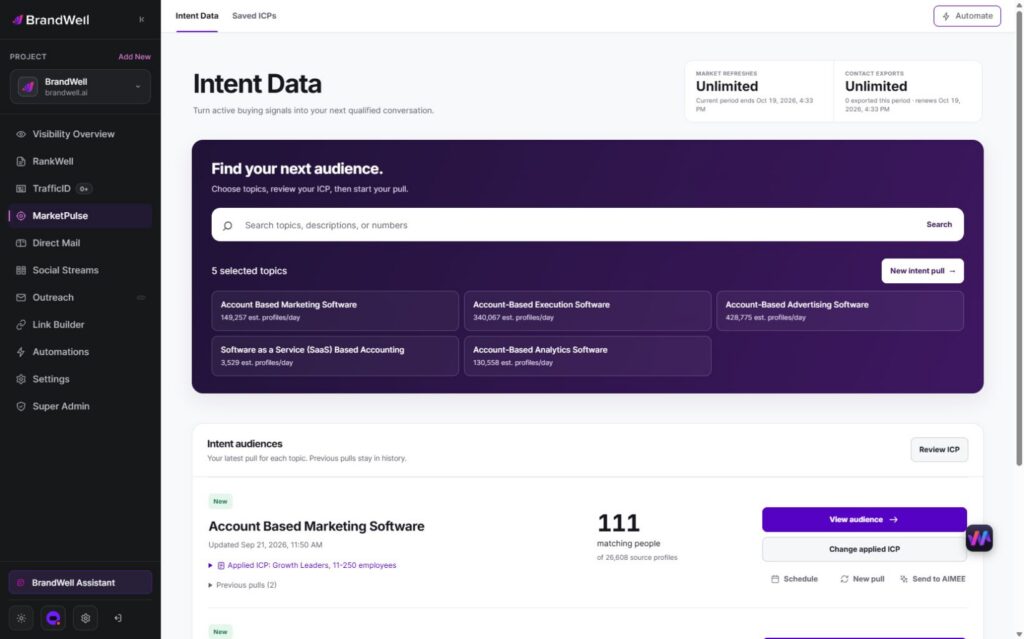
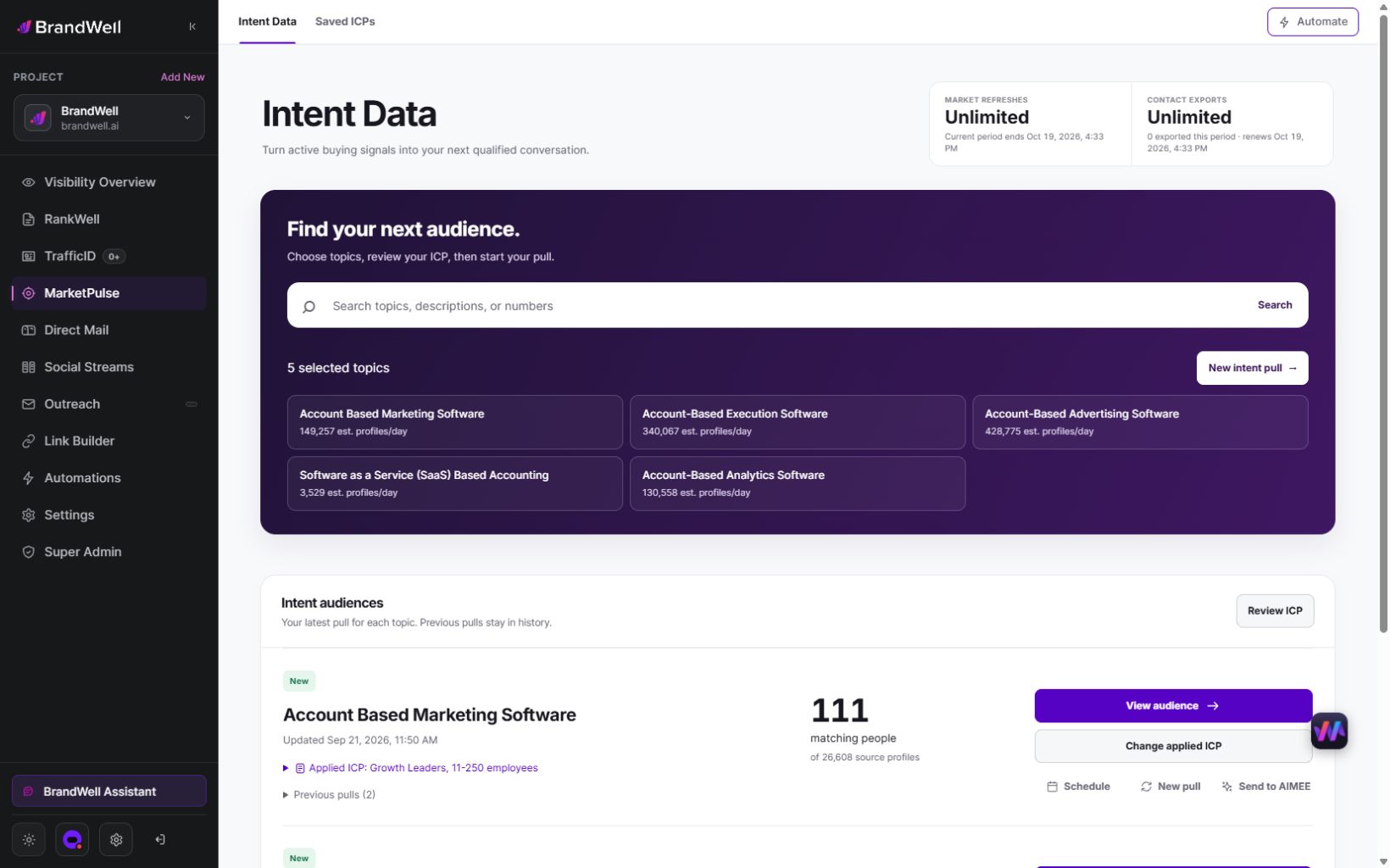
BrandWell MarketPulse: intent data from $250/month. Find people researching topics relevant to what you sell, apply saved ICP filters, and review available contact details before taking action.
| Plan | Price | Topics and refreshes | Monthly exports |
|---|---|---|---|
| Starter | $250/month | 1 topic, weekly | 25,000 contacts |
| Growth | $500/month | 3 topics, daily | 100,000 contacts |
| Scale | $1,000/month | 10 topics, daily | Unlimited contacts |
Swipe the table to see all columns.
A pull retrieves available data from the previous 24 hours for one topic. Daily use across all included topics provides 90 Growth pulls or 300 Scale pulls in a 30-day month. Weekly Starter pulls vary by calendar month. Available audience size and contact fields vary, and audiences may overlap. Refreshes stop at the plan limit without overage charges.
- Find and qualify: search the topic catalog, save your ICP, and review the people and companies that match.
- Act on the research: export qualified contacts or prepare an Outreach or Direct Mail workflow. Connected products, channel usage, and fulfillment may cost extra.
- Get help from AIMEE: Growth and Scale include AIMEE for the initial user to research accounts and prepare the next step through connected tools.
Agencies and other service businesses can build client deliverables around their available topic pulls and exports. Keep each client’s scope, permissions, and service fees clear. A subscription is not a promise of a white-label platform or exclusive access to a market.
Explore MarketPulse and watch the demo or compare plans starting at $250/month. Any early-access discount is a separate, time-limited offer shown to an eligible recipient.
Treat every topic as a decision hypothesis
A useful topic answers a practical sentence: If a qualified account shows this defined research pattern, the client will make this different decision. The decision might be account research, seller prioritization, content selection, campaign segmentation, customer-risk review, or a request for human validation. If no owner can name the permitted action, the topic is probably decorative.
Begin with the client’s positioning and ICP, not the provider’s topic catalog. Ask what problem the buyer is trying to solve, what category they would research, which use cases make the problem urgent, what alternatives enter the evaluation, and what risk or compliance language appears. Translate those concepts into topic candidates, then verify that the source’s definition matches the intended meaning. Similar labels can represent different underlying taxonomies.
A broad topic set can feel safer because it appears to provide coverage. It usually creates a larger review burden and makes relevance harder to explain. A governed high-relevance taxonomy is easier to test because each topic has a purpose, owner, action, and retirement rule. The goal is not to minimize topics mechanically. It is to maintain the smallest set that supports the client’s approved decisions and learning agenda.
Build a layered client taxonomy
Organize topic candidates into layers so the client can see what kind of interest each signal might represent:
- Problem layer: The business pain, operational constraint, or risk that begins the research journey.
- Category layer: The solution class a buyer may use to frame options.
- Use-case layer: The specific workflow, department, or outcome being evaluated.
- Capability layer: Features, integrations, standards, or requirements that narrow fit.
- Alternative layer: Competing approaches, build-versus-buy questions, or named alternatives when contractually and legally appropriate.
- Risk layer: Security, privacy, compliance, implementation, or adoption concerns that may appear during evaluation.
- Customer layer: Expansion, replacement, churn-risk, or adjacent-use topics for existing accounts, only when the approved purpose supports them.
Do not assume every client needs every layer. A narrow professional service may gain more from problem and use-case topics than from a large capability vocabulary. A mature software client may need product, integration, competitor, and risk branches. Map each topic to one primary layer and document overlaps so reporting does not count near-synonyms as independent evidence.
Use a five-state maintenance lifecycle
- Candidate: The topic has a clear buyer rationale but has not been approved or tested. Record source definition, synonyms, exclusions, ICP segment, intended action, and risk.
- Testing: The topic runs in a limited, labeled cohort. Review observed accounts, false-fit examples, overlap, identity state, actionability, and client feedback. Do not blend it into the baseline.
- Active: The topic meets the client’s relevance and operational criteria. It has a named owner, approved use, reporting treatment, and review point.
- Watch: The topic remains visible but is not used for independent activation because volume, relevance, drift, duplication, or downstream adoption is uncertain.
- Retired: The topic is no longer used for current decisions. Preserve its definition, dates, evidence, and retirement reason so historical reports remain interpretable.
State transitions require evidence and approval. Do not silently rename an active topic, replace its definition, or combine it with another. A topic change can alter the eligible account cohort, which means past and current periods may no longer be directly comparable.
Coordinate lifecycle changes with the weekly and monthly intent-data reporting cadence. Weekly reporting can flag drift and exceptions. Monthly review can approve state changes and reset a baseline.
Copyable topic scorecard and change log
Score each candidate with evidence and plain-language notes. Do not collapse the result into a magical certainty score. The fields below form a decision worksheet.
CLIENT INTENT-TOPIC SCORECARD
Topic label:
Provider definition:
Taxonomy layer:
Buyer problem or decision represented:
ICP segment:
Included concepts and synonyms:
Excluded meanings:
Approved signal source:
Identity level available:
Permitted activation:
Required human review:
ASSESSMENT
- Strategic relevance: low / medium / high, with evidence
- Specificity: low / medium / high, with examples
- Overlap with active topics:
- Observed account fit:
- Action adoption:
- Outcome association:
- Privacy, security, or expectation risk:
- Delivery cost and review burden:
DECISION
- Candidate / Testing / Active / Watch / Retired
- Owner:
- Test cohort:
- Start and review trigger:
- Hold, expand, refine, or stop rule:
- Approver and version:
TOPIC CHANGE LOG
Topic and prior version:
Requested change:
Reason and evidence:
Affected reports, workflows, and clients:
Historical comparability impact:
Security or data-use review needed:
Approved by:
Migration and rollback steps:
New review trigger:
Use real examples in the notes. One carefully documented false-fit account can reveal a taxonomy problem that an aggregate score hides. Also preserve negative findings. A topic that was tested and retired is useful knowledge, not failed work to erase.
Compare broad libraries, manual curation, automation, and white-label management
Broad topic libraries support exploration when a client has a mature analyst and clear filters. Their limitation is semantic overlap and review burden. Breadth is not evidence of relevance.
Manual curation is strong for discovery interviews, nuanced definitions, and low-volume testing. Its limitation is consistency across clients and the cost of frequent review. Use templates and a second reviewer.
Automated recommendations can surface adjacent concepts and detect changes at scale. Their limitation is that the system may optimize for lexical similarity or observed activity rather than the client’s commercial meaning. Treat recommendations as candidates, never automatic activations.
White-label topic management can give agencies a repeatable branded service, client portal, and common governance workflow. Its limitation is that available topic definitions, changes, exports, and exclusivity are controlled by current written terms and provider capabilities. The agency still owns positioning, approval, and client explanation.
A hybrid is usually practical: people define the client problem and approve states, tools gather and organize evidence, and the delivery surface keeps versions and decisions visible. Choose the approach using actual review time, false-fit burden, client adoption, and contract rights, not a claim that more software produces more intent.
Measure topic quality without pretending to know purchase intent
Useful topic KPIs include relevance among reviewed accounts, overlap with other topics, share of unresolved identity, suppression rate, proportion assigned, action acceptance, completion, exception rate, and client-defined outcomes for the cohort. Measure time from topic approval to first useful decision. Track the labor required to review and explain each topic.
Use client-specific baselines and stable definitions for benchmarks. Compare a testing cohort with a clearly documented alternative such as the client’s prior list or an eligible holdout when operationally and ethically appropriate. Do not present an external average as a universal performance standard. Outcome association can inform the next test, but it does not prove that the topic caused a meeting, opportunity, or sale.
For every active topic, preserve signal source, observation time, recurrence when available, account fit, identity state, validation, permitted action, owner, disposition, and later outcome evidence. That same lineage should flow into the client CRM and marketing-stack integration.
Model setup, maintenance, and package economics
Topic selection cost comes from client discovery, taxonomy research, source-definition review, mapping, testing, documentation, and approval. Maintenance cost comes from monitoring, drift review, client feedback, changes, reporting, exceptions, and provider or platform usage. A large topic library can increase both without creating better decisions.
TOPIC SETUP COST = discovery + taxonomy design + source review
                 + mapping + test cohort + documentation + approval
TOPIC MAINTENANCE COST = monitoring + client review + change control
                       + reporting + exceptions + contracted usage
TOPIC VALUE REVIEW = useful decisions and observed outcomes
                   considered alongside total delivery cost
There is no defensible universal setup fee or ROI benchmark. Scope the number of topics, layers, client segments, sources, review cycles, and custom definitions. State what triggers re-scoping, such as a new market, product line, region, or source taxonomy change.
BrandWell topic offer and product boundary
For agencies, BrandWell connects client-specific MarketPulse audiences with content, outreach, and campaign workflows. AIMEE desktop assistance helps prepare and execute assigned work, while the agency sets the service scope, reviews results, and manages its client relationship. Confirm branding, client capacity, and usage in the selected agency package.
Start with MarketPulse intent data from $250/month. Review a topic and its matching audience, then use BrandWell’s connected growth tools and AIMEE desktop assistance to prepare the next action. Agency packaging and services can be scoped around the client workflow.
MarketPulse plans start at $250/month. Starter includes 1 topic, weekly refreshes, and 25,000 exportable contacts per month. Growth is $500/month for 3 topics, daily refreshes, and 100,000 exportable contacts. Scale is $1,000/month for 10 topics, daily refreshes, and unlimited contact exports. AIMEE for the initial user is included with Growth and Scale. Compare MarketPulse plans and current offers.
Govern privacy, security, and expectation risk
Document the approved purpose for every topic and activation. Collect and expose only the data needed for that purpose, restrict access, and define retention and deletion. The NIST Privacy Framework is a voluntary, risk-based tool for managing privacy risks arising from data processing. It can help the agency and client discuss roles, data flows, and desired outcomes without treating compliance as a checkbox.
Watch for sensitive inferences, ambiguous meanings, topics that create discriminatory or inappropriate targeting risk, and topic labels that a client may overinterpret. Require additional review or exclude a topic when its use cannot be explained and defended. Current law, contract, platform policy, and client rules control. This article is an operating guide, not legal advice.
Agent-ready topic-governance instructions
AIMEE is the agent-powered desktop app in BrandWell’s growth workflow. Assign work through the tools connected to your workspace and choose which actions can run automatically or require approval. Desktop availability, account permissions, and the configured workflow determine what can execute.
ROLE: Assist an agency strategist with topic governance.
INPUTS:
- Client positioning, ICP, products, and approved use cases
- Redacted discovery notes
- Current provider topic labels and definitions
- Active taxonomy, outcomes, and change log
- Exclusions, policies, and contract constraints
TASK:
1. Group candidates by problem, category, use case, capability,
   alternative, risk, and customer layer.
2. Flag overlaps, vague terms, ambiguous meanings, and missing exclusions.
3. Map each candidate to an ICP segment and permitted action.
4. Draft testing hypotheses and evidence fields.
5. Recommend Candidate, Testing, Active, Watch, or Retired for review.
BOUNDARIES:
- Do not invent source definitions or availability.
- Do not infer an individual's buying state.
- Do not recommend automatic activation.
- Do not include secrets or unrestricted personal data.
OUTPUT:
- Candidate map
- Ambiguity and overlap report
- Test plan
- Open questions
- Human approval queue
Ten topic-governance questions an agency should answer
How should an agency design topic selection for quick, repeatable value?
Begin with one ICP segment, one buyer problem, a small governed topic set, and a permitted action. Run a labeled test, inspect accepted and false-fit accounts, capture client use, and change one dimension at a time. Repeatable value comes from topic definitions, states, version control, and review rules, not from monitoring the broadest possible taxonomy.
What steps, owners, SLAs, checks, and handoffs belong in topic governance?
Document discovery, candidate creation, source-definition verification, overlap review, client approval, test launch, weekly monitoring, monthly state review, change control, and retirement. Name the strategist, client approver, data owner, analyst, activation owner, and security or privacy reviewer. Set service levels for review and changes without promising signal volume.
Which tools, templates, portals, or integrations best support topic work?
Use a taxonomy map, scorecard, change log, test register, evidence ledger, and client approval record. A portal or software tool should preserve definitions, versions, state, ownership, and exports. Integrations should carry the topic version and allowed activation into the CRM. Tool selection comes after the governance model.
How do manual, automated, and white-label approaches compare?
Manual curation supplies context but costs strategist time. Automated recommendations help discovery and monitoring but require verification. White-label management can standardize branded delivery but depends on current platform definitions and contract rights. Use a hybrid when it keeps human judgment at topic approval and client activation.
What delivery cost and setup fee should the agency model?
Include discovery, taxonomy design, provider review, mapping, testing, documentation, approval, monitoring, changes, reporting, client meetings, and contracted tools. Scope topics, segments, products, sources, and review cadence explicitly. Do not use a universal pricing benchmark. Reconcile actual effort after each review cycle.
Which time-to-value, quality, adoption, and outcome metrics matter?
Track time to an approved topic set and first useful decision, reviewed-account relevance, topic overlap, unresolved identity, suppressions, action acceptance, completion, exceptions, and client-defined outcome association. Include review hours and change frequency. Never treat an observed topic as a guaranteed pipeline or revenue event.
How should topic selection vary by maturity, stack, and package?
An early client may need a small manually reviewed set and simple report. A client with CRM dispositions can test topic cohorts and activation rules. A mature multi-product client may need layered taxonomies, versioned integrations, and different topics by segment. Expand only when the client can review and use the additional evidence.
Which signals, identity states, activations, and evidence matter?
Record the provider definition, source, observation time, recency or recurrence when available, account fit, identity state, validation, suppression, approved action, owner, disposition, and outcome evidence. Do not let topic labels overwrite identity facts. Preserve testing, watch, and retired records so the client sees the full decision history.
What scope, data, security, drift, and expectation risks must be monitored?
Control vague or sensitive topics, overlap, semantic drift, hidden source changes, broad activation, stale definitions, unreviewed automation, excessive access, unbounded client changes, and claims that topics prove purchase readiness. Put use, access, retention, review, and change rules in writing. Escalate material definition changes.
What belongs in a recurring agency intent-topic package?
Include client discovery, the governed taxonomy, source-definition record, topic states, test cohorts, monitoring, a change log, weekly exceptions, monthly review, client-branded reports, activation mapping, security boundaries, and stop-or-expand rules. For service-model choices, use the agency intent-data service model guide. Recurring value should come from maintained decisions and transparent learning, not guaranteed signal volume or outcomes.

Written by