On this page
- Current MarketPulse research workflow
- Give weekly and monthly reports different jobs
- Reconcile a seven-step reporting process
- Copyable weekly action pulse
- Copyable monthly decision memo
- Separate six levels of evidence
- Compare reporting preparation methods
- Budget scope, labor and exceptions
- Keep product and reporting scope clear
- Review access and measurement risks
- Copyable assistant reporting review
- Ten practical reporting questions
- Worked example: reconcile weeks before reporting a month
- Frequently asked questions
Direct answer: A weekly intent-data report should help the client decide what to do next. A monthly report should help the client decide what to change. The weekly pulse covers new and changed signals, data quality, assignments, exceptions, and near-term actions. The monthly decision memo compares cohorts and outcomes, explains changes, reviews service economics, and recommends whether to continue, refine, expand, or stop a motion.
Who this is for: Account managers, analysts, and agency operations teams responsible for turning buyer-intent activity into useful client decisions and a defensible recurring service.
Activity counts are context, not the conclusion. A credible report separates observed signal, identity status, agency interpretation, client action, and downstream outcome.
Current MarketPulse offer: intent-data plans start at $500/mo. See the product, demo, and current plans. Updated October 3, 2026.
Current MarketPulse research workflow
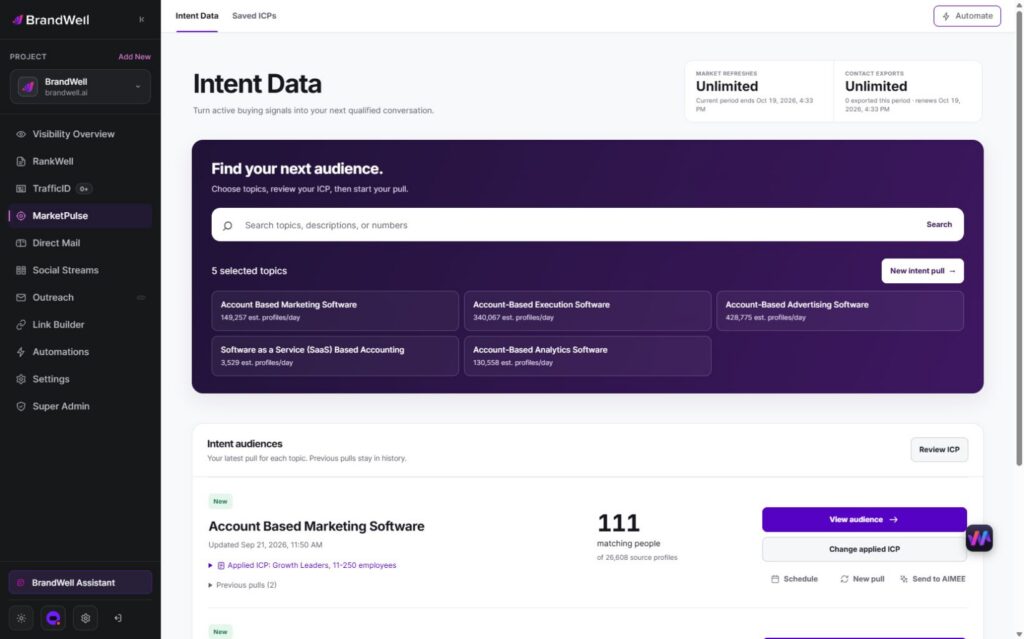
BrandWell MarketPulse: intent data starting at $500/mo. Find people researching topics relevant to what you sell, apply saved ICP filters, and review available contact details before taking action.
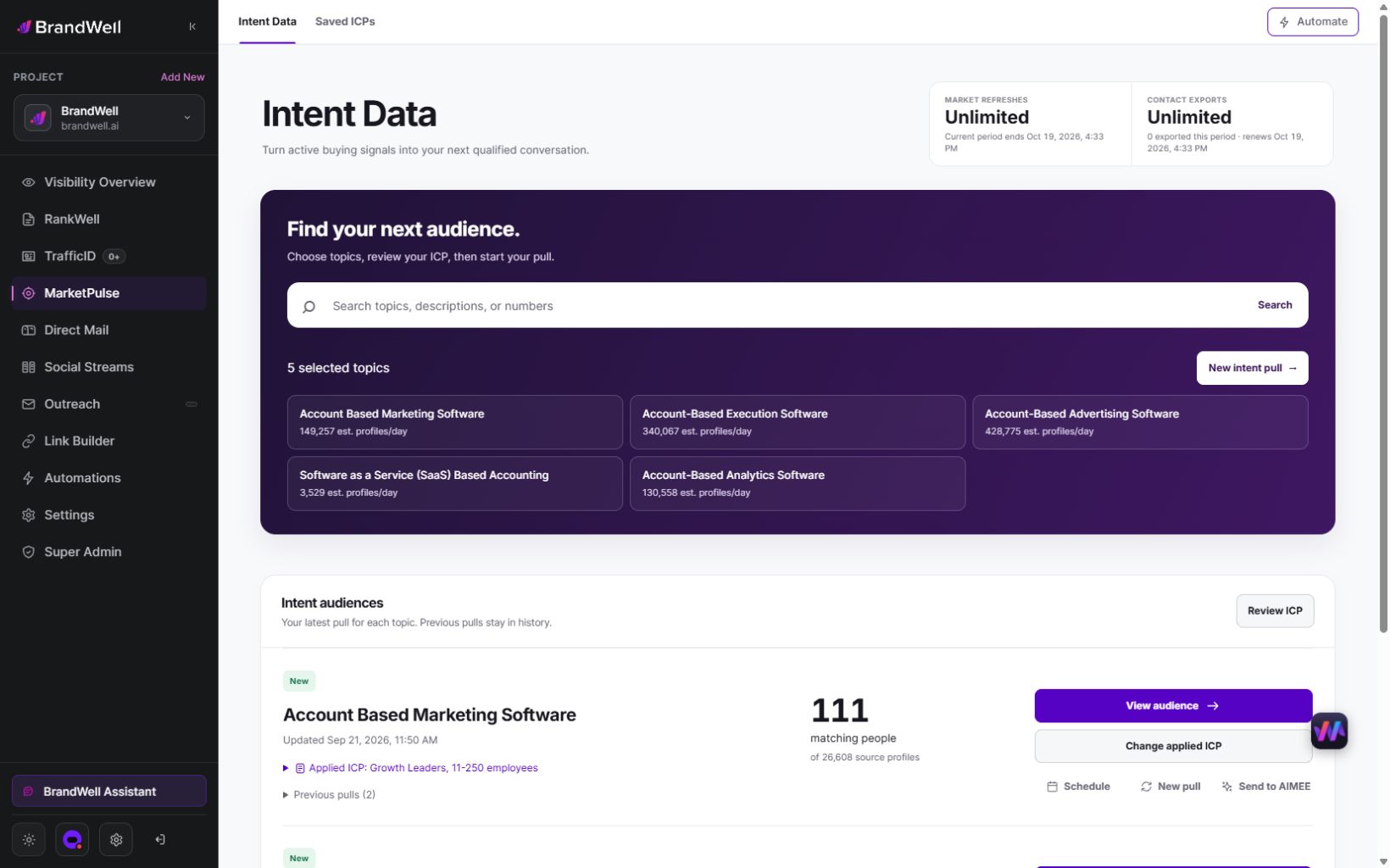
MarketPulse plans are starting at $500/mo. Verify current package scope and offers on the product page.
| Plan | Topics and refreshes | Monthly exports |
|---|---|---|
| Starter | 1 topic, weekly | 25,000 contacts |
| Growth | 3 topics, daily | 100,000 contacts |
| Scale | 10 topics, daily | Unlimited contacts |
Swipe the table to see all columns.
A pull retrieves available data from the previous 24 hours for one topic. Daily use across all included topics provides 90 Growth pulls or 300 Scale pulls in a 30-day month. Weekly Starter pulls vary by calendar month. Available audience size and contact fields vary, and audiences may overlap. Refreshes stop at the plan limit without overage charges.
- Find and qualify: search the topic catalog, save your ICP, and review the people and companies that match.
- Act on the research: export qualified contacts or prepare an Outreach or Direct Mail workflow. Connected products, channel usage, and fulfillment may cost extra.
- Get help from AIMEE: Growth and Scale include AIMEE for the initial user to research accounts and prepare the next step through connected tools.
Agencies and other service businesses can build client deliverables around their available Intent Scans and exports. Keep each client’s scope, permissions, and service fees clear. A subscription is not a promise of a white-label platform or exclusive access to a market.
Explore MarketPulse and watch the demo or compare plans starting at $500/mo. Any early-access discount is a separate, time-limited offer shown to an eligible recipient.
Give weekly and monthly reports different jobs
Many reporting programs fail because the same dashboard is emailed at two intervals. Frequency changes, but the decision does not. Instead, assign each cadence a job.
The weekly report is an operating pulse. It asks which accounts changed, which records passed review, what owners should do, which exceptions need attention, and whether any rule or integration broke. Keep it short enough to use in an active account meeting. A weekly report should expire or carry forward open actions explicitly, not let them disappear behind a fresh set of charts.
The monthly report is a decision memo. It asks which topics, sources, segments, actions, and handoffs appear useful; where adoption stalled; what changed in the data or process; and whether the client should hold, refine, expand, or stop something. It should connect cost and labor to accepted work and observed outcomes without turning association into causal proof.
This split supports a durable intent-data reporting service for agencies: the weekly artifact keeps work moving, while the monthly artifact protects strategy and client trust.
Reconcile a seven-step reporting process
- Close the observation window. Freeze the source period, applicable rule version, and prior comparison period. Late-arriving data should be labeled rather than silently moved into the closed window.
- Reconcile inputs. Compare source records, loaded records, accepted records, suppressed records, unresolved identities, duplicates, and failures. Investigate unexplained differences before creating graphics.
- Review material changes. Identify new accounts, meaningful topic shifts, stale records, changed identity states, and reopened exceptions. Do not call every event a new opportunity.
- Join action evidence. Pull assignment, acceptance, rejection, outreach, campaign, meeting, opportunity, and other approved disposition fields. Preserve “unknown” rather than filling gaps with assumptions.
- Draft decisions. For each significant finding, name the evidence, uncertainty, recommended owner, next action, due window, and stop condition.
- Run a quality review. Check denominators, filters, time zones, cohort definitions, identity labels, client names, permissions, and whether every claim can be traced to a source row.
- Deliver and capture response. Record who received the report, what was accepted, what was challenged, what action was assigned, and what definition changed.
The account manager owns narrative and client decisions. The analyst owns computation and reproducibility. A delivery lead owns deadlines and exceptions. The client owns sales and marketing follow-through. Those roles can be held by fewer people in a small agency, but the responsibilities should not be unnamed.
Copyable weekly action pulse
This is a working document, not a decorative executive summary. Keep the report concise and attach the evidence ledger when detail is needed.
WEEKLY INTENT PULSE

Decision window:
Data and rule version:
Client owner:
Agency reviewer:

1. WHAT CHANGED
- New accepted accounts:
- Material topic or recency changes:
- Records expired or suppressed:
- Integration or source changes:

2. QUALITY AND COVERAGE
- Source records / accepted / rejected / unresolved:
- Duplicate and suppression counts:
- Exceptions outside the agreed response window:
- Known limitations:

3. ACTION QUEUE
- Account or segment:
- Why it is here:
- Identity state:
- Permitted action:
- Owner:
- Due window:
- Approval required:

4. PRIOR ACTIONS
- Accepted / completed / declined / no disposition:
- Meetings, opportunities, or other client-defined outcomes:
- Notes on attribution limits:

5. DECISIONS NEEDED
- Continue, correct, pause, or escalate:
- Named approver and response due:
A useful weekly report includes zeroes and absences. “No material change” is a valid result. Hiding quiet periods trains the team to reward volume instead of relevance.
Copyable monthly decision memo
MONTHLY INTENT DECISION MEMO

Decision to make:
Stable comparison period and cohort:
Changes to topics, sources, identity, or activation rules:

1. EXECUTIVE ANSWER
- What appears to be working:
- What is uncertain:
- What should change next:

2. SIGNAL AND DATA HEALTH
- Relevance by topic or segment:
- Identity states and unresolved share:
- Freshness, duplicates, suppressions, exceptions:

3. ADOPTION AND ACTIVATION
- Assigned, accepted, acted, declined, and unreported:
- Completion time by owner or workflow:
- Reasons for non-use:

4. OUTCOME EVIDENCE
- Client-defined meetings, opportunities, progression, or retention events:
- Cohort and denominator:
- What the evidence does and does not establish:

5. SERVICE ECONOMICS
- Agency labor and contracted tools:
- Rework and exception cost:
- Client fee and contribution before overhead:

6. DECISION
- Hold, refine, expand, or stop:
- Owner, next test, review point, and stop condition:
The memo should preserve past rule versions. If topic definitions, ICP, identity logic, or activation changed, do not compare the periods as if the method were stable. Explain the break and start a new baseline where necessary.
Separate six levels of evidence
Weekly and monthly intent-data reporting becomes more credible when metrics are organized as a ladder. Each level answers a different question:
- Delivery: Did the expected source files, portal records, or integrations arrive and reconcile?
- Quality: How many records were accepted, duplicated, suppressed, unresolved, corrected, or expired?
- Adoption: Did the assigned team view, accept, reject, and act on the records?
- Activation: Which approved outreach, campaign, prioritization, or research action actually occurred?
- Outcome association: Which meetings, qualified opportunities, stage changes, or other client-defined events are associated with the cohort?
- Economics: What did the agency and client spend in labor and contracted tools for accepted work and observed outcomes?
Do not jump from delivery to revenue. A high signal count with low adoption may indicate poor fit, weak training, or a workflow problem. High adoption without outcomes may point to messaging, offer, timing, identity, or measurement limitations. Benchmarks should come from the same client’s stable baseline or a clearly labeled comparable cohort. External averages rarely share the same definitions.
For integrations that feed these reports, use the client CRM and marketing-stack integration guide so report fields have an owner and auditable source.
Compare reporting preparation methods
Manual reporting is appropriate when the agency is learning the decision model and a reviewer must inspect every record. It supports rich context but can consume analyst time, introduce spreadsheet drift, and make late delivery more likely. Use locked templates, source hashes, and a second-person review.
Automation can support repeatable preparation when field definitions, joins, filters and exception rules are stable. It can also repeat errors. Reconcile source totals, show freshness warnings and require review of narrative conclusions before delivery.
White-label reporting is appropriate when the agency needs repeatable client-branded delivery, tenant separation, and consistent packaging. It does not remove the agency’s responsibility to interpret findings, manage expectations, and confirm permitted use. Verify portal rights, exports, client access, support, and billing boundaries in writing.
Combine automated preparation, human review and separately configured client reporting only where the actual requirements justify the work. Evaluate delivery time, error rate, adoption and rework. Do not assume a research subscription supplies a native white-label portal.
Budget scope, labor and exceptions
Separate setup work from recurring delivery. Setup can include discovery, topic and field definitions, template design, integration mapping, historical baseline creation, permissions, and training. Recurring cost can include analyst review, account management, exception work, revisions, client meetings, portal or software usage, and evidence retention.
REPORTING SETUP = discovery + metric definitions + data mapping
                + template configuration + testing + training

RECURRING COST = analyst review + account management + exceptions
               + contracted tools + revisions + governance

SERVICE REVIEW = client fee - recurring cost before agency overhead
Do not invent a universal setup fee or margin benchmark. Put included cadence, revision limits, data sources, meeting time, custom analysis, and out-of-scope work in the service description. Review actual delivery cost monthly and improve the workflow before assuming scale will fix it.
Keep product and reporting scope clear
MarketPulse supports topic research and saved ICP review. Custom client dashboards, white-label portals and agency reporting services are separately scoped work. Verify actual fields, permissions, product capabilities and supported destinations.
Start with supported MarketPulse research starting at $500/mo and preserve the actual topic, available fields and pull window. AIMEE can help organize an approved comparison brief through configured tools. The agency owns its separate metric dictionary, reporting cadence and client agreement.
MarketPulse plans are starting at $500/mo. Starter includes 1 topic, weekly refreshes, and 25,000 exportable contacts per month. Growth includes 3 topics, daily refreshes, and 100,000 exportable contacts. Scale includes 10 topics, daily refreshes, and unlimited contact exports. AIMEE for the initial user is included with Growth and Scale. Compare MarketPulse plans and current offers.
Review access and measurement risks
Restrict each report to its approved purpose and audience. Verify source rights, fields, access, retention and export controls. Available identifiers do not automatically belong in a shared slide deck or unrestricted client download.
Common reporting mistakes include changing filters without disclosure, omitting denominators, using screenshots as source evidence, counting duplicate actions, treating unresolved identity as known, presenting a quiet week as failure, attributing every outcome to intent, and hiding client non-adoption. A quality checklist should explicitly test each risk.
Copyable assistant reporting review
AIMEE can help draft a narrative from an approved evidence ledger through configured connected tools. Preserve actual period boundaries, rule versions, missing dispositions and uncertainty. Human owners approve computations, claims and client delivery.
ROLE: Draft an intent-report narrative from approved evidence.

INPUTS:
- Redacted weekly or monthly evidence table
- Metric dictionary and rule version
- Prior comparable period
- Approved client outcomes and action states
- Exceptions and known data limitations

TASK:
1. Reconcile totals and show denominators.
2. Separate signal, identity, action, and outcome evidence.
3. Identify material changes and plausible explanations.
4. Label uncertainty and missing dispositions.
5. Recommend hold, refine, expand, or stop with an owner.

DO NOT:
- Invent values or fill unknowns.
- Claim a signal proves purchase intent.
- Claim causation, guaranteed ROI, pipeline, or revenue.
- Include secrets, unrestricted personal data, or credentials.
- Publish without human review.

OUTPUT:
- Direct answer
- Evidence and limitations
- Action queue
- Open questions
- Draft client decision
Ten practical reporting questions
How should weekly and monthly reporting create quick, repeatable value?
Make the weekly report an action queue and the monthly report a decision memo. Both should use the same metric dictionary, identity states, and evidence ledger. Start with the smallest report that changes a real client decision. Repeatability comes from closed periods, reconciled inputs, named owners, stable cohorts, and recorded feedback rather than from producing more charts.
What steps, owners, SLAs, checks, and handoffs should reporting include?
Define period close, ingestion, reconciliation, analysis, narrative review, client approval, action assignment, and disposition capture. Name a data owner, analyst, account manager, quality reviewer, delivery owner, and client action owner. Set service levels for source cutoff, draft completion, review, correction, delivery, and exceptions. The intent-data SLA framework helps define clocks and exclusions.
Which tools, templates, portals, or integrations best support reporting?
Use a metric dictionary, evidence ledger, weekly pulse, monthly memo, action queue, change log, and exception register regardless of software. Select reporting software or a white-label portal only after verifying access control, tenant separation, data freshness, export, filters, versioning, and client workflow. A simple governed document is better than a dashboard nobody uses.
How do manual, automated, and white-label approaches compare?
Manual review provides context during discovery, automation supports stable repeatability, and white-label delivery creates an agency-branded surface. Manual-only systems can be slow. Automation can scale errors. White-label portals can still lack client-specific interpretation. Combine them when needed: automated preparation, human conclusion, branded delivery.
What delivery cost and setup fee should an agency model?
Estimate discovery, metric design, data mapping, template configuration, baseline work, testing, permissions, and training for setup. Estimate analysis, account management, exceptions, meetings, revisions, tools, and governance for recurring work. Keep custom requests out of the base scope unless priced. Use actual labor and written provider terms rather than an unverified price benchmark.
Which time-to-value, quality, adoption, and outcome metrics matter?
Track time to first accepted report and first assigned action; reconciliation difference; accepted, suppressed, duplicate, unresolved, and corrected records; report views; accepted and completed actions; exception age; and client-defined outcomes by stable cohort. Use contribution before overhead to inspect service economics. Label association and measurement limits instead of presenting outcomes as guaranteed ROI.
How should reporting vary by client maturity, stack, and package?
An early-stage client may need a reviewed action list and a monthly learning memo. A client with reliable CRM dispositions can support cohort and progression analysis. A mature multi-channel client may need source-level quality, activation, opportunity, and service economics views. Do not sell a sophisticated dashboard when the client lacks owners or outcome fields.
Which signals, identity checks, activations, and evidence belong in the report?
Show source, topic, recency, recurrence, relevant fit, identity state, match method where available, validation, suppression, assigned action, owner, completion, and outcome disposition. Keep account-level observations separate from known-person activity. Report rejected and unresolved states so the client sees the selection process rather than only a polished output.
What scope, data, security, and expectation risks affect reporting?
Risks include unclear metric definitions, silent rule changes, missing denominators, unauthorized personal data, weak client access controls, stale exports, screenshots used as evidence, excessive revisions, and claims that overstate attribution. Control them with a data dictionary, access list, retention rule, change log, approval record, and written scope.
What belongs in recurring white-label intent-data reporting?
Include the agency-branded weekly pulse, monthly decision memo, approved source and metric definitions, quality review, action queue, exception handling, client meeting, change log, evidence retention, support boundary, and renewal review. State the client responsibilities for dispositions and outcomes. Renewal should be based on useful decisions, adoption, and defensible delivery, not a promised number of signals or sales.
Worked example: reconcile weeks before reporting a month
Suppose four fictional weekly reports list 40, 50, 45 and 55 accepted account entries: 190 appearances. After an approved account-level reconciliation, there are 120 unique accounts for the month. Report 190 appearances and 120 distinct accounts separately. Do not sum weekly opportunity counts unless the event definitions and deduplication rule support it. Preserve source windows, time zone and the actual account key.
Suppose the client acts on 60 of those 120 accounts and records dispositions for 45 of the 60. Action coverage is 50% of unique accepted accounts. Feedback coverage is 75% of acted accounts. If nine of the 45 known dispositions become accepted opportunities, that is 20% of known dispositions or 7.5% of all accepted accounts. Fifteen acted accounts lack feedback. Do not silently treat them as unsuccessful or successful, or compare the two denominator choices as a change in performance.
For a fictional reporting package, four weekly preparations take eight total hours at $75; the monthly memo takes four hours at $100 and allocated tools cost $200. The $1,200 recurring cost leaves $600 against an $1,800 fee: a 33.3% delivery remainder before acquisition, general overhead, tax and financing. Six extra correction hours at $75 reduce it to $150, or 8.3%. Recovering an additional $900 setup cost over three months adds $300 per month, producing a $150 delivery loss in that stressed month. These are planning assumptions, not typical returns or BrandWell service prices.
Put uncertainty beside the result
Government Analysis Function guidance emphasizes explaining evidence limits and uncertainty. Its official-statistics context is a useful reporting analogy, not certification of an agency report. The page notes that it is under review; do not use it as an accessibility compliance standard.
Use the actual MarketPulse evidence
Review the available topic audience with the saved ICP and preserve its preceding-24-hour window and permitted fields. Keep research matches separate from client-confirmed actions and outcomes. AIMEE can help draft an approved summary through configured tools. Human owners reconcile the ledger and approve the separately scoped report.
Frequently asked questions
Can weekly account counts be added for the month?
Only as appearances. Reconcile distinct accounts separately.
Is missing feedback a zero outcome?
No. Keep unknown dispositions visible.
Does an associated opportunity prove causal lift?
No. Selection and measurement limits still apply.
Does MarketPulse include a custom agency reporting portal?
Do not assume that. Verify product capabilities and scope separately.
Review the supported research product: explore MarketPulse and current plans.
Reviewed and updated October 3, 2026.

Written by