
On this page
- Who this is for
- BrandWell: MarketPulse intent data and connected growth automation
- How should an agency use QBRs to improve adoption, renewal, and expansion?
- What cadence, ownership, playbooks, and communication are required?
- Which customer-success, reporting, or analytics tools best support QBRs?
- How do proactive, reactive, and data-led QBR approaches compare?
- What should an agency invest, and how should expansion economics be measured?
- Which adoption, health, renewal, expansion, and revenue metrics belong in the review?
- Which clients, stages, and risk profiles need different QBR formats?
- Which signal, identity, activation, and outcome evidence matters most?
- What attribution, expectation, data-use, and trust risks must the agency manage?
- How should QBRs be built into a recurring intent-data service?
- Put buyer intent to work with MarketPulse
Direct answer: Run an intent-data QBR as an evidence-led decision review, not a generic dashboard presentation. Reconcile the data before the meeting, show what the client actually used, separate delivery from outcomes, explain limitations, and ask stakeholders to choose the next action. A useful QBR ends with owners and decisions, not applause for activity.
Current MarketPulse offer: intent-data plans start at $250/month. See the product, demo, and current plans. Updated October 1, 2026.
Running QBRs for intent-data clients can improve adoption, renewal, and expansion because it connects signals to the client’s operating reality. It can also damage trust if the agency inflates attribution, hides weak usage, or brings dozens of unexplained charts. The method below uses a compact evidence packet and a seven-part agenda that an account director can repeat without making every client review look identical.
Who this is for
This guide is for account directors, client strategists, analysts, RevOps partners, and agency owners responsible for an intent-data relationship. It works for established quarterly reviews and for smaller clients that need a lighter decision meeting on a similar cadence.
BrandWell: MarketPulse intent data and connected growth automation
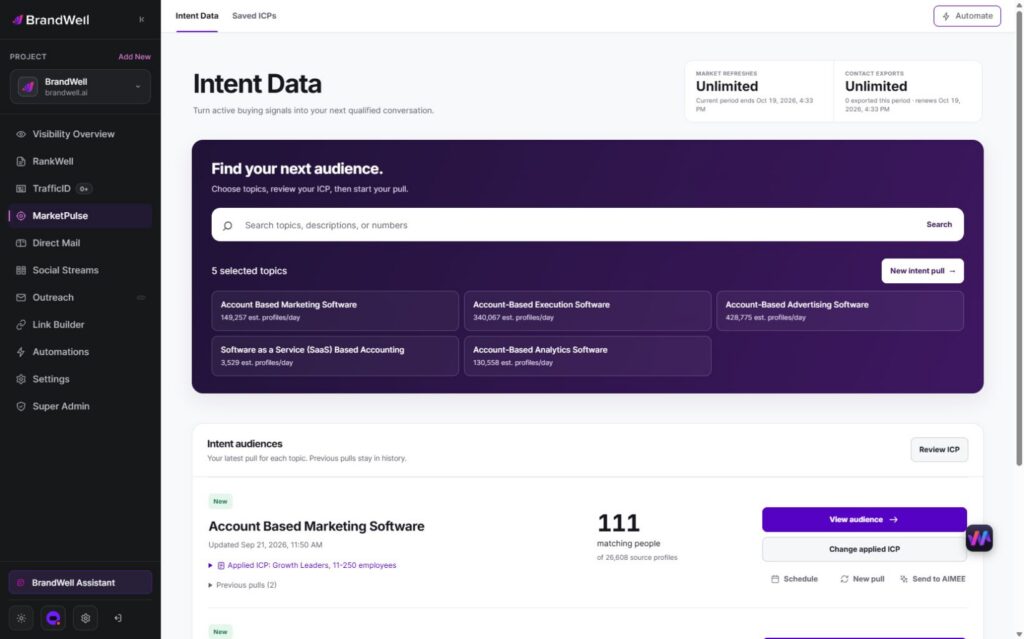
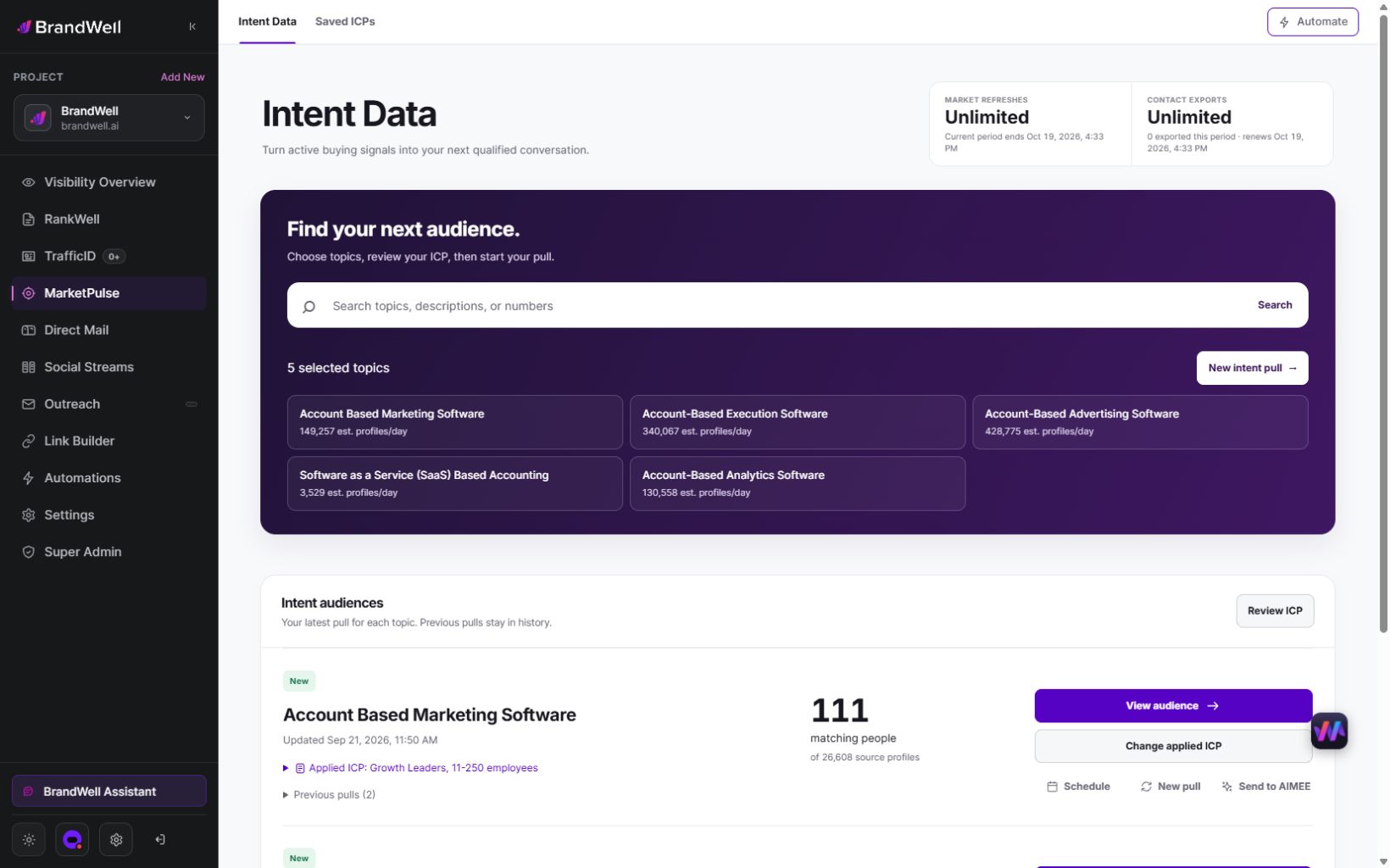
BrandWell MarketPulse: intent data from $250/month. Find people researching topics relevant to what you sell, apply saved ICP filters, and review available contact details before taking action.
| Plan | Price | Topics and refreshes | Monthly exports |
|---|---|---|---|
| Starter | $250/month | 1 topic, weekly | 25,000 contacts |
| Growth | $500/month | 3 topics, daily | 100,000 contacts |
| Scale | $1,000/month | 10 topics, daily | Unlimited contacts |
Swipe the table to see all columns.
A pull retrieves available data from the previous 24 hours for one topic. Daily use across all included topics provides 90 Growth pulls or 300 Scale pulls in a 30-day month. Weekly Starter pulls vary by calendar month. Available audience size and contact fields vary, and audiences may overlap. Refreshes stop at the plan limit without overage charges.
- Find and qualify: search the topic catalog, save your ICP, and review the people and companies that match.
- Act on the research: export qualified contacts or prepare an Outreach or Direct Mail workflow. Connected products, channel usage, and fulfillment may cost extra.
- Get help from AIMEE: Growth and Scale include AIMEE for the initial user to research accounts and prepare the next step through connected tools.
Agencies and other service businesses can build client deliverables around their available topic pulls and exports. Keep each client’s scope, permissions, and service fees clear. A subscription is not a promise of a white-label platform or exclusive access to a market.
Explore MarketPulse and watch the demo or compare plans starting at $250/month. Any early-access discount is a separate, time-limited offer shown to an eligible recipient.
How should an agency use QBRs to improve adoption, renewal, and expansion?
Define the QBR around three questions: What did we agree to change? What evidence shows what happened? What decision must we make now? Start by revisiting the prior review’s actions. If a client agreed to disposition high-fit accounts within a set window, show completion, exceptions, and what the team learned. Do not skip directly to fresh charts.
Adoption becomes visible through named behaviors: stakeholders opened the report, reviewed accounts, accepted or rejected recommendations, activated approved records, and returned dispositions. Renewal becomes defensible when the service has a consistent delivery record, transparent corrections, active users, and an evidence trail tied to decisions. Expansion is appropriate only when the current use case works and an adjacent problem has a responsible owner.
The account director should state a recommendation early: continue, correct, expand, narrow, or stop. The rest of the QBR should show evidence for that recommendation and invite the client to challenge it. This keeps the agency accountable and gives executives a reason to attend.
Agree on success language before the first review. “Delivered” means the agency completed the contracted output. “Adopted” means the client performed the defined behavior. “Associated” means an event and signal share a documented relationship. “Influenced” requires a stated contribution rule. “Incremental” requires a defensible comparison. These terms prevent an operational win from being presented as proven revenue impact.
Use the QBR to surface negative evidence too: ignored accounts, rejected identities, failed activations, lost opportunities, and client objections. A review that contains only wins cannot guide resource allocation. It also makes later corrections feel like surprises.
What cadence, ownership, playbooks, and communication are required?
The quarterly meeting is only the visible checkpoint. A reliable playbook begins with weekly operations checks and a monthly performance read. Weekly review catches feed failures, stale records, identity exceptions, rejected activations, and missing dispositions. Monthly review reconciles definitions, cohort changes, client usage, and service economics. Quarterly review turns that record into a business decision.
Assign four roles: the service owner prepares the narrative, the analyst certifies calculations and limitations, the client operator validates workflow usage, and the executive sponsor approves priorities or scope. Name a backup for each. Set a close date for the evidence window so late events do not change slides during the meeting.
Send a concise pre-read with the prior decision, current status, material changes, open risks, and decisions requested. Ask attendees to correct factual errors before the meeting. Afterward, send the decision log and owner list, not a second promotional recap. The weekly and monthly reporting framework can supply the operating evidence without duplicating the QBR.
Which customer-success, reporting, or analytics tools best support QBRs?
Choose tools by the evidence they preserve, not the attractiveness of their charts. A practical QBR stack has seven parts:
- Metric dictionary: formulas, denominators, exclusions, identity states, owners, and changes.
- Source register: signal, enrichment, CRM, advertising, outreach, and outcome systems.
- Evidence ledger: the path from signal to qualification, approval, action, and returned outcome.
- Exception queue: unresolved identities, duplicates, stale records, suppressions, and client corrections.
- Client action register: prior commitments, owners, due points, status, and notes.
- Service economics sheet: recurring revenue, direct data cost, delivery time, support, credits, and margin.
- Decision brief: one page with recommendation, evidence, limits, choices, and approvals.
A CRM can hold outcomes and owners. Analytics software can calculate cohorts. Customer-success software can track health and renewal. A portal can deliver branded reports. A presentation tool can support the conversation. None of those systems knows whether a signal caused revenue. Preserve source links and calculation versions so the analyst can reproduce every important number. The best running QBRs for intent-data clients software is the governed combination the team will maintain.
A copyable QBR evidence packet
Build the packet from twelve artifacts: meeting charter, attendee and decision-right list, prior action register, scope snapshot, metric dictionary, source and identity map, service-health page, cohort performance page, exceptions and corrections, outcome ledger, account economics, and decision memo. Add an appendix for row-level evidence that authorized reviewers can inspect without displaying sensitive details to every attendee.
For each page, place the conclusion first, then evidence, limitation, and requested action. For example: “Activation slowed because one destination rejected a changed field. The agency corrected the mapping, reprocessed the approved cohort, and proposes a validation gate before the next release.” This structure is more useful than a chart title such as “activation over time” because it explains what happened and what should change.
A preparation countdown
Well before the meeting, confirm the decision owner and close the reporting window. Then reconcile source totals, sample identities and suppressions, collect client dispositions, calculate service cost, and identify definition changes. Circulate the pre-read after factual review, not while calculations are still moving. Hold an internal challenge session in which someone who did not build the report tries to reproduce its main conclusions.
On meeting day, log questions that cannot be answered from the evidence instead of improvising. Afterward, issue the final decision record, update the action register, and file the frozen packet. If a material correction occurs later, append it visibly rather than silently replacing history.
How do proactive, reactive, and data-led QBR approaches compare?
A reactive QBR responds to a renewal deadline, complaint, or executive request. It may solve an immediate issue, but the team often lacks a stable baseline and spends the meeting debating data. A proactive QBR follows a calendar, monitors health beforehand, and surfaces risks early. It produces continuity, although it can become routine status theater.
A data-led QBR frames a decision and tests it with traceable evidence. It does not mean every choice is automated. It means the team states the comparison, shows the denominator, labels uncertainty, and records why it chose the next action. Use proactive preparation and a data-led meeting. Reserve reactive sessions for incidents that cannot wait.
The key contrast is present a generic dashboard versus present an evidence-led decision review. A dashboard displays. A decision review interprets, challenges, and commits. If a chart does not change a decision, move it to the appendix or remove it. If a missing metric prevents a decision, make the measurement gap an explicit action.
What should an agency invest, and how should expansion economics be measured?
Budget for preparation, data reconciliation, analysis, narrative construction, client coordination, the meeting, follow-up, and action tracking. Record actual time by role. A polished meeting can be unprofitable if senior analysts rebuild every measure manually. Reusable definitions and automated extracts reduce effort, but human interpretation and approval remain necessary.
Measure the QBR’s economics indirectly through decisions and account health. Track whether agreed actions are completed, whether avoidable exceptions fall, whether adoption broadens, whether scope changes are priced, and whether renewal risk is resolved. Do not claim that the meeting itself generated pipeline. For expansion, model added recurring revenue against added data usage, topics, integrations, delivery labor, support, and risk.
A healthy proposal names the adjacent use case, client owner, acceptance test, cost, margin, review point, and stop condition. A weak proposal adds every available module because a renewal meeting created attention. Use the existing service evidence to constrain the offer, then follow a documented intent-service expansion and upsell process.
Which adoption, health, renewal, expansion, and revenue metrics belong in the review?
Open with service health: delivery completion, timeliness, exceptions, corrections, support, and material changes. Then show signal fitness: eligible coverage, recency, recurrence, match state, validation, duplicates, and suppressions. Next show activation: accounts reviewed, recommendations accepted, actions completed, time to action, rejected records, and unworked signals.
Adoption measures should name behavior by role. Show active stakeholders, accounts dispositioned, feedback returned, playbooks used, and requested changes. Outcome evidence can include qualified conversations, opportunities, stage movement, losses, pipeline association, and controlled comparisons where available. Keep associated, influenced, and incremental evidence distinct.
Finish with account economics: contracted scope, usage, delivery hours, direct cost, margin, credits, renewal state, expansion hypothesis, and risks. Every rate must show its denominator. Every material change must be annotated. Never convert pipeline into revenue or present an unverified external benchmark as the standard the client should meet.
Which clients, stages, and risk profiles need different QBR formats?
A new client needs an activation review: data readiness, baseline, early exceptions, workflow ownership, and time to first useful decision. An adopted client needs optimization: cohort performance, adoption depth, outcome evidence, economics, and one controlled test. A renewal-risk client needs a recovery review: root causes, disputed expectations, remediation owners, and a go-or-stop point. An expansion candidate needs proof that the current use case is stable.
Enterprise clients may require security, legal, procurement, RevOps, marketing, and sales stakeholders, so use a formal pre-read and role-specific appendix. Smaller clients may need a forty-minute working session with fewer measures. High-risk data uses require stronger identity, purpose, access, retention, and approval evidence. Low-volume markets require qualitative account evidence and longer observation windows.
Do not force the same benchmark across clients with different markets, channels, sales capacity, or CRM discipline. Keep the agenda structure stable while adapting the comparison and decision. A consistent process does not require identical claims.
Which signal, identity, activation, and outcome evidence matters most?
Show enough lineage for the client to understand why an entity appeared. Include signal category, topic or first-party behavior, recency, recurrence, fit criteria, exclusions, and changes. Label identity state explicitly: company match, known person, candidate person, unresolved, suppressed, or corrected. Do not collapse those states into a single reveal count.
Activation evidence should show human acceptance, destination, mapping, timing, rejection, and completion. If the service supports paid media, separate audience upload from platform acceptance and spend. If it supports outreach, separate record delivery from validation, human review, send, response, meeting, and opportunity. If it supports website visitor workflows, separate company identification from person-level resolution.
Outcome evidence must return through stable identifiers and documented rules. Show missing data as missing. When sales feedback conflicts with the signal, preserve both records and resolve the discrepancy. The purpose is not to make the provider look right. It is to improve the next decision.
What attribution, expectation, data-use, and trust risks must the agency manage?
Attribution risk includes crediting every downstream event to intent, selecting only wins, changing cohorts, hiding losses, and mixing unlike identity states. Expectation risk includes treating planning targets as guarantees or implying that a topic signal proves an individual is ready to buy. Data-use risk includes excessive access, unauthorized exports, stale retention, unsafe outreach language, and agent actions without approval.
Client trust also fails through avoidable presentation choices: unexplained metric changes, screenshots without lineage, vague definitions, missing denominators, and recommendations that always sell more scope. Put limitations next to the related conclusion. Document corrections openly. Ask counsel to interpret applicable law and contracts. The NIST Privacy Framework can support privacy-risk thinking, but it is a voluntary reference, not certification or legal advice.
Record conflicts of interest. If the agency earns more when usage grows, say how expansion was evaluated. A credible QBR can recommend narrowing or stopping a workflow. That option makes an expansion recommendation more trustworthy.
How should QBRs be built into a recurring intent-data service?
Include the QBR in scope from the beginning. Define who attends, which evidence the client must return, the reporting window, preparation cutoff, metric dictionary, correction process, decision rights, and follow-up. Store a review packet containing the frozen data, calculations, appendix, decision log, and assigned actions. Begin the next QBR with the prior packet.
A strong seven-part agenda is: prior decisions, service health, signal and identity quality, activation and adoption, outcome evidence, economics and risk, then next decision. The account director should leave time for disagreement. Renewal belongs in the operating narrative throughout the relationship, not as a surprise at the last meeting. This intent-service renewal strategy shows how to convert evidence into an honest continuation decision.
Agent-ready QBR preparation instruction:
Using the approved metric dictionary, prior decision log, and supplied evidence, draft a QBR pre-read. Reconcile definitions, show denominators, list missing outcomes, preserve identity states, separate association from causal evidence, and propose continue, correct, expand, narrow, or stop. Do not invent performance, prices, identities, client sentiment, legal conclusions, or attribution. Do not send the report, change source data, contact stakeholders, activate audiences, or approve scope. Route all decisions and external actions to a human.
Claude, ChatGPT, or AIMEE can prepare the packet under these constraints. Human owners must verify calculations, approve interpretation, and conduct the client conversation.

Written by