On this page
- Who owns the client exit
- Current MarketPulse research workflow
- Use the exit to learn without forcing renewal
- Assign four closure checkpoints
- Maintain the twelve-part exit inventory
- Choose the authorized transition path
- Budget offboarding before the contract starts
- Separate service history from closure metrics
- Adapt the plan to retained systems and risk
- Trace data, access and automation dependencies
- Verify named systems and disclose exceptions
- Design the exit during onboarding
- Worked example: a nearly closed inventory still has an exception
- Frequently asked questions
Direct answer: Offboard an intent-data client with a written transition plan that freezes new work, inventories data and access, completes or transfers agreed deliverables, exports authorized artifacts, revokes credentials, applies retention and deletion duties, reconciles billing, and confirms closure. Do not cut access immediately unless security, law, contract, or an authorized incident decision requires it.
Current MarketPulse offer: intent-data plans start at $500/mo. See the product, demo, and current plans. Updated October 3, 2026.
Offboarding an intent-data client responsibly is part of service design, not an administrative afterthought. Intent programs connect data sources, identity states, CRM fields, audiences, reports, workflows, and human decisions. A vague exit can leave stale access, orphaned automations, missing context, or data retained without purpose. The process below gives agency operations and client-service leaders a controlled handoff while preserving evidence of what was done.
Who owns the client exit
This guide is for agency operations leaders, account directors, security owners, analysts, and client stakeholders ending or materially reducing an intent-data service. It supports normal expiration, client-requested termination, vendor transition, scope reduction, and higher-risk exits that require counsel or security leadership.
Current MarketPulse research workflow
BrandWell MarketPulse: intent data starting at $500/mo. Find people researching topics relevant to what you sell, apply saved ICP filters, and review available contact details before taking action.
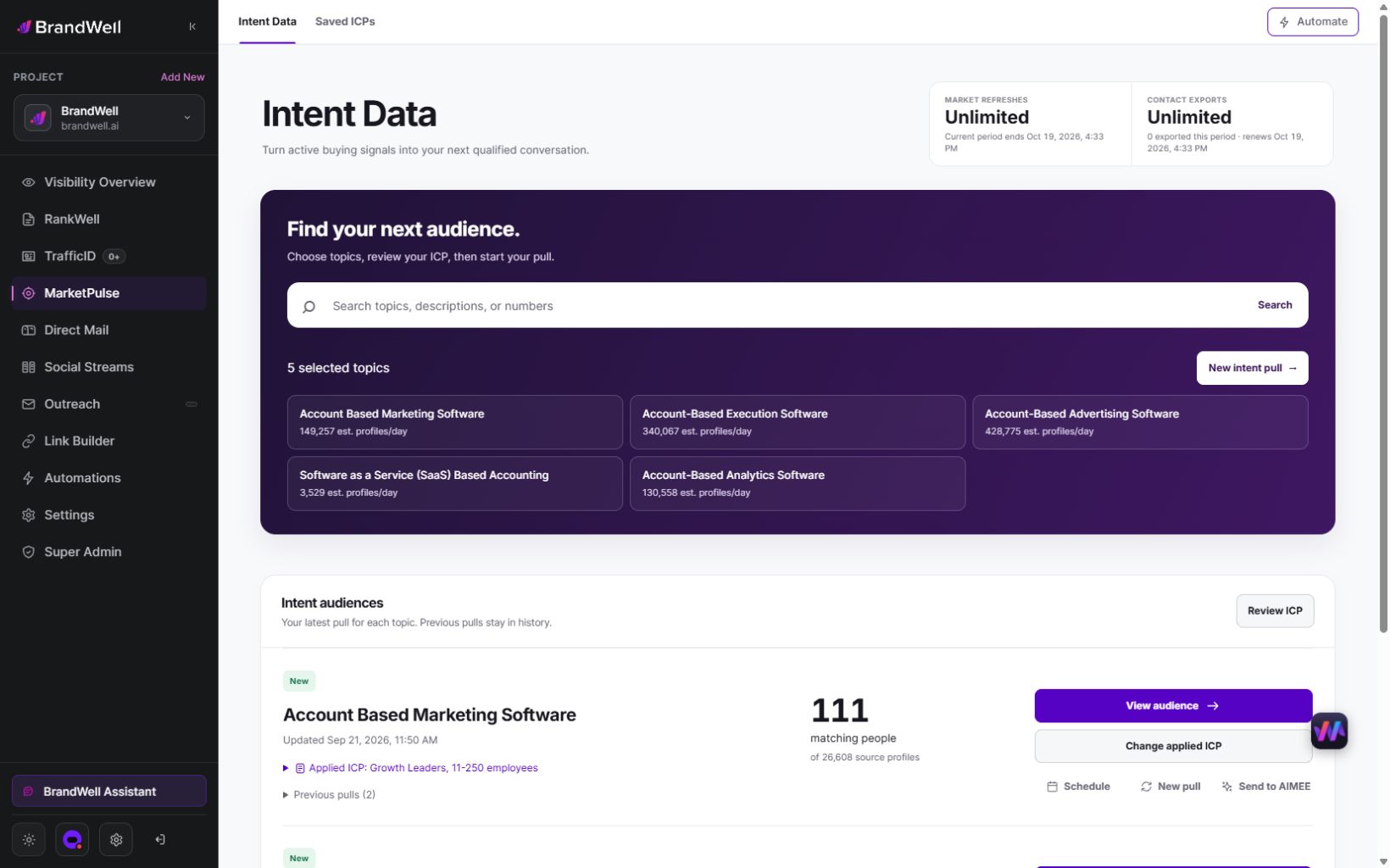
MarketPulse plans are starting at $500/mo. Verify current package scope and offers on the product page.
| Plan | Topics and refreshes | Monthly exports |
|---|---|---|
| Starter | 1 topic, weekly | 25,000 contacts |
| Growth | 3 topics, daily | 100,000 contacts |
| Scale | 10 topics, daily | Unlimited contacts |
Swipe the table to see all columns.
A pull retrieves available data from the previous 24 hours for one topic. Daily use across all included topics provides 90 Growth pulls or 300 Scale pulls in a 30-day month. Weekly Starter pulls vary by calendar month. Available audience size and contact fields vary, and audiences may overlap. Refreshes stop at the plan limit without overage charges.
- Find and qualify: search the topic catalog, save your ICP, and review the people and companies that match.
- Act on the research: export qualified contacts or prepare an Outreach or Direct Mail workflow. Connected products, channel usage, and fulfillment may cost extra.
- Get help from AIMEE: Growth and Scale include AIMEE for the initial user to research accounts and prepare the next step through connected tools.
Agencies and other service businesses can build client deliverables around their available Intent Scans and exports. Keep each client’s scope, permissions, and service fees clear. A subscription is not a promise of a white-label platform or exclusive access to a market.
Explore MarketPulse and watch the demo or compare plans starting at $500/mo. Any early-access discount is a separate, time-limited offer shown to an eligible recipient.
Use the exit to learn without forcing renewal
Offboarding is not a tactic for forcing renewal. Its direct purpose is to complete obligations and reduce risk. It can still improve the agency’s long-term economics by preserving trust, capturing learning, preventing unpaid work, and demonstrating that the service is portable and well governed. A client that receives a clean handoff can make an informed future decision without feeling trapped.
Use the exit to distinguish a service failure, fit mismatch, budget change, internal ownership gap, strategic shift, or normal completion. Record the client’s reason in its own words and compare it with delivery, adoption, outcome, support, and margin evidence. Do not rewrite the reason to protect a retention metric.
Before the final decision, the agency may offer a clearly priced correction, narrower scope, pause, or transition if those options genuinely address the cause. The client must be free to decline. Expansion should not be discussed unless the client asks and the evidence supports a different use case. A professional exit can support reputation and referrals, but neither is guaranteed.
Conduct an optional exit interview after operational pressure has eased. Ask what the client expected, which deliverables it used, where the workflow broke, what the agency communicated well, and what it should change. Separate facts that can be checked from opinions that should be preserved as client perspective. Do not debate the client or turn the interview into a save attempt.
Convert lessons into system improvements without copying unnecessary client details. Possible actions include a clearer fit gate, a stronger identity explanation, earlier adoption review, better scope boundary, revised support allowance, more realistic attribution language, or an earlier offboarding trigger.
Assign four closure checkpoints
Assign an offboarding owner, technical owner, data steward, billing owner, client approver, and escalation contact. Create one closure record with the termination basis, effective point, contract duties, systems, credentials, data categories, exports, retention, deletion, open work, fees, communications, and final approvals. Freeze scope changes unless formally authorized.
Use four checkpoints. The initiation review confirms authority, dates, risk, and communication. The inventory review maps assets, data, integrations, automations, access, and owners. The handoff review verifies exports, documentation, accepted deliverables, and client dependencies. The closure review verifies revocation, deletion or retained-data basis, billing, exceptions, and sign-off.
Communicate one source of truth. Tell the client what will stop, what will continue temporarily, what must be downloaded, what cannot be transferred, what action the client must take, and how questions will be handled. Do not promise deletion that has not been verified. Use a maintained intent-data delivery SOP so the exit can trace the same systems and owners used during delivery.
Maintain the twelve-part exit inventory
The best tools are those that provide a complete inventory, approval trail, and verifiable closure. Use this twelve-part offboarding checklist:
- Authority record: confirms who requested and approved the exit.
- Contract matrix: extracts notice, transition, export, retention, deletion, fee, and survival duties.
- Data map: lists sources, categories, identity states, locations, purposes, and client ownership.
- Access register: includes users, service accounts, API keys, browser sessions, shared folders, and vendors.
- Automation register: includes triggers, schedules, destinations, dependencies, and safe shutdown order.
- Deliverable ledger: marks accepted, pending, disputed, transferable, or cancelled work.
- Export manifest: names authorized files, formats, hashes, recipients, and limitations.
- Retention and deletion schedule: states what is removed, retained, why, where, by whom, and how verified.
- Billing reconciliation: covers fees, usage, credits, taxes, disputes, and final invoice.
- Exception queue: holds unresolved technical, legal, security, or client issues.
- Closure certificate: records completed controls and qualified exceptions without overstating certainty.
- Lessons log: captures process improvements without retaining unnecessary client data.
A ticketing system can coordinate tasks, a password manager can revoke secrets, a data catalog can support inventory, and a secure transfer method can deliver authorized exports. No tool substitutes for named human approval.
A practical closure evidence packet
Store a compact packet that another authorized reviewer can reproduce. Include the approved termination request, contract summary, final scope snapshot, system and data inventory, access changes, automation shutdown evidence, export manifest, client acceptance, deletion and retention record, billing reconciliation, exceptions, and closure approval. Link to controlled records rather than copying sensitive data into a general project ticket.
The export manifest should describe each file, its authorized purpose, format, row or object count, applicable identity state, creation method, integrity hash, transfer method, recipient, and acceptance status. It should also identify material exclusions. A hash can show that a file did not change after creation, but it does not prove that the contents are correct, complete, lawful, or received by the right person.
A safe shutdown sequence
First freeze new configuration and identify work already in motion. Second obtain approvals for completion, cancellation, or transfer. Third stop upstream triggers so new records do not enter while downstream systems are being closed. Fourth reconcile queues and destinations. Fifth create and validate authorized exports. Sixth revoke human and machine access in dependency order. Seventh execute documented deletion and retention actions. Eighth monitor for unexpected jobs, credentials, or transfers before final closure.
Use a rollback or incident path if a shutdown step disrupts a retained client system. Do not reactivate a service account informally. Record why it was restored, who approved it, its limited purpose, and when it will be removed again.
Choose the authorized transition path
Immediate cutoff is appropriate when authorized security response, legal instruction, material misuse, nonpayment terms, or another high-risk condition requires it. It reduces ongoing exposure but can interrupt legitimate client operations. Use an incident-approved path and preserve required evidence.
A phased transition is usually better for normal expiration or vendor change. The agency freezes new scope, completes defined work, exports authorized artifacts, runs a limited overlap if contracted, transfers documentation, then revokes access in dependency order. It provides continuity but needs firm boundaries so transition work does not become open-ended support.
A data-led approach uses the exit reason, system inventory, access evidence, service usage, and risk classification to choose the appropriate path. The contrast is cut access immediately versus follow a documented data-transition plan. Neither is universally correct. The governing factors are authority, risk, contract, client continuity, and applicable obligations. Record the rationale and approver.
Budget offboarding before the contract starts
Price and staff offboarding before the contract begins. Estimate standard account review, export, documentation, access revocation, deletion verification, billing, and closure. Define which transition work is included, which is billable, and which requires a separate statement of work. Higher-complexity integrations, custom reports, unusual export formats, or extended parallel operation can materially increase effort.
Measure operational economics rather than inventing an offboarding ROI. Track planned versus actual hours, vendor or transfer costs, rework, disputed charges, unbilled support, delayed receivables, exceptions, and time until access closure. Review whether the original price covered the work and update future contract assumptions.
Do not hold client-owned or contractually exportable artifacts hostage to a renewal conversation. Do not provide unauthorized data simply to end the relationship quickly. When ownership or transfer rights are disputed, stop and route the decision to authorized legal and business owners. A clean financial close is important, but it cannot override security, privacy, or contractual duties.
Separate service history from closure metrics
Use the exit review to preserve a truthful account history. Service-health measures include delivery completion, exceptions, corrections, incidents, support demand, and response time. Adoption measures include active users, reports reviewed, accounts dispositioned, actions completed, and feedback returned. Outcome measures include qualified conversations, opportunities, losses, and other evidence within the agreed attribution limits.
Commercial measures include contracted revenue, defined data cost, delivery labor, contribution, credits, unpaid invoices, contraction, renewal decision, and termination reason. Add exit measures: assets inventoried, access revoked, automations stopped, exports accepted, deletion verified, retained items justified, exceptions aged, and client sign-off.
Never reinterpret a nonrenewal as successful retention because the agency completed offboarding. Keep service performance and closure performance separate. Closure quality can reveal improvements to onboarding, scope, pricing, QBRs, or product fit, but it does not erase the client’s decision.
Review these measures by exit type rather than blending every account. A planned completion, strategic consolidation, budget cancellation, service failure, and security termination require different interpretation. Report small cohorts cautiously and avoid turning a few exits into a universal benchmark. The purpose is to improve controls and fit, not manufacture a favorable retention story.
Adapt the plan to retained systems and risk
A small client using reports and one CRM connection may need a short, checklist-driven transition. An enterprise client with multiple workspaces, data destinations, service accounts, audiences, subprocessors, and regional stakeholders needs a formal plan, change control, security review, and evidence packet. A reseller client may also need end-client separation and branded asset handling.
Normal expiration allows more planning than an incident, insolvency, dispute, or suspected misuse. A scope reduction differs from full termination because retained workflows must keep functioning while removed access and data are isolated. A vendor migration may require a controlled overlap, but the agency should not blend data in ways that violate either contract.
Higher-risk profiles include person-level identity, regulated clients, sensitive segments, large exports, automated outreach, shared credentials, custom models, and unresolved legal holds. Obtain counsel and security leadership for applicable requirements. Do not apply a generic deletion timetable when an authorized retention duty controls.
Trace data, access and automation dependencies
Inventory data by purpose and state. For each topic signal, first-party event, website visitor record, contact record, score, audience, report, and disposition, record origin, client, location, identity state, validation, downstream destinations, retention basis, and owner. Keep company matches separate from known people, candidate identities, and unresolved events.
Trace activation dependencies in shutdown order. Stop new triggers, drain or cancel approved queues, reconcile destinations, preserve required logs, export authorized artifacts, revoke tokens, and confirm that scheduled jobs cannot restart. For CRM and marketing systems, use the intent-data integration map to locate fields, identifiers, syncs, and ownership before removal.
Outcome evidence is part of the client history only within agreed rights and retention. Do not keep raw personal data merely because it might support a future case study. If anonymized or aggregated learning is permitted, document the transformation and review it. Missing evidence should remain missing rather than reconstructed by an agent.
Verify named systems and disclose exceptions
The most serious risks include deleting before an authorized export, retaining after purpose ends, leaving credentials active, overlooking scheduled automations, mixing client datasets, sending data to the wrong recipient, promising complete deletion without verification, or keeping unnecessary identity records. Attribution disputes can arise when the agency and client disagree about pipeline, accepted work, or fees at exit.
Use qualified review for the actual contract and legal requirements. NIST SP 800-88 Rev. 2 addresses media sanitization and supersedes Rev. 1. That reference does not verify deletion from every cloud copy, backup or client system. An agency compliance program should preserve named-system evidence and documented exceptions.
Trust requires precise language. Say “revocation confirmed for the listed accounts” rather than “all access is gone” when untracked systems may exist. Say “deletion request completed in the named systems, subject to the documented exceptions” rather than claiming universal erasure. Disclose unresolved items and owners.
Design the exit during onboarding
Define exit while onboarding. Put roles, notice, export formats, transition support, access closure, retention, deletion, client dependencies, fees, dispute handling, and surviving terms into the service design and current written agreement. Test the access and automation register during normal operations. Review data locations and client owners in QBRs so the inventory is not reconstructed under pressure.
Agent-ready offboarding instruction:
Using only the approved contract summary, system inventory, data map, access register, automation register, deliverable ledger, and client instructions, draft a sequenced closure checklist. Separate verified completion, pending work, exceptions, and approvals. Preserve identity uncertainty and authorized evidence. Do not invent rights, ownership, deletion, consent, legal conclusions, or completion. Do not revoke access, delete or export data, stop automations, contact anyone, alter billing, or close the account without human authorization.
Claude, ChatGPT, or AIMEE can prepare and reconcile the checklist within those boundaries. Authorized humans must interpret obligations, approve client communication, perform sensitive actions, and sign closure.
Worked example: a nearly closed inventory still has an exception
Suppose a fictional access inventory lists 20 human accounts and five service credentials. Evidence confirms revocation for 24 of those 25 items: 96% of the listed inventory. The remaining service credential is pending with an owner and deadline. That is not proof that all access is gone, and it says nothing about systems absent from the inventory. Check sessions, scheduled work and downstream permissions against the actual system map.
Suppose the data inventory separately lists 10 named storage locations. Eight have verified removal evidence and two have documented, authorized retention exceptions. Do not call this universal deletion or treat the retained locations as a completed erasure. Record each retained purpose, permitted access, review date and responsible owner. A checksum on an exported file establishes a comparison value for integrity checks, not lawful ownership, complete contents or recipient acceptance.
For the financial plan, suppose six closure hours at $75 plus $50 of transfer cost total $500. A $300 offboarding allowance leaves $200 of unrecovered defined cost. If the exit requires eight hours instead, cost is $650 and the allowance shortfall becomes $350. These are invented planning inputs, not standard BrandWell fees. Do not charge a new fee without the actual agreement and approval; use the result to improve future scoping.
Reconcile a BrandWell research handoff
List the actual permitted MarketPulse exports, saved research settings, connected destinations and accountable owners used for the client service. AIMEE can help organize a minimized closure checklist through configured tools. Verify source terms and the client’s authorized recipient before any transfer. A human approves and verifies each access or data action in its actual system. Do not assume that ending an agency contract automatically deletes every destination copy or changes a separately held BrandWell subscription.
Frequently asked questions
Does 96% revocation mean offboarding is complete?
No. Resolve the remaining listed credential and verify the inventory and other closure duties.
Can a retained-data exception be called complete deletion?
No. Name the retained systems, purpose, access and review obligations.
Does a file hash prove a lawful transfer?
No. Verify rights, contents, recipient and acceptance separately.
Does an agency exit cancel every connected product?
Do not assume that. Reconcile the actual account ownership, agreements and authorized changes.
Review the supported research product: explore MarketPulse and current plans.
Reviewed and updated October 3, 2026.

Written by