On this page
- Use the five P-R-O-O-F gates
- Current MarketPulse research workflow
- Define the approved marketing purpose
- Assign evidence and approval owners
- Evaluate the supported account workflow
- Compare research with approved first-party context
- Model recurring cost and review burden
- Measure marketing outcomes and delivery cost
- Choose clients with a separated marketing scope
- Preserve evidence and allowed destinations
- Review the actual regulatory scope
- Maintain the recurring account review
- Copyable P-R-O-O-F review for an assistant
- Test the decisioning boundary before scaling
- Worked example: a contribution target is not a markup
- Frequently asked questions
Direct answer: An intent-data service for a B2B financial-services client should prioritize permitted marketing review, not make or influence credit, underwriting, suitability, eligibility, or other regulated decisions. Define the marketing purpose, confirm rights and restrictions, separate identity states, enforce access and retention, keep a technical and procedural decisioning firewall, and require human approval before activation.
Current MarketPulse offer: intent-data plans start at $500/mo. See the product, demo, and current plans. Updated October 3, 2026.
The agency can promise a governed research and prioritization workflow. It cannot promise compliance, buyer intent, qualified pipeline, revenue, creditworthiness, suitability, or a financial outcome.
Who this is for: Financial-services agency owners supporting B2B marketing for institutions, providers, or vendors with heightened governance expectations.
Use the five P-R-O-O-F gates
- Purpose: write the exact B2B marketing decision the service supports and prohibited downstream uses.
- Rights: confirm contractual rights, source terms, client instructions, jurisdiction, and required review.
- Owners: name data, marketing, activation, security, privacy, legal, and client approvers.
- Output firewall: keep marketing priority fields and systems out of credit, underwriting, suitability, eligibility, pricing, and other consequential decision paths.
- Facts: preserve source, identity confidence, validation, action, outcome evidence, corrections, and limitations.
No record crosses a failed gate. Passing the model is an internal operating control, not a compliance certification.
Current MarketPulse research workflow
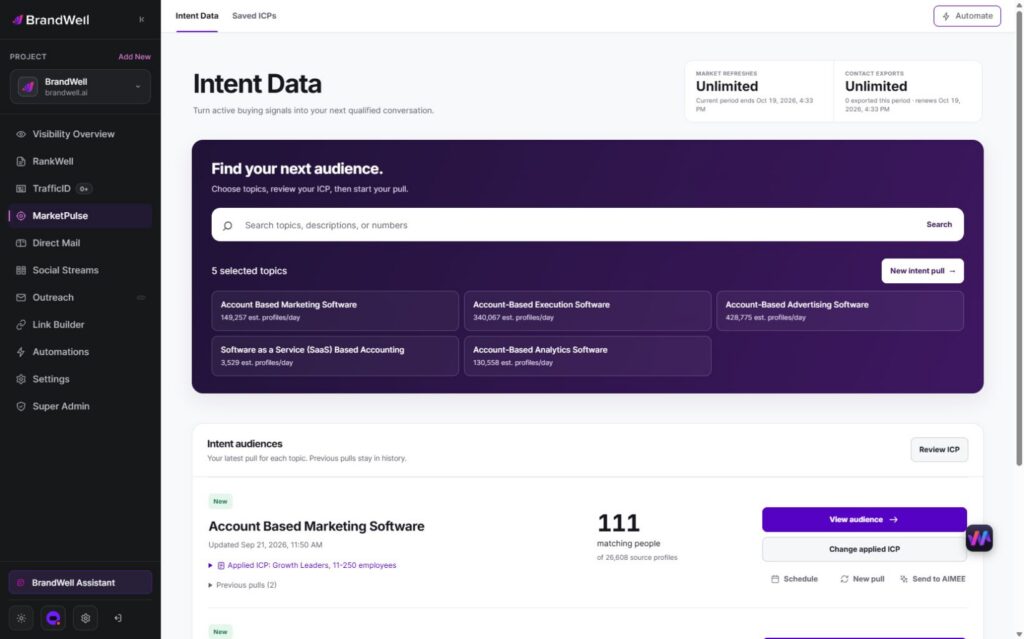
BrandWell MarketPulse: intent data starting at $500/mo. Find people researching topics relevant to what you sell, apply saved ICP filters, and review available contact details before taking action.
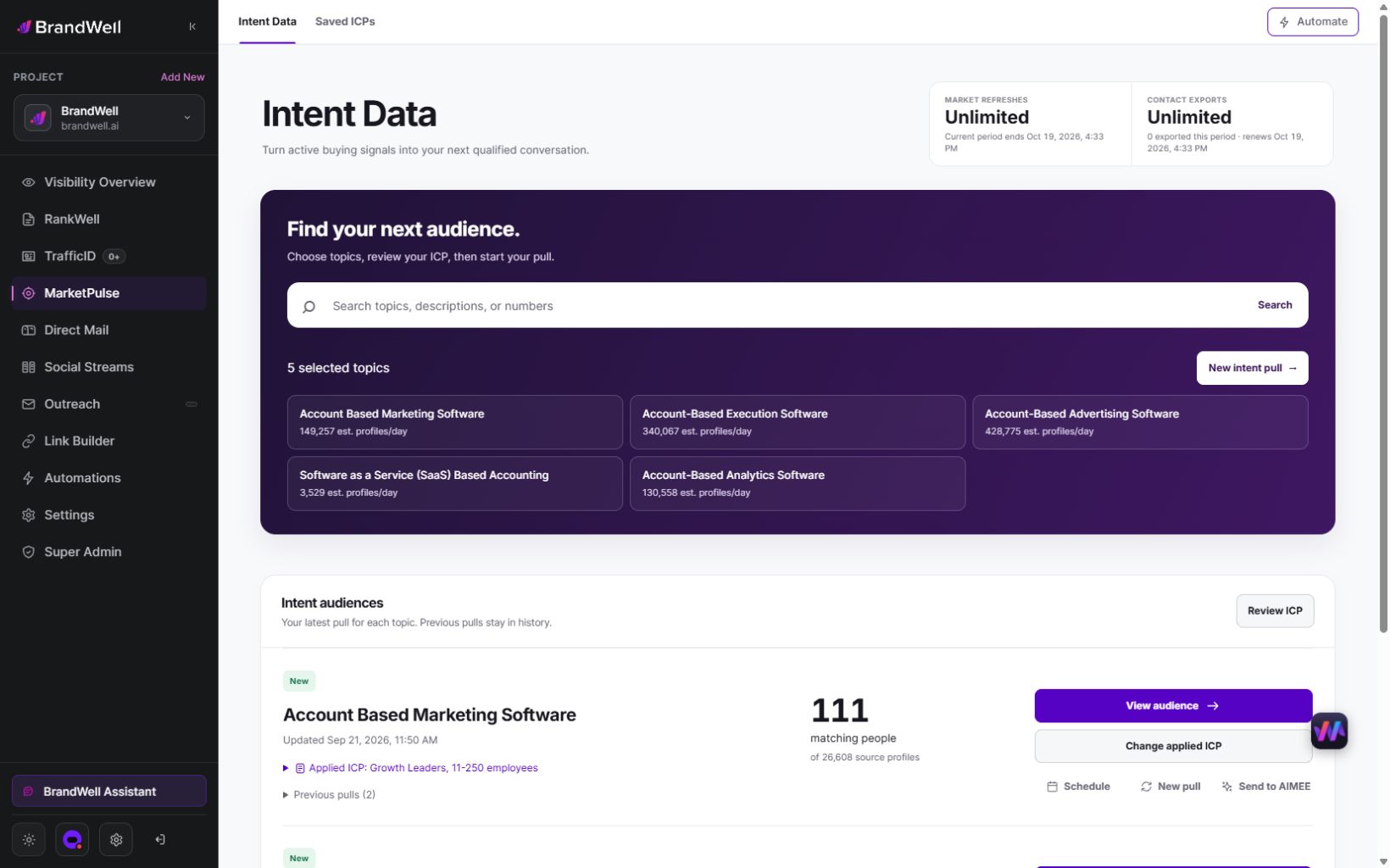
MarketPulse plans are starting at $500/mo. Verify current package scope and offers on the product page.
| Plan | Topics and refreshes | Monthly exports |
|---|---|---|
| Starter | 1 topic, weekly | 25,000 contacts |
| Growth | 3 topics, daily | 100,000 contacts |
| Scale | 10 topics, daily | Unlimited contacts |
Swipe the table to see all columns.
A pull retrieves available data from the previous 24 hours for one topic. Daily use across all included topics provides 90 Growth pulls or 300 Scale pulls in a 30-day month. Weekly Starter pulls vary by calendar month. Available audience size and contact fields vary, and audiences may overlap. Refreshes stop at the plan limit without overage charges.
- Find and qualify: search the topic catalog, save your ICP, and review the people and companies that match.
- Act on the research: export qualified contacts or prepare an Outreach or Direct Mail workflow. Connected products, channel usage, and fulfillment may cost extra.
- Get help from AIMEE: Growth and Scale include AIMEE for the initial user to research accounts and prepare the next step through connected tools.
Agencies and other service businesses can build client deliverables around their available Intent Scans and exports. Keep each client’s scope, permissions, and service fees clear. A subscription is not a promise of a white-label platform or exclusive access to a market.
Explore MarketPulse and watch the demo or compare plans starting at $500/mo. Any early-access discount is a separate, time-limited offer shown to an eligible recipient.
Define the approved marketing purpose
Begin with a bounded B2B marketing use case, such as prioritizing approved business accounts for research, campaign planning, or human sales review. Identify the client entity, regulator or oversight environment, products, audience, jurisdictions, systems, and internal policies before choosing data. An institutional buyer campaign is not automatically low risk simply because the audience is a business.
Define success as consistent, reviewable marketing operations: relevant topics, correct account resolution, proportionate actions, recorded dispositions, and learning. Pipeline and revenue may be observed in the client’s system, but they depend on many factors and need explicit attribution labels. They should not be the unconditional service promise.
Recurring value comes from maintaining the controls as topics, products, users, sources, destinations, and rules change. Use BrandWell’s agency intent-data compliance program guide as an operational starting point, then adapt it through authorized client and counsel review.
Create a written allow-list for ordinary marketing actions and a deny-list for consequential uses. The allow-list might include approved account research, campaign planning, and human sales review. The deny-list should cover any use the client has prohibited and any movement into credit, underwriting, suitability, eligibility, pricing, or comparable decisioning without a separately authorized program.
Assign evidence and approval owners
The minimum team includes an agency delivery lead, data or signal analyst, client marketing owner, client data owner, activation owner, security reviewer, privacy reviewer, and legal or compliance reviewer authorized by the client. Procurement and vendor-risk owners may also be required. Do not let an account manager approve a new purpose or destination alone.
- Classify: document product, audience, purpose, data categories, jurisdictions, systems, and prohibited uses.
- Approve: record source rights, client instructions, provider terms, roles, retention, and review decisions.
- Configure: establish topics, entity and identity states, exclusions, suppression, and marketing-only destinations.
- Test: sample quality, tenant isolation, access, correction, failure, and decisioning-firewall controls.
- Operate: deliver to named humans, record receipts and dispositions, and keep exceptions visible.
- Reconcile: check source, portal, destination, and client records; investigate unexpected movement.
- Review: reassess purpose, rights, users, sources, topics, model rules, retention, incidents, and economics.
The cadence should follow risk and change, not a generic template. A new integration or audience should trigger review even if the next scheduled meeting is later. Put approval limits and stop authority in the runbook.
Evaluate the supported account workflow
Look for a capability chain: contracted signal and enrichment sources, entity resolution, separate identity and contact validation, rule-based qualification, access and tenant management, a client review queue, controlled CRM or marketing destinations, monitoring, correction, retention, and an evidence ledger. Where required by the client’s program, tools may also need security documentation, audit support, incident processes, and subprocessors information.
Evaluate actual contracts and controls. Ask what data is collected, why, from where, under which rights, how it is matched, who can access it, where it is stored, how long it remains, how errors are corrected, and how offboarding works. Test a prohibited-use scenario and verify that the service cannot feed a consequential decision system through an undocumented export or shared field.
Useful templates include a purpose statement, use allow-list and deny-list, data-flow map, role matrix, source-rights register, control test, change request, incident path, decisioning-firewall test, evidence ledger, client review, and offboarding certificate. A “best platform” comparison is incomplete without the client’s own security, legal, compliance, procurement, and architecture requirements.
Compare research with approved first-party context
| Approach | Strength | Risk or limitation | When it fits |
|---|---|---|---|
| Static account program | Clear approved universe and simple governance | May ignore changing research context | Complete market coverage or restricted environments |
| Manual research | Contextual judgment and careful exception handling | Slower, harder to standardize, and still subject to data rules | Small, high-value, or novel account sets |
| Intent-led prioritization | Adds timely research context to approved accounts | Can be mistaken for individual certainty or regulated decisioning | Marketing review with explicit purpose and controls |
| Compliance-reviewed hybrid | Combines standard signals, rules, and human approval | Higher setup and governance work | Most repeatable financial-services agency packages |
Swipe the table to see all columns.
Choose the least complex approach that answers the marketing question. Intent data should not be added merely because it is available. If the client cannot keep the output separate from regulated decisioning, use a safer manual or non-intent workflow, redesign the systems, or avoid the service.
Model recurring cost and review burden
Model discovery and governance as real delivery costs. Setup can include purpose classification, data and system mapping, source and contract review, procurement support, topic design, access configuration, integration, firewall testing, QA, documentation, and training. Recurring cost includes wholesale and usage, analyst review, client service, reporting, monitoring, corrections, control testing, support, change reviews, and allocated overhead.
Copyable financial-services price floor
Setup floor = discovery + source and contract review + workflow design + integration + control testing + documentation + training
Recurring cost = platform and usage + operations + QA + client service + monitoring + approved review + allocated overhead
Client price floor = recurring cost / (1 - chosen contribution rate)
Change event = new product + new audience + new source + new destination + new jurisdiction + new consequential-use risk
There is no responsible universal price or margin benchmark. Use actual requirements, client response time, vendor terms, review burden, capacity, and the agency’s chosen contribution target. Price change work explicitly instead of assuming the original setup covers every future review.
Measure marketing outcomes and delivery cost
Track control and quality first: approved sources, purpose exceptions, access reviews, stale records, duplicate entities, identity-confidence distribution, corrections, destination receipts, firewall test results, unresolved incidents, and closure time. Adoption metrics include active approved reviewers, completed dispositions, accepted account research, suppressed records, and documented campaign decisions.
Agency metrics include recurring fee, cost to serve, review and support hours, change requests, contribution, collection status, renewal, contraction, and expansion. Client marketing outcomes may include responses, meetings, opportunities, pipeline, or revenue when the agreed system supports them. Preserve sourced, influenced, associated, and unknown labels.
A lack of control exceptions does not by itself prove effectiveness or compliance. Likewise, a marketing outcome does not validate every input or use. Review performance, evidence, and governance as separate dimensions.
Choose clients with a separated marketing scope
The best fit is an agency with disciplined delivery and a client that can name the B2B marketing purpose, owners, approved systems, security requirements, and activation capacity. The client must be willing to involve authorized privacy, legal, compliance, security, and procurement reviewers where applicable. A maintained CRM and explicit dispositions make learning possible.
An early program should begin with a small approved account set and manual review. A mature program may automate bounded handoffs after control tests pass. Complex organizations may require separate tenants, business units, products, jurisdictions, or entitlements. Treat those as scope, not a single generic feed.
Exclude use cases seeking creditworthiness, underwriting, eligibility, pricing, suitability, financial advice, or other consequential conclusions from marketing intent. Also pause when data rights are unclear, client owners are absent, the firewall cannot be tested, or sales asks the agency to imply compliance certification.
Preserve evidence and allowed destinations
Use only approved sources for the defined B2B marketing purpose. Inputs may include company-level topic research, permitted website behavior, client first-party engagement, firmographic fit, and CRM relationship. Record the source, topic, timestamp, company match, permitted use, confidence, and exclusions. Do not infer a particular person’s activity from a company-level signal.
Keep entity, person, contact, and role validation separate. A valid business email does not prove authority, need, suitability, or creditworthiness. At activation, route a proportionate marketing action to an approved human or system. Include reason codes and prevent the priority field from flowing into a restricted decision process.
The evidence ledger should retain source reference, versioned rule, identity state, reviewer, destination receipt, disposition, and outcome association. Use BrandWell’s lead and intent data quality assurance checklist to test the handoff without converting confidence into certainty.
Review the actual regulatory scope
The largest strategic risk is purpose drift: a marketing score gradually reused for a decision it was never designed or approved to support. Operational risks include shared fields, uncontrolled exports, mistaken identity, stale topics, excessive access, undocumented model changes, weak vendor oversight, and retention beyond need. Trust risk appears when the agency calls the service compliant or predicts an individual’s financial behavior.
The Federal Reserve security guide addresses covered financial institutions. The FTC Safeguards guide scopes its rule to covered institutions under FTC jurisdiction. Have authorized reviewers determine actual applicability, contracts and controls. Neither source establishes that every agency shares the same obligations.
The May 2025 withdrawal notice includes CFPB Circular 2022-03. Do not treat that circular as current guidance. This article scopes business marketing research and excludes credit decisions. Obtain current qualified review of the actual laws and permitted use.
Have qualified reviewers determine actual requirements. Use BrandWell’s procurement readiness checklist to prepare evidence without representing that a checklist proves compliance.
Test the decisioning firewall as a system, not a sentence
List every field, export, API, shared table, user role, automated rule, and downstream destination that could move the marketing priority. Test that restricted users and systems cannot retrieve or repurpose it through an ordinary path. Review diagrams only as orientation; the authoritative evidence should be configuration, access, transfer, and exception records.
Repeat the test after a new integration, field mapping, product, audience, source, or jurisdiction. A policy that says “marketing only” is not enough if a shared field quietly reaches a consequential workflow. Record the tester, result, exception, owner, remediation, and authorization to resume.
Maintain the recurring account review
A recurring package can include approved topic monitoring, company resolution, quality and identity checks, a human marketing review queue, controlled activation, evidence reporting, control testing, and a governance review. Separately scope new products, audiences, sources, jurisdictions, destinations, custom security work, or higher-frequency review. Sustainable economics depend on adoption, standardized controls, priced change work, and actual delivery cost.
AIMEE can help prepare an approved business account brief through configured connected tools. Preserve the evidence, missing fields and human approval owner. Marketing research must not become an input to credit, underwriting, eligibility or pricing decisions.
Start with supported MarketPulse topic research starting at $500/mo. Verify the actual topic, fields and permissions, then use configured BrandWell tools to prepare an approved marketing action. A plan price does not establish regulatory suitability or approve a financial-services use case.
Copyable P-R-O-O-F review for an assistant
ROLE: Act as a B2B marketing operations reviewer. Do not provide legal advice, certify compliance, make regulated decisions, or activate records.

INPUTS:
- approved marketing purpose and explicit prohibited uses
- source, rights, data categories, identity states, and retention
- systems, fields, roles, exports, and destinations
- qualification rules and decisioning-firewall design
- client control requirements and named approvers

TASK:
1. Test Purpose, Rights, Owners, Output firewall, and Facts.
2. Map each field from source to destination and flag side paths.
3. Separate company signals, person identity, contact validation, and outcomes.
4. Mark claims supported, limited, unavailable, or requiring specialist review.
5. Draft a control-test plan, exception list, and human approval record.

STOP CONDITIONS:
- Do not infer intent, authority, budget, creditworthiness, suitability, eligibility, or financial condition.
- Do not invent rights, approvals, benchmarks, prices, identity, or outcomes.
- Do not export, contact, score for a regulated decision, alter access, or change production systems.

HUMAN APPROVAL REQUIRED:
The client marketing and data owners approve purpose and workflow. Authorized privacy, security, legal, compliance, procurement, and sector reviewers approve applicable controls. A human approves every activation and production change.
Claude, ChatGPT, or AIMEE can document the review and expose gaps. It cannot replace the client owners or qualified reviewers.
Test the decisioning boundary before scaling
Choose one narrow B2B marketing use, map every field and destination, and test a prohibited path. If the team cannot show where marketing prioritization stops, do not activate the service.
Worked example: a contribution target is not a markup
Suppose an agency defines a fictional recurring month’s tools, analyst review, specialist review and reporting costs as $2,000. For a chosen 40% contribution target before acquisition, setup recovery, general overhead, tax and financing, the price floor is $2,000 / (1 – 0.40) = $3,333.33. Adding a 40% markup instead gives $2,800 and a $800 remainder: 28.6% of revenue, not 40%.
At a $3,500 fee, the $1,500 remainder is 42.9%. If an exception requires five additional specialist hours at $150, cost becomes $2,750 and the remainder falls to $750, or 21.4%. These amounts are invented planning inputs, not typical performance, specialist quotes or BrandWell financial-services terms. Price unresolved review work explicitly and stop excluded uses even when the account is profitable.
Prepare an approved marketing brief in BrandWell
Check an available MarketPulse business topic against the saved client ICP and the approved purpose. Preserve the actual preceding-24-hour pull window. AIMEE can help draft a minimized brief using configured tools and flag missing evidence. A reviewer checks the fields, message and destination before activation. Do not place that research, its score or derived labels in a credit, underwriting, eligibility or pricing workflow.
Frequently asked questions
Does topic research establish creditworthiness?
No. This workflow is limited to approved business marketing research and excludes credit decisions.
Is the 2022 CFPB circular current guidance?
The May 2025 notice includes it among withdrawn guidance. Use current qualified review instead.
Is a 40% markup a 40% contribution rate?
No. Contribution divides the defined remainder by revenue; markup uses cost as its denominator.
Does a MarketPulse subscription approve a financial-services use case?
No. Verify actual contracts, data rights, controls and regulatory scope separately.
Review supported business research: explore MarketPulse and current plans.
Reviewed and updated October 3, 2026.

Written by