On this page
- Current MarketPulse research workflow
- Choose one country and client case
- Assign country and specialist review owners
- Evaluate the supported country record
- Compare standardization, local delivery and referral
- Model launch and recurring country costs
- Measure launch health and accepted delivery
- Choose clients ready for country review
- Keep source, identity and activation evidence separate
- Control transfer and localization changes
- Maintain the recurring country module
- Verify country coverage before calculating a launch return
- Worked example: launch recovery changes recurring economics
- Frequently asked questions
Direct answer: Expand an agency intent service one market at a time. Before launch, verify the lawful purpose, source rights, identity method, transfers, local activation rules, language, sales ownership, usable coverage, and unit economics for that country. Reuse operating principles, but never assume one global data or outreach playbook is permitted or effective everywhere.
Current MarketPulse offer: intent-data plans start at $500/mo. See the product, demo, and current plans. Updated October 3, 2026.
Who this is for: Agency owners, privacy leaders, counsel, and market-expansion operators deciding whether a proven domestic intent service can be offered in one specific additional country.
International expansion is a controlled replication problem, not a translation project. A workflow that is economical and allowed in one market can fail elsewhere because the source contract, data-transfer arrangement, identity coverage, channel rule, local expectation, or handoff model differs. “Global” should describe an operating ambition, not an unsupported permission or coverage claim.
Choose one country and one client case. Assign a local reviewer. Preserve a written decision trail. The agency’s broader intent-data compliance program can supply common control patterns, but each market needs its own rule, source, transfer, and activation record.
Current MarketPulse research workflow
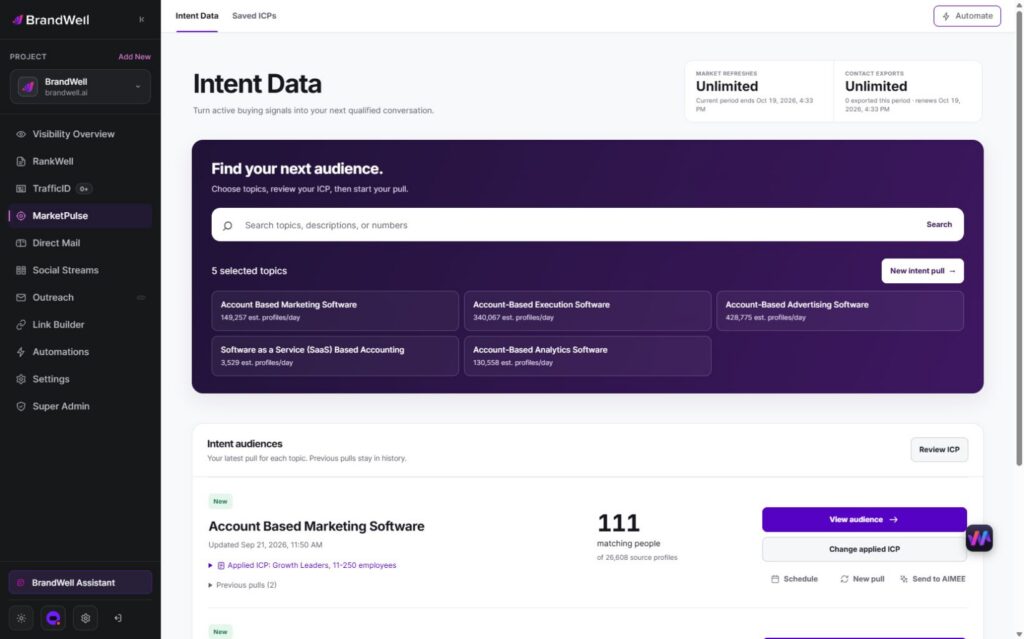
BrandWell MarketPulse: intent data starting at $500/mo. Find people researching topics relevant to what you sell, apply saved ICP filters, and review available contact details before taking action.
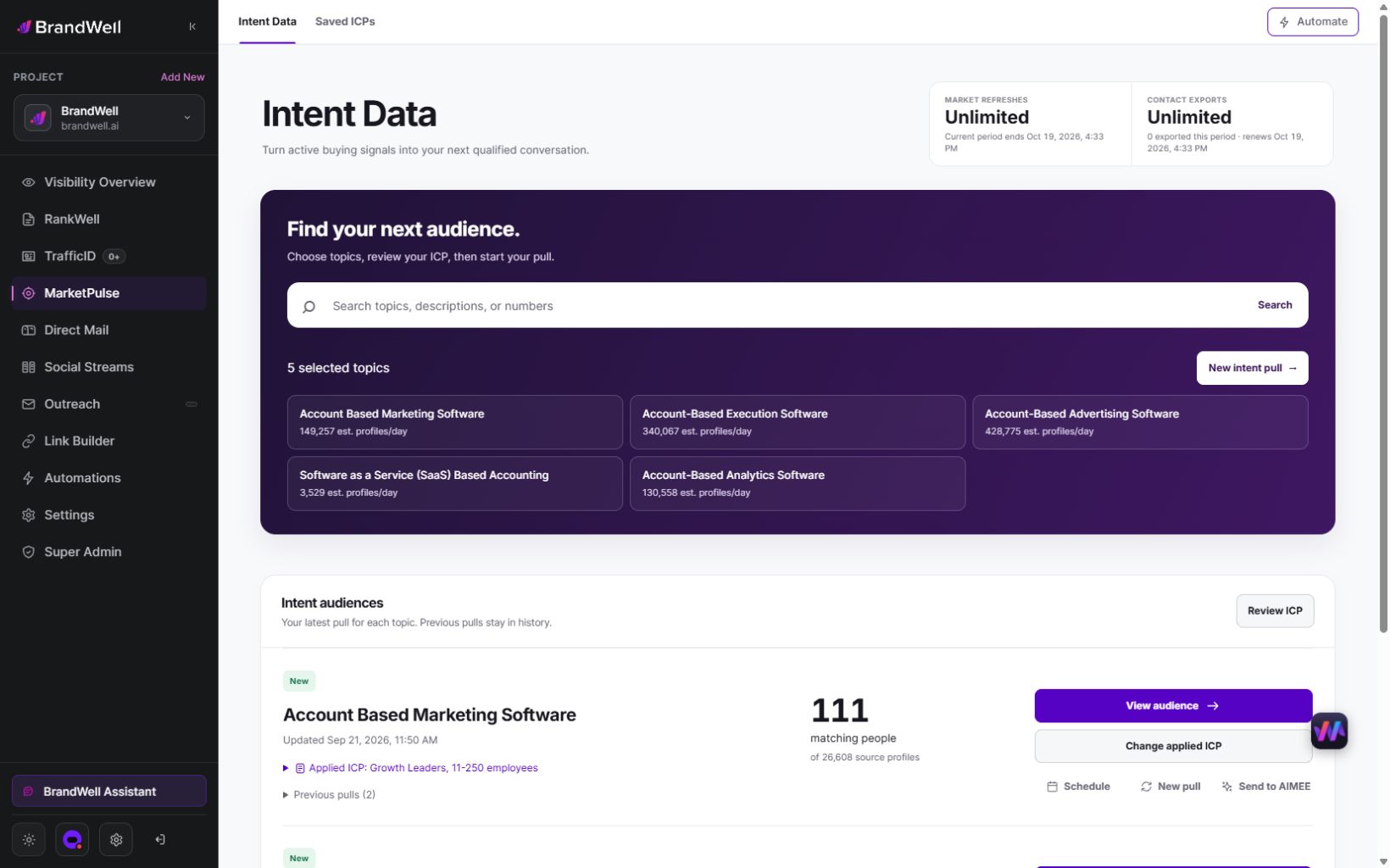
MarketPulse plans are starting at $500/mo. Verify current package scope and offers on the product page.
| Plan | Topics and refreshes | Monthly exports |
|---|---|---|
| Starter | 1 topic, weekly | 25,000 contacts |
| Growth | 3 topics, daily | 100,000 contacts |
| Scale | 10 topics, daily | Unlimited contacts |
Swipe the table to see all columns.
A pull retrieves available data from the previous 24 hours for one topic. Daily use across all included topics provides 90 Growth pulls or 300 Scale pulls in a 30-day month. Weekly Starter pulls vary by calendar month. Available audience size and contact fields vary, and audiences may overlap. Refreshes stop at the plan limit without overage charges.
- Find and qualify: search the topic catalog, save your ICP, and review the people and companies that match.
- Act on the research: export qualified contacts or prepare an Outreach or Direct Mail workflow. Connected products, channel usage, and fulfillment may cost extra.
- Get help from AIMEE: Growth and Scale include AIMEE for the initial user to research accounts and prepare the next step through connected tools.
Agencies and other service businesses can build client deliverables around their available Intent Scans and exports. Keep each client’s scope, permissions, and service fees clear. A subscription is not a promise of a white-label platform or exclusive access to a market.
Explore MarketPulse and watch the demo or compare plans starting at $500/mo. Any early-access discount is a separate, time-limited offer shown to an eligible recipient.
Choose one country and client case
Start with a market thesis that names the country, client segment, B2B business purpose, buyer problem, expected action, accountable owner, and reason the existing service may transfer. Do not begin with a multi-country rollout. A single-country learning cycle exposes missing rights, source gaps, language problems, and support needs without multiplying them.
Separate the reusable core from the local layer. Reusable components can include evidence definitions, account-fit logic, report structure, QA stages, incident handling, and economic modeling. Local components include applicable rules, data flow, country permission, identity resolution, language, consent or opt-out practice, sender identity, suppression, tax and billing dependencies, and escalation ownership.
The outcome is a go, conditional-go, refer, or no-go decision. “Refer” means a qualified specialist must resolve an issue. “Conditional-go” means the agency can proceed only after named controls are met. This disciplined market gate can support recurring revenue, but the service cannot guarantee pipeline, revenue, sales, or demand in the new country.
Assign country and specialist review owners
Assign a global service owner, country owner, qualified local legal or privacy reviewer, security and data owner, source or vendor owner, analyst, activation owner, client sales owner, and finance or contracting owner. Avoid leaving “international” with a general operations team that lacks decision authority.
The process begins with a country intake and a data-flow map. Review purpose, sources, permitted countries, roles, exporter and importer, subprocessors, systems, storage, access, retention, deletion, channel, consent or opt-out logic, suppressions, language, and complaints. Next, run a contained evidence and coverage test using the approved scope. Only after human review should the client activate records.
Hold weekly launch reviews until exceptions stabilize. Run monthly country governance after launch. Re-open the review when a law, regulator position, contract, subprocessor, source, transfer mechanism, destination, topic, or client purpose changes. Maintain versioned decisions rather than overwriting the old rationale.
Evaluate the supported country record
The essential tool is a controlled country record, supported by systems that reveal rather than flatten differences. Use:
- Country rule register: primary source, scope, status, reviewer, interpretation note, and open question.
- Source-rights matrix: provider, collection context, permitted country, purpose, onward use, and contract restriction.
- Data-flow map: parties, roles, systems, subprocessors, access, storage, retention, deletion, and transfer path.
- Coverage test: account resolution, location accuracy, contactability, language, duplicates, exclusions, and usable cohort.
- Activation checklist: approved channel, sender, consent or opt-out path, suppression, message, destination, and owner.
- Economics sheet: review, localization, delivery, currency, billing, support, and exception cost.
- Decision log: go, conditional-go, refer, or no-go with approvers and prerequisites.
When choosing infrastructure, evaluate an intent-data vendor on country-specific rights, source evidence, transfer posture, identity performance, deletion, support, and contract terms. Brand recognition does not establish permission or usable local coverage.
Compare standardization, local delivery and referral
A standardized platform model is useful when common controls are stable and the local layer can be expressed as configuration. A managed local service is stronger when language, rules, market structure, or activation requires specialist judgment. Manual research is appropriate for a small test cohort, strategic accounts, or uncertain identity coverage. Referral to a local partner can be the best option when the agency lacks qualified review or sales ownership.
Keeping the service domestic is a valid decision when the new market lacks usable account evidence, permitted source rights, a defensible transfer path, a local activation process, or acceptable economics. Do not frame a no-go as failure. It is evidence that the current model should not be exported.
Compare options on controllability, local expertise, evidence quality, time to launch, support burden, reversibility, client demand, and cost. A more automated option is not better if it hides jurisdiction or source differences. A manual approach may produce less volume but better learning before the agency commits to recurring operations.
Model launch and recurring country costs
Separate one-time launch cost from recurring country delivery. Launch cost includes qualified review, contract analysis, source validation, transfer and systems mapping, localization, coverage testing, channel setup, client training, and documentation. Recurring cost includes data and platform use, ongoing review, translation or local copy, QA, support, reporting, deletion and complaint handling, and change monitoring.
Country expansion economics sheet
- Market setup: research, qualified review, contracts, transfer analysis, source validation, and localization.
- Operating floor: governance, systems, support, reporting, and market-owner time.
- Unit work: topics, accounts reviewed, contacts checked, destinations, language variants, and exceptions.
- Commercial dependencies: currency, payment, tax, term, client price, and sales ownership.
- Decision threshold: minimum client scope and contribution required under conservative, expected, and high-effort cases.
Do not assume data volume or reuse a domestic conversion rate. Use the coverage test and actual delivery hours to replace assumptions. Include the cost of a no-go decision in portfolio planning; spending modestly to reject an unsuitable market can prevent a much larger operating loss.
Model a pause and exit case as well. Record the cost to stop collection, remove access, return or delete data where required, notify the client, close local destinations, and retain only the permitted evidence record. Reversibility is part of the investment decision because a country may become uneconomical or unsuitable after launch.
Measure launch health and accepted delivery
Launch-health measures include unresolved control count, source and contract exceptions, account-resolution rate, usable cohort, language-review rejection, suppression, deletion or complaint events, routing latency, local owner acceptance, and coverage drift. These indicate whether the market is governable.
Delivery metrics include accepted accounts, client action, response by approved cohort, observed qualification, support time, cost per accepted account, country-level contribution under the stated model, renewal, expansion, and cancellation reasons. Report commercial outcomes as observed events. Do not attribute a transaction to intent merely because the signal occurred earlier.
Set maintenance triggers. Rescan primary sources and contract status at an appropriate cadence, but also react to change notices, regulator updates, subprocessor changes, complaints, incidents, and source shifts. A green launch decision is not permanent. Each country record should show the current owner, next review trigger, and unresolved questions.
Choose clients ready for country review
Expansion fits agencies with a proven domestic workflow, a real client case in one target country, enough recurring scope, clear account buyers, a local sales or partner owner, qualified review, and the ability to support data subject, complaint, deletion, and security processes. The client should understand that market validation precedes activation.
Poor fits include speculative “global coverage” offers, client demand for immediate multi-country volume, consumer or sensitive-person targeting, unclear exporter and importer roles, no permitted source rights, no local-language review, no suppression process, or economics that depend on guaranteed conversion.
Stage the path. An agency can start with a manual research assessment, move to a limited country pilot, then standardize only after rules, evidence, support, and unit economics are stable. Different countries may remain at different stages indefinitely.
Keep source, identity and activation evidence separate
For every source, record country scope, collection context, permitted purpose, onward use, contract restriction, update process, and termination or deletion condition. For identity, test company match, domain, location, legal entity, language, contactability, duplicates, and exclusions with a country sample. Do not infer that coverage in one market predicts another.
The activation record needs channel, sender identity, lawful-use decision or other applicable condition, message language, consent or opt-out handling, global and local suppressions, destination, sales owner, and escalation. The outcome ledger should show client acceptance, actual action, reply, qualification, complaint, deletion, incident, rejection, and cost. Separate the signal observation from each later event.
Use the evidence to select central nurture, local research, client review, account advertising, sales handoff, suppression, or no action. Ambiguous source rights, transfer paths, or identity stop the record. The workflow should make uncertainty visible rather than translate it into a universal score.
Control transfer and localization changes
Common failures include assuming domestic rules travel, relying on search snippets instead of primary sources, ignoring transfer and onward-use restrictions, overstating country coverage, confusing company location with individual location, weak consent or opt-out operations, poor localization, no complaint owner, hidden subprocessors, and margins erased by exceptions.
European Commission transfer materials describe safeguards for personal data leaving the EEA. ICO transfer guidance addresses the UK regime. Qualified reviewers must assess the actual parties, flows and rules; these links do not approve a campaign.
The 8-column Country Launch Control Matrix
- Market and client case: one country, segment, purpose, sponsor, and success decision.
- Lawful-use decision: applicable regime, required condition, marketing rules, primary sources, and local reviewer.
- Source and rights: collection context, permitted countries and purposes, onward use, and contract restrictions.
- Identity and coverage: account resolution, contactability, language, location accuracy, exclusions, and usable cohort.
- Transfer and storage: exporter, importer, systems, subprocessors, mechanism, access, retention, and deletion.
- Activation and suppression: channel, sender, consent or opt-out handling, message, destination, and local plus global suppressions.
- Delivery and economics: handoff, SLA, review hours, currency, billing dependencies, delivery cost, and client price.
- Evidence and decision: acceptance, outcome, complaint, deletion, incident, margin, conditions, and go status.
Test operational reality with a small set of client-approved accounts. Ask the local owner to review identity, language, ownership, and next action before anything reaches an activation system. Record rejection reasons in the country matrix. A small, honestly reviewed cohort provides more decision value than a large export whose rights, identity, or routing remain uncertain.
Localization deserves evidence of its own. A translated message can remain technically correct and still carry an inappropriate tone, unsupported claim, or unfamiliar call to action. Require a qualified local reviewer to assess meaning, sender identity, disclosure, suppression instructions, and escalation language. Preserve the approved version and do not let an agent silently rewrite it for activation.
The agency should also maintain a dependency register for local partners, subprocessors, counsel, translators, and client owners. Name the service each party provides, the data or system it can access, the contract and review owner, and the fallback if it becomes unavailable. A country service is not operationally ready when one undocumented person is the only path to approval.
Record the market’s stop conditions before launch: an expired contract, an unverified source change, an unresolved complaint, a failed deletion, an unapproved subprocessor, identity quality below the chosen threshold, or loss of a local owner. A stop condition should name who pauses the service, which destinations are affected, what evidence is preserved, and who can authorize resumption.
Maintain the recurring country module
Offer a country module containing rule and source maintenance, approved topics, coverage checks, identity QA, localized activation, suppressions, delivery, evidence reporting, and change review. Define which elements are centralized and which require local ownership. Before sales expansion, prepare the service for procurement with the relevant data flow, security, privacy, contract, and operating evidence.
AIMEE can help organize a sourced country review packet through configured connected tools. Preserve verified facts, assumptions, reviewer interpretations and unanswered questions. Local specialists and authorized owners make the actual launch, transfer and activation decisions.
Copyable agent-ready workflow: country launch matrix compiler
Run this in Claude, ChatGPT, or AIMEE only as a research organizer. Human specialists make every consequential decision.
Goal: Prepare a sourced country launch review packet for one market and one client use case.
Inputs: target country; business purpose; qualified-reviewer notes; current primary legal sources; provider contracts and country documents; data-flow and subprocessor inventory; activation, suppression, SLA, and economics inputs.
Populate: the eight matrix columns. For every rule, attach source, scope, status, owner, and unresolved question. Separate verified facts, internal assumptions, reviewer interpretations, and missing evidence.
Decision options: go, conditional-go, refer, or no-go.
Stop if: a primary jurisdictional source is missing; transfer or onward use is unclear; country rights or coverage are unverified; local consent or suppression is absent; sales ownership is missing; or economics require guaranteed volume or revenue.
Output only: a review matrix and open-questions log. Do not make a legal conclusion, accept a contract, transfer data, activate a market, or send outreach.
Approvals: qualified local reviewer, security and data owner, client, and commercial owner.
Pilot one market without promising its outcome
MarketPulse topic plans are starting at $500/mo. Before including them in a country service, verify the specific country, source rights, coverage, fields and permitted destination. Do not extrapolate a domestic plan allowance into guaranteed foreign records. Custom localization, country review and integrations need separately verified scope.
MarketPulse plans are starting at $500/mo. Starter includes 1 topic, weekly refreshes, and 25,000 exportable contacts per month. Growth includes 3 topics, daily refreshes, and 100,000 exportable contacts. Scale includes 10 topics, daily refreshes, and unlimited contact exports. AIMEE for the initial user is included with Growth and Scale. Compare MarketPulse plans and current offers.
Verify country coverage before calculating a launch return
A country module needs an actual supported source, permitted use and approved destination. A generic plan price is not a quote for country-specific data, translations or legal work. Record confirmed coverage separately from unknown coverage; do not mark an untested country as zero or as fully supported.
Keep the date and scope of each reviewer decision. The provider’s country rights, the client purpose, data-transfer path and marketing-channel rules are separate questions. A decision about one does not answer the others. Reopen the country record when the source, contract, subprocessor, destination or local owner changes.
Worked example: launch recovery changes recurring economics
Suppose a fictional country pilot reviews 100 distinct approved accounts. Forty have sufficient source, identity and local-use evidence, and 20 are accepted by the local owner. Usable-account yield is 40%; local acceptance is 20 / 40 = 50% of usable accounts or 20% of the original cohort. Those are different denominators, and none represents a guaranteed opportunity rate.
Suppose recurring source costs are $500, local review is $600, localization is $400 and reporting is $300, for $1,800 defined recurring cost. A $2,500 fee leaves $700, or 28%, before acquisition, general overhead, tax and financing. If a $2,400 setup investment is planned to be recovered over six paid months, the planning allocation is $400 per month. Including that allocation produces $2,200 cost and a $300 remainder, or 12%. It assumes all six paid months occur; it is not an accounting policy or a promised renewal.
Four extra local-review hours at $100 add $400, taking the monthly result to negative $100 before the other exclusions. Include currency conversion, payment charges, tax treatment and exit costs when applicable, using actual quotes and dated assumptions. These amounts are invented in one reporting currency, not legal-service quotes or BrandWell international terms. If setup is already recovered through a separate fee, avoid charging the same recovery twice in this model.
Use BrandWell research only within confirmed country scope
Check the actual topic and geography support, available fields and permitted use before preparing a MarketPulse country sample. Preserve the preceding-24-hour window for every actual pull. Use a saved ICP with supported fields, then organize a sourced account brief through configured AIMEE tools. Obtain the local review and destination approval before any export or follow-up. If support is unavailable or unclear, use another verified assessment path or pause the affected scope.
Frequently asked questions
Does one country’s permission apply worldwide?
No. Review each source, flow, channel and jurisdiction in the actual client case.
Does a MarketPulse allowance guarantee international coverage?
No. Verify the specific supported country and available evidence separately.
Is a conditional-go decision permanent?
No. Record its prerequisites and reopen it when relevant facts change.
Should setup recovery be included in the cost model?
Make it explicit and avoid counting the same recovery in both a setup fee and recurring allocation.
Review the current product and ask scope-specific questions: explore MarketPulse.
Reviewed and updated October 3, 2026.

Written by