On this page
- Define the nine-gate mail operating model
- Current MarketPulse workflow
- Choose a controlled activation promise
- Assign audience, creative and fulfillment owners
- Evaluate the supported mail-production chain
- Compare build, resell, refer and avoid
- Price pieces, production and service work
- Preserve mailing and outcome evidence
- Choose clients with approved postal use
- Keep company, recipient and address states separate
- Control quality, production and expectation risks
- Maintain the recurring mail package
- Inspect a bounded first cohort
- Postal tracking is not proof that someone read the offer
- Worked example: postage is not the full service cost
- Frequently asked questions
Direct answer: Productize intent-based direct mail as a controlled account-activation service, not as an automatic response to a signal. The agency should promise that qualified company evidence will pass through permitted-address, suppression, creative, fulfillment, and client-approval gates before mail is sent. It should not promise delivery, response, meetings, or revenue.
Current MarketPulse offer: intent-data plans start at $500/mo. See the product, demo, and current plans. Updated October 3, 2026.
Direct mail earns a recurring place when the agency can maintain audience rules, address quality, creative approval, fulfillment evidence, returned-mail handling, opt-out controls, and measured follow-up.
Who this is for: Agencies serving B2B clients with focused account lists, sufficient deal value, approved postal use, and a human-owned follow-up motion.
Product boundary: BrandWell’s current Direct Mail product supports postcards to eligible verified home mailing addresses with suppression, proof approval and authorized spend. Business-address executive packages and custom formats discussed below are separate agency concepts; verify their provider, rights and implementation rather than implying BrandWell fulfills them.
Define the nine-gate mail operating model
- Purpose: define the permitted business use and the decision the mail supports.
- Organization: confirm that the signal is company-level unless stronger evidence exists.
- Selection: apply account fit, recency, exclusions, and frequency controls.
- Target address: use only an approved postal source and validation method.
- Message: approve creative without exposing sensitive or surprising inferences.
- Authorization: obtain client release before production.
- Receipt: preserve production, induction, delivery, and return states without overstating them.
- Knowledge: connect responses and client actions to the original cohort.
- Keep-out: update suppression, opt-out, and future-frequency rules.
This is an intent based direct mail services framework, implementation guide, and operational checklist. Every gate can stop a mailpiece before cost or privacy risk increases.
Current MarketPulse workflow
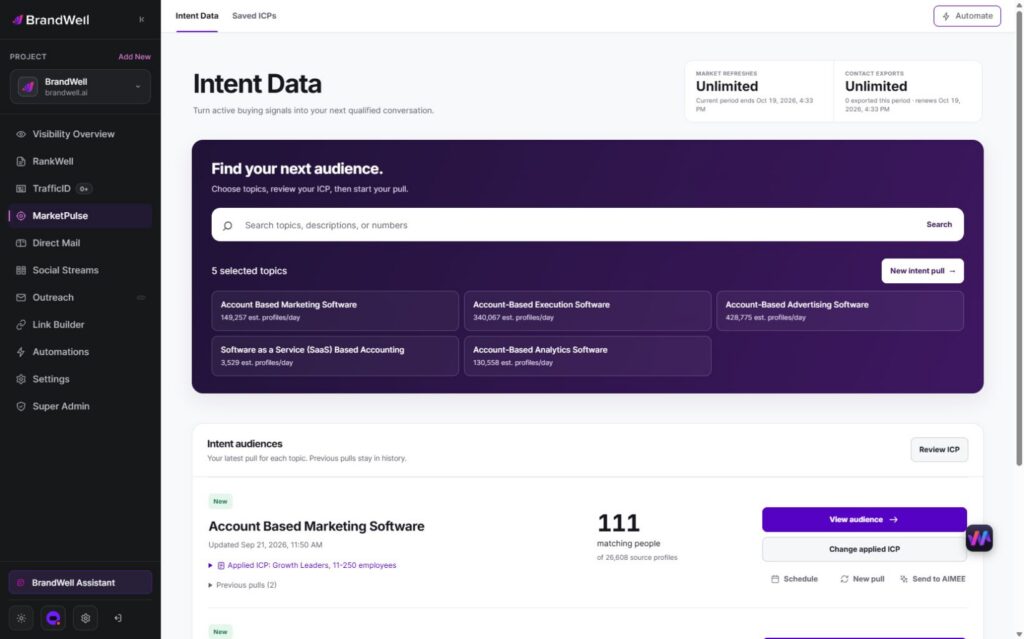
BrandWell MarketPulse: intent data starting at $500/mo. Find people researching topics relevant to what you sell, apply saved ICP filters, and review available contact details before taking action.
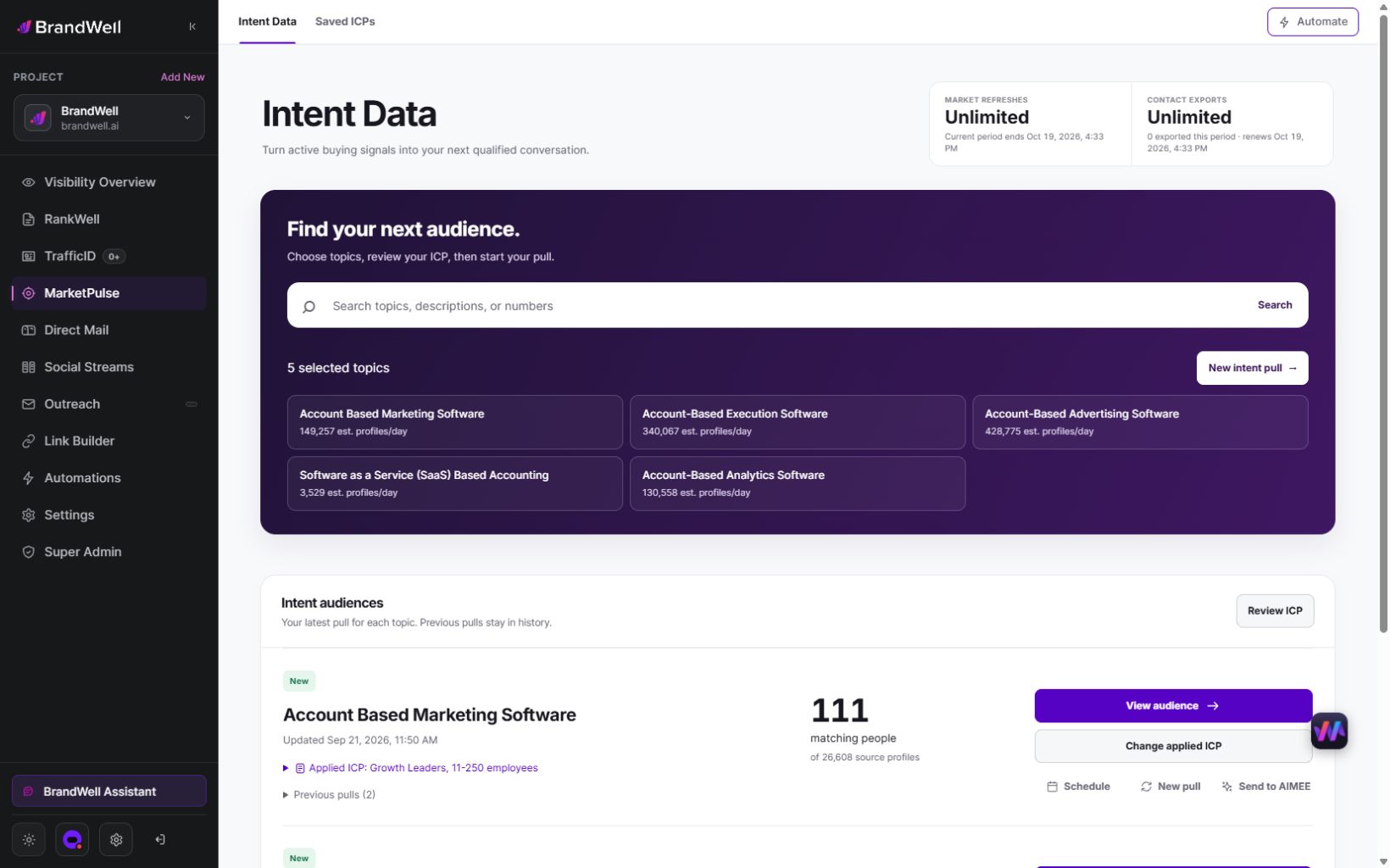
MarketPulse plans are starting at $500/mo. Verify current package scope and offers on the product page.
| Plan | Topics and refreshes | Monthly exports |
|---|---|---|
| Starter | 1 topic, weekly | 25,000 contacts |
| Growth | 3 topics, daily | 100,000 contacts |
| Scale | 10 topics, daily | Unlimited contacts |
Swipe the table to see all columns.
A pull retrieves available data from the previous 24 hours for one topic. Daily use across all included topics provides 90 Growth pulls or 300 Scale pulls in a 30-day month. Weekly Starter pulls vary by calendar month. Available audience size and contact fields vary, and audiences may overlap. Refreshes stop at the plan limit without overage charges.
- Find and qualify: search the topic catalog, save your ICP, and review the people and companies that match.
- Act on the research: export qualified contacts or prepare an Outreach or Direct Mail workflow. Connected products, channel usage, and fulfillment may cost extra.
- Get help from AIMEE: Growth and Scale include AIMEE for the initial user to research accounts and prepare the next step through connected tools.
Agencies and other service businesses can build client deliverables around their available Intent Scans and exports. Keep each client’s scope, permissions, and service fees clear. A subscription is not a promise of a white-label platform or exclusive access to a market.
Explore MarketPulse and watch the demo or compare plans starting at $500/mo. Any early-access discount is a separate, time-limited offer shown to an eligible recipient.
Choose a controlled activation promise
Offer the service when a client has a narrow B2B account universe, a meaningful reason to use a physical channel, adequate economics, and permission to use the required postal data. Promise an approved, traceable process that turns qualified company signals into mailed pieces and records what happened next. The outcome is controlled activation and evidence, not guaranteed attention or demand.
Intent can help prioritize the account cohort, but a company signal does not prove that a household or a named individual showed intent. A responsible strategy keeps company, location, recipient, and household states separate. Creative should not reveal or imply sensitive research behavior. A neutral business message at an approved business address is materially different from a personalized piece sent to a home using inferred personal context.
Direct mail may be wrong when deal value cannot support production and postage, addresses are unreliable, the client lacks a follow-up owner, or the use would surprise recipients. Digital outreach, client-owned account research, or a one-off creative test are valid alternatives. Do not force the channel simply because a signal exists.
Assign audience, creative and fulfillment owners
The program owner defines account and signal rules. A data operator validates company identity, address source, exclusions, and suppression. A creative lead develops approved variants. A fulfillment partner prints, prepares, and submits the mail. The client owner approves audience and creative, owns sales follow-up, and records disposition. Privacy, legal, procurement, and brand reviewers enter where the use, jurisdiction, contract, or creative requires them.
- Approve purpose, entity level, audience, address sources, exclusions, and frequency.
- Build the company cohort and preserve the signal timestamp and qualification reason.
- Validate postal fields, remove duplicates, apply suppression, and quarantine conflicts.
- Generate an approval proof using minimized data and neutral creative.
- Obtain client release for exact count, cost ceiling, creative, and destination action.
- Send the approved production file to the contracted fulfillment path.
- Capture production receipt, mailing status, returned mail, response, and client action.
Set SLAs for cohort preparation, address exception review, proof approval, production-file release, fulfillment evidence, return processing, and reporting. Separate agency timing from postal transit and client delay. Handoff includes cohort ID, company, permitted recipient and address state, signal context, creative version, approval, fulfillment reference, suppression state, and next owner. Use the lead and intent-data quality assurance process to define acceptance tests before production.
Evaluate the supported mail-production chain
The best setup is a governed chain of capabilities. It needs signal and account qualification, approved company and postal identity, address validation, duplicate and suppression control, creative proofing, print and fulfillment, delivery or return evidence where available, CRM cohort tracking, and client reporting. No single feature list determines fit.
Evaluate any build, mailing platform, fulfillment partner, or white-label provider with the same criteria: address source and rights, validation method, supported mail classes, proof and approval controls, data retention, production security, file transfer, error remedies, return data, cancellation window, integrations, support, and quote-backed costs. Confirm who acts as mail owner, who has the production file, and how deletions or suppressions propagate.
AIMEE can help prepare a reviewed account brief and campaign through configured connected tools. Preserve source meaning, identity uncertainty, postal eligibility, suppression, approved creative and the authorized spend limit.
Compare build, resell, refer and avoid
| Choice | When it fits | What the agency still owns |
|---|---|---|
| Build workflow | Low volume, limited variants, and experienced production management. | Security, address QA, proofs, vendor coordination, returns, and reporting. |
| Resell or white-label | A contracted partner supports branding, approvals, fulfillment, evidence, and remedies. | Client scope, audience quality, creative truth, and expectations. |
| Refer | Complex production, specialized formats, or regulated use exceeds agency capability. | A clear handoff and honest limits on agency control. |
| Avoid | Personal-address rights, purpose, suppression, or client approval are unresolved. | The obligation to refuse an unsafe activation. |
Swipe the table to see all columns.
The comparison should include a one-off project and a no-mail option. A one-off may validate data, creative, and fulfillment before a recurring program. Digital account outreach may fit lower-value cohorts. Build versus resell depends on operating control, not just platform cost. A common mistake is treating print execution as the product while leaving audience governance unpriced.
Price pieces, production and service work
Calculate price from distinct units. Setup can include strategy, data-source review, cohort rules, creative, proofing, integration, and fulfillment configuration. Recurring intent based direct mail services cost includes signal or data access, address work, list hygiene, design changes, print, personalization, postage, fulfillment, returns, vendor minimums, operator labor, privacy review, client approvals, reporting, and overhead.
Copyable mail-unit economics worksheet
Approved cohort cost = data and validation + audience QA + creative and proof allocation
Per-piece mailed cost = print + personalization + postage + fulfillment + vendor fees
Program delivery cost = approved cohort cost + (per-piece mailed cost multiplied by approved mailed count) + return processing + labor + support + governance + overhead
Defined contribution percentage = (collected client fee - program delivery cost) / collected client fee
A realistic margin is unavailable until quotes and actual exception work are known. Model returned mail, rejected addresses, reprints, late approvals, minimum order quantities, and an error reserve. Do not omit postage or client-review labor to make the service appear more profitable. Reprice when formats, destinations, cadence, personalization, or vendor terms change.
Preserve mailing and outcome evidence
Create a cohort ledger before files go to production. Record eligibility, address acceptance, suppression, approval, production, mailing, return, response, client action, and downstream association. Keep a comparable group or staged release when the client and sample support it. If the campaign has no control, label the finding as descriptive.
Useful KPIs include approved-account count, address exception rate, mailed count, production error, returned-mail rate, response by approved mechanism, client follow-up, and cohort-level opportunity association. Delivery evidence may differ by mail class and provider, so describe the actual event rather than calling every vendor status delivered. Intent based direct mail services ROI needs the fully loaded cost and a client-accepted outcome definition.
A response code, dedicated URL, phone route, or CRM campaign member can improve association, but multi-channel exposure still limits causal claims. The intent-data attribution guide explains how to keep sourced, influenced, associated, and unknown states distinct. No benchmark or isolated success story should become a guarantee.
Choose clients with approved postal use
Good-fit clients sell higher-consideration B2B offers to a limited account set, have approved business-address use, can review a cohort before release, and have a coordinated sales follow-up plan. Use cases include a neutral executive package to qualified business locations, a customer-expansion message triggered by an approved account event, or a small ABM cohort test.
Exclude programs that depend on unverified personal addresses, sensitive inference, household-level assumptions, large untargeted volume, deceptive creative, or follow-up the client cannot support. Pause if the client’s brand, legal, privacy, procurement, or mail owner will not approve the exact audience and proof. Also pause if production cost would consume the budget needed to measure and act.
An agency guide should qualify client fit across economics, data rights, identity level, address quality, creative suitability, fulfillment capacity, response route, and evidence. Intent based direct mail services examples should show the controls and limitations, not only the finished mailpiece.
Keep company, recipient and address states separate
The evidence chain begins at the company. Preserve source, topic or approved behavior, recency, company match, account-fit rule, address source, address validation, suppression, creative version, client approval, fulfillment record, return state, response, and client action. Do not infer that a person at the address performed the research. Do not print a sensitive topic or personal inference on the outer piece or in creative.
Choose activation strength by evidence. A company-level signal may justify human account research. A qualified company plus a permitted business address and client-approved creative may enter the mail cohort. A conflicting address, household-only record, suppressed recipient, or unapproved message stops. The activation workflow must remain reversible until production release.
Signal quality and measurement improve when every record carries a cohort ID and rule version. Returned mail should correct or suppress future use as appropriate. A client response belongs to the cohort evidence, but it still does not prove that the original intent signal caused the response.
Control quality, production and expectation risks
Data risks include stale addresses, shared locations, mistaken company identity, duplicates, and suppression gaps. Production risks include wrong creative, personalization errors, missed cancellation windows, damaged pieces, and incomplete receipts. Privacy risks increase with home addresses, personal data, unexpected inferences, and uncontrolled vendor files. Expectation risk appears when an induction or vendor event is presented as human receipt.
Keep postal eligibility, suppression, minimum production fields, secure transfer, proof approval, count reconciliation, returns and incident handling in the release record. Confirm the actual mail class, provider terms, address method and jurisdictions with the appropriate owners; this operational checklist is not a compliance finding.
Use the agency intent-data compliance program to assign controls, but obtain qualified advice for the actual jurisdictions, data, contracts, and creative. If permitted postal use or opt-out handling is unavailable, do not mail.
Maintain the recurring mail package
Define account and signal rules, approved address sources, validation and suppression, creative variants, proof and release, production limits, mail class, fulfillment responsibilities, cancellation, returns, opt-out handling, follow-up, evidence cadence, service levels, and change control. State standard, configurable, custom, and out-of-scope work. Include a cohort worksheet, proof approval, production receipt, return log, and measurement brief.
MarketPulse supplies topic audiences and saved ICP filtering starting at $500/mo. Direct Mail is a separate postcard workflow requiring eligible verified postal addresses, approved proofs, suppression checks and authorized spend. Agency creative, fulfillment coordination and custom delivery need their own scope.
Package the first recurring cycle around one approved format and a fixed release ceiling. Reconcile the planned cohort, approved proof, production count, mailed count, returns, suppressions, responses, and client actions before another release. This creates a useful intent based direct mail services template and exposes vendor, address, or creative problems while the program is still small enough to correct.
Copyable agent-ready preflight for a mail cohort
Use Claude, ChatGPT, or AIMEE with the approved company cohort, rules, creative brief, and minimized operational fields.

1. Reconcile company-level signal, fit rule, address source, validation, suppression, frequency, and creative version.
2. Separate approved, exception, suppressed, returned, and unresolved records.
3. Flag personal-address use, household inference, sensitive wording, stale data, missing approval, or cost above the ceiling.
4. Draft a proof checklist, production count, exception report, and client release packet.
5. Preserve the source record and proposed changes for review.

STOP CONDITIONS:
- Do not infer a household's or individual's intent from a company signal.
- Do not invent an address, permission, postal status, response, benchmark, price, or result.
- Do not release production, export a vendor file, alter suppression, or contact anyone.

HUMAN APPROVAL REQUIRED:
The client owner approves cohort, creative, budget, and follow-up. Authorized privacy or legal reviewers approve applicable use. The fulfillment owner confirms production constraints. The agency owner approves scope and price. A human releases every mailing.
The agent can identify inconsistencies and prepare evidence, but the irreversible production decision stays human-controlled.
Record the reason for every stopped mailpiece. A stopped record may indicate a bad address, suppression, an unapproved creative, a personal-data concern, or an exceeded budget. Those reasons are service evidence. They help the agency improve targeting and operations without pretending that unsent volume was a failure.
Inspect a bounded first cohort
Validate every gate on a bounded company cohort. Scale only after address exceptions, proofs, production counts, returns, suppression, and client actions can be reconciled.
Postal tracking is not proof that someone read the offer
USPS’s Intelligent Mail barcode overview describes letter and flat sorting, tracking and mail-stream visibility. Report the actual available production or postal event. Do not upgrade a processing scan into proof that a recipient read the card or responded.
Keep release, printing, postal induction, available tracking, returns, QR activity and matched conversions separate. A matchback associates a later recorded event under a stated method; it is not automatically incremental revenue.
Worked example: postage is not the full service cost
At the currently listed $1.18 postcard rate for an eligible MarketPulse Growth or TrafficID customer, 100 approved postcards cost $118 for that stated unit. Suppose the fictional agency also allocates $500 in software, $300 in audience review and $150 in creative and reporting. Defined program cost is $1,068, or $10.68 per mailed piece. Verify current eligibility, checkout terms and any additional expenses before release; this is not an all-inclusive quote.
Suppose five pieces are returned and ten distinct recipients record a QR response. Returned-mail rate is 5 / 100 = 5% of mailed pieces; recorded QR response is 10 / 100 = 10% of the mailed cohort. Cost per distinct recorded QR respondent is $1,068 / 10 = $106.80. Do not substitute total scans for unique respondents or count nonreturned pieces as confirmed human receipt.
If a $1,500 agency fee covers this defined program, the $432 remainder is 28.8% before acquisition, general overhead, setup recovery, tax and financing. Five extra unpriced review hours at $75 add $375 and reduce the remainder to $57, or 3.8%. Counts, labor and fees are invented planning inputs, not typical response rates or BrandWell agency terms.
Prepare an eligible postcard campaign in BrandWell
Review a MarketPulse topic and saved client ICP, preserving its actual preceding-24-hour window. For a supported Direct Mail campaign, check eligible verified home address, suppression and repeat limits, approve the exact front and back proof, and authorize the count and spend. AIMEE can help coordinate configured campaign work; preserve the actual approval boundary. Review QR and matchback evidence separately from causal outcomes.
Frequently asked questions
Does BrandWell Direct Mail send custom executive packages?
The current product describes eligible home-address postcards. Custom formats and business-address packages need separate confirmation.
Can every topic or visitor record be mailed?
No. A campaign needs an eligible verified postal address and its other approval and suppression requirements.
Is a postal scan proof of readership?
No. Describe the specific event rather than claiming human attention.
Does matchback prove incremental revenue?
No. State the matching method and retain other possible explanations.
Review the supported physical-channel workflow: explore Direct Mail and current postcard pricing.
Reviewed and updated October 3, 2026.

Written by