On this page
- MarketPulse supplies topic research for the workflow
- Who this is for
- The pipeline evidence ledger: a copyable operating template
- Define the decision before attribution
- Owners, service levels and handoff
- Tools and evidence requirements
- Manual, automated and branded reporting
- Setup and recurring delivery costs
- Quality, adoption and outcome metrics
- Match measurement to client readiness
- Preserve the evidence chain
- Risks and exceptions
- A recurring agency reporting package
- A decision model for association, influence, and incrementality
- Copyable attribution analyst brief
- What a credible monthly answer sounds like
- Attribution rules are not the same as an experiment
- A worked pipeline example
- Frequently asked questions
- Build around a relevant audience
Attribute pipeline to an intent-data program with a time-stamped evidence ledger, then report association, defined influence and credible incremental estimates separately. A touched opportunity is not automatically sourced revenue. Fix the definitions before launch and retain the record of what was known at each decision.
This guide provides a ledger, ownership model, client reporting process and worked examples. Treat it as a recommended agency operating method, not a claim that BrandWell supplies a preconfigured attribution dashboard.
MarketPulse supplies topic research for the workflow
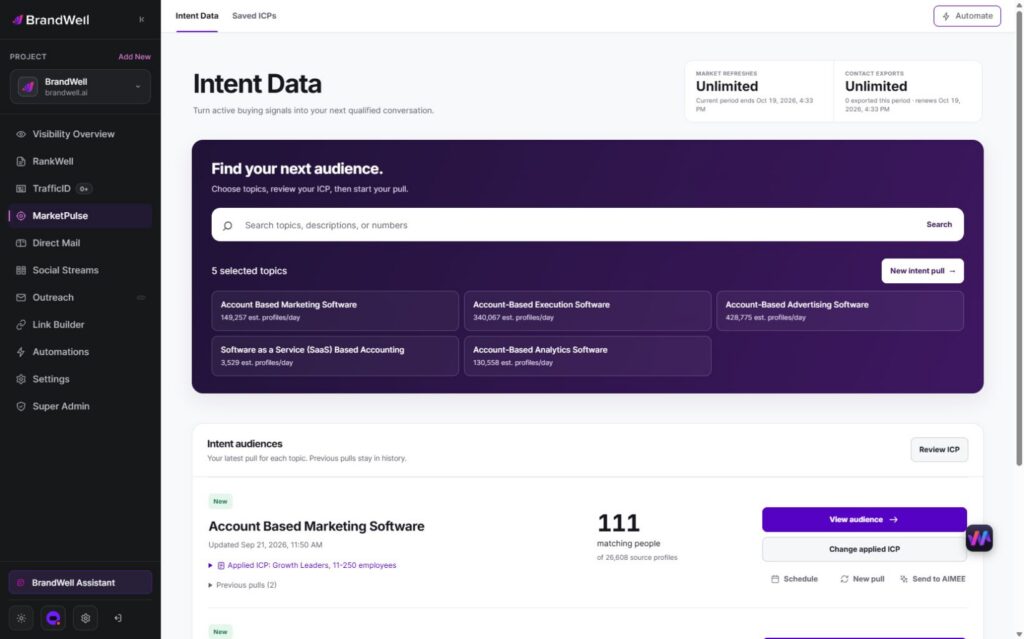
MarketPulse lets teams review topic research audiences with saved ICP filters and available contact details. Standard monthly plans start for one weekly topic and 25,000 exports. Growth includes three daily topics and 100,000 exports; Scale includes ten daily topics and unlimited exports.
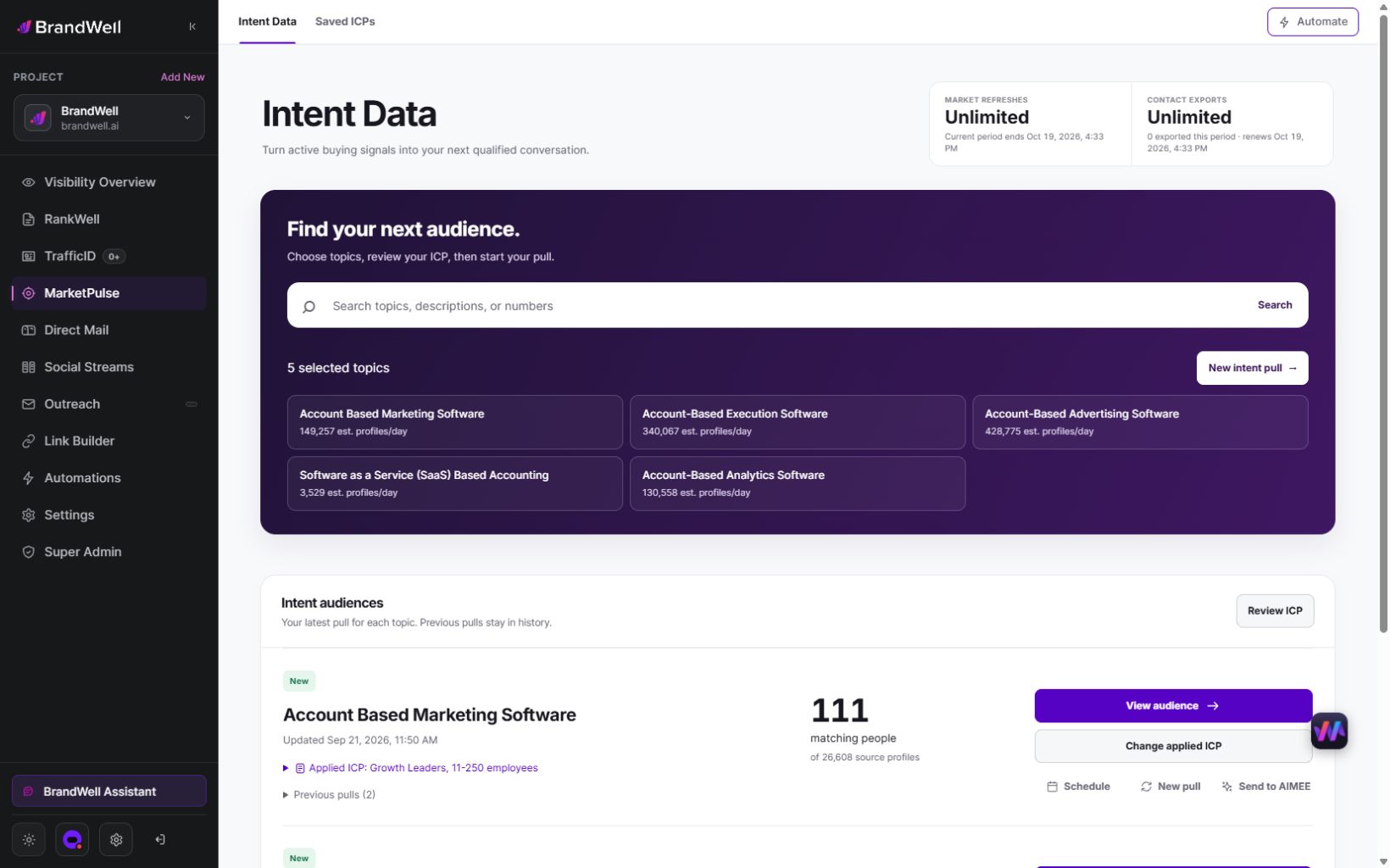
Daily use provides 90 or 300 pulls in a 30-day month. A pull retrieves available data from the previous 24 hours; fields, audience size and overlap vary. Keep software costs, activation costs and agency services separate. Current plan scope does not establish wholesale rights, white-label reporting or a native CRM integration.
Use TrafficID separately for identifiable activity on the client’s authorized website. Keep submitted forms, resolved visitors, added stakeholders and topic research as different evidence sources.
Who this is for
Agency strategists, RevOps analysts, demand-generation leads, and client success teams responsible for proving the value of recurring B2B intent programs. It assumes the client has a CRM owner and will agree on definitions, access, and review cadence.
The pipeline evidence ledger: a copyable operating template
Create one row per eligible account-event pair, not one row per claim. Preserve the raw event and every subsequent decision as separate fields. This prevents a later CRM stage from silently rewriting what the agency knew at activation time.
- Signal fields: event ID, source category, topic or behavior, entity level, observed time, freshness rule, provenance reference, and known limitation.
- Identity fields: input entity, resolved account or contact ID, method category, confidence or conflict state, review outcome, and reviewer.
- Eligibility fields: ideal-client fit, suppression result, territory, existing-opportunity state, consent or permitted-use decision where applicable, and exclusion reason.
- Activation fields: audience, report, route, destination, treatment, owner, approval, delivery time, and control or holdout assignment if used.
- Response fields: reply, meeting, website return, content action, rejection, unsubscribe, or other client-defined behavior, each with source and time.
- Outcome fields: CRM account, lead, contact, campaign, opportunity, stage, amount, creation time, close state, and finance-recognized revenue only when the client has authorized that view.
- Attribution fields: association rule met, influence rule met, comparison group, observation window, contamination, confidence note, and reviewer.
- Economics fields: wholesale and usage cost, direct labor, setup labor, client fee, credited value under each view, and caveat.
Add a monthly reconciliation worksheet with six questions: Did every reported signal have provenance? Did every activated entity pass eligibility? Did identity change after activation? Did opportunity amounts or stages change? Did sales accept or reject the account? Did any program contact occur outside the tracked workflow? The answer may lower the number. That is a feature of trustworthy measurement.
Define the decision before attribution
Begin with one use case, one activation route, and one decision the report must support. Agree on the unit of analysis, eligible population, signal time, identity method, activation definition, opportunity source of truth, and observation window before launch. Establish a baseline from the client’s own recent data if it is sufficiently comparable. If no reliable baseline exists, state that and use operational evidence first.
Deliver value quickly by producing a reconciled chain for a small scope, not a sweeping multi-touch model. Show which accounts qualified, which were acted on, what sales did, and what outcomes appeared. Then decide whether data coverage and adoption justify more complexity. The intent-data client onboarding checklist helps lock definitions and owners before attribution starts.
Owners, service levels and handoff
The signal owner registers source events. Data operations validates schema and provenance. The identity owner resolves entities and handles conflict. Campaign or sales operations records eligibility and activation. RevOps reconciles CRM outcomes. The account strategist interprets results. A client owner approves definitions and corrective action. Keep those roles separate enough that the person benefiting from the number is not the only reviewer.
The workflow is: ingest, validate, resolve, qualify, suppress, approve, activate, observe, reconcile, classify, report, and decide. Set service levels for data receipt, exception acknowledgement, CRM reconciliation, late-stage corrections, and client review. Define dependency stops for missing client data or access. At handoff, pass field definitions, query logic, known gaps, open exceptions, last reconciliation state, and owner contacts. A dashboard without its logic and exceptions is not a complete handoff.
Tools and evidence requirements
Choose categories before brands: a source-event store, identity layer, activation log, CRM, analytics or query environment, version-controlled metric dictionary, exception tracker, and client-facing report or portal. A spreadsheet can support a bounded pilot if row ownership, validation, and history are controlled. Automation becomes useful when repeated joins, late-arriving outcomes, or several clients make manual reconciliation unreliable.
Evaluate tools on event-level export, stable IDs, timestamps and time zones, source provenance, field history, deduplication, access control, client isolation, deletion, API reliability, audit logs, calculation transparency, and the ability to reproduce a reported number. Avoid choosing software because it advertises one attractive attribution model. The best tool is the one that lets the team inspect the evidence chain and correct it without hiding logic.
Manual, automated and branded reporting
Manual attribution is flexible and transparent for a limited program, but it is slow and vulnerable to inconsistent joins and overwritten files. Automated attribution supports recurring volume and late CRM updates, but bad definitions can scale quietly. White-label attribution can speed agency packaging and give clients a branded experience, but the agency must confirm data lineage, permissions, calculation logic, and export behavior. A hybrid uses automation for repeatable joins and humans for identity conflicts, opportunity exceptions, and interpretation.
Compare approaches with the same criteria: setup time, recurring labor, reproducibility, correction effort, client visibility, identity handling, security boundary, portability, and total cost. Do not score them by the size of the pipeline number produced. A method that reports less but can be audited may be the stronger commercial choice.
Setup and recurring delivery costs
Model initial discovery, data dictionary work, historical CRM inspection, ID mapping, integration, field creation, baseline calculation, QA, client review, training, and documentation. Recurring cost includes data and platform charges, analyst reconciliation, identity exceptions, sales-adoption support, reporting, client meetings, correction, and change requests. Include the cost of inaccessible or inconsistent client data rather than assuming a clean CRM.
Build a setup fee from scoped labor and third-party costs, then add a clearly documented complexity or risk allowance. For recurring pricing, use price floor = wholesale and usage cost + direct delivery labor + allocated tooling + expected support and rework + risk reserve. Track contribution margin against actual hours and costs. There is no responsible universal setup fee or gross-margin benchmark. Current client scope and written supplier terms determine the economics.
Quality, adoption and outcome metrics
Time-to-value metrics include time to first accepted event, first approved activation, first sales action, and first reconciled review. Quality metrics include provenance coverage, schema-valid rate, identity-conflict rate, eligible-record share, duplicate and suppression failures, unmatched CRM share, and late-outcome correction. Adoption metrics include accepted-account rate, action completion, disposition completeness, and report-review participation.
Outcome metrics can include responses, meetings, opportunity creation, stage movement, influenced pipeline under a documented rule, closed outcomes, and contribution economics. Show counts and rates with eligible denominators. Use client-specific baselines instead of borrowed benchmarks. For ROI, state the numerator, denominator, time window, and attribution view. A ratio built on influenced pipeline is not realized return. The monthly intent reporting template can keep operating metrics and commercial evidence in the same review without blending them.
Match measurement to client readiness
A low-maturity client may need a manual evidence ledger, a few CRM fields, weekly disposition, and an operational scorecard. A middle-maturity client can add automated event capture, stable account IDs, campaign membership, field history, and recurring reconciliation. An advanced client may support holdouts, matched comparisons, warehouse models, finance reconciliation, and sensitivity analysis. More maturity permits stronger inference, not automatic proof.
Match the package to data readiness and the decision at stake. Do not sell experimental incrementality to a client without stable assignment, adequate sample, or protection from contamination. Do not force a warehouse build for a small paid pilot. When stacks differ, preserve a canonical agency dictionary and map each client field to it. Document every transformation so a client migration does not erase meaning.
Preserve the evidence chain
Use signals whose source category, entity level, topic or behavior, observation time, and permitted use can be recorded. Treat first-party visits, third-party research activity, CRM engagement, public company events, and campaign responses as distinct evidence. Identity checks should preserve the original entity, resolved entity, method, conflict state, and review. Do not silently merge person and account records or assume a shared domain proves an individual action.
Activation evidence should state the eligibility rule, suppression, owner, destination, treatment, approval, and time. Outcome evidence should come from the system of record and retain revisions. The attribution chain is strongest when the program event precedes the action and outcome, the definitions were fixed in advance, and alternative paths are visible. Even then, association and influence are not the same as causal lift.
Risks and exceptions
Key risks are missing provenance, identity drift, duplicated events, inconsistent time zones, retroactive CRM edits, self-reported sales activity, opportunity recycling, contamination between treatment and comparison groups, inaccessible fields, client-specific logic hidden in code, excessive personal data, cross-client exposure, and pressure to inflate results. Maintain an exception register with impact on each reported view.
Limit collection and access to what the measurement decision requires. The FTC’s Start with Security guidance discusses keeping only necessary information, limiting access, securing data through its lifecycle, and overseeing providers. The NIST Privacy Framework is a voluntary tool for managing privacy risk. Neither source validates an attribution model or supplies legal advice.
A recurring agency reporting package
Include the metric dictionary, evidence ledger, integration map, identity and eligibility rules, monthly reconciliation, exception register, change log, client scorecard, decision notes, and a stop-or-expand rule. The client report should show scope, data completeness, adoption, association, defined influence, any valid incremental view, delivery cost, and limitations. It should not present a single pipeline total without its denominator and logic.
A renewal review should answer: Is the data reliable enough to act on? Is the client team using it? Are outcomes directionally useful under the agreed view? Is the program economically supportable? Which risk or gap requires repair? The agency intent-data reporting guide provides a wider client-reporting structure for the recurring service.
A decision model for association, influence, and incrementality
Use association when a qualified signal and outcome coexist inside a defined window. Use influence only when a documented program action occurred before an outcome and the client accepts the rule. Use incrementality when a planned comparison can credibly estimate what changed relative to a counterfactual. A randomized holdout can be strong when feasible. Matched or time-based comparisons can be informative but require explicit assumptions and sensitivity checks.
Always show contamination, exclusions, sample limits, and changes to assignment. If the comparison is weak, downgrade the language instead of forcing a conclusion. Attribution is a set of decision views, not a courtroom verdict.
Copyable attribution analyst brief
Use approved, minimized data. Prefer stable IDs over names or raw personal fields. Keep the assistant outside live activation and CRM write access unless a qualified owner has approved the system, permissions, and human review.
Act as an attribution evidence analyst for an agency intent-data program.
Inputs: metric dictionary, eligible population, signal ledger, identity decisions,
activation log, CRM outcome export, costs, exclusions, and comparison design.
Reconcile records by approved stable IDs and timestamps. Produce separate tables
for association, defined influence, and incremental estimates. For every metric,
show formula, numerator, denominator, window, missing-data rate, exclusions, and
limitations. Create an exception queue rather than guessing unmatched records.
Do not invent identities, joins, amounts, stage history, baselines, costs, causal
effects, ROI, pricing, or outcomes. Do not give full credit to touched deals.
Flag privacy, security, legal, financial, and experimental-design questions for
qualified human review. Require human approval before any client-facing report.
What a credible monthly answer sounds like
Run the review in a fixed order: data completeness, identity and eligibility exceptions, activation adoption, response evidence, opportunity reconciliation, attribution views, delivery economics, risks, and the next decision. Starting with the biggest pipeline number encourages confirmation bias. Starting with evidence quality lets the client decide how much weight the outcome view deserves.
End with one explicit action for each owner. Sales might disposition unresolved accounts. RevOps might repair stage history. The agency might narrow a topic, change a suppression rule, or hold expansion. Record whether the team will continue, repair, reduce, expand, or stop the program and which new evidence would change that decision.
A credible review says, “These accounts met the signal and eligibility rules. This subset was activated. Sales acted on this share. These opportunities were associated under our stated window, these were influenced under the agreed action rule, and this comparison suggests a possible incremental difference with these limitations.” That answer invites a better decision. “Intent generated all touched pipeline” invites a dispute the evidence cannot resolve.
Attribution rules are not the same as an experiment
Google Analytics describes attribution as assigning credit for important actions to touchpoints. A model determines that allocation. As a practical reporting distinction, your own opportunity-influence rule should not be presented as a randomized test of the intent program’s effect.
A worked pipeline example
Suppose a fictional client has ten opportunities totaling $200,000. Six opportunities totaling $120,000 meet a defined signal-association window. Three of those, totaling $60,000, also meet the agreed influence rule because a reviewed program action preceded their creation.
Report $120,000 associated pipeline and $60,000 influenced pipeline under their respective rules. The influenced set is a subset, so adding the figures would double-count it. Neither amount is closed revenue or an incremental revenue estimate. Keep existing opportunities and later amount revisions visible.
In a separate fictional comparison, 20 of 100 assigned treatment accounts and 12 of 100 comparison accounts create an opportunity. The observed rates are 20% and 12%, a difference of eight percentage points. Interpretation requires the assignment design, uncertainty, contamination, observation window and relevant assumptions. The arithmetic alone is not proof of lift.
If monthly software costs $500 and reconciliation takes ten hours at $60, listed operating cost is $1,100. Include setup, adjacent software and activation costs before evaluating full economics. Dividing pipeline by that cost does not produce realized ROI.
Frequently asked questions
Can I credit all touched pipeline to intent data?
No. Define the relevant association and influence rules, show overlap and exclusions, and keep a supported incremental view separate.
What if the client has no reliable baseline?
Start with data completeness, accepted records, action completion and reconciled outcomes. State the baseline gap instead of inventing an improvement percentage.
How do I handle late CRM changes?
Preserve source timestamps and outcome revisions. Reconcile the changed amount or stage against the prior report and note how it affects each reporting view.
Can AIMEE prepare the report?
AIMEE can help research and prepare an evidence summary through connected tools. The relevant owner must verify joins, calculations and limitations. Product scope, access and approval rules determine what can execute.
Build around a relevant audience
Explore MarketPulse and current plans starting at $500/mo. Choose topics relevant to the client’s offer, then preserve source, ownership and outcome evidence as the workflow progresses.
Reviewed and updated October 3, 2026.

Written by