On this page
- Current MarketPulse workflow
- Define a narrow, testable market thesis
- Assign research, delivery and commercial owners
- Choose tools that preserve claim evidence
- Compare breadth, channel expertise and a demand thesis
- Budget research, enablement and maintenance
- Measure recognition, fit and service economics
- Match the thesis to evidence and delivery maturity
- Preserve sources through a bounded activation test
- Control public claims and misinterpretation
- Apply the thesis to recurring service decisions
- Research the problem before promoting the position
- Worked example: recognition is not revenue impact
- Frequently asked questions
Direct answer: Build an agency point of view around in-market demand as a falsifiable thesis, not a slogan. State the buyer problem, the evidence you observe, what that evidence can and cannot mean, the action you recommend, and how you will revise the thesis. That specificity can help buyers recognize fit without claiming that signals prove demand or revenue.
Current MarketPulse offer: intent-data plans start at $500/mo. See the product, demo, and current plans. Updated October 3, 2026.
Who this is for: B2B agency owners and GTM consultants who want a sharper market position and a responsible bridge to a recurring buyer-intent service.
“We generate demand” is not a point of view. Neither is “we use intent data.” A useful agency thesis explains how buying conditions develop, where conventional channel metrics hide uncertainty, and which decisions become better when evidence is interpreted carefully. It should be opinionated enough to guide choices and humble enough to be tested.
The strongest point of view comes from documented buyer problems, repeated delivery observations, first-party conversations, and outcome evidence. Search results and market commentary can broaden the question set, but they should not be copied into a confident claim. The agency earns differentiation through the reasoning system it can show.
Current MarketPulse workflow
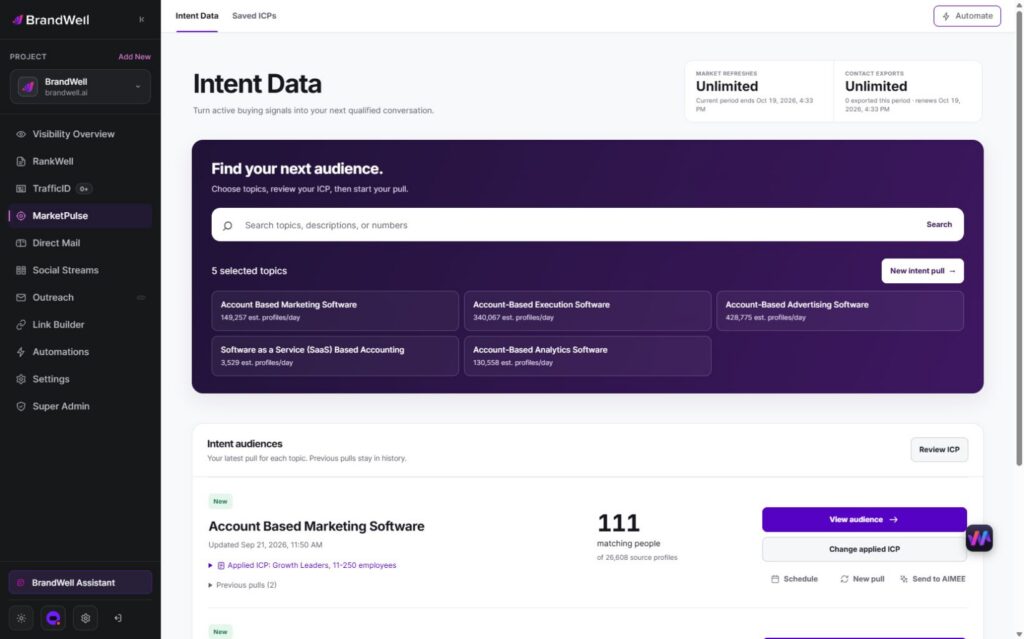
BrandWell MarketPulse: intent data starting at $500/mo. Find people researching topics relevant to what you sell, apply saved ICP filters, and review available contact details before taking action.
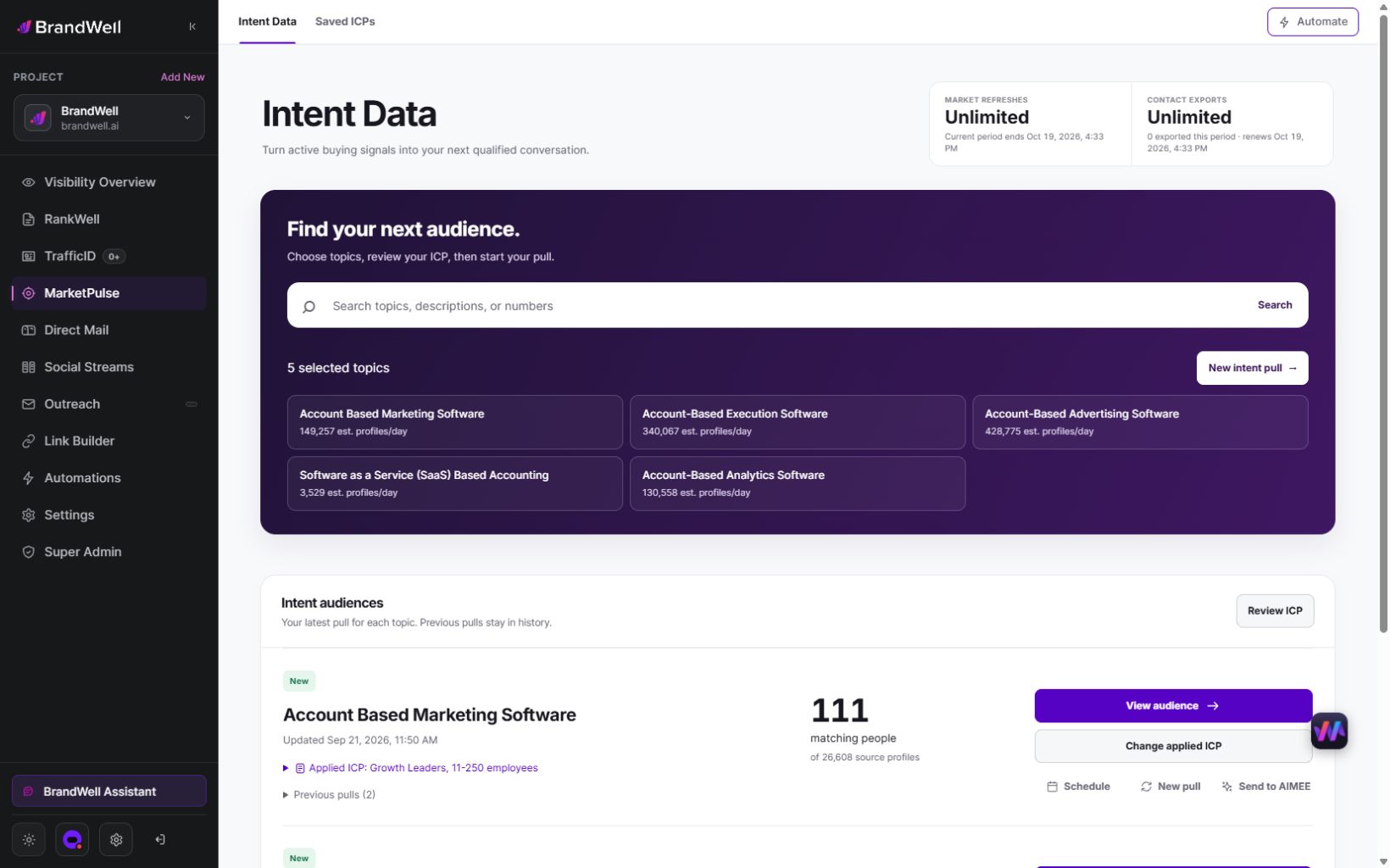
MarketPulse plans are starting at $500/mo. Verify current package scope and offers on the product page.
| Plan | Topics and refreshes | Monthly exports |
|---|---|---|
| Starter | 1 topic, weekly | 25,000 contacts |
| Growth | 3 topics, daily | 100,000 contacts |
| Scale | 10 topics, daily | Unlimited contacts |
Swipe the table to see all columns.
A pull retrieves available data from the previous 24 hours for one topic. Daily use across all included topics provides 90 Growth pulls or 300 Scale pulls in a 30-day month. Weekly Starter pulls vary by calendar month. Available audience size and contact fields vary, and audiences may overlap. Refreshes stop at the plan limit without overage charges.
- Find and qualify: search the topic catalog, save your ICP, and review the people and companies that match.
- Act on the research: export qualified contacts or prepare an Outreach or Direct Mail workflow. Connected products, channel usage, and fulfillment may cost extra.
- Get help from AIMEE: Growth and Scale include AIMEE for the initial user to research accounts and prepare the next step through connected tools.
Agencies and other service businesses can build client deliverables around their available Intent Scans and exports. Keep each client’s scope, permissions, and service fees clear. A subscription is not a promise of a white-label platform or exclusive access to a market.
Explore MarketPulse and watch the demo or compare plans starting at $500/mo. Any early-access discount is a separate, time-limited offer shown to an eligible recipient.
Define a narrow, testable market thesis
Start with a narrow claim about a specific buyer and decision. For example: a client should not treat a surge in research activity as a lead; it should use that observation to select accounts for further qualification. Define the situation where the claim applies, the alternatives it rejects, the evidence that would challenge it, and the operational behavior it changes.
Better-fit clients can recognize themselves in those boundaries. They see the problem you solve, the evidence standard you use, and the work they must contribute. That helps shift a sales conversation away from interchangeable channel capacity. It does not eliminate price pressure by itself. The agency still needs credible delivery, a commercially useful offer, and proof that the thesis improves decisions. Avoid asserting that positioning will create a particular client mix, fee level, or sales result.
The six-part in-market demand thesis canvas
- Buyer tension: name one expensive or confusing decision faced by a specific client role.
- Observable evidence: list the first-party, third-party, commercial, and qualitative observations relevant to that decision.
- Interpretation rule: explain what each evidence state may suggest and what it cannot establish.
- Recommended action: specify the next human decision, workflow, or test instead of announcing a buyer.
- Outcome and limitation: define what will be measured, the denominator, the comparison, and known uncertainty.
- Revision trigger: state which result, client objection, market shift, or repeated exception will change the thesis.
Use real discovery language to fill the canvas. A disciplined set of agency discovery questions about buying intent can expose whether the proposed thesis matches the client’s decision rather than merely decorating a pitch.
Assign research, delivery and commercial owners
Assign a thesis owner, a research lead, a delivery representative, and a commercial reviewer. The thesis owner maintains definitions and scope. Research gathers buyer interviews, client objections, market evidence, and competing explanations. Delivery contributes observed exceptions. The commercial reviewer tests whether prospects understand the claim and whether it attracts the intended work. Legal or privacy review joins when evidence use or public claims require it.
Maintain a source library, observation log, claim-evidence ledger, signal taxonomy, decision journal, objection register, and version history. Run a short monthly evidence review and a deeper quarterly challenge session based on material changes, not a publishing quota. Every review should record keep, narrow, revise, test, or retire. The cadence should prevent stale positioning while avoiding a new opinion every time a single prospect disagrees.
Choose tools that preserve claim evidence
Choose tools by the reasoning job. Use a research repository for interviews and primary sources, a structured claim ledger for support and limitations, a taxonomy workspace for signal definitions, a decision log for experiments, and a content system for controlled distribution. Add an intent and identity layer only when the agency has a clear purpose and an activation workflow. No software can supply the thesis on its own.
Connect the six-part canvas to a claim ledger with audience, observation, source, competing explanation, permitted use, recommended decision, outcome measure, owner and revision trigger. Mark unsupported statements for research rather than polishing them into confident marketing copy.
Compare breadth, channel expertise and a demand thesis
Generic full-service positioning emphasizes breadth and convenience. It can fit clients that want one accountable partner across established needs, but it may leave the agency hard to distinguish. Channel-only differentiation emphasizes specialized execution in paid media, content, outbound, or another discipline. It works when the client already understands the problem and needs expert delivery. An in-market demand point of view differentiates the agency’s diagnosis and decision model across channels.
These are not mutually exclusive. A full-service firm can lead with a demand thesis, and a channel specialist can apply the thesis inside one activation path. Select the model based on client buying criteria, actual capabilities, evidence, and delivery scope. Do not adopt a demand point of view merely because it sounds strategic. If the agency cannot explain signals, identity, action, and outcomes, channel specialization may be the more honest claim.
Budget research, enablement and maintenance
Budget research time, buyer and client interviews, evidence review, writing, design, commercial enablement, staff training, distribution, measurement, and maintenance. Include opportunity cost: senior specialists working on the thesis are not delivering client work. If intent evidence is part of the offer, add topic maintenance, data, identity QA, activation support, reporting, and governance.
Model the economics as a portfolio of observed effects rather than a guaranteed return. Track the cost of creating and maintaining the thesis, the share of qualified opportunities that cite the point of view, proposal fit, discounts, sales effort, service attach, delivery cost, contribution, renewal, and expansion. Compare periods or cohorts cautiously because offer mix and market conditions change. A thesis may be useful even before direct attribution is possible, but that is not permission to invent ROI.
Point-of-view investment ledger
- Creation: interviews, research, analysis, writing, design, and challenge review.
- Enablement: sales examples, qualification prompts, delivery training, and objection practice.
- Distribution: owned articles, workshops, partner education, and client-facing applications.
- Maintenance: evidence review, corrections, versioning, retirement, and new-market adaptation.
- Observed value: qualified recognition, service fit, reduced avoidable custom work, attach, contribution, and retention, each with a defined method.
Measure recognition, fit and service economics
Use three metric groups. Recognition includes relevant direct traffic, content completion, qualified replies, and prospect language that accurately restates the thesis. Commercial fit includes qualified-opportunity share, disqualification reasons, proposal fit, discount behavior, attach rate for the related service, and time spent educating unsuitable prospects. Service economics includes delivery contribution under the agency’s cost model, rework, exception load, renewal, expansion, cancellation reasons, and thesis-driven product changes.
Define every metric, source, owner, denominator, and review window. Record leading indicators separately from financial outcomes. A prospect citing an article does not establish revenue impact. A retained client does not prove the point of view caused renewal. Use a documented pipeline attribution method for intent programs when linking observations to commercial events, and disclose overlap with other marketing and sales activity.
Match the thesis to evidence and delivery maturity
The approach fits agencies with a repeatable B2B problem, access to client and buyer evidence, enough delivery experience to identify patterns, and willingness to exclude poor-fit work. Productized services, demand-generation specialists, RevOps consultancies, account-based programs, and sector specialists can all benefit when the thesis shapes real delivery choices.
It is weaker for a very early agency without evidence, a broad staff-augmentation model judged mainly on capacity, or a firm unwilling to state limits. Early-stage agencies can still publish a provisional learning thesis, but they should label it as such and invite challenge. Mature agencies should resist turning accumulated anecdotes into universal truth. Fit depends on evidence density and operational usefulness, not age or headcount alone.
Preserve sources through a bounded activation test
Combine buyer interviews, sales-call themes, first-party behavior, campaign responses, client-system events, and permissioned third-party research observations. Each source answers a different question. Separate the observation from interpretation. For account-level signals, check company resolution, hierarchy, market fit, geography, duplicates, and contact validity before recommending action. None of these proves authority, budget, timing, or demand by itself.
Activation should test the thesis. Route a defined cohort to a human reviewer, state why it was selected, use an approved message, capture disposition, and compare the result with a useful baseline when possible. Maintain topics using a documented topic governance and maintenance workflow. Outcome evidence should include no-action, rejection, and correction states, not only positive responses.
Control public claims and misinterpretation
Strategic risks include copying a fashionable claim, making the agency the hero, becoming so broad that the thesis guides nothing, or becoming so absolute that new evidence cannot change it. Operational risks include inconsistent definitions, unsupported sales claims, outdated examples, missing owners, and a gap between public advice and client delivery. Trust erodes when a point of view hides uncertainty or implies private knowledge about buyers.
Data-use risks include unclear provenance, using evidence outside the agreed purpose, retaining it too long, weak access control, and treating probabilistic company activity as person-level fact. Keep a claim-evidence register, client-specific permissions, revision history, corrections process, and public-claim approval. Stop distribution when a material claim loses support. A distinctive opinion is not worth a misleading conclusion.
Trust also depends on teaching the point of view consistently. Give sales and delivery teams a short claim guide containing approved language, prohibited shortcuts, evidence examples, and escalation paths. Review recorded objections for misinterpretation. If prospects repeatedly hear a stronger promise than the article makes, treat that as a system defect and correct the enablement, not merely the individual sentence.
Apply the thesis to recurring service decisions
The thesis can become the operating logic of a recurring service: which topics matter, what observations qualify, which accounts receive human review, which action follows, which outcomes count, and when the program changes. That creates a coherent offer rather than a feed of data. It can also reduce custom work when clients fit the same documented decision model. Stronger economics remain a hypothesis until delivery cost, acceptance, retention, and commercial outcomes are measured.
Package the thesis into a repeatable monthly decision cycle. One session reviews buyer and market evidence. A second reviews topic and identity quality. A third inspects activation and client outcomes. The final decision is to keep, revise, test, or stop. Publishing the resulting learning can create a durable distribution asset, but client-specific evidence must remain within its approved use and public claims need fresh support.
AIMEE can help organize supplied observations, identify contradictions and draft a bounded thesis through configured connected tools. Human owners verify sources, interpretations and approved public claims.
MarketPulse supplies topic audiences and saved ICP filtering starting at $500/mo. Review the actual preceding-24-hour topic window and available fields before proposing an action. Agency research, reporting and custom client delivery need their own supported scope and implementation.
Copyable agent-ready demand thesis workshop
Act as an evidence editor helping a B2B agency draft an in-market demand point of view.

Use only the supplied buyer interviews, client observations, source documents, signal definitions, and outcome records.

1. Cluster repeated buyer tensions without merging contradictory evidence.
2. Draft one narrow thesis for one audience and decision.
3. Build a table with observation, interpretation, alternative explanation, recommended action, outcome measure, and revision trigger.
4. Identify every sentence that implies buyer identity, authority, budget, timing, pipeline, revenue, or causality.
5. Rewrite unsupported implications as bounded hypotheses or remove them.
6. Generate three challenges that would falsify or narrow the thesis.
7. Propose one small activation test with explicit eligibility, human review, stop conditions, and a comparison plan.

Claude, ChatGPT, or AIMEE can synthesize and challenge the supplied material. A human thesis owner verifies sources, approves interpretations, decides data use, signs off public claims, and authorizes any client activation.
Test the thesis across formats before treating recognition as demand. Ask a prospect to summarize it after a sales call, ask a delivery specialist to apply it to an ambiguous account, and ask a client to name where it would not apply. Track misunderstandings rather than correcting them silently. If the audience repeatedly interprets a research signal as a purchase declaration, the thesis needs stronger limits or a different example.
Create a small evidence maintenance queue. New interviews, objections, signal-quality changes, client outcomes, and contrary findings enter with an owner and review status. High-impact contradictions receive priority over content-calendar requests. Approved revisions flow into sales guidance, delivery documentation, and public articles together. That prevents several incompatible versions of the agency’s view from circulating.
A memorable agency point of view is not the loudest claim. It is a clear decision system that a buyer can examine, a delivery team can apply, and evidence can correct.
Research the problem before promoting the position
GOV.UK’s discovery research guidance recommends learning users’ goals, current behavior and problems before service design. It concerns public-service research; an agency can apply the underlying discipline by investigating buyer decisions before writing its positioning.
Ask a buyer to describe a recent account-prioritization decision, what evidence they had, where the process failed and what happened next. Preserve contradictory experiences. An interview can reveal a useful problem, but it is not a representative estimate of market demand or proof that the proposed service solves it.
Worked example: recognition is not revenue impact
In a fictional pilot, 20 qualified prospects receive a thesis brief and 12 accurately restate its intended decision and limits: 60%. Eight request a scoped discussion: 40% of all recipients, or 66.7% of those who restated it. Three later purchase a service. Report these observed counts without declaring that the brief caused the purchases; prior interest, sales work and other touches may contribute.
Assume 15 research and writing hours at $100, plus $300 in design and review. Defined creation cost is $1,800. Dividing by eight discussion requests gives $225 per request, but not incremental acquisition cost or ROI. If three subsequent engagements each provide $400 in defined contribution, their $1,200 combined contribution is still $600 below the creation cost before maintenance and other exclusions. Association does not establish recovery of the investment.
Turn a bounded thesis into a reviewed BrandWell brief
A useful provisional thesis might be: “For this client, topic research helps prioritize account review; it does not declare that a person is ready to buy.” Review an available MarketPulse topic, apply the saved ICP and preserve its actual data window. AIMEE can draft the account context from supplied evidence through configured tools. Have the owner review fit, uncertainty and the proposed action, then record acceptance and contrary findings.
Frequently asked questions
Does topic activity prove an account is buying?
No. Treat it as evidence for review and preserve uncertainty about identity, fit and readiness.
Can interviews establish a market-size estimate?
Not by themselves. Describe the interview sample and avoid projecting its frequency onto the whole market.
Does a prospect repeating the thesis prove sales impact?
No. Recognition is a leading observation; revenue and incremental effect require separate evidence.
When should a thesis change?
When material contrary evidence, repeated misunderstanding or delivery experience challenges its stated scope or assumptions.
Evaluate the topic-data input: explore MarketPulse and current plans.
Reviewed and updated October 3, 2026.

Written by