
On this page
- BrandWell: MarketPulse intent data and connected growth automation
- Should an agency offer client education and training subscriptions, and what client outcome should it promise?
- What should the delivery workflow, staffing, SLA, and client handoff include for client education and training subscriptions?
- What are the best tools, platforms, or white-label providers for client education and training subscriptions?
- Should an agency build, resell, refer, or avoid client education and training subscriptions?
- How much should an agency charge for client education and training subscriptions, and what gross margin is realistic?
- How should an agency prove the pipeline or revenue impact of client education and training subscriptions?
- Which agency clients are the best fit for client education and training subscriptions, and who should be excluded?
- How should buyer intent, website behavior, identity, and enrichment support client education and training subscriptions?
- What data-quality, delivery, privacy, and client-expectation risks affect client education and training subscriptions?
- What should a recurring agency package for client education and training subscriptions include?
- Put buyer intent to work with MarketPulse
Direct answer: Build a client education subscription around capability and operating consistency, not a monthly pile of content. The service should move named client roles through signal literacy, applied practice, office hours, competency checks, governed workflow adoption, and renewal feedback. Each learning activity should connect to an approved decision or task.
Current MarketPulse offer: intent-data plans start at $250/month. See the product, demo, and current plans. Updated October 1, 2026.
Who this is for: Agency owners, strategists, enablement leaders, RevOps consultants, and client success teams seeking recurring revenue from capability building.
Training becomes a subscription when the client’s environment changes and people need repeated practice, coaching, and governance. It fails when generic lessons are delivered without role assignments, client data boundaries, practice evidence, or a definition of competent performance.
BrandWell: MarketPulse intent data and connected growth automation
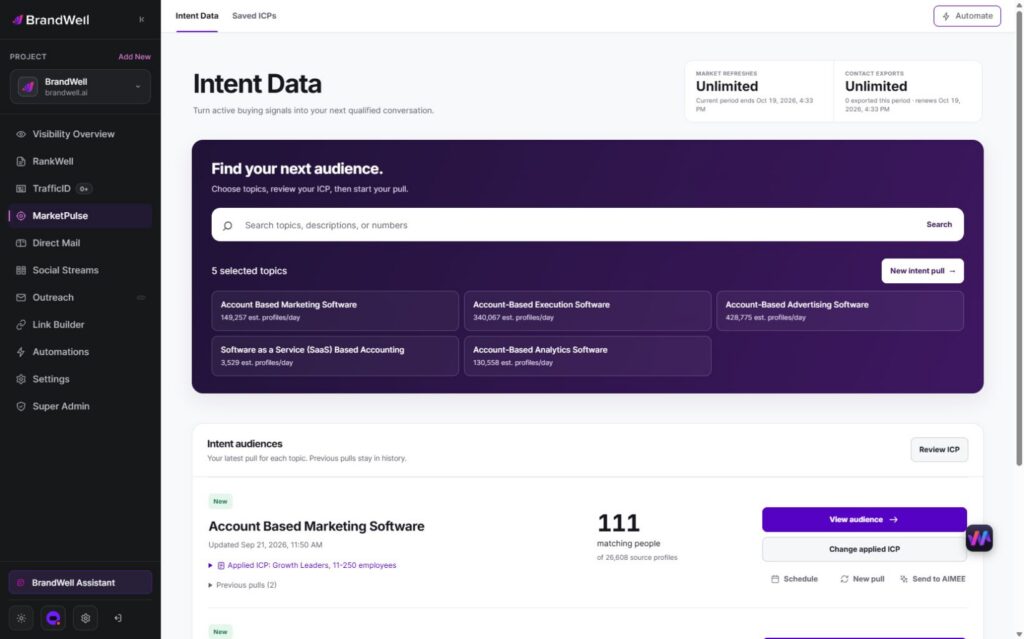
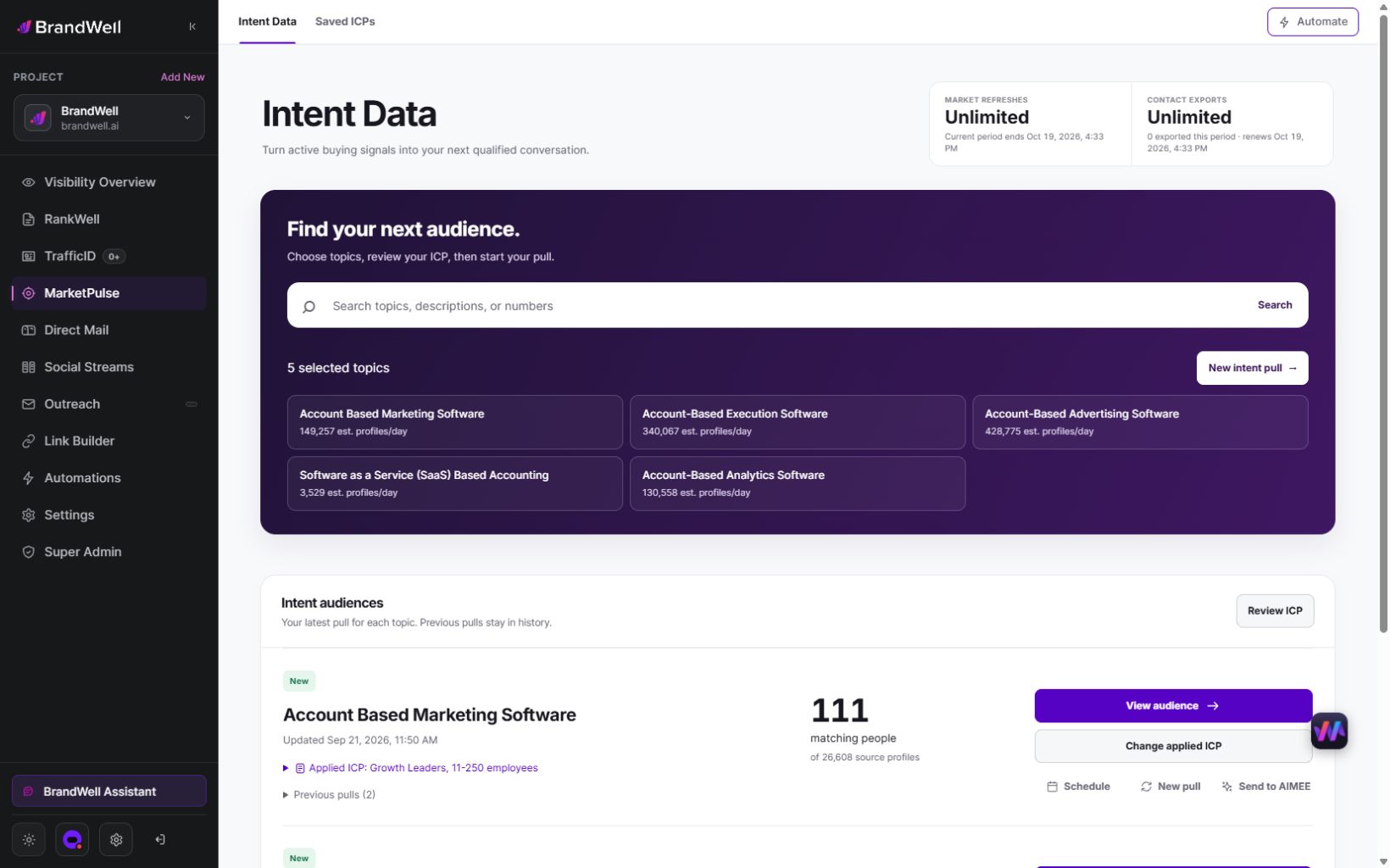
BrandWell MarketPulse: intent data from $250/month. Find people researching topics relevant to what you sell, apply saved ICP filters, and review available contact details before taking action.
| Plan | Price | Topics and refreshes | Monthly exports |
|---|---|---|---|
| Starter | $250/month | 1 topic, weekly | 25,000 contacts |
| Growth | $500/month | 3 topics, daily | 100,000 contacts |
| Scale | $1,000/month | 10 topics, daily | Unlimited contacts |
Swipe the table to see all columns.
A pull retrieves available data from the previous 24 hours for one topic. Daily use across all included topics provides 90 Growth pulls or 300 Scale pulls in a 30-day month. Weekly Starter pulls vary by calendar month. Available audience size and contact fields vary, and audiences may overlap. Refreshes stop at the plan limit without overage charges.
- Find and qualify: search the topic catalog, save your ICP, and review the people and companies that match.
- Act on the research: export qualified contacts or prepare an Outreach or Direct Mail workflow. Connected products, channel usage, and fulfillment may cost extra.
- Get help from AIMEE: Growth and Scale include AIMEE for the initial user to research accounts and prepare the next step through connected tools.
Agencies and other service businesses can build client deliverables around their available topic pulls and exports. Keep each client’s scope, permissions, and service fees clear. A subscription is not a promise of a white-label platform or exclusive access to a market.
Explore MarketPulse and watch the demo or compare plans starting at $250/month. Any early-access discount is a separate, time-limited offer shown to an eligible recipient.
Should an agency offer client education and training subscriptions, and what client outcome should it promise?
Yes, for clients whose outcomes depend on teams interpreting signals and following a repeatable playbook. Promise a governed learning path and measurable participation, practice, and competency evidence. Do not promise course completion, behavior change, service adoption, retention, pipeline, revenue, ranking, or citation. The agency can control curriculum quality and facilitation, not every learner or business outcome.
The strongest outcome is reduced operating ambiguity. Learners should know what a signal means, what it does not mean, which action is approved, when human judgment is required, and how to record a disposition. The subscription supports that capability through repetition and feedback.
What should the delivery workflow, staffing, SLA, and client handoff include for client education and training subscriptions?
Assign a program owner, subject-matter lead, facilitator, client sponsor, learner managers, data or privacy approver, and support contact. Onboarding maps roles, baseline knowledge, workflows, approved examples, tools, access, and competency criteria. The handoff includes a learning calendar, role paths, practice environment, office-hour process, escalation route, and manager scorecard.
- Diagnose the operating gap. Interview role owners and inspect the actual decisions, errors, and handoffs.
- Set role outcomes. Define what each learner must explain, decide, execute, and escalate.
- Build a learning spine. Sequence concepts, demonstrations, guided practice, independent practice, and review.
- Localize safely. Separate reusable curriculum from client-specific data, permissions, policies, and examples.
- Practice in context. Use sanitized or approved scenarios and require learners to record reasoning.
- Check competency. Score against explicit criteria, not attendance alone.
- Coach through office hours. Review questions, rejected actions, workflow friction, and source changes.
- Report adoption honestly. Show participation, practice, competency, exceptions, and manager follow-through.
- Refresh and renew. Update lessons when tools, terms, topics, or client processes change.
Set delivery targets for sessions, feedback, office hours, and curriculum changes the agency controls. Do not create an SLA for learning or business results. The intent-data client onboarding checklist can supply the access, role, and governance inputs needed before training begins.
What are the best tools, platforms, or white-label providers for client education and training subscriptions?
Choose tools by learning job: curriculum delivery, live facilitation, practice, assessments, office hours, version control, analytics, access management, and evidence exports. Evaluate tenant separation, role paths, content permissions, client-specific workspaces, audit history, accessibility, data retention, and the ability to distinguish attendance from competency.
A platform cannot create a learning strategy. A compact stack may work if roles and evidence are clear. Avoid a universal “best” claim because fit depends on learner count, practice type, client systems, privacy, facilitation, and reporting. Verify current primary product documentation and written terms before relying on features or prices.
Should an agency build, resell, refer, or avoid client education and training subscriptions?
Build reusable curriculum when the agency has distinctive expertise and a stable method. Resell licensed training when rights permit client delivery and the agency adds facilitation or application. Refer specialist training when accreditation or subject depth exceeds the agency’s competence. Avoid a subscription when the client wants only a one-time event, managers will not support practice, or the agency cannot separate reusable material from confidential client information.
Compare paths on intellectual property rights, update burden, facilitator skill, localization, access controls, assessment integrity, learner support, and exit portability. The best model can blend reusable lessons with contracted client-specific coaching, but the boundary must be explicit.
How much should an agency charge for client education and training subscriptions, and what gross margin is realistic?
Price from program design and recurring delivery: diagnosis, curriculum creation or licensing, facilitation, office hours, practice review, assessments, client-specific updates, learner support, manager reporting, administration, and tooling. Scope by roles, cohorts, session cadence, practice depth, and customization rather than “unlimited training.”
Model gross margin under expected attendance, high support, additional customization, facilitator substitution, and curriculum-change scenarios. No universal margin is realistic. Preserve the right to quote out-of-scope content, custom integrations, or private coaching separately.
AIMEE is the agent-powered desktop app in BrandWell’s growth workflow. Assign work through the tools connected to your workspace and choose which actions can run automatically or require approval. Desktop availability, account permissions, and the configured workflow determine what can execute.
Start with MarketPulse intent data from $250/month. Review a topic and its matching audience, then use BrandWell’s connected growth tools and AIMEE desktop assistance to prepare the next action. Agency packaging and services can be scoped around the client workflow.
How should an agency prove the pipeline or revenue impact of client education and training subscriptions?
Prove learning operation with baseline and follow-up evidence: attendance, practice completion, rubric scores, common errors, escalation quality, approved workflow use, and manager observations. If a client later links better decisions to commercial outcomes, preserve that evidence and label attribution limits. Do not turn training participation into a revenue claim.
A QBR for intent-data clients can connect competency evidence to service adoption, rule changes, and next-quarter coaching. Report missing data, learner drop-off, and inconsistent manager support. Those facts are often more useful than a flattering completion percentage.
Which agency clients are the best fit for client education and training subscriptions, and who should be excluded?
Best-fit clients have repeatable roles, an executive sponsor, managers who will reinforce practice, an approved workflow, and enough change or complexity to justify ongoing learning. Exclude clients seeking a certificate without practice, refusing access controls, expecting training to fix a broken service, or demanding guaranteed adoption or results.
Qualification should test the business decision, learner roles, baseline, time allocation, manager involvement, systems, permitted examples, competency definition, feedback cadence, and refresh triggers. A training subscription is not the answer when the real gap is missing authority, poor data, or no agreed process.
How should buyer intent, website behavior, identity, and enrichment support client education and training subscriptions?
Buyer intent, website behavior, identity, and enrichment can provide realistic case material and help teach prioritization when rights permit. Use synthetic or sanitized examples unless client-specific data is explicitly approved. Teach identity states and uncertainty so learners do not mistake an enriched candidate for a confirmed buyer.
BrandWell may support the underlying intent-data examples and branded topic reporting within a broader learning service. Topic governance matters, so use the guide to choosing and maintaining intent topics to teach how definitions, exclusions, and drift affect interpretation.
What data-quality, delivery, privacy, and client-expectation risks affect client education and training subscriptions?
Risks include stale curriculum, exposed client data, copied confidential examples, misleading assessment, accessibility gaps, unsupported claims, over-automation, and managers treating attendance as competency. Controls include version ownership, approved example libraries, tenant-separated workspaces, role access, retention rules, transparent rubrics, facilitator review, and a correction process.
Keep a curriculum change log. When a data source, tool, contract, or policy changes, identify affected lessons, pause unsafe exercises, update examples, and require approval before reuse. Never let an agent silently rewrite governing instructions.
Role-based curriculum worksheet
For each learner role, document the decisions it owns, prerequisite knowledge, concepts to explain, tasks to demonstrate, approved systems, prohibited actions, escalation conditions, practice scenario, competency rubric, evidence retained, manager reinforcement, and refresh trigger. This converts a broad curriculum into a client education and training subscriptions implementation guide.
A signal analyst might need to explain provenance and identity states, apply qualification rules, reject weak matches, and document a disposition. A client manager may need to approve actions, review exceptions, and interpret evidence. An executive sponsor may need to understand program limits and decide whether to continue or change scope. Giving every role the same lesson wastes time and hides accountability.
A practical monthly learning cycle
- Release a short concept or change briefing tied to the live workflow.
- Run a guided scenario using sanitized or approved information.
- Assign role-specific practice with a clear deadline and rubric.
- Review errors and edge cases in office hours.
- Require a manager or subject-matter owner to validate competent application.
- Publish a learning operations summary with missing evidence and next actions.
The cadence can change by client, but the loop should preserve explanation, practice, feedback, and application. Content consumption alone is not capability.
Training evidence that matters
Track enrollment only as an administrative fact. More useful evidence includes attendance, practice submission, rubric criteria met, recurring errors, escalation accuracy, response to feedback, workflow usage, manager observation, and the age of the curriculum version used. Keep learner surveillance proportionate and disclose what is measured.
Client education and training subscriptions KPIs should help the sponsor decide what to coach, update, or stop. They should not be used to manufacture a retention or revenue promise.
Common mistakes
- Building a large course library before observing the client’s real decisions.
- Using production client data in exercises without a documented right and need.
- Letting generative output introduce product, legal, or performance claims that no reviewer verified.
- Issuing completion certificates when competency was never assessed.
- Refreshing slides but not the rubric, examples, support process, or manager guidance.
- Counting office-hour attendance without resolving recurring workflow friction.
A strong renewal review asks whether the client needs continued practice, a new role path, a changed workflow, or a deliberate end. Recurring revenue should follow recurring capability needs, not calendar inertia.
Office hours as an operating control
Office hours should collect patterns, not become unlimited consulting. Require learners to submit the decision, evidence, attempted action, and question. Group common issues, answer within the approved curriculum and service scope, and route product, legal, privacy, security, or contract questions to the accountable owner. Add recurring misunderstandings to the next lesson or manager guide.
Record decisions and approved examples without exposing one learner or client team unnecessarily. If a session reveals an unsafe live workflow, stop the exercise and trigger the service escalation path.
Manager reinforcement plan
Give managers a short observation rubric: Did the learner identify the signal state? Apply fit and suppression? Choose an approved action? Explain uncertainty? Preserve evidence? Escalate correctly? Managers should review real work only where access is permitted. The agency can coach the rubric, but the client remains responsible for internal performance management.
At renewal, compare baseline and current competency evidence, curriculum freshness, manager use, recurring errors, and the next role or decision gap. If managers do not reinforce the workflow, offer a reset or end rather than promising that more lessons will create adoption.
Curriculum version and source controls
Every lesson should name an owner, source set, approved claim boundary, applicable workflow version, review trigger, and retirement status. Link factual instructions to current primary or internal authoritative material. When evidence is unavailable, teach the uncertainty instead of filling the gap with plausible text.
Generative agents can accelerate drafts and practice variants, but a subject-matter reviewer must confirm product, data, legal, security, and performance statements. Keep the approved version separate from working drafts so learners do not encounter conflicting instructions.
Subscription renewal decision
Continue when there is a recurring capability need, learner and manager participation, fresh curriculum, usable practice evidence, and a defined next decision. Re-scope when roles or workflows change. End when the client needs a process or product repair rather than more training.
Learning support boundary: Publish response channels, office-hour cadence, facilitator scope, and escalation owners. Distinguish a curriculum question from client consulting, product support, and a privacy or security incident. This protects learning quality and prevents an apparently simple subscription from absorbing unlimited advisory work.
Provide alternative formats and reasonable access support for learners where applicable. A technically correct lesson still fails if the intended role cannot use it. Test instructions, examples, captions, documents, and practice steps with representative learners before broad release.
Protect psychological safety in coaching: correct the decision process without turning shared office hours into public performance management. Route individual performance issues to the client manager through the agreed process.
Use learner feedback to improve clarity, not to lower essential controls. When learners find a step difficult, determine whether the lesson, tool, authority, data, or underlying process is the real constraint before rewriting the curriculum.
What should a recurring agency package for client education and training subscriptions include?
A recurring package should include diagnosis, role-based paths, live or asynchronous lessons, guided practice, office hours, competency checks, manager reporting, curriculum updates, support boundaries, access and retention controls, and a renewal review. Higher scopes can add roles, private coaching, or custom practice, but should not promise unlimited content.
Copyable agent-ready learning workflow: Give Claude, ChatGPT, or AIMEE the approved curriculum version, role outcomes, sanitized examples, rubric, prohibited claims, access rules, and lesson template. Ask it to draft explanations, scenarios, and feedback. It must not expose client data, change a rubric, issue a final competency decision, or send learner communications. Require human approval from a subject-matter reviewer and client approver for localized material. Stop when source truth is missing, examples contain personal or confidential data, a requested lesson implies a guarantee, or the task exceeds the learner’s approved role.
Start with one role and one recurring decision. Observe learners completing a real or sanitized practice, then refine the path. That produces a client education and training subscriptions framework grounded in capability rather than content volume.

Written by