On this page
- BrandWell: MarketPulse intent data and connected growth automation
- Choose the decision and comparison
- Define the event trail and owners
- Select tools that preserve the evidence
- Separate experiment, attribution and observation
- Budget the reporting workload
- Show counts, windows and missing data
- Recognize insufficient evidence
- Separate research, identity and client action
- Check bias, contamination and privacy
- Write a useful renewal decision memo
- Worked example: three different acceptance rates
- Review the current product and the client event trail separately
- Frequently asked questions
Direct answer: Agency accepted-signal reporting should inform whether qualification rules, delivery, and client follow-up deserve to change. Define the eligible-signal denominator, acceptance event, window, cohort, owner, and downstream event before reading the result. Report operational evidence and associations clearly, without calling them causal proof.
Current MarketPulse offer: intent-data plans start at $500/mo. See the product, demo, and current plans. Updated October 3, 2026.
Who this is for: Agency owners, client success leads, analysts, and RevOps teams responsible for showing whether an intent-data service is useful enough to renew, refine, expand, or stop.
An accepted signal is not simply a delivered record. It is an eligible observation that a named client reviewer has evaluated under a stable definition and marked useful for a specified next decision. Acceptance might mean “research this account,” “add to monitored accounts,” or “prepare an approved play.” It should not silently mean opportunity, pipeline, or revenue.
The distinction matters because the delivery funnel contains different events: observed, eligible, delivered, reviewed, accepted, acted on, responded to, progressed to opportunity, associated with pipeline, and associated with revenue. Collapsing them into one success rate makes the report look cleaner while making the decision less reliable.
BrandWell: MarketPulse intent data and connected growth automation
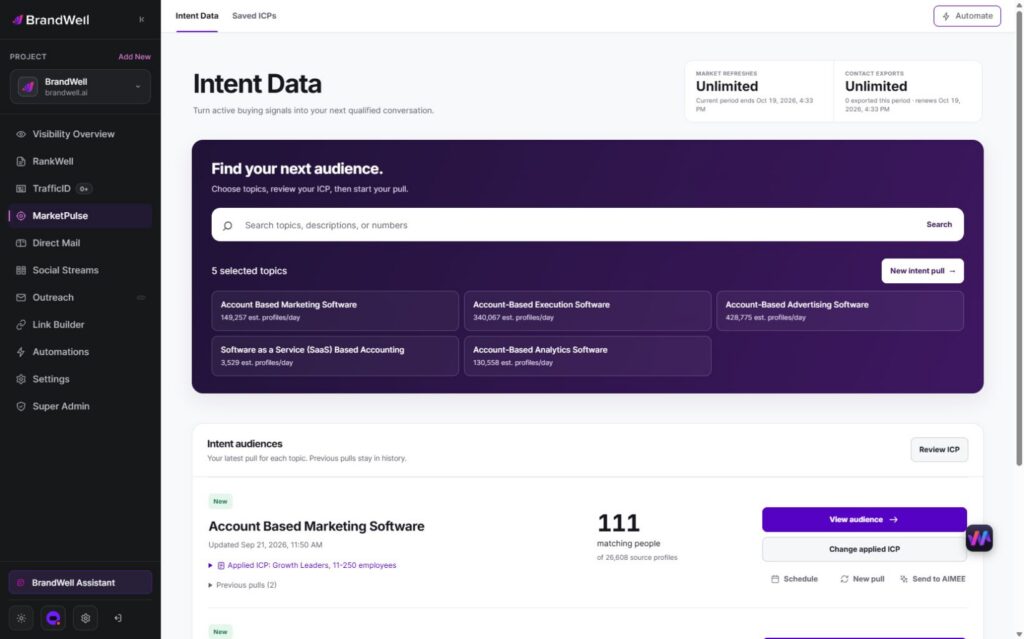
BrandWell MarketPulse: intent data starting at $500/mo. Find people researching topics relevant to what you sell, apply saved ICP filters, and review available contact details before taking action.
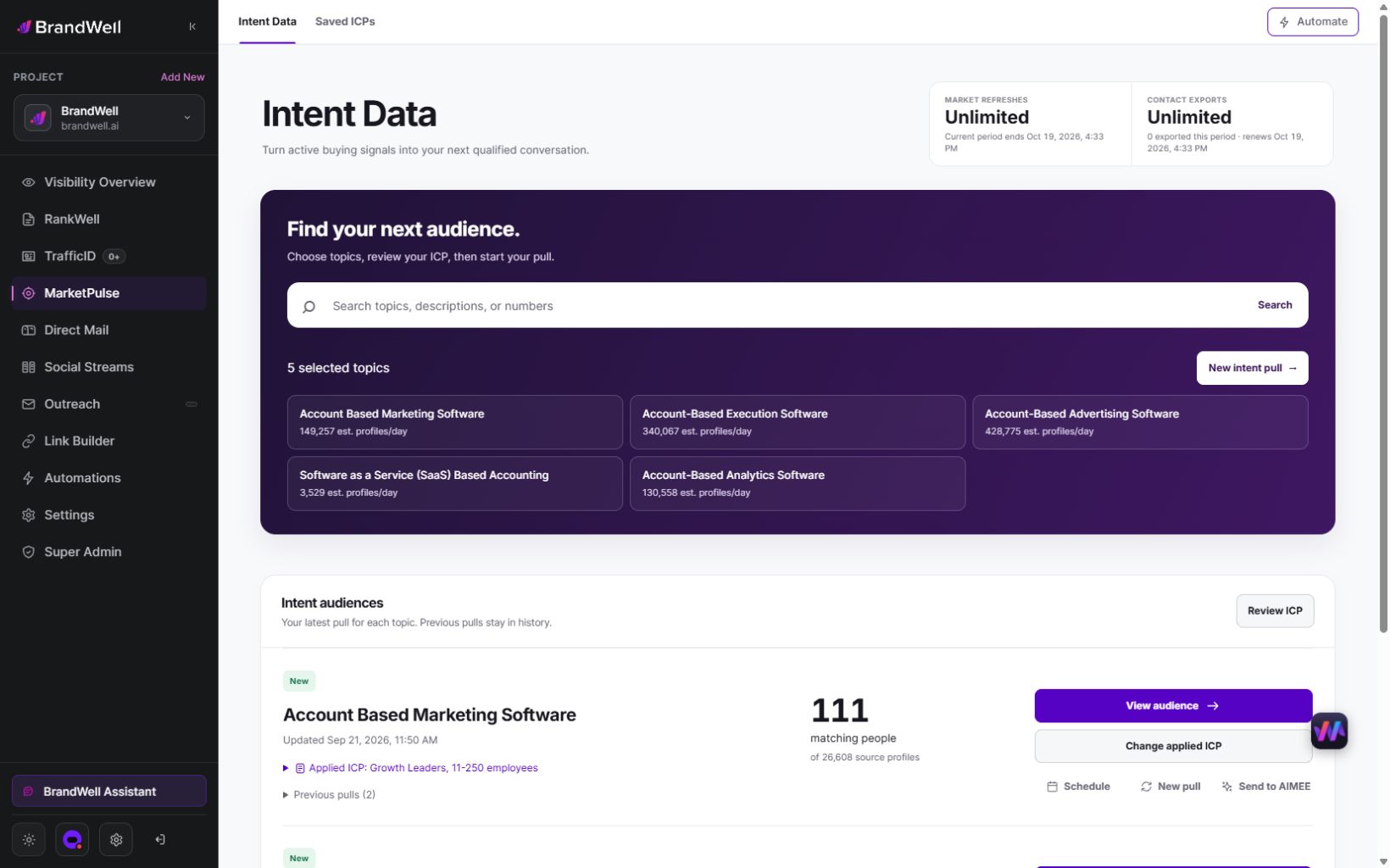
MarketPulse plans are starting at $500/mo. Verify current package scope and offers on the product page.
| Plan | Topics and refreshes | Monthly exports |
|---|---|---|
| Starter | 1 topic, weekly | 25,000 contacts |
| Growth | 3 topics, daily | 100,000 contacts |
| Scale | 10 topics, daily | Unlimited contacts |
Swipe the table to see all columns.
A pull retrieves available data from the previous 24 hours for one topic. Daily use across all included topics provides 90 Growth pulls or 300 Scale pulls in a 30-day month. Weekly Starter pulls vary by calendar month. Available audience size and contact fields vary, and audiences may overlap. Refreshes stop at the plan limit without overage charges.
- Find and qualify: search the topic catalog, save your ICP, and review the people and companies that match.
- Act on the research: export qualified contacts or prepare an Outreach or Direct Mail workflow. Connected products, channel usage, and fulfillment may cost extra.
- Get help from AIMEE: Growth and Scale include AIMEE for the initial user to research accounts and prepare the next step through connected tools.
Agencies and other service businesses can build client deliverables around their available Intent Scans and exports. Keep each client’s scope, permissions, and service fees clear. A subscription is not a promise of a white-label platform or exclusive access to a market.
Explore MarketPulse and watch the demo or compare plans starting at $500/mo. Any early-access discount is a separate, time-limited offer shown to an eligible recipient.
Choose the decision and comparison
Start with one decision: keep, change, expand, narrow, or stop a topic, source, threshold, workflow, or service package. Then choose the comparison that can actually support that decision. A baseline might be the same client’s prior period under the same definition. A counterfactual might be a comparable holdout or randomized assignment when feasible and ethical.
If the question is operational, such as whether reviews are faster after a routing change, a stable before-and-after comparison may be useful. If the question is causal, such as whether the service created more qualified opportunities than would otherwise have occurred, a descriptive trend is not enough. Record what alternative explanation the design does and does not address.
Write the decision statement before calculating a rate: “If acceptance is lower for topic family A after controlling for client tier and reviewer coverage, we will revise or retire it.” This prevents teams from searching through metrics until a flattering result appears.
Define the event trail and owners
Use a versioned metric dictionary and a row-level event trail. Each observation needs client, topic or source, observed time, eligibility state, delivery time, reviewer, review state, acceptance state, reason code, action, action time, downstream event, and evidence reference. Preserve unknowns instead of filling them with assumptions.
Define the denominator precisely. Accepted divided by delivered is different from accepted divided by reviewed, and both can be distorted by unreviewed backlog. Set a review window and an outcome window. Assign an operations owner for data completeness, a client owner for acceptance decisions, and an analyst owner for calculation and narrative.
The workflow should freeze definitions for the reporting period, validate event joins, reconcile missing reviews, calculate segmented results, test sensitivity, draft conclusions, and obtain client approval. The agency intent-signal reporting guide can provide the broader report structure.
Select tools that preserve the evidence
Choose tools by the decision and evidence burden, not by dashboard polish. A governed spreadsheet may be enough for a small, transparent cohort. A warehouse and business-intelligence layer may be needed for multi-client event history. Experiment software helps only when assignment, exposure, sample, and contamination can be controlled.
At minimum, the tool should preserve definitions, event timestamps, client and cohort dimensions, unknown states, reason codes, source lineage, and revisions. It should expose the numerator and denominator behind each rate and allow reconciliation to row-level evidence. A calculator that hides exclusions or silently drops missing data is dangerous.
Use a metric-definition card, cohort table, event audit, and narrative template regardless of software. Do not recommend a universal platform without verifying current capabilities, privacy posture, prices, and contracts on primary pages. The best tool is the least complex system that preserves the required decision trail.
Separate experiment, attribution and observation
Experimental designs can estimate an effect under controlled assignment; quasi-experimental designs seek a credible comparison without random assignment; attribution assigns credit by a rule; observational reporting describes what happened. These are not interchangeable labels.
CDC’s evaluation framework organizes context, evaluation questions, credible evidence, conclusions and action. Its public-health origin does not make it an agency performance benchmark.
Attribution rules can support consistent reporting while still failing to identify cause. A first-touch or last-touch label tells the team how credit was assigned, not what would have happened without the signal. Observational reporting is often the honest default for early service operations: it can show acceptance, action, and associated progression while explicitly limiting causal claims.
Budget the reporting workload
Budget the full measurement system: event capture, identity and account joins, storage, analytics access, definition work, reconciliation, analysis, client review, privacy controls, and maintenance. Add the opportunity cost of asking sellers or client reviewers to code every signal, especially if the process does not change a decision.
Data costs may vary with retained history, enrichment, destinations, and user access. Analyst costs vary with exceptions, segmentation, definition drift, and narrative review. Tooling can reduce repeated work but adds implementation, administration, and monitoring. A cheap dashboard with unreliable joins creates expensive debates.
Use an effort ledger by report step and client. Track minutes spent repairing data, chasing reviews, changing definitions, explaining results, and answering exceptions. Price a reporting service only after these costs and current written platform terms are visible. Do not assume a generic ROI or margin benchmark.
Show counts, windows and missing data
Report volume, eligibility, review coverage, acceptance, action completion, response, opportunity association, and downstream association as separate metrics. Segment by client, topic, source, company tier, identity state, freshness, reviewer, action, and rule version when sample supports it.
Every rate needs numerator, denominator, window, exclusions, missing-data count, and definition version. Confidence checks should include small-cell flags, duplicate detection, delayed-outcome sensitivity, reviewer consistency, join success, and whether the result changes materially when ambiguous rows are excluded. Avoid decorative precision.
Benchmarks should be internal and comparable unless an external benchmark has a verified method and matching population. A low acceptance rate can reflect weak topics, strict reviewers, an overly broad denominator, or poor review coverage. The intent-data service performance guide can help maintain comparable definitions.
Recognize insufficient evidence
It is decision-useful when definitions are stable, review coverage is adequate, the relevant cohort has enough observations, and the possible action is clear. It is insufficient when missing reviews dominate, windows are incomplete, client behavior changed midperiod, the cohort is tiny, or several rule versions are mixed.
Do not convert “insufficient” into a negative conclusion. A small sample may support case review rather than a rate comparison. Read the accepted and rejected examples, inspect reason codes, and decide whether to collect more data, combine only defensibly similar periods, or narrow the question.
Set a minimum evidence rule before the report. It might require complete reviewer coverage above a chosen threshold, a fully elapsed outcome window, and a stated minimum cohort for a rate. The threshold should reflect the consequence of the decision, not a universal industry number.
Separate research, identity and client action
Intent can describe observed research, identity can connect an observation to an account or person at a stated confidence, and activation can show that an approved action occurred. Together they reconstruct a process. They do not prove that the process caused the downstream outcome.
Keep source and identity state in the event record so results can be segmented honestly. Company-level resolution should not be reported as a known individual. A delivered email or CRM task is not evidence that the buyer noticed it. An accepted signal is a client workflow decision, not buyer confirmation.
Use a progression receipt: observation, qualification, acceptance, action, response, opportunity, and associated outcome. Each stage needs its own timestamp and owner. For more on downstream interpretation, use the pipeline attribution guide while preserving the distinction between assigned credit and causal evidence.
Check bias, contamination and privacy
Common distortions include accepting only obvious accounts, reviewing high-value clients faster, changing rules midperiod, exposing comparison groups to the same action, omitting failures, joining the wrong entity, and reporting association as causation. Document these threats before the conclusion.
Selection can make acceptance appear higher when reviewers skip difficult records. Contamination can make groups look similar when sellers act on both. Attrition appears when unreviewed or unmatched observations disappear from the denominator. Seasonality, concurrent campaigns, territory changes, and seller capacity can all explain downstream movement.
Review the measurement purpose, applicable jurisdictions, lawful basis where required, notices, access, retention and deletion with qualified reviewers. Retain only necessary fields and avoid exposing personal-level rows in summaries unless needed and permitted. A reporting template does not establish compliance.
Write a useful renewal decision memo
Use a decision memo: what changed, what remained stable, what the evidence supports, what it cannot support, and what action is recommended. Show the funnel with denominators, segmented acceptance and action, review coverage, rejected examples, operational issues, downstream associations, limitations, and next test.
For renewal, connect the report to service usefulness: did the client review signals, make decisions, complete actions, learn which topics work, and maintain the operating process? Do not convert associated pipeline into “revenue generated.” Renewal should depend on the client’s value judgment, actual service costs, and future decision needs.
AIMEE can prepare a reporting brief through configured connected tools. Supply the metric dictionary, allowed evidence and calculation rules. Require a reviewer to reconcile the output and approve client delivery. Verify each actual integration and destination rather than assuming an instruction executes it.
Use MarketPulse topic research and the defined ICP to review available matching people and company fields. Keep topic evidence separate from the client’s acceptance and action records. Scope additional agency reporting and services separately from the subscription.
Seven-layer accepted-signal measurement ladder
- Observe: Preserve source, time, topic, entity, and identity state.
- Qualify: Apply the stable eligibility rule and record exclusions.
- Deliver: Confirm destination, recipient, time, and receipt.
- Review: Track coverage, reviewer, decision time, and unknowns.
- Accept: Record the precise client decision and reason code.
- Act: Confirm the approved action actually occurred.
- Associate: Link later events under a declared attribution rule and causal limitation.
Copyable agent workflow for Claude, ChatGPT, or AIMEE
ROLE: You are a measurement analyst who may calculate and draft, but may not assert causation.
INPUTS: Metric dictionary, eligible population, event rows, exclusions, windows, cohorts, reviewer coverage, rule versions, and decision statement.
1. Validate required fields, joins, timestamps, duplicate state, and definition versions.
2. Calculate each stage with numerator, denominator, exclusions, and missing count.
3. Segment only when the cohort is large enough for the stated decision.
4. Test whether delayed outcomes, missing reviews, or ambiguous joins change the conclusion.
5. Draft supported observations, plausible alternatives, limitations, and the next decision.
STOP WHEN: denominator or window is undefined, rule versions are mixed, coverage is inadequate, joins conflict, or causal wording exceeds the design.
HUMAN APPROVAL: Required for final definitions, exclusions, causal interpretation, client delivery, pricing, renewal recommendation, and external use.
OUTPUT: Draft metric table, audit exceptions, supported findings, limitations, and recommended next test.
Metric-definition card: For every metric, record name, decision, event, numerator, denominator, inclusion, exclusion, source, join key, window, lag, owner, version, missing-data rule, segment, and permitted wording. Then add one sentence describing what would make the result misleading.
Keep a change ledger. If the acceptance definition, topic catalog, reviewer policy, identity method, or outcome window changes, record the effective point and avoid presenting the new series as continuous without explanation. Restate history only when the method is reproducible and preserve the original privately.
Monthly reporting and renewal worksheet
Build the monthly packet from the event trail, not from a manually curated success list. Start with all eligible signals, reconcile deliveries, show reviewed and unreviewed counts, and disclose records that could not be joined. Present the operational funnel before any outcome association. Include representative accepted, rejected, and unresolved records so the client can inspect how the rule behaves.
For each topic or source, ask five questions: Is review coverage sufficient? Are rejection reasons concentrated? Does action occur after acceptance? Are downstream associations mature enough to read? Would a rule change create a meaningful client decision? The answer can be maintain, revise, pause, collect more evidence, or retire. “Insufficient evidence” is a valid disposition, not a reporting failure.
Renewal analysis should separate service delivery from commercial judgment. Summarize what the agency delivered, how the client used it, what the joint team learned, the current cost to serve, known risks, and the next operating hypothesis. If the client did not review signals or complete agreed actions, say so. Do not fill the missing value story with broad market benchmarks or implied causality.
Maintain a private evidence appendix with query logic, metric versions, excluded-row counts, join diagnostics, sensitivity results, and approvals. The client-facing page can remain concise, but every material number should be reproducible. If a later correction changes a conclusion, issue a versioned correction rather than silently replacing the old report. Record who approved the correction and which decisions may need reconsideration.
Worked example: three different acceptance rates
In a fictional reporting cohort, 1,000 observations meet the frozen eligibility rule. Of these, 900 are delivered, 600 are reviewed within the stated window, and 300 are accepted by the client for the specified next decision.
- Acceptance among reviewed observations: 300 divided by 600, or 50%.
- Acceptance among delivered observations: 300 divided by 900, or 33.3%.
- Acceptance among eligible observations: 300 divided by 1,000, or 30%.
- Review coverage among delivered observations: 600 divided by 900, or 66.7%.
The 300 delivered but unreviewed observations remain unresolved. They are not automatically rejected, and the 100 not delivered need an explicit disposition. If acceptance requires reviewer judgment, the reviewed subset may be selected and may not represent all delivered observations.
For a fictional $1,200 measurement-and-review cost, cost per accepted observation is $4. This is not cost per customer, incremental revenue or ROI. Record the actual scope of included costs and assess downstream actions separately.
Review the current product and the client event trail separately
- Review the selected MarketPulse topic and ICP.
- Record the actual available fields, observation window and duplicates.
- Track delivery, review, acceptance and action in the authorized client workflow.
- Reconcile the stage counts before drafting the summary.
- Approve any client-facing interpretation and identify unresolved evidence.
Compare current MarketPulse plans and watch the demo. Standard subscriptions are starting at $500/mo. An Intent Scan retrieves available data from the previous 24 hours; it does not equal one accepted observation or one customer.
Frequently asked questions
What counts as an accepted signal?
A named reviewer marks an eligible observation useful for a defined next decision under the stated rules. Delivery alone is not acceptance.
Which acceptance denominator should I show?
Show the denominator matching the question, alongside review coverage and unresolved counts. Reviewed, delivered and eligible populations answer different questions.
Does acceptance prove the buyer is interested?
No. It records a client workflow decision, not a buyer’s confirmation or permission for contact.
Can associated pipeline justify an ROI claim?
Association does not establish incremental benefit. Define the costs and a defensible comparison before claiming ROI.
Reviewed and updated October 3, 2026.

Written by