On this page
- Define the agency model and client rights
- Use seven written-evidence checks
- Preserve the versioned decision log
- Compare five operating models
- Separate product and agency responsibilities
- Count costs and committed terms
- Review rights and action boundaries
- Copyable assistant contract-review brief
- Answers to ten program questions
- Review a bounded research workflow
- Copyable program-rights checklist
- Frequently asked questions
Evaluate buyer-intent service models using actual client decisions, written rights, implemented delivery boundaries and full costs. A research subscription is not evidence of a reseller program, exclusive territory, custom portal or guaranteed client outcome. Verify the current scope before quoting client delivery.
Who this is for: Agency owners and consultants comparing white-label intent providers, direct enterprise platforms, data inputs, referral relationships, and build-your-own options.
Define the decision intent data is intended to inform. It should never be presented as proof that a person is ready to buy or as permission for an unreviewed action.
Current MarketPulse offer: intent-data plans start at $500/mo. See the product, demo, and current plans. Updated October 3, 2026.
Define the agency model and client rights
Choose a program by operating model before features. If the agency wants to own the client relationship and monthly service, it needs explicit resale rights, client separation, branded reporting, predictable wholesale cost, usable data exports, implementation support, and an exit path. If it only wants referral revenue or to support one enterprise client, a different path may be better.
Use seven written-evidence checks
- 1. Freeze the intended client outcome and agency responsibility.
- 2. Ask each provider to document reseller, referral, OEM, multi-client, and end-client rights.
- 3. Run a representative coverage test using the agency’s target topics and client markets.
- 4. Inspect identity states, fields, validation, provenance, refresh, expiration, and suppressions.
- 5. Map the full signal-to-action workflow and every human approval point.
- 6. Calculate total cost with usage, labor, support, integrations, and minimum terms.
- 7. Use a paid validation and require an exportable evidence trail before full commitment.
Preserve the versioned decision log
Maintain one versioned record from the first client question through the final commercial decision. Record the eligible market, topic definition, signal source, observed time, identity state, validation state, fit decision, suppressions, reviewer, approved next action, downstream disposition, and fully loaded cost. Do not overwrite rejected, expired, duplicated, or corrected evidence. Preserve the original record and add a reason-coded disposition so the agency can explain what changed. Review the log with the client at an agreed cadence, then use the evidence to tighten qualification, remove noisy topics, revise service scope, and decide whether to stop or expand. This operating record is also the source for renewal reporting, exception handling, and any claim about adoption or outcomes. A polished dashboard without this audit trail can hide weak process quality instead of improving it.
The first control for this workflow is: Freeze the intended client outcome and agency responsibility. The final control is: Use a paid validation and require an exportable evidence trail before full commitment. Those bookends keep the service tied to a buyer decision rather than raw signal volume.
Add a short review note whenever the policy, topic definition, client scope, source, identity rule, activation path, or outcome definition changes. The note should identify who approved the change, which records or clients it affects, and whether earlier results remain comparable. This helps expose process changes that might otherwise be mistaken for performance improvements. It also gives account teams a plain-language explanation when volume, acceptance, cost, or outcomes move between reporting periods.
Compare five operating models
Compare five operating models: separately scoped agency services using permitted research; contract-authorized resale; a referral arrangement with actual written commission terms; managed support for a client-owned account; and custom delivery built on licensed inputs. These are evaluation categories rather than provider rankings or BrandWell program promises. Verify ownership, source rights, support, billing, implementation, export and exit terms for the actual arrangement.
Use the current plan table above for standard topic, refresh and export allowances. Eligible early-access pricing is separate. Quote actual agency setup, review, reporting, support and channel usage separately from a software subscription.
Current MarketPulse research workflow
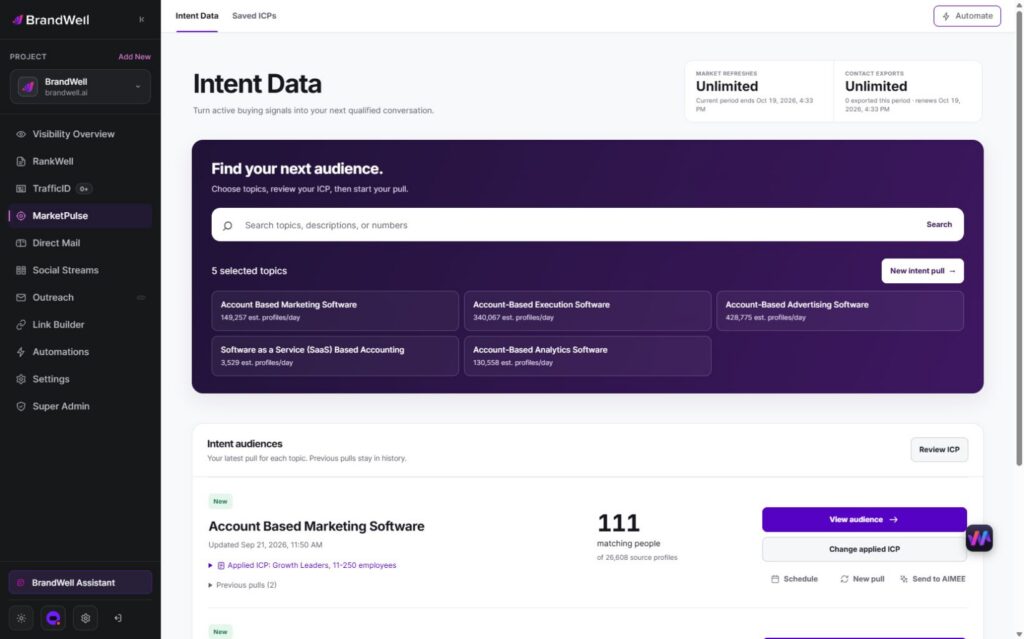
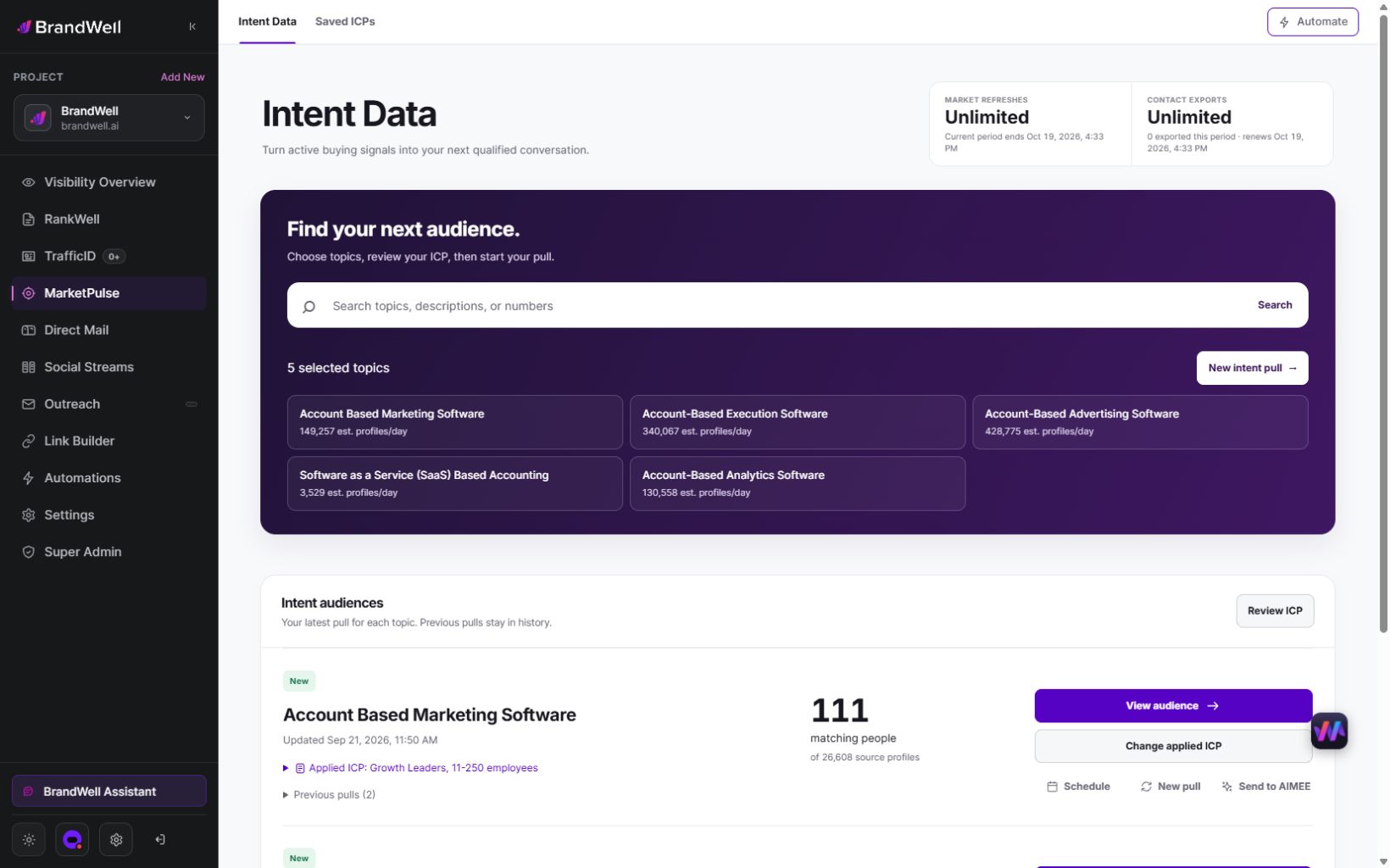
BrandWell MarketPulse: intent data starting at $500/mo. Find people researching topics relevant to what you sell, apply saved ICP filters, and review available contact details before taking action.
MarketPulse plans are starting at $500/mo. Verify current package scope and offers on the product page.
| Plan | Topics and refreshes | Monthly exports |
|---|---|---|
| Starter | 1 topic, weekly | 25,000 contacts |
| Growth | 3 topics, daily | 100,000 contacts |
| Scale | 10 topics, daily | Unlimited contacts |
Swipe the table to see all columns.
A pull retrieves available data from the previous 24 hours for one topic. Daily use across all included topics provides 90 Growth pulls or 300 Scale pulls in a 30-day month. Weekly Starter pulls vary by calendar month. Available audience size and contact fields vary, and audiences may overlap. Refreshes stop at the plan limit without overage charges.
- Find and qualify: search the topic catalog, save your ICP, and review the people and companies that match.
- Act on the research: export qualified contacts or prepare an Outreach or Direct Mail workflow. Connected products, channel usage, and fulfillment may cost extra.
- Get help from AIMEE: Growth and Scale include AIMEE for the initial user to research accounts and prepare the next step through connected tools.
Agencies and other service businesses can build client deliverables around their available Intent Scans and exports. Keep each client’s scope, permissions, and service fees clear. A subscription is not a promise of a white-label platform or exclusive access to a market.
Explore MarketPulse and watch the demo or compare plans starting at $500/mo. Any early-access discount is a separate, time-limited offer shown to an eligible recipient.
Separate product and agency responsibilities
BrandWell MarketPulse is topic-based intent-data software for businesses and agencies. Choose relevant research topics, apply saved ideal-customer-profile filters, review available names, roles, companies and contact details, and export the audience or prepare a connected workflow. Plans start at $500/mo. TrafficID identifies visitors to your own website and is a separate product. A MarketPulse subscription does not by itself promise a white-label portal, custom API implementation, exclusive topics, or managed client delivery.
Review an available MarketPulse topic, saved ICP and actual preceding-24-hour matches for the agreed research purpose. AIMEE can organize supplied company context through configured tools. Custom portals, CRM work, managed outreach and agency reporting require separately verified rights, implementation, scope and fees.
Use the current plan table above for standard topic, refresh and export allowances. Eligible early-access pricing is separate. Quote actual agency setup, review, reporting, support and channel usage separately from a software subscription.
Scope the implementation around defined research inputs, human review, a client action and actual outcome return. MarketPulse supplies research. Custom interfaces, scoring rules, CRM joins and managed delivery need separate implementation; a product subscription does not establish those agency capabilities.
Count costs and committed terms
Compare actual usable scope and full costs over the committed period. Include tools, minimum fees, client setup, review, support, reporting, activation, implementation and corrections. A lower quote or larger database does not establish lower accepted-input cost or a profitable client service.
Use a stop-or-expand scorecard
Track accepted-signal cost, qualified-account coverage, signal age at action, meeting and opportunity rate, agency hours per client, contribution margin, client adoption, retention, and corrections. A provider’s volume should never substitute for a downstream scorecard.
Important: Intent signals are probabilistic evidence. They do not prove identity, consent, need, authority, budget, stage, qualification, purchase, pipeline, or revenue. Report association and uncertainty honestly.
Review rights and action boundaries
Do not infer resale permission from a sales demo. Put client ownership, derived data, exports, deletion, suppression, territory, topic protection, subprocessor, security, incident, and termination responsibilities in writing. Never expose inferred research behavior in outreach.
Document actual supplier security requirements and evidence. NIST SP 1305 addresses communicating supplier requirements for cybersecurity supply-chain risk. Commercial resale, branding, multi-client delivery and data-use rights need separate written verification; this guidance does not grant them or certify BrandWell.
- Preserve source, observed time, identity state, confidence, and validation status.
- Separate known people, candidate people, companies, domains, and unresolved visitors.
- Apply customer, employee, competitor, duplicate, geography, consent, and opt-out suppressions before action.
- Require a named human approval before CRM writes, audience uploads, spend, or outreach.
- Give clients correction, export, deletion, escalation, and offboarding paths.
Copyable assistant contract-review brief
AIMEE can prepare a program-review brief through configured connected tools. Preserve actual client prerequisites, missing evidence and blocked actions. Named owners approve scope, destinations and external actions; a proposed program does not establish native platform capability.
Objective: Compare provider evidence for a named agency use case. Use identical fields: operating model, client separation, branding, signals, identity, activation, implementation, pricing evidence, governance, measurement, export, and limitation. Mark unknowns. Do not rank on unverified marketing claims or recommend a provider until a human reviews the written terms.
Inputs: approved ICP, topic dictionary, signal source and time, identity state, CRM lifecycle, suppressions, permitted-use policy, and current written commercial scope.
Rules: preserve provenance and uncertainty; never infer budget, authority, consent, or purchase readiness; never expose private behavior in messaging; stop before external action.
Output: decision, reason codes, missing evidence, recommended next step, and audit log.
Keep actual sources, unknowns, proposed program dependencies and reviewer together. Reconcile the brief against current product capabilities and client scope. Do not invent an integration, budget or approval to fill a missing prerequisite.
Answers to ten program questions
What should an agency decide before selecting and operating a buyer-intent reseller program, and what client outcome can it responsibly promise?
Choose a program by operating model before features. If the agency wants to own the client relationship and monthly service, it needs explicit resale rights, client separation, branded reporting, predictable wholesale cost, usable data exports, implementation support, and an exit path. If it only wants referral revenue or to support one enterprise client, a different path may be better.
What workflow, owners, SLA, quality checks, approvals, and client handoff does a buyer-intent reseller program require?
Assign a named agency owner, client owner, operator, and technical or CRM owner. The operating sequence is: 1) Freeze the intended client outcome and agency responsibility. 2) Ask each provider to document reseller, referral, OEM, multi-client, and end-client rights. 3) Run a representative coverage test using the agency’s target topics and client markets. 4) Inspect identity states, fields, validation, provenance, refresh, expiration, and suppressions. 5) Map the full signal-to-action workflow and every human approval point. 6) Calculate total cost with usage, labor, support, integrations, and minimum terms. 7) Use a paid validation and require an exportable evidence trail before full commitment. Set the response SLA, log exceptions, preserve uncertainty, and require a client handoff with permitted next steps and ownership.
Which platforms, tools, templates, calculators, and integrations best support selecting and operating a buyer-intent reseller program?
BrandWell MarketPulse is topic-based intent-data software for businesses and agencies. Choose relevant research topics, apply saved ideal-customer-profile filters, review available names, roles, companies and contact details, and export the audience or prepare a connected workflow. Plans start at $500/mo. TrafficID identifies visitors to your own website and is a separate product. A MarketPulse subscription does not by itself promise a white-label portal, custom API implementation, exclusive topics, or managed client delivery.
How do white-label, referral, build-your-own, and direct enterprise approaches compare for selecting and operating a buyer-intent reseller program?
Branded delivery needs written rights and an implemented interface. Referral needs actual commission eligibility and payment terms and does not establish client ownership. Custom delivery needs source licensing, implementation, support and exit arrangements. Managing a client-owned deployment needs an approved role and task boundary. Agency services using permitted research need their own scope and fees. Compare the written model rather than assuming a label grants rights or protects margin.
How should an agency price a buyer-intent reseller program, and which setup, usage, labor, support, and risk costs determine gross margin?
Compare actual usable scope and full costs over the committed period. Include tools, minimum fees, client setup, review, support, reporting, activation, implementation and corrections. A lower quote or larger database does not establish lower accepted-input cost or a profitable client service.
Which quality, adoption, meeting, opportunity, pipeline, cost, margin, and retention metrics show whether a buyer-intent reseller program is working?
Track accepted-signal cost, qualified-account coverage, signal age at action, meeting and opportunity rate, agency hours per client, contribution margin, client adoption, retention, and corrections. A provider’s volume should never substitute for a downstream scorecard.
Which clients are ready for a buyer-intent reseller program, and which prospects should the agency exclude?
Agency owners and consultants comparing white-label intent providers, direct enterprise platforms, data inputs, referral relationships, and build-your-own options. Best-fit clients also have a clear ICP, sufficient addressable market or qualified traffic, relevant commercial topics, a named action owner, measurable CRM outcomes, conservative economics, and privacy readiness. Exclude clients demanding guaranteed leads, universal identity, prohibited use, or automation without review.
Which signal sources, identity checks, qualification rules, activation steps, and outcome evidence matter most for a buyer-intent reseller program?
Combine relevant topic or first-party behavior with fit, recency, recurrence, identity state, enrichment and validation, suppressions, human acceptance, an approved activation path, and outcome return. Keep every evidence type separate so an inference does not become a false fact.
Which data-quality, privacy, security, scope, billing, delivery, and client-trust risks must the agency control for a buyer-intent reseller program?
Do not infer resale permission from a sales demo. Put client ownership, derived data, exports, deletion, suppression, territory, topic protection, subprocessor, security, incident, and termination responsibilities in writing. Never expose inferred research behavior in outreach.
What should an agency require in a reseller agreement and recurring client-delivery package?
A recurring package should connect the client decision to the operating path described in five operating models described above. Define the eligible market, topics, signals, identity states, qualification policy, branded deliverable, portal or export, action SLA, approvals, usage, pricing, scorecard, governance, support, change control, and offboarding. Expand only after the client uses the first module well.
Review a bounded research workflow
Assess the audience and the operating cost before expanding the service. Explore MarketPulse with the data, tools, and client delivery scope you need.
Copyable program-rights checklist
Model: [Agency service, authorized resale, referral, managed client account or custom implementation.] Rights: [Actual client delivery, branding, derived data, recipients and permitted purposes.] Boundary: [Read, export, action, client separation and approvals.] Deliverable: [Implemented report or interface, actual source, unit and period.] Fees: [Minimums, usage, setup, support and renewal.] Evidence: [Coverage, acceptance, defects and missing outcomes.] Exit: [Notice, fees, export, deletion and responsible owner.]
Record the actual agreement clause and unresolved question beside each item. A demo, affiliate label or ordinary software subscription cannot substitute for written rights. Verify any proposed custom portal or commission arrangement separately.
Worked example: the minimum commitment can outlast the clients
Assume a fictional supplier minimum of $1,000 per month and three clients paying $1,500 each. Review costs $600 per client and shared support costs $300: $4,500 in revenue minus $1,000 tools, $1,800 review and $300 support leaves $1,400, or 31.1%. With two clients, revenue is $3,000 against $1,000 tools, $1,200 review and $300 support, leaving $500, or 16.7%. Shared tools are counted once.
Now assume the agency commits to a noncancelable $12,000 supplier term, but all three clients stop after three paid periods. Client receipts are $13,500. The supplier commitment remains $12,000, and three periods of review and support add $6,300. Defined costs total $18,300, leaving a negative $4,800 remainder. Actual cancellation and refund rights can change this exposure; do not assume these invented terms apply to BrandWell. Setup, acquisition, general overhead, tax and financing are excluded.
Compare usable cost under the same review definition
Suppose two fictional research inputs each cost $500 and require $1,000 in review. The first yields 100 accepted unique records, the second 150. Cost per accepted record is $15 versus $10. This comparison requires the same unit, eligibility rule, period and treatment of overlap. Acceptance is not contact permission, client use or improved pipeline; measure those separately.
Prepare the supported BrandWell research input
Review an available MarketPulse topic, saved ICP and actual preceding-24-hour matches against the written client purpose. Verify public company context and preserve uncertainty. TrafficID is separately scoped own-site visitor work. AIMEE can organize supplied context through configured tools. Owners approve exports, Outreach enrollment, audience uploads and CRM writes. Agency reports, client interfaces and managed delivery require separately verified implementation and source rights.
Frequently asked questions
Does a software subscription establish a reseller program?
No. Verify actual permitted client use and commercial terms.
Does a branded mockup establish a working portal?
No. Verify implementation, rights and client boundaries.
Does a lower quote establish lower usable cost?
No. Compare accepted units and full review costs.
Can supplier obligations outlast client revenue?
Yes. Review the full committed term and actual exit rights.
Review the research product: explore MarketPulse and current plans.
Reviewed and updated October 3, 2026.

Written by