On this page
- Confirm client readiness and permitted channels
- Use seven audience-review steps
- Preserve the versioned evidence log
- Compare five workflow choices
- Copyable audience-service worksheet
- Scope the recurring client operation
- Separate product and agency responsibilities
- Budget actual acceptance and delivery
- Review source and destination permissions
- Copyable assistant audience brief
- Maintain current sources and scope
- Related agency operating guides
- Answers to ten audience-service questions
- Review one supported research use
- Worked example: acceptance is not ad reach or profit
- Frequently asked questions
An in-market audience service prepares a reviewed audience decision for a defined client purpose. Combine fit, source rights, signal recency, identity state, exclusions and channel eligibility. Record actual platform acceptance, delivery, spend and downstream outcomes. A signal, an accepted upload or a higher conversion count does not by itself demonstrate improved advertising performance.
Who this is for: Paid-media agencies, ABM consultants, demand-generation firms, and data-service resellers that want to sell reviewed in-market audiences as a recurring client service.
Define the decision intent data is intended to inform. It should never be presented as proof that a person is ready to buy or as permission for an unreviewed action.
Current MarketPulse offer: intent-data plans start at $500/mo. See the product, demo, and current plans. Updated October 3, 2026.
Confirm client readiness and permitted channels
Decide whether the agency can define an eligible market, validate useful signals, create platform-compliant audiences, and return outcome data. Promise a maintained audience qualification and activation process. Do not promise that a signal proves a buyer, that every record can be matched, or that a campaign will produce guaranteed pipeline.
Use seven audience-review steps
- 1. Freeze the client ICP, exclusions, commercial topics, and permitted channels.
- 2. Separate company, domain, known-person, candidate-person, and unresolved identity states.
- 3. Score fit, recency, recurrence, source diversity, and prior relationship without collapsing them into certainty.
- 4. Apply customer, employee, competitor, geography, consent, opt-out, and minimum-size suppressions.
- 5. Require a named reviewer before every audience creation, refresh, or expansion.
- 6. Record platform acceptance, delivery, spend, engagement, meetings, and opportunity outcomes.
- 7. Refresh, expire, suppress, or stop the audience based on a versioned scorecard.
Preserve the versioned evidence log
Use one versioned record to show why each in-market audience activation service decision was made. Capture the eligible market, topic definition, source, observed time, identity state, validation result, suppression, reviewer, approved action, downstream disposition, and fully loaded cost. Preserve rejected, expired, duplicated, and corrected records with reason codes rather than overwriting them. This makes client explanations and later comparisons reproducible.
Open the log with Freeze the client ICP, exclusions, commercial topics, and permitted channels. Close each review cycle with Refresh, expire, suppress, or stop the audience based on a versioned scorecard. If a topic, source, identity rule, activation path, outcome definition, price, or policy changes, record the approver, affected records, and whether prior periods remain comparable.
Compare five workflow choices
This BrandWell-owned guide compares workflow choices rather than ranking vendors. MarketPulse supplies topic research; channel eligibility, implementation, campaign operation and measurement require separately reviewed scope. Compare actual written rights, capabilities, support and costs for the client purpose.
Compare five operating choices: topic-research briefs, own-site visitor review, client-owned advertising operations, licensed-input integration and a manually reviewed pilot. They have different source requirements and responsibilities; none automatically grants permission to upload contact data.
1. BrandWell: MarketPulse intent data and connected growth automation
BrandWell MarketPulse: intent data starting at $500/mo. Find people researching topics relevant to what you sell, apply saved ICP filters, and review available contact details before taking action.
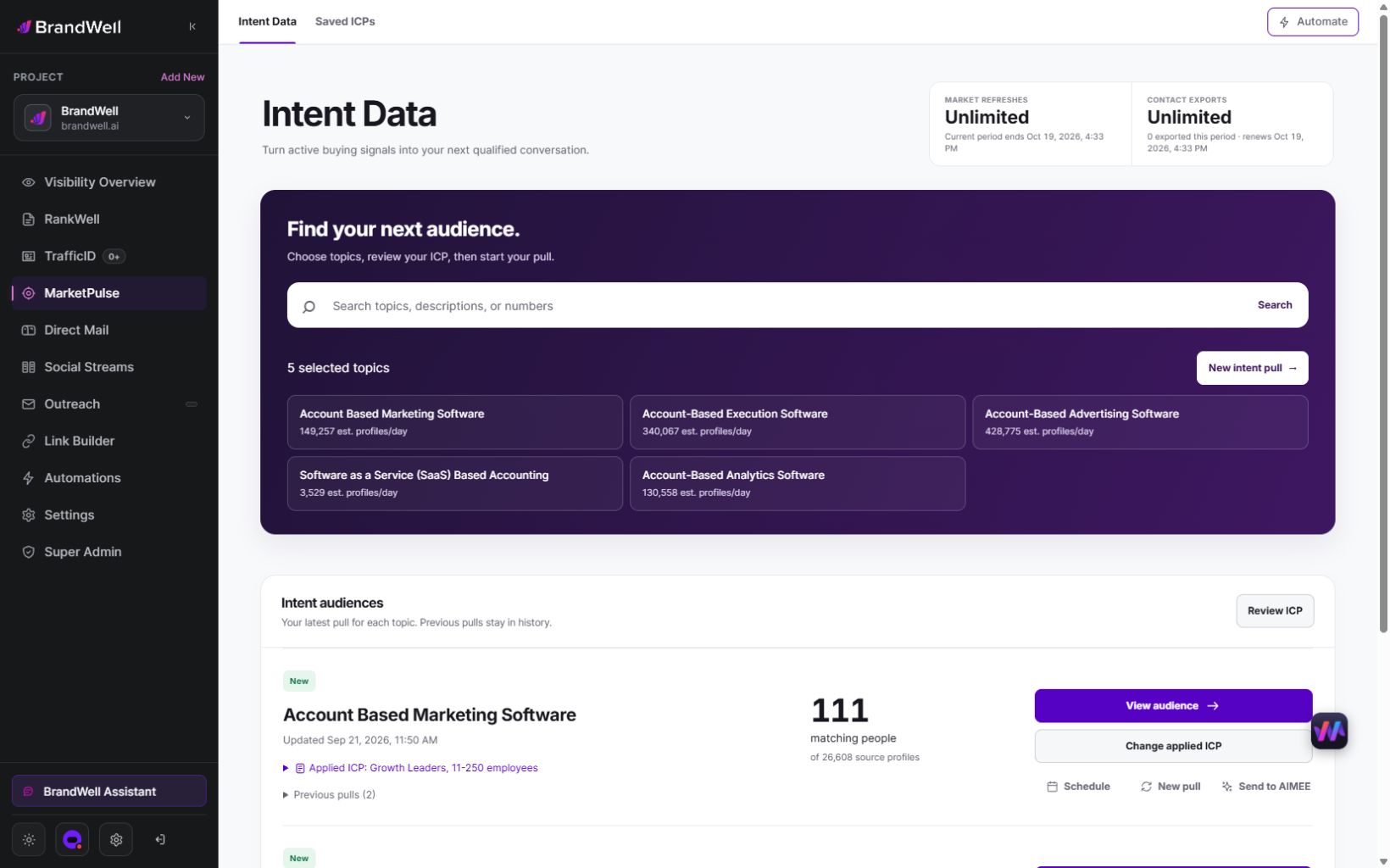
MarketPulse plans are starting at $500/mo. Verify current package scope and offers on the product page.
| Plan | Topics and refreshes | Monthly exports |
|---|---|---|
| Starter | 1 topic, weekly | 25,000 contacts |
| Growth | 3 topics, daily | 100,000 contacts |
| Scale | 10 topics, daily | Unlimited contacts |
Swipe the table to see all columns.
A pull retrieves available data from the previous 24 hours for one topic. Daily use across all included topics provides 90 Growth pulls or 300 Scale pulls in a 30-day month. Weekly Starter pulls vary by calendar month. Available audience size and contact fields vary, and audiences may overlap. Refreshes stop at the plan limit without overage charges.
- Find and qualify: search the topic catalog, save your ICP, and review the people and companies that match.
- Act on the research: export qualified contacts or prepare an Outreach or Direct Mail workflow. Connected products, channel usage, and fulfillment may cost extra.
- Get help from AIMEE: Growth and Scale include AIMEE for the initial user to research accounts and prepare the next step through connected tools.
Agencies and other service businesses can build client deliverables around their available Intent Scans and exports. Keep each client’s scope, permissions, and service fees clear. A subscription is not a promise of a white-label platform or exclusive access to a market.
Explore MarketPulse and watch the demo or compare plans starting at $500/mo. Any early-access discount is a separate, time-limited offer shown to an eligible recipient.
Copyable audience-service worksheet
Use this field set during discovery, onboarding, and the first client review. It turns an in-market audience activation service into a reproducible decision record instead of an informal promise. Replace every bracketed prompt with written evidence and leave unknowns visible.
IN-MARKET AUDIENCE ACTIVATION SERVICE DECISION WORKSHEET
Client decision: [one decision this service must improve]
Eligible market and exclusions: [written ICP, geography, lifecycle, customers, competitors]
Evidence required: [source, observed time, topic rule, identity state, validation]
Path being evaluated: [topic-research brief; own-site visitor review; client-owned ad operations; licensed-input integration; manual pilot]
First operating control: [Freeze the client ICP, exclusions, commercial topics, and permitted channels.]
Final operating control: [Refresh, expire, suppress, or stop the audience based on a versioned scorecard.]
Owners and approvals: [agency, client, data, CRM, activation, privacy, billing]
Fully loaded monthly cost: [platform + usage + labor + support + risk reserve]
Evidence of use: [accepted, rejected, corrected, acted on, downstream disposition]
Stop, revise, or expand rule: [threshold, reviewer, next action]
Scope the recurring client operation
Translate the workflow into a client scope for an in-market audience activation service: the decision being improved, eligible market, topic set, branded deliverable, portal or export, action SLA, review cadence, usage boundary, support path, change control, and stop rule. Mark records as eligible, review, suppressed, expired, or unresolved so the client knows what can happen next.
Assign named owners for sales, client success, data operations, identity review, CRM, activation, privacy, security, analytics, and billing. Attach evidence to every handoff. Review the first month as an operating test by comparing accepted, rejected, corrected, suppressed, and acted-on records with delivery hours, outcome return, and contribution margin. Narrow or stop the service when the client cannot use the evidence reliably.
Separate product and agency responsibilities
BrandWell MarketPulse is topic-based intent-data software for businesses and agencies. Choose relevant research topics, apply saved ideal-customer-profile filters, review available names, roles, companies and contact details, and export the audience or prepare a connected workflow. Plans start at $500/mo. TrafficID identifies visitors to your own website and is a separate product. A MarketPulse subscription does not by itself promise a white-label portal, custom API implementation, exclusive topics, or managed client delivery.
Review an available MarketPulse topic, saved ICP and actual preceding-24-hour matches for the agreed research use. AIMEE can organize supplied company context through configured tools. Verify source rights and actual advertising-platform eligibility before preparing an audience; campaign operation and media spending require separate authority and scope.
Use the current plan table above for standard topic, refresh and export allowances. Eligible early-access pricing is separate. Include actual agency review, campaign administration and channel usage in the client service cost model.
AIMEE can prepare an approved research brief through configured connected tools. Preserve missing fields, unresolved permissions and client dispositions. Named owners approve actual uploads, campaign changes and spending; a draft is not launch authorization.
Budget actual acceptance and delivery
Price the service around topic coverage, audience refresh cadence, identity and enrichment usage, operator review, CRM and ad-platform work, reporting, client support, and media governance. Separate data and service fees from media spend. Compare actual usable scope and downstream evidence rather than inferring value from raw audience size.
The in-market audience activation service stop-or-expand scorecard
Track eligible-market coverage, match state, audience acceptance, time to activation, platform rejection, spend, cost per engaged account, qualified meetings, opportunities, corrections, opt-outs, delivery hours, gross margin, and renewal. Compare against the client’s prior audience or a defensible holdout where practical.
Important: Intent signals are probabilistic evidence. They do not prove identity, consent, need, authority, budget, stage, qualification, purchase, pipeline, or revenue. Report association and uncertainty honestly.
Review source and destination permissions
Major risks include treating lookalikes as proven buyers, inferring identity too aggressively, exposing research behavior in creative, uploading prohibited data, ignoring platform minimums, retaining stale audiences, and attributing every downstream conversion to the signal. Document permitted use and approval boundaries.
Review actual source rights, client purpose, necessary fields, retention and destinations before activation. Google Ads explains ROAS as conversion value divided by ad cost. That denominator excludes the broader service and fulfillment costs needed for a profit view. This reference defines a metric; it does not establish that a proposed audience is eligible or recommend a bidding change.
- Preserve source, observed time, identity state, confidence, validation, and policy version.
- Separate known people, candidate people, companies, domains, and unresolved visitors.
- Apply customer, employee, competitor, duplicate, geography, consent, and opt-out suppressions.
- Require named human approval before CRM writes, audience uploads, spend, or outreach.
- Give clients correction, export, deletion, escalation, incident, and offboarding paths.
Copyable assistant audience brief
Objective: Prepare an in-market audience recommendation from approved ICP, topic signals, website evidence, identity states, exclusions, and platform rules. Return eligible, review, reject, and expire groups with reasons. Stop before any audience upload, campaign change, spend, or external message and request named human approval.
Inputs: approved ICP, topic dictionary, signal source and time, identity state, client lifecycle, suppressions, permitted-use policy, outcome definitions, and current written commercial scope.
Rules: preserve provenance and uncertainty; never infer budget, authority, consent, or purchase readiness; never expose private behavior in messaging; stop before external action.
Output: decision, reason codes, missing evidence, recommended next step, and audit log.
Keep the supplied source, missing field, proposed destination, permission boundary and reviewer together. An assistant draft does not settle platform eligibility or source rights. Reconcile it against the actual client purpose and approval record before external action.
Maintain current sources and scope
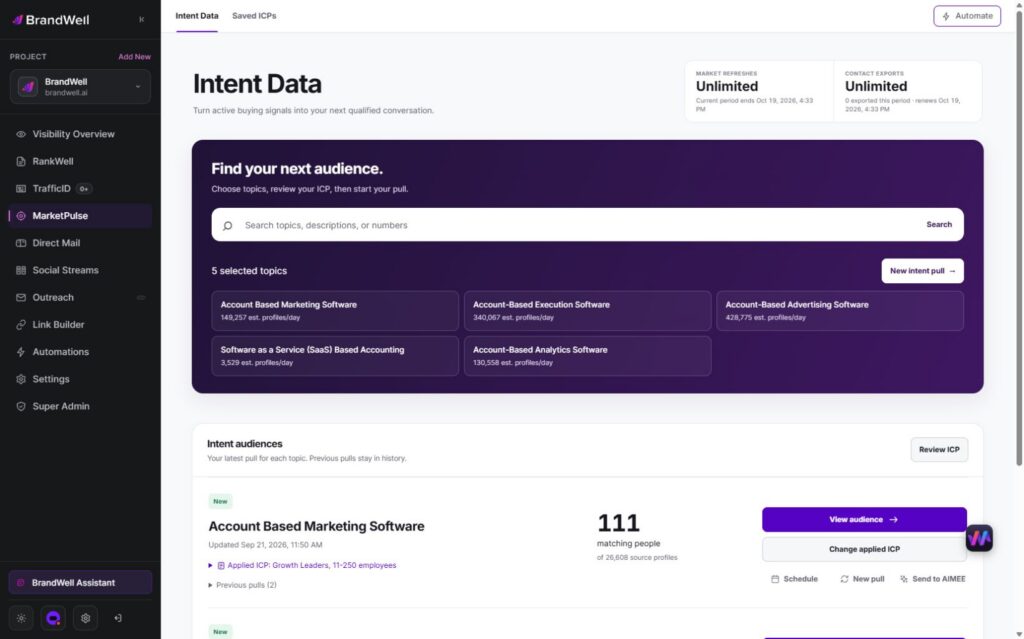
This guide evaluates an in-market audience activation service through one defined client decision, a seven-step operating workflow, consistent option criteria, a fully loaded cost model, an outcome scorecard, and explicit limitations. The MarketPulse workspace image illustrates the interface; its example counts do not establish advertising performance or audience eligibility. Current contracts, official product documentation, platform policies, and scope-matched written quotes control volatile facts.
Recheck the relevant claim before a client quote and whenever a provider changes pricing, modules, permitted uses, reseller rights, retention, export, support, platform policy, or contract terms. Revise the affected statement and workflow rather than carrying an old assumption into a new engagement.
Related agency operating guides
Use these companion guides to move from the current decision into the next operating layer without collapsing distinct buyer questions into one oversized page.
- How to Launch a Managed Intent-Based Paid Media Service
- Best White-Label Intent Client Portals for Agencies
- How to Choose an Intent-Data Vendor for an Agency Service
Answers to ten audience-service questions
What should an agency decide before building and operating an in-market audience activation service, and what client outcome can it responsibly promise?
Make a go, revise, or stop decision before delivery begins. The governing test is: Decide whether the agency can define an eligible market, validate useful signals, create platform-compliant audiences, and return outcome data. Promise a maintained audience qualification and activation process. Do not promise that a signal proves a buyer, that every record can be matched, or that a campaign will produce guaranteed pipeline.
What workflow, owners, SLA, quality checks, approvals, and client handoff does an in-market audience activation service require?
Assign a named agency owner, client owner, operator, and technical or CRM owner. The sequence is: 1) Freeze the client ICP, exclusions, commercial topics, and permitted channels. 2) Separate company, domain, known-person, candidate-person, and unresolved identity states. 3) Score fit, recency, recurrence, source diversity, and prior relationship without collapsing them into certainty. 4) Apply customer, employee, competitor, geography, consent, opt-out, and minimum-size suppressions. 5) Require a named reviewer before every audience creation, refresh, or expansion. 6) Record platform acceptance, delivery, spend, engagement, meetings, and opportunity outcomes. 7) Refresh, expire, suppress, or stop the audience based on a versioned scorecard. Set the response SLA, log exceptions, preserve uncertainty, and require a client handoff with permitted next steps and ownership.
Which platforms, tools, templates, calculators, and integrations best support building and operating an in-market audience activation service?
BrandWell MarketPulse is topic-based intent-data software for businesses and agencies. Choose relevant research topics, apply saved ideal-customer-profile filters, review available names, roles, companies and contact details, and export the audience or prepare a connected workflow. Plans start at $500/mo. TrafficID identifies visitors to your own website and is a separate product. A MarketPulse subscription does not by itself promise a white-label portal, custom API implementation, exclusive topics, or managed client delivery.
How do white-label, enterprise ABM, account-intent input, sales-intelligence, and manual audience compare for building and operating an in-market audience activation service?
A topic-research brief prepares context and account review. Own-site visitor review uses separately scoped website evidence. Client-owned advertising operations use the client platform and named authority. A licensed-input integration adds separately implemented connectors and reconciliation. A manually reviewed pilot limits scope while testing actual usability. Compare these paths against the same purpose, rights, adoption evidence, full cost and exit terms.
How should an agency price an in-market audience activation service, and which setup, usage, labor, support, and risk costs determine gross margin?
Build a client-level cost model before setting price. Price the service around topic coverage, audience refresh cadence, identity and enrichment usage, operator review, CRM and ad-platform work, reporting, client support, and media governance. Separate data and service fees from media spend. Compare actual usable scope and downstream evidence rather than inferring value from raw audience size. Put usage overages, client work, exception handling, and out-of-scope activation in writing.
Which quality, adoption, meeting, opportunity, pipeline, cost, margin, and retention metrics show whether an in-market audience activation service is working?
Use a baseline and one review cadence. Track eligible-market coverage, match state, audience acceptance, time to activation, platform rejection, spend, cost per engaged account, qualified meetings, opportunities, corrections, opt-outs, delivery hours, gross margin, and renewal. Compare against the client’s prior audience or a defensible holdout where practical. Do not call correlation incremental impact without an appropriate comparison.
Which clients are ready for an in-market audience activation service, and which prospects should the agency exclude?
A client is ready for an in-market audience activation service when it has a clear ICP, sufficient market or qualified traffic, relevant commercial topics, a named action owner, measurable outcomes, conservative economics, privacy readiness, and a way to return dispositions. Require this first control: Freeze the client ICP, exclusions, commercial topics, and permitted channels. Exclude clients demanding guaranteed leads, universal identity, prohibited use, or automation without review.
Which signal sources, identity checks, qualification rules, activation steps, and outcome evidence matter most for an in-market audience activation service?
For an in-market audience activation service, combine topic or first-party behavior with fit, recency, recurrence, identity state, validation, suppressions, human acceptance, the approved activation path, and returned outcomes. Apply the specific controls in this workflow: Separate company, domain, known-person, candidate-person, and unresolved identity states. Score fit, recency, recurrence, source diversity, and prior relationship without collapsing them into certainty. Keep evidence types separate so an inference never becomes a false fact.
Which data-quality, privacy, security, scope, billing, delivery, and client-trust risks must the agency control for an in-market audience activation service?
Maintain a risk register owned by the agency and client. Major risks include treating lookalikes as proven buyers, inferring identity too aggressively, exposing research behavior in creative, uploading prohibited data, ignoring platform minimums, retaining stale audiences, and attributing every downstream conversion to the signal. Document permitted use and approval boundaries. Record the control, owner, evidence, exception path, and next review for every material risk.
What should an agency include in a recurring in-market audience activation package?
The recurring package should identify the research purpose, available topic, actual source and fields, identity state, eligibility checks, exclusions, refresh and expiry rules, reviewer, destination, spending authority and feedback period. Define setup, usage, service fees, support, correction and stop rules. Expand only when adoption, costs and permissions support the revised scope.
Review one supported research use
Review an available MarketPulse topic, saved ICP and actual preceding-24-hour matches for the agreed research use. AIMEE can organize supplied company context through configured tools. Verify source rights and actual advertising-platform eligibility before preparing an audience; campaign operation and media spending require separate authority and scope.
Worked example: acceptance is not ad reach or profit
Assume a fictional preparation cycle starts with 1,000 rows representing 800 distinct contacts. Source and channel review approve 600 contacts; the receiving platform accepts 450 records. Acceptance is 75% of eligible contacts, 56.25% of distinct contacts and 45% of original rows. Preserve the review and rejection reasons. None of those counts establishes how many unique people actually saw an advertisement, and technical acceptance does not resolve source permission.
Compare two performance views
Suppose a campaign reports $12,000 in attributed net sales against $4,000 in media cost: 3x ROAS, or 300%. If those sales require $7,200 in fulfillment, plus a $1,500 service fee and $500 of separately allocated tools, the defined costs total $13,200. The remainder is negative $1,200 before acquisition, general overhead, tax and financing. Avoid counting tools twice if already included in the service fee. Attributed sales are also not proof of incremental sales caused by the audience.
Price the reviewed service workload
For the agency, a separate fictional service fee of $2,000 covers $500 in tools, 12 review hours at $75 and $200 in support: $1,600 total, leaving $400, or 20%, before excluded costs. Four unexpected review hours at $100 consume that remainder. Do not add the client’s media budget to service revenue when comparing these margins. These invented inputs are not typical campaign results or BrandWell agency fees.
Prepare a supported BrandWell research brief
In MarketPulse, review an available topic, saved ICP and actual preceding-24-hour matches against the written research purpose. Verify public company context and preserve uncertain fields. TrafficID covers separately scoped own-site visitor work. AIMEE can organize supplied context through configured tools. Before an ad-platform upload, verify that platform’s current permitted sources, consent, category and list rules: purchasing data or exporting records is not automatic upload eligibility.
Frequently asked questions
Are accepted audience records unique ad viewers?
No. Measure actual reach separately.
Can positive ROAS coexist with a loss?
Yes. Include fulfillment and service costs in a separate profit view.
Does attribution prove incremental lift?
No. State comparison limitations and use an appropriate study.
Does buying research data authorize an ad upload?
No. Verify actual source rights and destination rules.
Review the research product: explore MarketPulse and current plans.
Reviewed and updated October 3, 2026.

Written by