On this page
- Decide whether a client portal fits the client
- A seven-step client portal workflow
- Build the evidence log for a client portal
- Copy this client portal decision worksheet
- Package a client portal as a recurring client operation
- How BrandWell fits into a client portal
- Price and measure a client portal
- Guardrails for a client portal
- Run the client portal review with Claude, ChatGPT, or AIMEE
- Method and maintenance for a client portal
- Related agency intent-service guides
- The practical next step
- Compare operating paths rather than product labels
- Test access boundaries before a client launch
- Make delivery cost visible
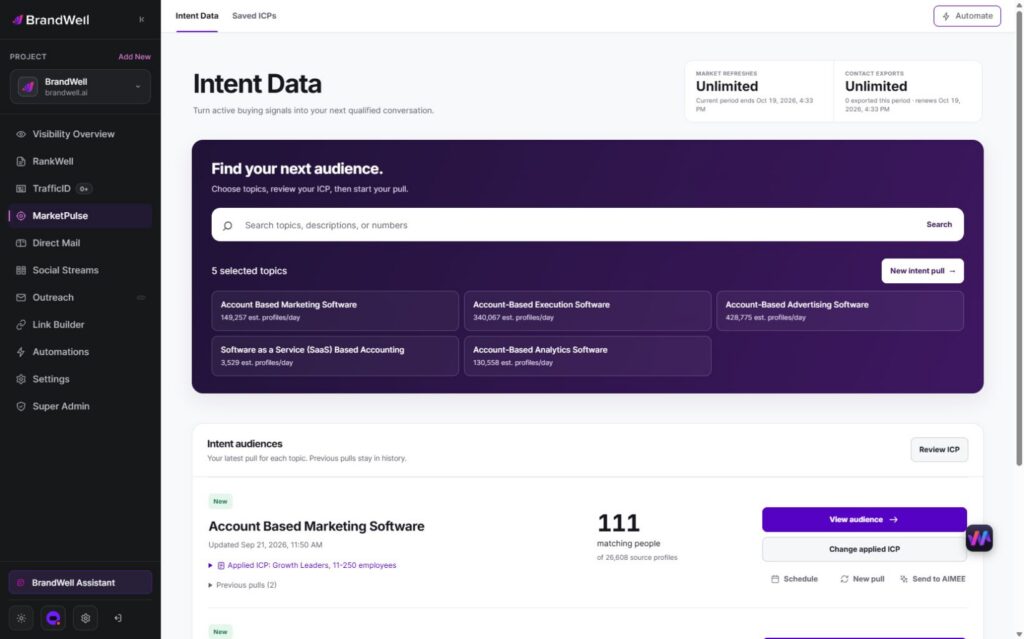
- Review the current MarketPulse workspace
- Frequently asked questions
A client portal should help an agency client decide what to review, act on, reject, suppress, and measure. Branding alone is not enough. Evaluate tenant separation, roles, topic definitions, signal provenance, identity states, filters, exports, activation approvals, audit history, reporting, billing boundaries, support, and offboarding.
Who this is for: Agency owners and operations leaders comparing portals, enterprise platforms, data inputs, and custom builds for a recurring branded intent service.
Intent data should improve a decision. It should never be presented as proof that a person is ready to buy or as permission for an unreviewed action.
Current MarketPulse offer: intent-data plans start at $500/mo. See the product, demo, and current plans. Updated October 3, 2026.
Decide whether a client portal fits the client
Choose the portal only after freezing the client workflow and written rights. Promise a branded decision workspace with controlled access and evidence. Do not imply that portal presentation validates the underlying data, identity, consent, or purchase readiness.
A seven-step client portal workflow
- 1. Map the client decisions, users, roles, actions, and evidence before evaluating interface features.
- 2. Require tenant separation, least privilege, audit logs, session controls, and incident procedures.
- 3. Inspect topic, source, time, identity, validation, confidence, suppression, and missing-state fields.
- 4. Test branded reports, filters, exports, API or CRM handoffs, and human approval gates.
- 5. Confirm reseller, end-client, derived-data, retention, deletion, and termination rights in writing.
- 6. Model setup, user, client, topic, usage, integration, support, and migration cost.
- 7. Run a realistic client scenario and require an exportable evidence trail before commitment.
Build the evidence log for a client portal
Use one versioned record to show why each client portal decision was made. Capture the eligible market, topic definition, source, observed time, identity state, validation result, suppression, reviewer, approved action, downstream disposition, and fully loaded cost. Preserve rejected, expired, duplicated, and corrected records with reason codes rather than overwriting them. This makes client explanations and later comparisons reproducible.
Open the log with Map the client decisions, users, roles, actions, and evidence before evaluating interface features. Close each review cycle with Run a realistic client scenario and require an exportable evidence trail before commitment. If a topic, source, identity rule, activation path, outcome definition, price, or policy changes, record the approver, affected records, and whether prior periods remain comparable.
Copy this client portal decision worksheet
Use this field set during discovery, onboarding, and the first client review. It turns a client portal into a reproducible decision record instead of an informal promise. Replace every bracketed prompt with written evidence and leave unknowns visible.
WHITE-LABEL INTENT CLIENT PORTAL DECISION WORKSHEET
Client decision: [one decision this service must improve]
Eligible market and exclusions: [written ICP, geography, lifecycle, customers, competitors]
Evidence required: [source, observed time, topic rule, identity state, validation]
Path being evaluated: [branded portal; client-operated workspace; licensed data input; custom build]
First operating control: [Map the client decisions, users, roles, actions, and evidence before evaluating interface features.]
Final operating control: [Run a realistic client scenario and require an exportable evidence trail before commitment.]
Owners and approvals: [agency, client, data, CRM, activation, privacy, billing]
Fully loaded monthly cost: [platform + usage + labor + support + risk reserve]
Evidence of use: [accepted, rejected, corrected, acted on, downstream disposition]
Stop, revise, or expand rule: [threshold, reviewer, next action]
Package a client portal as a recurring client operation
Translate the workflow into a client scope for a client portal: the decision being improved, eligible market, topic set, branded deliverable, portal or export, action SLA, review cadence, usage boundary, support path, change control, and stop rule. Mark records as eligible, review, suppressed, expired, or unresolved so the client knows what can happen next.
Assign named owners for sales, client success, data operations, identity review, CRM, activation, privacy, security, analytics, and billing. Attach evidence to every handoff. Review the first month as an operating test by comparing accepted, rejected, corrected, suppressed, and acted-on records with delivery hours, outcome return, and contribution margin. Narrow or stop the service when the client cannot use the evidence reliably.
How BrandWell fits into a client portal
BrandWell MarketPulse is topic-based intent-data software for businesses and agencies. Choose relevant research topics, apply saved ideal-customer-profile filters, review available names, roles, companies and contact details, and export the audience or prepare a connected workflow. Plans start at $500/mo. TrafficID identifies visitors to your own website and is a separate product. A MarketPulse subscription does not by itself promise a white-label portal, custom API implementation, exclusive topics, or managed client delivery.
Evaluate a relevant MarketPulse topic and ICP, inspect the available records and document the approved next action. AIMEE can help prepare configured work through connected tools. Subscription features are distinct from your client-delivery agreement.
MarketPulse plans are starting at $500/mo. Starter includes 1 topic, weekly refreshes, and 25,000 exportable contacts per month. Growth includes 3 topics, daily refreshes, and 100,000 exportable contacts. Scale includes 10 topics, daily refreshes, and unlimited contact exports. AIMEE for the initial user is included with Growth and Scale. Compare MarketPulse plans and current offers.
Document connected tools, access, allowed actions and review points before using AIMEE to prepare work. Check the result at its destination. Instructions alone do not establish a working integration, a branded client portal or permission to activate records.
Price and measure a client portal
Compare total agency economics: platform minimum, clients, users, topics, records, enrichment, activation, integrations, branded assets, support, migration, and operator time. Prefer the option that meets the same written scope with the strongest total-cost case, not simply the lowest marketing number.
The client portal stop-or-expand scorecard
Track time to first decision, client login and action adoption, accepted and rejected signals, export success, CRM handoff, permissions errors, support tickets, corrections, delivery hours, contribution margin, renewal, and migration readiness. A beautiful portal with no client action is not success.
Important: Intent signals are probabilistic evidence. They do not prove identity, consent, need, authority, budget, stage, qualification, purchase, pipeline, or revenue. Report association and uncertainty honestly.
Guardrails for a client portal
Risks include cross-tenant exposure, excessive access, weak audit history, unclear end-client rights, exports that omit provenance, data lock-in, stale users, insecure links, and assuming a polished UI makes uncertain identity certain. Complete security, privacy, and contract review.
Have qualified reviewers assess the actual contracts, data flows, jurisdictions, security and permitted uses. A polished interface, an evaluation checklist or a software subscription does not establish compliance or independently validate the records.
- Preserve source, observed time, identity state, confidence, validation, and policy version.
- Separate known people, candidate people, companies, domains, and unresolved visitors.
- Apply customer, employee, competitor, duplicate, geography, consent, and opt-out suppressions.
- Require named human approval before CRM writes, audience uploads, spend, or outreach.
- Give clients correction, export, deletion, escalation, incident, and offboarding paths.
Run the client portal review with Claude, ChatGPT, or AIMEE
Objective: Compare portal options for a named agency workflow using identical criteria: tenant separation, users, branding, signals, identity, provenance, filters, exports, activation, integrations, audit, security, pricing, support, and exit. Mark unknowns and stop before recommendation until written terms are reviewed.
Inputs: approved ICP, topic dictionary, signal source and time, identity state, client lifecycle, suppressions, permitted-use policy, outcome definitions, and current written commercial scope.
Rules: preserve provenance and uncertainty; never infer budget, authority, consent, or purchase readiness; never expose private behavior in messaging; stop before external action.
Output: decision, reason codes, missing evidence, recommended next step, and audit log.
Have qualified reviewers assess the actual contracts, data flows, jurisdictions, security and permitted uses. A polished interface, an evaluation checklist or a software subscription does not establish compliance or independently validate the records.
Method and maintenance for a client portal
This guide evaluates a client portal through one defined client decision, a seven-step operating workflow, consistent option criteria, a fully loaded cost model, an outcome scorecard, and explicit limitations. The homepage screenshots identify the companies and show homepage positioning only. They do not prove reseller rights, feature availability, pricing, performance, or fit. Current contracts, official product documentation, platform policies, and scope-matched written quotes control volatile facts.
Recheck the relevant claim before a client quote and whenever a provider changes pricing, modules, permitted uses, reseller rights, retention, export, support, platform policy, or contract terms. Revise the affected statement and workflow rather than carrying an old assumption into a new engagement.
Related agency intent-service guides
Use these companion guides to move from the current decision into the next operating layer without collapsing distinct buyer questions into one oversized page.
- How to Choose an Intent-Data Vendor for an Agency Service
- Intent-Data Service Models for Agencies: Resell vs Build vs Enterprise
- Build vs Resell vs Refer an Intent Platform: Agency Guide
The practical next step
Evaluate a relevant MarketPulse topic and ICP, inspect the available records and document the approved next action. AIMEE can help prepare configured work through connected tools. Subscription features are distinct from your client-delivery agreement.
Compare operating paths rather than product labels
- Branded client portal: evaluate end-client rights, isolation, roles, support and the decisions clients can make.
- Client-operated workspace: the client may own the account while the agency delivers agreed services. Confirm access and responsibility.
- Licensed data input: a feed or export requires a separate operating layer for review, delivery and client access.
- Custom build: budget for engineering, authorization, monitoring, maintenance, migration and support, not just the first interface.
Test access boundaries before a client launch
OWASP recommends verifying tenant authorization rather than trusting supplied identifiers. Use an authorized test environment and synthetic records to check the actual portal design.
A proposed acceptance test uses two separate client accounts with permitted test users. Confirm each user can perform its allowed tasks and is denied the other client’s records, downloads and actions. Also test revoked access and stale links. Record the expected behavior, observed result and defect owner. A checklist pass is bounded evidence for the tested configuration, not a security certification.
Make delivery cost visible
In a fictional month, six clients each pay $600, generating $3,600 service revenue. A $1,000 software cost, $1,200 operator labor and $400 other variable delivery costs leave $1,000 contribution, or about 27.8%, before overhead, acquisition, taxes and other excluded costs. It is not net profit or an expected BrandWell result.
If 90 client tasks are completed, those $2,600 included costs equal about $28.89 per completed task. Define a task consistently and include rework. Do not compare that unit cost with a contact-export price as if they were the same deliverable.
Review the current MarketPulse workspace
MarketPulse provides topic research, ICP filtering and available contact records. Standard plans are starting at $500/mo. A subscription does not by itself include a white-label client portal, exclusive topics, custom API implementation or managed client delivery. Special commercial rights require an explicit agreement.
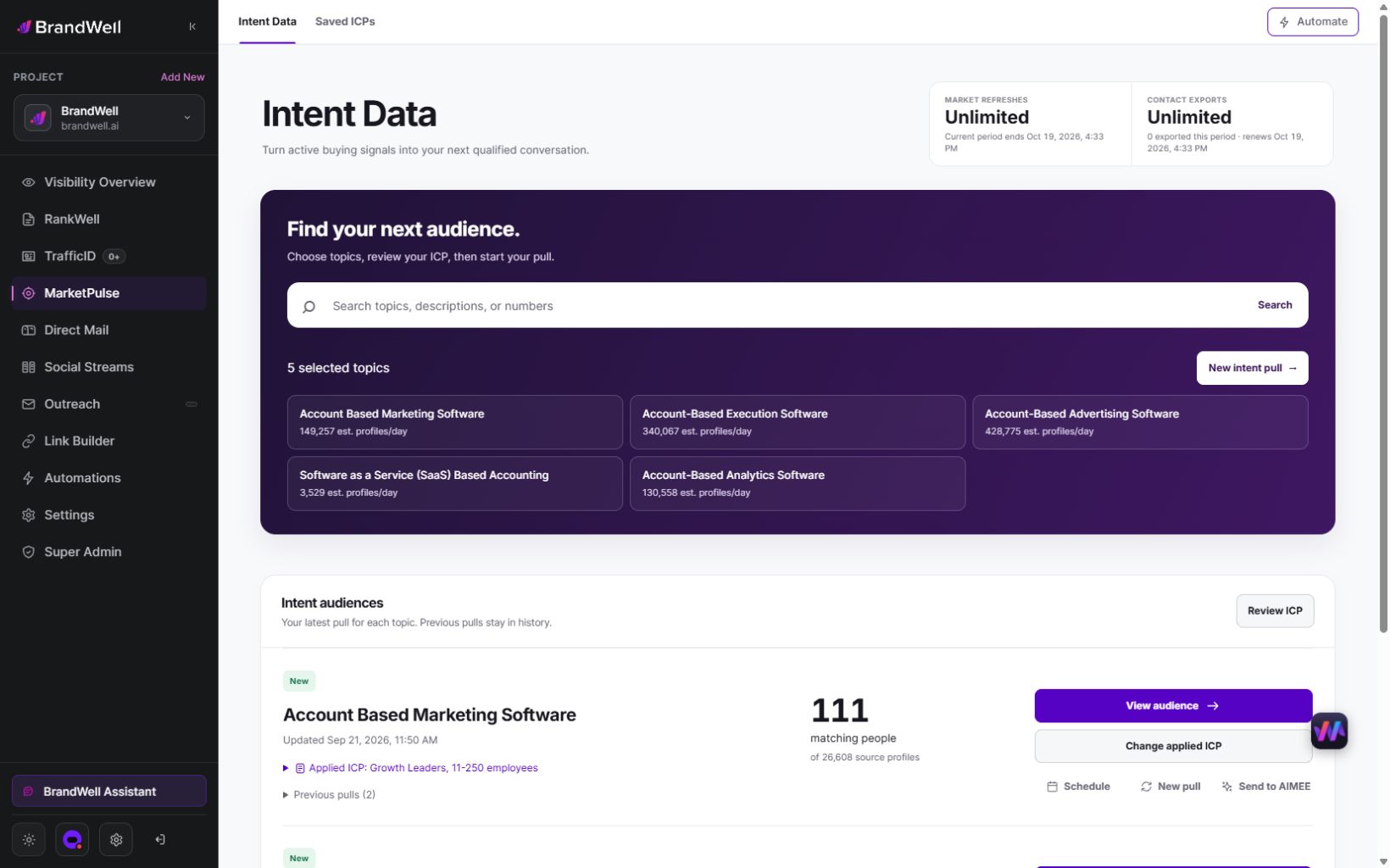
Watch the MarketPulse demo and compare current plans, then scope your client-delivery responsibilities separately.
Frequently asked questions
Does white-label branding establish resale rights?
No. Branding, licensing, end-client access, data use and support are separate questions. Obtain the relevant rights in writing.
Is an intent-data feed a client portal?
No. A feed supplies data; a portal needs defined access, presentation, workflows, responsibilities and maintenance. Compare the actual job each component performs.
Does MarketPulse include a branded client portal?
A standard subscription provides the documented topic research and available output, not a promise of a white-label implementation or exclusive market agreement.
What should an exit plan include?
Document revocation, exports, deletion, contract rights and responsibility for records and outstanding tasks. Test the process with authorized synthetic data before relying on it.
Reviewed and updated October 3, 2026.

Written by