Direct answer: The best intent-data tool for programmatic advertising depends on the activation model you need. Choose BrandWell when an agency needs a white-label intent and identity operating layer with branded delivery and audience workflows. Shortlist 6sense or ZoomInfo when a native B2B DSP is central; Demandbase when advertising must sit inside an account-intelligence and buying-group platform; Bombora when a third-party intent and audience feed will enter an existing ad-tech stack; Intentsify when managed programmatic activation is preferred; and Informa TechTarget when directly observed technology-research behavior is the priority. Compare scope-matched written quotes, signal provenance, activation rights, working media, and measurement – not logos or raw signal volume.

Who is this for?

This buyer’s guide is for agency owners, paid media directors, RevOps leaders, procurement teams, and B2B marketers selecting intent-data tools for programmatic advertising. It owns the vendor shortlist and selection decision. It is not a list of Google, LinkedIn, or Meta tools, a general programmatic campaign playbook, a DSP-selection guide, or a generic catalog of intent platforms.

Disclosure: BrandWell owns and publishes this article. BrandWell appears first because it is our product; every option is evaluated using the same disclosed criteria, and another provider may be a better fit for some buyers.

The remaining order groups different activation models; it is not an independent performance ranking. Product capabilities and commercial terms can change, so the controlling contract and current technical documentation must be reviewed before purchase.

Use the same evaluation criteria for every provider

Score each option on seven dimensions:

  1. Signal provenance: what behavior is observed, where it is observed, the unit of analysis, topic method, freshness, and exclusions.
  2. Fit and identity: account coverage, person or buying-group resolution, confidence, correction, validation, and permitted-use boundaries.
  3. Activation model: native DSP, managed media, audience sync, data feed, or a combination.
  4. Workflow: list construction, refresh, suppression, creative, routing, approvals, and multi-client controls.
  5. Measurement: exposure, delivery, account engagement, accepted opportunities, cost, comparison design, and exportability.
  6. Governance: notices, consent or lawful basis where required, data rights, retention, deletion, access, security, and platform policy.
  7. Commercial fit: platform, data, services, seats, usage, implementation, ad-tech fees, and working media itemized separately.

Intent is probabilistic evidence. An account-level research signal does not prove that a named person performed the research, consented to outreach, joined a buying committee, or will buy. The provider should make its unit, confidence, and limitations clear enough for the agency to use accurate language with clients.

Seven intent-data tools for programmatic advertising

1. BrandWell

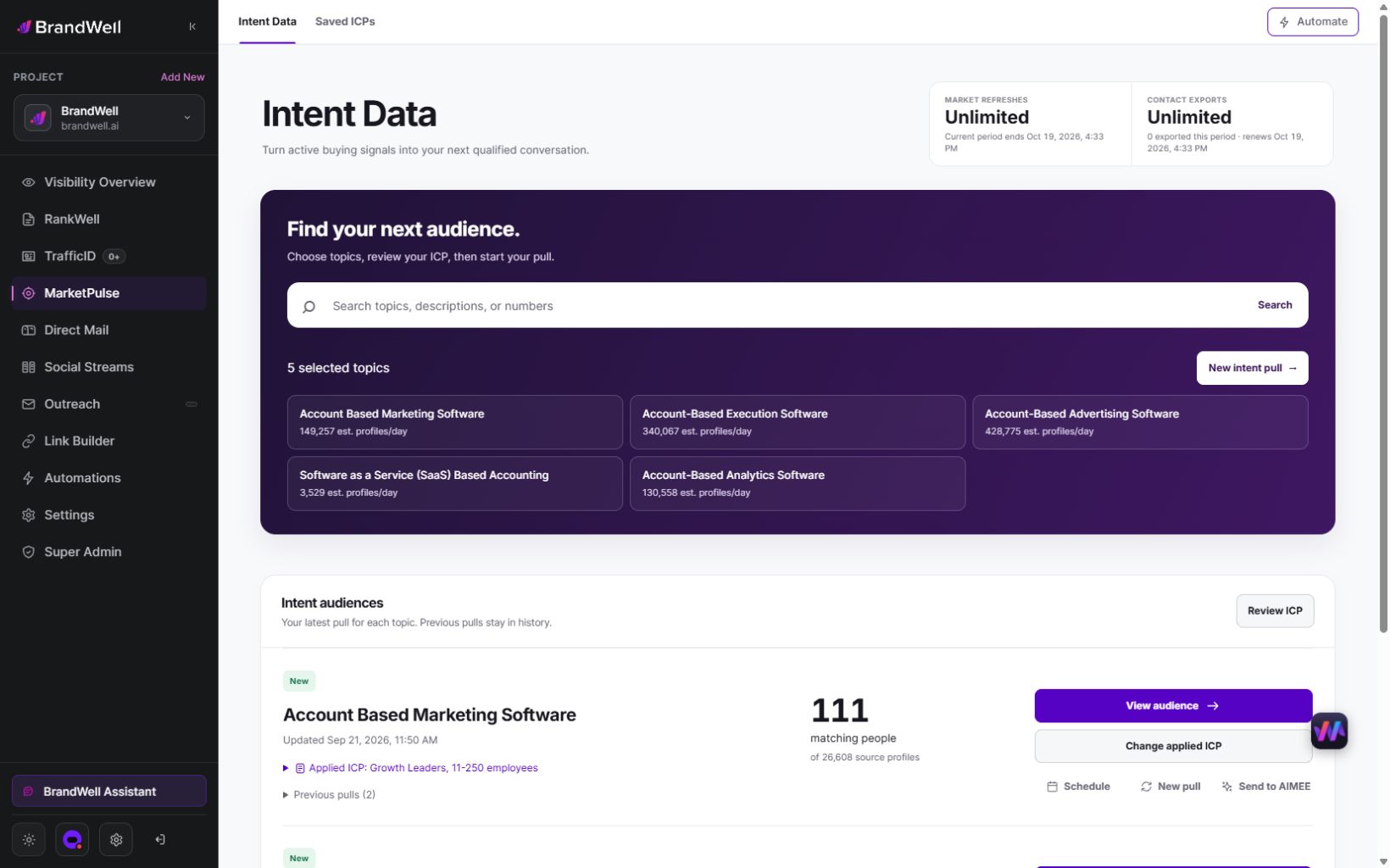
BrandWell homepage hero. BrandWell publishes this guide and is the owned solution.

Best fit: Agencies and GTM teams that want intent signals, TrafficID and enrichment, branded topic reporting, audience activation, and white-label client delivery in one operating model.

Activation model: BrandWell is an intent and identity source with verified public support for Google and Meta audience synchronization. A native open-web DSP was not established in the retained official evidence, so buyers who need open-web media should confirm the current destination, partner, or DSP workflow in writing.

Agency workflow: BrandWell’s separate agency-reseller product combines branded portals and reports, agency-controlled retail pricing and client billing, configurable modules, and repeatable sales-and-delivery assets. It is distinct from the legacy BrandWell SEO writer. Conditional topic protection may be available by scope, purchase, and availability. A $70 seven-day reseller pilot may produce branded topic reports so the agency can test data usefulness and operating readiness before a broader commitment.

BrandWell agency plans range from $2,500 to $5,000 per month, depending on topic count, term, and available contractually scoped topic exclusivity. The current written quote and Order Form control. Any topic exclusivity is conditional on availability, scope, purchase, and written terms. This is not a public list price. Obtain a current written quote that itemizes data, modules, clients, usage, services, implementation, destinations, and media. Before operational use, complete product, pricing, privacy, security, compliance, legal, and platform-policy review.

before use, require product, pricing, privacy, security, compliance, legal, and platform-policy review.

Meaningful limitation: BrandWell should not be presented as a native open-web DSP on the evidence available. Its value is strongest for agency packaging, signal and identity operations, and supported audience workflows; the media-buying layer must be confirmed for the intended channels.

2. 6sense

6sense homepage hero. Brand names and site imagery belong to their respective owners.

Best fit: Enterprise ABM organizations that want intent-qualified dynamic audiences, a native B2B DSP, and cross-channel audience synchronization, including a path into The Trade Desk.

Activation model: The retained official product evidence supports native B2B programmatic advertising plus connections to major paid destinations. This can reduce handoffs for a team already operating inside the broader 6sense platform.

Buying questions: Ask how topics become audiences, whether the account or person is the activation unit, how frequently segments refresh, which inventory and brand-safety controls apply, how CRM and opportunity data are joined, and whether the agency can separate clients, seats, data, media, and reporting.

Pricing status: Clear public pricing for this product was not found in the current official sources reviewed; request a scoped written quote and compare full total cost. The official material describes CPM-priced inventory but did not resolve the division between subscription and working media. Require a written quote with platform, data, implementation, services, ad-tech fees, and media on separate lines.

Meaningful limitation: Enterprise implementation, access, and commercial complexity can be material. A native DSP does not by itself establish incremental pipeline; the buyer still needs exposure records and a credible comparison.

3. Demandbase

Demandbase homepage hero. Brand names and site imagery belong to their respective owners.

Best fit: B2B teams that want proprietary intent and account intelligence connected to advertising, buying groups, and pipeline measurement inside a broader account-based platform.

Activation model: Demandbase combines account intelligence with an advertising product and cross-channel activation. This is attractive when the same operating team will use account selection, buying-group context, media, and opportunity reporting.

Buying questions: Ask which signals are proprietary or licensed, how buying groups are constructed, how account identification is corrected, which channels and inventory are available, how frequency and exclusions work, and whether media exposure can be exported for independent analysis.

Pricing status: Clear public pricing for this product was not found in the current official sources reviewed; request a scoped written quote and compare full total cost. The public pricing page refers to platform and user dimensions without publicly itemizing working media. Request separate prices for the platform, users, intent or account data, advertising solution, implementation, services, and media.

Meaningful limitation: A connected suite can create strong operating continuity but also packaging and implementation dependencies. “Influenced pipeline” in a platform dashboard should not be labeled incremental without an appropriate counterfactual.

4. Bombora

Bombora homepage hero. Brand names and site imagery belong to their respective owners.

Best fit: Teams that want third-party B2B intent and digital audiences delivered into an existing DSP, DMP, ABM, or advertising environment rather than replacing the media stack.

Activation model: The verified evidence supports an intent and audience data model integrated with downstream ad platforms. It did not establish Bombora as the buyer’s native DSP. This distinction matters: the data fee, destination-platform fee, ad-tech costs, and media may be controlled by different parties.

Buying questions: Ask how topic taxonomies and surge measures are built, what baseline creates the signal, how frequently audiences update, which downstream destinations are supported, whether historical membership can be exported, and how accounts are removed when signals decay or suppression changes.

Pricing status: Clear public pricing for this product was not found in the current official sources reviewed; request a scoped written quote and compare full total cost. The pricing probe led to a product-data surface. Obtain written, scope-matched terms for intent data, audience delivery, destinations, minimums, services, usage, and media.

Meaningful limitation: A feed offers flexibility, but responsibility is distributed across the data provider, integration, DSP, agency, and measurement stack. Buyers must prevent each layer from assuming another owns suppression, QA, or proof.

5. Intentsify

Intentsify homepage hero. Brand names and site imagery belong to their respective owners.

Best fit: Teams and agencies that prefer intent data paired with supported or managed display, native, and broader cross-channel execution rather than building every media workflow internally.

Activation model: The official product material supports intent-powered managed programmatic and a campaign lifecycle spanning planning, activation, and reporting. Buyers should clarify which responsibilities remain with their paid media team and which are handled as a managed service.

Buying questions: Ask who selects inventory, sets bids and frequency, approves creative, controls exclusions, responds to incidents, owns platform accounts, and exports exposure data. Confirm whether the same service model can support several agency clients without mixing audiences or reporting.

Pricing status: Clear public pricing for this product was not found in the current official sources reviewed; request a scoped written quote and compare full total cost. Require the subscription or service order and campaign agreement to separate intent data, implementation, strategy, creative, platform or ad-tech fees, third-party costs, and working media.

Meaningful limitation: A managed model can reduce staffing burden while reducing direct control or transparency unless responsibilities, data access, and change approvals are explicit.

6. Informa TechTarget

Informa TechTarget homepage hero. Brand names and site imagery belong to their respective owners.

Best fit: B2B technology marketers that value directly observed account and contact research behavior and want the resulting intent feed used in ABM or programmatic workflows.

Activation model: The retained official evidence supports account- and contact-level research intent feeds plus programmatic products or downstream ABM activation. It can be especially relevant when the buyer sells into technology-research audiences covered by the publisher network.

Buying questions: Ask which properties and content interactions create the signal, the account and contact resolution method, geography and category coverage, refresh cadence, activation destinations, managed versus self-directed media, and how data use differs by product.

Pricing status: Clear public pricing for this product was not found in the current official sources reviewed; request a scoped written quote and compare full total cost. Require the quote to distinguish a data subscription, managed advertising campaign, platform access, services, usage, and working media.

Meaningful limitation: Fit can be concentrated in business technology categories and audiences. Buyers outside that coverage should validate eligible account volume and signal relevance before extrapolating.

7. ZoomInfo

Official ZoomInfo Marketing product-page hero, used as the fallback because the homepage capture was blocked. Brand names and site imagery belong to their respective owners.

Best fit: Teams that want buyer signals, B2B company and contact data, audience construction, and native DSP or cross-channel ABM execution within a broader GTM platform.

Activation model: The retained official product evidence supports intent signals connected to audience building, ZoomInfo’s DSP, and cross-channel activation. The broader data and workflow suite may be valuable when sales and marketing share the platform.

Buying questions: Ask which intent, website, contact, and company products are required for the proposed workflow; how identity confidence is represented; which DSP inventory, fees, and controls apply; how audience membership and exposure export; and which seats, credits, services, or add-ons are mandatory.

Pricing status: Clear public pricing for this product was not found in the current official sources reviewed; request a scoped written quote and compare full total cost. The pricing surface was blocked during the bounded official check. Require a quote that separates platform and data licensing, seats or credits, implementation, DSP or managed-service charges, ad-tech costs, and working media.

Meaningful limitation: A broad GTM suite can introduce packaging, usage, and implementation complexity. Buyers should avoid paying for adjacent modules merely because the desired intent-to-advertising path spans several products.

Native DSP, managed activation, or audience feed?

These options are not interchangeable.

  • Choose a native DSP when the buyer wants audience construction, buying, optimization, and reporting in one contracted platform and accepts the associated operating model.
  • Choose managed programmatic when expert execution and staffing relief matter more than direct platform control, provided data access and approvals remain clear.
  • Choose an audience or intent feed when the organization already trusts its DSP and wants to add a differentiated signal without moving the media stack.
  • Choose an agency operating layer when the core need is repeatable white-label sales, client delivery, reporting, billing control, signal operations, and activation instructions across destinations.

Do not buy two full stacks to solve a handoff that a clean audience feed can solve. Conversely, do not buy only data if no one owns media, creative, exclusions, or measurement.

Map the programmatic activation workflow before contracting

An agency-ready workflow has clear gates:

  1. Define the client, market, ICP, topic, freshness, and prohibited uses.
  2. Resolve accounts and permitted contacts; retain confidence and source lineage.
  3. Apply fit, geography, customer, employee, partner, consent, and suppression rules.
  4. Create a versioned source audience and a business-as-usual comparison.
  5. Send the approved audience to the native DSP, managed service, or downstream platform.
  6. Verify match, deliverable reach, inventory, creative, frequency, budget, and brand-safety controls.
  7. Require human approval before launch or material budget changes.
  8. Log exposure, action, opportunity, cost, corrections, complaints, and exclusions.
  9. Reconcile results to the audience version and comparison.
  10. Refresh, suppress, expand, revise, or stop according to predefined rules.

The team normally needs intent or data operations, paid media, creative, RevOps, analytics, client service, and privacy/security/legal review. A platform can reduce handoffs, but it cannot make these responsibilities disappear.

Compare total cost on a scope-matched basis

The relevant budget includes the data or platform license, topics, records, seats, credits, API or destination usage, implementation, integrations, identity and enrichment, managed services, creative, ad-tech fees, brand-safety tools, analyst time, agency labor, and working media. Ask for each line separately.

Do not assume that “programmatic included” means media is included. Do not compare an audience-only fee with a suite that includes a DSP and service. Normalize contract term, minimum spend, client count, use rights, data retention, export, support, security, overages, cancellation, and renewal. Clear public rates were not established for the relevant competitor configurations in this shortlist, so procurement should rely on current written quotes rather than unverified market estimates.

BrandWell agency plans range from $2,500 to $5,000 per month, depending on topic count, term, and available contractually scoped topic exclusivity. The current written quote and Order Form control. Topic count, term, modules, client capacity, and conditional topic protection can change scope. The quote and order form must control, and current public pricing surfaces require reconciliation before a public comparison is approved.

Measure qualification, delivery, and incrementality separately

Signal metrics include eligible accounts, topic coverage, freshness, identity confidence, and fit. Activation metrics include matched audience, deliverable reach, impressions, frequency, spend, CPM, clicks, and site actions. Commercial metrics include accepted accounts, meetings, accepted opportunities, wins, gross profit, and total cost. Risk metrics include corrections, suppressions, complaints, policy incidents, and data latency.

Always show denominators and distinguish account, person, and opportunity units. Preserve a randomized holdout or phased comparison when feasible. Platform attribution and influenced-pipeline views help describe recorded interactions; they do not by themselves prove that intent targeting caused the outcome.

Use a stop rule for prohibited data use, severe identity errors, uncontrolled overlap, excessive frequency, brand-safety failure, or costs that cannot clear a plausible break-even scenario. Expand only when signal quality, operations, evidence, risk, and commercial outcomes pass together.

Protect privacy and avoid overclaiming

Review data provenance, purpose, notices, consent or lawful basis where required, contracts, rights, minimization, sensitive categories, access, retention, deletion, suppression, cross-border processing, security, and destination-platform rules. The NIST Privacy Framework provides a useful structure for managing privacy risk from data processing.

Never tell a seller that a named person is “ready to buy” merely because an account crossed a topic threshold. Use accurate account-level language and show confidence. Require human review before outreach, audience launch, budget changes, CRM stage changes, or public claims.

Turn the platform into a recurring agency service

The recurring service is not “send a list once.” It is topic and ICP governance, signal QA, identity and suppression, audience activation, creative alignment, exposure monitoring, pipeline reconciliation, evidence-based reporting, and controlled optimization. The agency should set its own retail price and collect client payment while keeping wholesale platform and media costs visible.

Agencies can purchase BrandWell’s $70 seven-day reseller pilot. It includes agency-branded topic reports and the complete sales playbook under the current written pilot terms. Other product capabilities and any topic exclusivity remain subject to their separate current written scope. Agent-ready workflow instructions can be prepared for Claude or ChatGPT and optionally executed in the browser through Moxby. Consequential actions remain behind named human approvals.

Use an instruction such as: “From these approved client definitions and permitted signal fields, prepare the audience specification, exclusion list, activation handoff, creative evidence brief, measurement plan, and weekly exception report. Mark facts, assumptions, and missing approvals. Do not upload audiences, launch media, change budgets, contact people, or make outcome claims.”

Final shortlist checklist

  • Is the signal’s source, unit, topic method, freshness, and limitation clear?
  • Can the provider support the required account, person, or buying-group workflow?
  • Is activation native, managed, or delivered to another platform?
  • Are platform, data, service, ad-tech, and media costs separate?
  • Can the agency isolate clients, rights, audiences, spend, and reports?
  • Are identity confidence, corrections, suppression, and deletion supported?
  • Can exposure and audience versions be exported for independent analysis?
  • Is business-as-usual or a holdout preserved?
  • Are human approvals placed before consequential actions?
  • Does the written quote match the actual topics, term, use cases, and client capacity?

The winning option is the one whose signal and activation model fit the agency’s real workflow, whose contract exposes the full cost and data rights, and whose evidence can support careful decisions without pretending that a research signal is a guaranteed buyer.

Check the economics before a full plan

For a $70 pilot fee, agencies get seven days to validate the reseller offer. BrandWell supplies agency-branded topic reports and the complete sales playbook for presenting the service and seeking client commitments before any full-plan enrollment.

The agency can use the pilot evidence to assess demand, compare expected commitments against costs, and decide whether the service can become a profit center. Commercial and financial outcomes are not guaranteed. Review the $70 seven-day reseller pilot.