On this page
- Current MarketPulse research workflow
- Separate research from operating methodology
- Test eight acceptance and monitoring steps
- Use six evaluation artifacts
- Compare equivalent populations and definitions
- Count full implementation and review costs
- Keep each quality denominator visible
- Check actual market and action constraints
- Require eligibility before activation
- Control sampling and unsupported claims
- Report actual evidence and unknowns
- Copyable methodology acceptance record
- Frequently asked methodology questions
BrandWell’s intent-data methodology should be evaluated as a chain of decisions, not as a single “intent score.” The practical question is whether a signal can move through market mapping, identity and enrichment, qualification, eligibility, action, and feedback with enough evidence for an agency or revenue team to use it responsibly.
For agencies, GTM consultants, RevOps leaders, demand-generation teams and procurement reviewers evaluating current MarketPulse research. The acceptance process below is a proposed operating method, not an independently audited description of every internal data-processing system or a subscription entitlement to custom implementation.
Current MarketPulse offer: intent-data plans start at $500/mo. See the product, demo, and current plans. Updated October 3, 2026.
Current MarketPulse research workflow
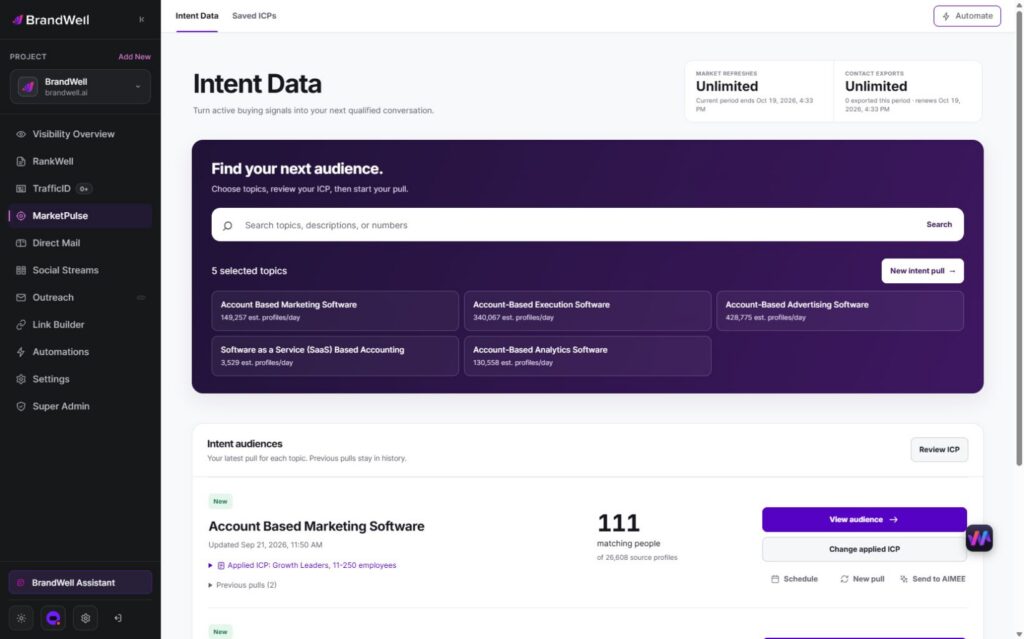
BrandWell MarketPulse: intent data starting at $500/mo. Find people researching topics relevant to what you sell, apply saved ICP filters, and review available contact details before taking action.
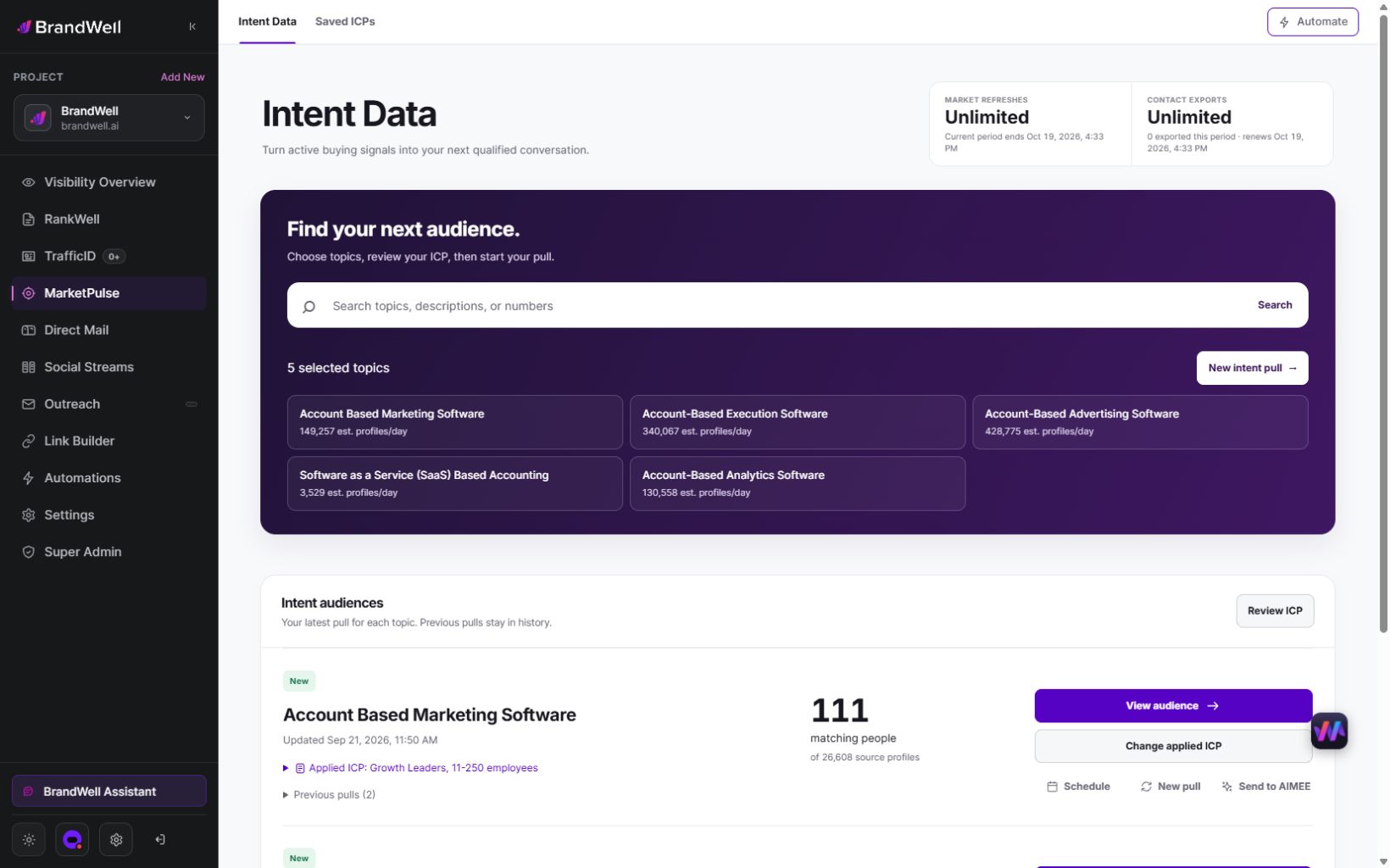
MarketPulse plans are starting at $500/mo. Verify current package scope and offers on the product page.
| Plan | Topics and refreshes | Monthly exports |
|---|---|---|
| Starter | 1 topic, weekly | 25,000 contacts |
| Growth | 3 topics, daily | 100,000 contacts |
| Scale | 10 topics, daily | Unlimited contacts |
Swipe the table to see all columns.
A pull retrieves available data from the previous 24 hours for one topic. Daily use across all included topics provides 90 Growth pulls or 300 Scale pulls in a 30-day month. Weekly Starter pulls vary by calendar month. Available audience size and contact fields vary, and audiences may overlap. Refreshes stop at the plan limit without overage charges.
- Find and qualify: search the topic catalog, save your ICP, and review the people and companies that match.
- Act on the research: export qualified contacts or prepare an Outreach or Direct Mail workflow. Connected products, channel usage, and fulfillment may cost extra.
- Get help from AIMEE: Growth and Scale include AIMEE for the initial user to research accounts and prepare the next step through connected tools.
Agencies and other service businesses can build client deliverables around their available Intent Scans and exports. Keep each client’s scope, permissions, and service fees clear. A subscription is not a promise of a white-label platform or exclusive access to a market.
Explore MarketPulse and watch the demo or compare plans starting at $500/mo. Any early-access discount is a separate, time-limited offer shown to an eligible recipient.
Separate research from operating methodology
Use the following sequence as a proposed review method: define relevant topics and the research purpose; review available matches; preserve uncertainty; evaluate fit, recency and necessary fields; check actual rights and destination eligibility; approve the next action; and record actual acceptance, rejection and downstream outcomes. Verify each custom enrichment, scoring, routing or reporting implementation separately.
- define the market and commercially relevant topics;
- observe an intent or first-party behavior signal;
- resolve a person or company where coverage supports it;
- enrich only the fields needed for a decision;
- evaluate fit, recency, confidence, contactability, and exclusions;
- verify that the proposed use is contractually, legally, and platform eligible;
- route the approved output to a report, CRM, advertising, outbound preparation, AI workflow, or export; and
- capture downstream acceptance, rejection, and outcome evidence.
BrandWell MarketPulse is topic-based intent-data software for businesses and agencies. Choose relevant research topics, apply saved ideal-customer-profile filters, review available names, roles, companies and contact details, and export the audience or prepare a connected workflow. Plans start at $500/mo. TrafficID identifies visitors to your own website and is a separate product. A MarketPulse subscription does not by itself promise a white-label portal, custom API implementation, exclusive topics, or managed client delivery.
The methodology should inform one buyer decision: Does BrandWell produce a sufficiently relevant, explainable, eligible, and usable signal-to-action flow for this market and use case at an acceptable total cost? A demo is not enough. The answer requires a representative test and a written claim register.
Intent remains probabilistic. A topic or visit may be relevant without indicating a purchase decision. An identity match can be wrong or incomplete. A usable contact field does not establish consent. A routed record does not establish pipeline. The workflow must preserve those distinctions.
Test eight acceptance and monitoring steps
Use a predeclared acceptance protocol for the proposed operating method.
- Write the use case. Name the target market, geography, signal types, observation unit, downstream decision, allowed actions, and prohibited uses.
- Freeze a representative test set. Include ordinary cases, ambiguous records, nulls, duplicates, stale records, exclusions, and known positives or negatives where lawful and available. Avoid a vendor-selected showcase set as the only evidence.
- Define fields before delivery. Record each field’s meaning, source class, time semantics, allowed values, null behavior, confidence meaning, retention, and intended use.
- Define acceptance rules. Specify required fields, fit conditions, identity evidence, freshness, contactability, eligibility, and rejection reasons. Do not change thresholds after seeing results without logging the change.
- Run a blinded review. Have qualified reviewers label a sample without being shown the system’s final tier when practical. Reconcile disagreements and preserve the denominator.
- Test the destination. Measure eligible, prepared, accepted, matched, routed, and acted-on counts separately. A source record that cannot enter the destination is not an activated record.
- Monitor drift. Track topic mix, null rates, freshness, match acceptance, manual overturns, outcome differences, integration failures, and suppression handling by batch.
- Refresh evidence. Re-test after material changes to topics, geography, data source, fields, identity logic, client ICP, destination, privacy rules, or platform policies.
Named owners should include product, data, client strategy, privacy, security, legal, compliance, and destination-platform reviewers. Human approval is required before audience uploads, direct outreach, material spend changes, suppression overrides, new purposes, or writes to systems of record.
The evidence record should show what was tested, what was not, which version produced the result, and which claims remain BrandWell-provided or unverified. “No evidence” is a valid result.
Use six evaluation artifacts
Apply the same five criteria to each artifact: purpose, required inputs, output, owner, and limitation.
1. Signal data dictionary
Defines topic, signal class, observation unit, source class, timestamp or age band, score, identity fields, fit fields, contactability, and eligibility flags.
Limitation: a dictionary explains fields; it does not validate their truth, provenance, or legal use.
2. Representative sample set
Contains a frozen sample of normal, ambiguous, excluded, stale, incomplete, duplicate, and destination-rejected records.
Limitation: a small or hand-selected sample cannot establish universal coverage or accuracy. Disclose the sampling method and denominator.
3. Acceptance scorecard
Scores relevance, field completeness, identity support, freshness, fit, contactability, permitted use, destination readiness, and actionability with reason codes.
Limitation: weights reflect a business decision. Do not present the total as a calibrated purchase probability unless that claim has been independently validated.
4. Match and adjudication worksheet
Compares system output with reviewer labels, records agreement and disagreement, and separates false acceptance, false rejection, unresolved, and not-applicable cases.
Limitation: reviewer labels can also be wrong or inconsistent. Use documented definitions and reconcile disagreement.
5. Destination acceptance test
Tracks source, eligible, uploaded or routed, accepted, matched, active, acted-on, and expired counts for each workflow destination.
Limitation: destination acceptance confirms technical usability, not correctness or business impact.
6. Claim and evidence register
Lists each material statement, source, test, population, result, limitation, approver, and recheck trigger. Separate public product descriptions, BrandWell-provided commercial terms, customer test results, and unknowns.
Limitation: a claim register becomes stale unless changes in product, sources, policies, and client use cases trigger review.
Use these artifacts to expose the evidence behind a provider score. They make a BrandWell intent data methodology demo testable and create documentation that can survive procurement, client reporting, and renewal review.
Compare equivalent populations and definitions
Do not compare one provider’s source-record count with another provider’s matched, enriched, or activated count. Use a symmetrical protocol:
| Dimension | Definition to freeze | Test condition | Evidence to request | Common distortion |
|---|---|---|---|---|
| Signal | Behavior and observation unit | Same topics, geography, and time window | Source class and age | Calling every activity “intent” |
| Coverage | Eligible records in the target population | Same ICP and exclusions | Numerator, denominator, nulls | Using the provider’s full universe |
| Identity | Person or company mapping | Same representative sample | Identifiers and ambiguity handling | Treating any match as correct |
| Freshness | Time from behavior or verification | Same age bands | Timestamp semantics | Mixing event time and delivery time |
| Completeness | Required non-null fields | Same field list | Field-level null rates | Averaging optional fields |
| Acceptance | Records passing client rules | Same rules and reviewers | Reason-coded results | Changing thresholds post hoc |
| Destination | Usable in the approved workflow | Same platform and account | Accepted and targetable counts | Reporting uploaded rows only |
| Outcome | Downstream action or revenue event | Same cohort and window | Baseline/control and uncertainty | Presenting attribution as causation |
| Governance | Rights, notice, controls, deletion | Same jurisdiction and use | Contracts, policies, process evidence | Treating vendor claims as legal approval |
| Total cost | Full operating cost | Same workload and support | Quote, usage, labor, overages | Comparing license with all-in service |
Swipe the table to see all columns.
Use identical input files where contracts permit, identical field definitions, the same reviewers, and a predeclared decision rule. If providers observe different proprietary signal populations, record that limitation rather than forcing a false apples-to-apples accuracy score.
Choose the approach supported by the actual test and operating constraints. An existing system may fit the required region, fields, destination or team responsibilities better. Do not imply a universal provider winner or unsupported native integration.
Count full implementation and review costs
Evaluate the research subscription and separately scoped operating work through total cost:
- market and topic mapping;
- data and signal access;
- identity resolution, enrichment, validation, and usage;
- TrafficID or first-party implementation where applicable;
- workflow design, integrations, dashboard or report configuration;
- security, privacy, legal, compliance, and platform review;
- sample labeling and acceptance testing;
- operator and analyst labor;
- exception handling, support, and retraining;
- destination media, outreach, or CRM costs;
- migration, export, and replacement work; and
- the opportunity cost of delayed or unusable activation.
Calculate total cost for the actual workload:
Total operating cost = quoted fees + implementation + internal labor + activation + governance + expected exceptions + switching reserve
A lower platform fee can be more expensive if the buyer must design and operate every rule. A higher managed fee can be wasteful if the client already has the people and systems. Compare the same delivery boundary.
Keep each quality denominator visible
A BrandWell intent data methodology evaluation checklist should include:
Signal metrics
- records by topic and signal class;
- age distribution;
- duplicate and suppression rates;
- share with interpretable source and time meaning.
Identity and enrichment metrics
- person and company match coverage, reported separately;
- unresolved and ambiguous rate;
- required-field completeness;
- field-level validation or reviewer agreement;
- manual-overturn and exception rate.
Qualification and destination metrics
- fit acceptance and rejection by reason;
- eligible-for-use rate;
- destination acceptance or match rate;
- routed, delivered, acted-on, and expired counts;
- time from signal to approved action.
Commercial metrics
- accepted meetings and opportunities;
- qualified pipeline and revenue by cohort;
- cost per eligible, accepted, and acted-on record;
- client and agency contribution margin;
- retention and expansion.
Use clear denominators. Required-field completeness = records with every required field / evaluated records. Accepted signal rate = records passing the frozen client rules / evaluated records. False-acceptance estimate = sampled accepted records rejected by adjudication / sampled accepted records. If no reliable reference label exists, call the metric reviewer disagreement or exception rate – not false-positive rate.
There is no defensible universal benchmark for BrandWell accuracy, coverage, freshness, or ROI. Establish baselines for the specific market and use case. Report confidence intervals or sample limitations where applicable. A larger output is not automatically better if it creates more false acceptance or client labor.
Check actual market and action constraints
Evaluate actual relevant research, an expressible ICP, allowed action, operator capacity and full costs. Agencies also need separately agreed client delivery, reporting, rights and margin. A subscription does not establish wholesale, branded-portal or reseller entitlements.
Expectations should change when:
- market size is small: topic relevance may be high but volume insufficient;
- topic is broad: volume rises while commercial specificity may fall;
- region changes: coverage, lawful basis, notice, consent, transfer, and channel rules may differ;
- person-level fields are required: identity ambiguity, field accuracy, and privacy risk increase;
- company-level prioritization is enough: the workflow may tolerate less person-level resolution;
- activation is advertising: platform eligibility and audience minimums become decisive;
- activation is outreach: contactability, suppression, message framing, and jurisdiction matter;
- use is reporting or research: aggregate output may be useful even when direct activation is not eligible; and
- quality threshold is high: expect more unresolved records and lower usable volume.
Exclude or remediate a use case when it involves sensitive inference, requires exposing observed behavior in a message, lacks a permitted destination, demands universal person-level identification, or requires guaranteed results. “Unknown” should remain a supported state.
Require eligibility before activation
Use an action-threshold sequence:
- Relevance: Is the topic connected to the offer, or merely adjacent education?
- Recency: Is the signal fresh enough for this decision cycle?
- Fit: Does the company or person meet the approved market definition?
- Identity: What evidence supports the entity match, and what ambiguity remains?
- Contactability: Are required fields present and validated for the allowed channel?
- Eligibility: Do contract, privacy, user choice, law, and destination policy allow the proposed use?
- Action: What is the least consequential useful step – monitor, report, research, nurture, prepare, or contact?
- Evidence: How will acceptance, rejection, outcome, and expiry return to the system?
Verify current destination rules for the actual source, recipient, geography, account and action. A research record is not automatically first-party customer information, permission to send a message or an eligible audience upload. Hold unresolved checks before activation; a general sync label does not establish approval.
For outreach, use the signal as context for research and prioritization, not as surveillance language. BrandWell’s own guidance recommends not telling a prospect exactly what they searched and describes intent as context rather than proof (BrandWell lead-generation workflow). Human review should approve the recipient, channel, claim, and send.
Control sampling and unsupported claims
Key BrandWell intent data methodology limitations and risks include:
- a nonrepresentative demo or acceptance sample;
- topic definitions that favor volume over relevance;
- unclear observation unit or timestamp meaning;
- coverage reported without the target-population denominator;
- identity matches treated as certain;
- missing values excluded from quality calculations;
- reviewer bias or inconsistent labels;
- score drift after data, topics, or rules change;
- signal decay before action;
- provenance, contractual-use, notice, consent, or suppression gaps;
- insecure exports or excess access;
- cross-client leakage in agency operations;
- destination policies that reject or restrict the data;
- attributed outcomes presented as causal; and
- illustrative interface examples repeated as real customer results.
Keep actual sources, purpose, necessary fields, recipients, access, retention, correction, deletion, suppression and incident ownership. Verify rights and approvals for the actual jurisdiction, channel and destination. Missing provenance is an unresolved gate, not proof of permission.
If AI prepares classifications or proposed actions, preserve actual inputs, rule version, unknowns, human review and implementation test evidence. A score band is not a calibrated purchase probability; a framework or draft does not validate a model or authorize execution.
Report actual evidence and unknowns
An agency-facing methodology report should include:
- client market, ICP, topics, geography, signal classes, and exclusions;
- field dictionary and observation-unit definitions;
- sample method, evaluated population, and denominator;
- fit, identity, freshness, contactability, and eligibility rules;
- accepted, rejected, unresolved, suppressed, and expired counts with reasons;
- destination workflow, approvals, and match loss;
- downstream adoption and outcome evidence;
- changes to topics, rules, data, or destinations;
- limitations, incidents, unknowns, and remediation; and
- renewal or expansion recommendation.
MarketPulse supplies topic research and available match details. AIMEE can organize supplied context through configured tools. An agency operating service, branded weekly report, CRM synchronization or custom client interface needs separately verified implementation, rights, scope and fees. The research subscription does not establish those delivery capabilities.
Review an available MarketPulse topic, saved ICP and actual preceding-24-hour matches for the approved research purpose. Keep uncertain company context visible. AIMEE can organize supplied context through configured tools; named owners approve actual exports, messages, audience uploads and CRM writes.
AIMEE can prepare a review brief through configured connected tools. Keep proposed actions separate from actual approvals and destination acknowledgements. Confirm the implementation and permissions before execution.
Using the approved BrandWell field dictionary, representative sample, acceptance rules, permitted-use matrix, and claim register, classify each record as accepted, rejected, unresolved, suppressed, or exception. Cite the supplied field evidence and rule version. Do not infer missing identity, consent, intent, or legal eligibility. Draft reports and action recommendations only. Do not contact people, upload audiences, change spend, modify a system of record, or publish without the named human reviewer.The methodology is credible when it makes it easy to see the chain from signal to decision – and equally easy to see where the chain breaks, where evidence is missing, and where a human must decide.
Before operational use, complete product, pricing, privacy, security, compliance, legal, and platform-policy review.
Copyable methodology acceptance record
Purpose: [Actual research question and approved action.] Population: [Unique unit, ICP, period and exclusions.] Version: [Dataset date, field definitions and frozen rules.] Evidence: [Available source context, uncertainty and labels.] Gates: [Required fields, permitted use and destination checks.] States: [Accepted, rejected, unresolved, acknowledged and expired.] Decision: [Owner, full costs, repair criteria and recheck trigger.]
Preserve the version behind each result
W3C’s Data on the Web Best Practices recommends data origins, version indicators and change history. Applied here, retain the actual dataset date and frozen acceptance rules; this is operating guidance, not evidence of native BrandWell version-history features.
Do not combine incompatible quality rates
In a fictional sample of 100 records, 80 contain every required field and 60 pass the frozen acceptance rules. Completeness is 80%; acceptance is 60% of all evaluated records. If 20 accepted records undergo adjudication and four are rejected, the observed rejection share is 20% of those 20. It does not establish a 20% error rate in the entire source population. Preserve sample selection, missing labels and uncertainty.
Uploaded rows are not usable outcomes
Suppose the fictional review has 60 accepted records, 45 approved for a destination, 40 acknowledged by that destination and 30 actually acted on. Acknowledgement is 88.9% of the 45 approved records, not 40% activation by an undefined denominator. Actual action is 75% of the 40 acknowledged records. Report each stage and pending or failed reasons separately; none proves a buyer committed.
A rule change can create apparent improvement
Two fictional 100-record batches produce 60 and 80 acceptances after the rule threshold changes. The apparent increase from 60% to 80% is not evidence that data quality improved. Re-evaluate a representative frozen sample against both rule versions, record the difference and review independent outcome labels before drawing a conclusion.
Price the full acceptance test
A fictional first-period test has the standard $500 Growth subscription, $400 setup and $600 reviewer labor: $1,500 in defined costs. At 30 acted-on records, that is $50 each. An additional $300 correction raises cost to $60 each. Media, acquisition, general overhead, tax and financing are excluded. These invented inputs are not BrandWell implementation fees or typical performance.
Start inside the current research product
Review an available MarketPulse topic, saved ICP and actual preceding-24-hour matches. Preserve uncertain context and field availability in the brief. TrafficID is separately scoped own-site visitor work. AIMEE can organize supplied research through configured tools. Owners approve actual exports, messages, Outreach enrollment, audience uploads and CRM writes. Custom scoring, reports, interfaces and synchronization need separately verified implementation, rights, scope and fees.
Frequently asked methodology questions
Is this an audit of every internal BrandWell process?
No. It is a proposed acceptance and review method.
Does field completeness establish match correctness?
No. Evaluate field presence, identity support and actual labels separately.
Can rule changes prove data quality improved?
No. Compare frozen definitions and a representative sample.
Are acknowledged records qualified opportunities?
No. Preserve actual action and buyer-confirmed outcomes.
Review the research product: explore MarketPulse and current plans.
Reviewed and updated October 3, 2026.

Written by