On this page
ChatGPT alternatives are worth evaluating when you need a different workflow, not simply a different chat window. Start with the job: research, drafting, coding, document review, creative planning, content production or execution across connected tools.
No single comparison can establish the best tool for every business. Access, models, pricing and integrations change. This guide replaces the archive’s old vendor quotas and model cutoffs with seven categories you can evaluate against your actual task.
Seven types of ChatGPT alternatives to compare
1. General conversational assistants
Use this category when your main task is discussing an idea, developing a first outline or asking follow-up questions. Evaluate whether the interface preserves the context you need and lets you correct assumptions. A fluent answer still needs evidence when it contains factual claims.
For an original hypothetical payroll-software brief, ask for questions a buyer should investigate before changing systems. Inspect whether the assistant separates questions from promises about compliance or implementation. Reject invented product capabilities.
2. Research and source-discovery workflows
For research, evaluate how you reach the original material. Open each cited page and compare its scope, date and wording with the answer. A citation can be irrelevant, outdated or insufficient even when its link works.
Keep a source log with the claim, primary source, supporting passage and date checked. A summary should help you investigate; it should not replace reading the source used to support a material statement.
3. Coding assistance
Coding has different acceptance criteria from writing an article. Check repository context, language support, permissions, tests and the review process you actually use. Do not infer software reliability from a persuasive explanation of the code.
Use a small task with a known expected behavior. Read the diff, run the relevant checks and inspect failure cases. A conversational draft of code and an integrated development workflow are different deliverables.
4. Document analysis
For documents, evaluate supported formats, extraction quality and the ability to point to the relevant section. Check whether tables, footnotes and page references survive the workflow. Confirm account and data controls before sharing nonpublic files.
In a hypothetical public-report evaluation, ask the assistant to separate a reported number from its interpretation. Compare the number, units and time period with the original table before using the summary.
5. Creative ideation
Creative planning can begin with alternatives for an angle, a headline or a scene. Give the actual audience, purpose and constraints. Judge whether the ideas fit the brief rather than selecting the longest output.
Keep invented examples visibly separate from customer evidence. A useful campaign concept is not permission to publish an invented testimonial, performance result or product promise.
6. Structured content production
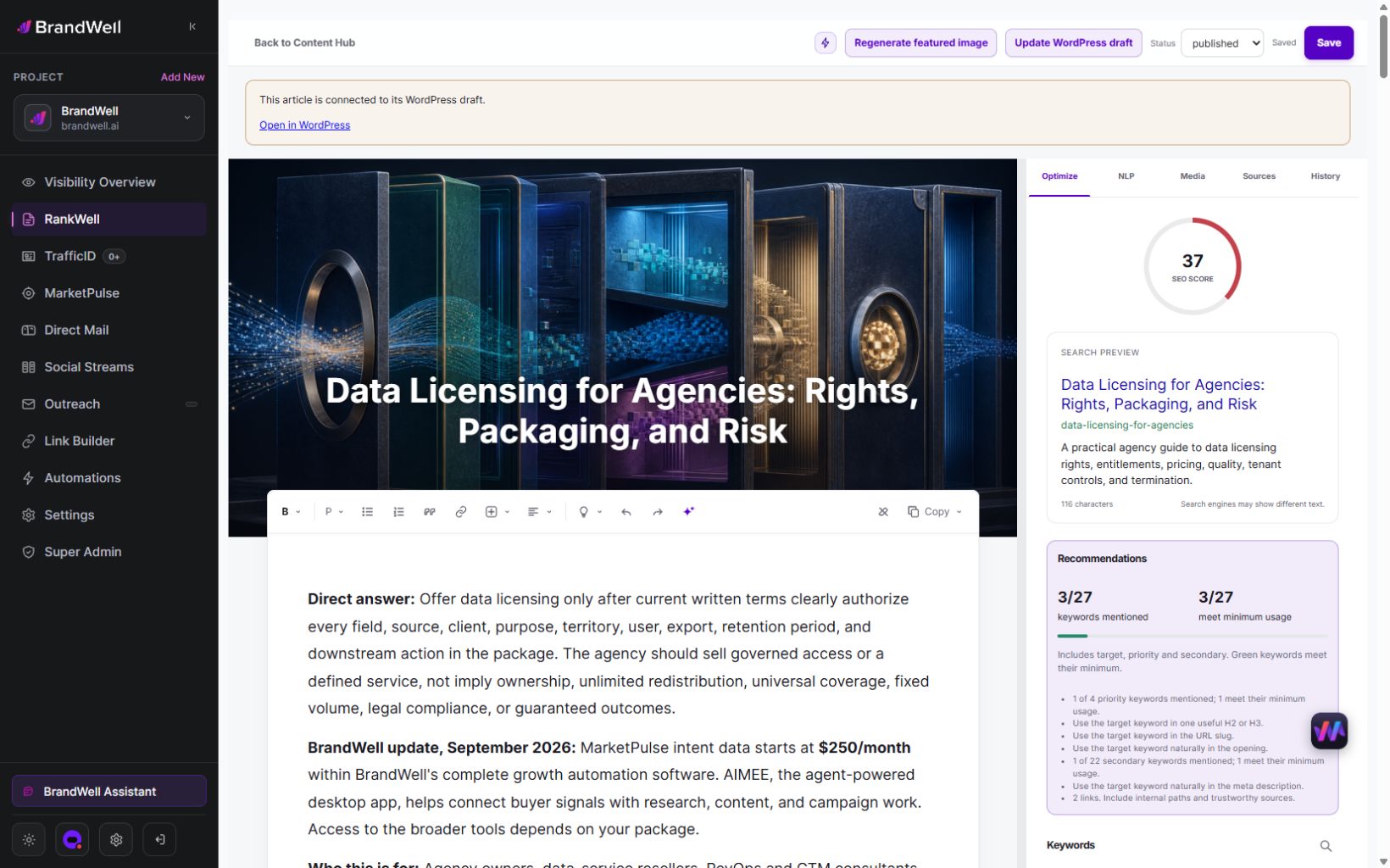
When the deliverable is an approved article, compare the complete process: brief, sources, draft, media, editing, search preview and publishing handoff. This is where a specialized content workflow may fit a different requirement from general conversation.
RankWell is the content workflow within current BrandWell. Use the editor to review the article alongside its search preview, recommendations, media and sources. Your reviewer remains responsible for evidence, usefulness and the final approval.
7. Connected execution
If the goal is carrying approved work into another tool, compare the configured actions, access controls and approval steps. Generating a suggestion and executing an action are different capabilities.
AIMEE helps carry work through configured tools and permissions. Confirm the actual integration and review requirements for your workflow; do not assume an action is available because you can describe it in a prompt.
Evaluate alternatives with the same brief
Choose one task and define the accepted output before testing. Use the same public source material, audience and constraints. Record corrections, missing evidence, active review time and whether the deliverable could be handed off.
- Fit: does it complete the required task?
- Evidence: can material claims be checked?
- Control: are data access and actions appropriate?
- Handoff: can approved work reach the next step?
- Cost: what does an accepted deliverable require?
The NIST AI Risk Management Framework is intended for voluntary use in evaluating and managing AI-related risk. It does not certify a chatbot or establish that a particular workflow is suitable for your business.
Compare accepted output rather than answer volume
In an original hypothetical test, workflow A produces ten drafts and six pass review. Workflow B produces eight drafts and seven pass review. The totals alone do not identify a winner. Include the work required, evidence quality and delivery requirements.
If each workflow costs an assumed $120 for the evaluation, the illustrative cost per accepted draft is $20 for A and about $17.14 for B. These are invented inputs, not current product prices or measured performance. Repeat the comparison with your actual task and costs.
Where BrandWell fits in the comparison
Use Visibility to investigate keyword opportunities, RankWell for content work and Automations for configured follow-up processes. These are distinct parts of a growth workflow, rather than a claim that every conversational task needs the same product.
Review the current product and plan details before committing to a workflow. Avoid applying legacy Content at Scale pricing or old chatbot access lists to current BrandWell.
Common questions
Is there one best ChatGPT alternative?
The useful comparison depends on the task, evidence requirements, account controls and delivery process. Define those requirements first.
Does a linked source make an answer ready to publish?
No. Read the source and verify that it supports the actual claim, date and context.
Is coding assistance the same as data analysis?
No. Evaluate the specific language, execution environment, input formats and acceptance checks for the task you need.
Reviewed and updated October 3, 2026.

Written by
Jeff Joyce has been helping brands grow online since the Myspace era, when custom HTML layouts were still a competitive advantage. What started in design quickly evolved into a career spanning social media, content strategy, video, agency ownership, and growth marketing. After building his own agency and testing countless AI tools, Jeff joined BrandWell with a clear focus: helping marketers understand how AI can actually improve the way they create, optimize, and scale content. Today, Jeff brings a CMO-level perspective to BrandWell's marketing strategy, blending brand positioning, content, video, customer education, and growth. His work centers on turning complex AI concepts into clear, practical marketing that helps brands move faster, create better content, and stay competitive without losing their voice.

 Justin McGill
 Farnaz Kia