On this page
Content hacking means using focused experiments to improve how useful content reaches an audience and supports business outcomes. It combines content planning, distribution and measurement. It does not make virality predictable, guarantee rankings or remove the work of serving customers.
The practical question is which improvement to test next. These 15 strategies give you a specific action, an illustrative example and a way to judge the result. Choose the ones that fit your audience and team rather than trying every tactic at once.
Content hacking versus growth hacking
Growth work can cover the whole customer experience, including acquisition, onboarding, product use and retention. Content hacking concentrates on the information people use along that journey: explanations, demonstrations, resources, stories and follow-up. The label is less important than a clear hypothesis, useful work and honest reporting.
Start with an audience problem and a business objective. Then define the next action, the production cost and the measurement window. A page that generates relevant consultations can be useful without attracting a huge audience. A widely shared post can still fail to bring the business suitable customers.
15 content hacking strategies you can test
1. Make useful resources easy to recommend
Create something people can confidently pass to a colleague: a checklist, comparison worksheet or clear answer to a recurring question. Give it a descriptive title and a stable link. Avoid putting an unnecessary form between the reader and basic information.
Example: a payroll software business publishes a checklist for preparing an implementation handoff. Measure: relevant referral visits and qualified requests, with known attribution gaps recorded. If you offer referral rewards, document their actual terms and avoid presenting incentivized recommendations as independent opinions.
2. Work with people who can demonstrate the subject
Choose collaborators for their relevant experience and audience fit. Agree on the topic, evidence, publication rights and approval process before creating an interview or demonstration. A large follower count does not prove that the audience needs your product.
Example: an IT business interviews an operations manager about planning an office move, with permission to publish. Measure: useful questions, relevant visits and suitable inquiries from the collaboration. Disclose paid or rewarded relationships clearly and review the claims each participant makes.
3. Give opted-in email subscribers a clear next step
Deliver the resource someone requested and explain the next action in plain language. Separate resource delivery, education and a sales invitation when they serve different purposes. Use real deadlines and offers. Do not manufacture scarcity to make an ordinary newsletter seem urgent.
Example: a checklist email includes a brief explanation of the consultation scope and a booking link. Measure: valid requests, qualified bookings and opt-outs. Treat opens cautiously; an open signal does not necessarily mean a person read the message. Keep contact permissions and suppression rules separate from audience research.
4. Localize the substance, not just the words
If you serve another language or region, review terminology, currencies, examples, screenshots and service availability. Ask a qualified reviewer to check whether the content makes sense locally. Automatic translation is a draft for review, not proof that the meaning survived.
Example: an implementation guide replaces a US-only process example with a supported regional workflow. Measure: completion of the relevant next action and customer questions in that region. Do not promise a localized service the business does not actually offer.
5. Choose length by the question being answered
A troubleshooting answer may be short; a detailed implementation guide may require steps, examples and limitations. Google states that it has no preferred word count. Expand a section because readers need the information, not to hit an arbitrary target.
Example: publish a concise definition that links to a deeper walkthrough. Measure: whether readers reach the answer and appropriate next step. Check mobile headings, paragraphs and visuals so a long resource remains navigable.
6. Turn recurring community questions into resources
Listen to customer discussions and identify questions you can answer with evidence. Obtain permission before quoting private conversations. Moderation, support ownership and a useful purpose matter more than simply opening another group.
Example: a service business turns a recurring onboarding question into a reusable guide, then invites corrections from customers. Measure: whether the resource resolves that question and what follow-up remains. Member totals alone do not establish community value.
7. Create content for existing customers
Look beyond acquisition. Customers may need setup instructions, realistic use cases, troubleshooting or a clearer explanation of a feature. Keep these resources synchronized with the product and label historical interfaces when you retain them.
Example: a workflow walkthrough explains the permissions and approvals needed before enabling an automation. Measure: task completion, repeated support questions and adoption of the intended workflow. Do not attribute retention changes to content without considering pricing, service and product changes.
8. Demonstrate a process with purposeful visuals
Use a screenshot, short video or diagram when it makes an action easier to understand. Show the relevant interface at a readable size, remove private information and explain what the viewer should notice. Do not rely on a claimed universal visual-processing multiplier.
Example: a brief video shows how to review a source before approving a draft. Measure: completion of the demonstrated task and meaningful video engagement. Provide captions or an equivalent explanation, and check how the visual behaves on a phone.
9. Respect the community where you share
Research the destination’s rules before posting. For example, Hacker News guidelines discourage primarily promotional use, soliciting votes and automated posting. They also prohibit generated submission text and generated or AI-edited comments. A generic automated distribution workflow is unsuitable there.
Example: a person contributes an original technical explanation where it is relevant and permitted, disclosing their affiliation. Measure: useful discussion and relevant visits. A community is not an audience you own, and participation does not entitle you to promotion.
10. Research unanswered questions rather than copying pages
Use customer conversations, relevant search results and your own Search Console data to identify gaps. Separate observed search visibility from inferred business performance. A page’s ranking does not reveal its profit, and an advertisement’s continued presence does not prove it converts.
Example: an existing article explains what a migration is but never shows the approval checklist. Add an original checklist supported by your service process. Measure: relevant search clicks and qualified next actions, alongside position and query mix.
11. Improve the next action in existing touchpoints
Audit places where a relevant reader already interacts with your business, such as resource pages, appropriate email signatures and help content. Add a concise next step when it helps the reader. Avoid crowding operational messages with unrelated promotions.
Example: a project-planning resource links to the service scope and consultation page. Measure: visits and qualified actions through that link. Use actual customer counts only when they are verified and clearly defined.
12. Offer a useful sample with honest boundaries
A worksheet, example report or product demonstration can help someone assess fit. Explain what is included, whether registration is required and what remains paid. A limited sample is not an unlimited free product or a promise of a personalized result.
Example: a sample report uses illustrative records labeled as samples. Measure: suitable requests and subsequent qualification. Include the cost of producing, maintaining and supporting the sample in the experiment’s budget.
13. Make evidence easy for others to inspect
When sharing a genuine announcement or research finding, provide the original evidence, dates, method, limitations and a responsible contact. Do not present a paid placement as independent editorial coverage or claim that every mention provides ranking value.
Example: publish a documented process change and an approved before-and-after workflow. Measure: relevant mentions, referral visits and useful inquiries. Coverage is an outcome to record, not something a pitch can guarantee.
14. Collect feedback at the point of confusion
Ask a focused question where readers struggle. Offer an easy way to say what is missing, and assign someone to review responses. Avoid collecting unnecessary personal information just to learn whether an explanation helped.
Example: ask whether a checklist explains who approves the next step, then revise that section if readers consistently find it unclear. Measure: the nature of the remaining questions and relevant task completion. Keep a change log so you know which version people saw.
15. Repurpose one useful idea for several contexts
Adapt an approved resource into a short explanation, a visual walkthrough and a relevant email. Preserve the evidence and limitations while changing the length and presentation. Do not publish the same unsupported claim in more formats.
Example: turn an IT office-move guide into a checklist, a short demonstration and three question-led social posts. Measure: the contribution of each format to relevant next actions, accounting for people who use more than one. No format guarantees virality.
A simple experiment plan you can actually use
This is an original hypothetical example, not a customer result. A payroll software business sees visitors reach an implementation article but few request the planning worksheet. Its hypothesis is that the next step is hard to find and does not explain what the worksheet contains.
- Change: add a short worksheet preview and a descriptive request link after the implementation steps.
- Keep stable: the offer, audience targeting and qualification criteria where practical.
- Record: the publication date, traffic sources, consent-related measurement gaps and any simultaneous changes.
- Judge: requests that match the target audience, not just clicks on the link.
Suppose the earlier period records 1,000 measured visits, 20 requests and eight qualified requests. A later period records 1,200 visits, 36 requests and 12 qualified requests. Request rate changes from 2% to 3%; qualified-request rate changes from 0.8% to 1%. These calculations describe the two periods. They do not establish statistical significance or prove that the content change caused the difference.
Include research, production, review, promotion and follow-up in the cost. If an experiment costs $480 and produces eight qualified requests, its cost per qualified request is $60. Sales and profitability require their own records and delivery-cost calculations.
Use BrandWell to organize the work
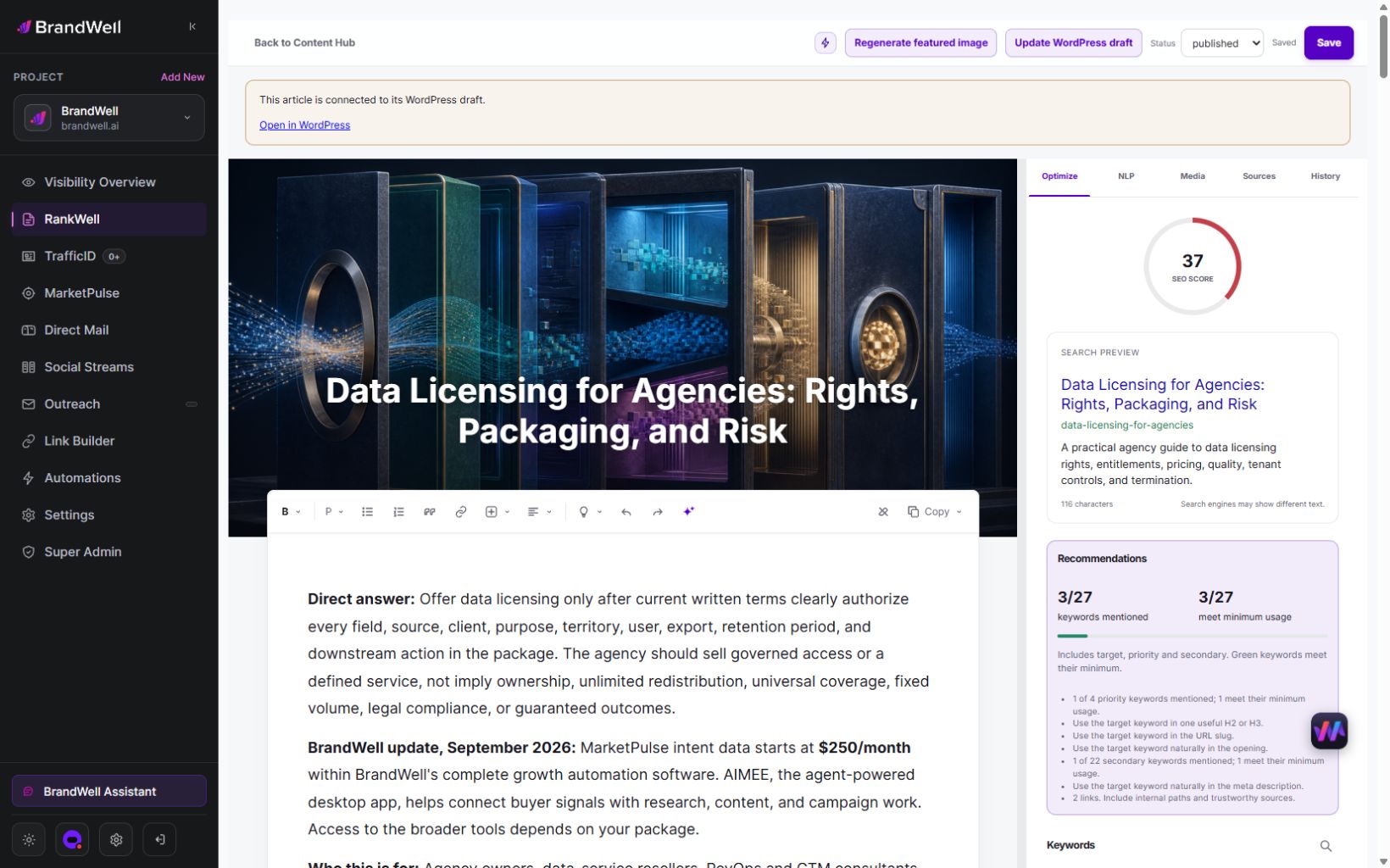
Explore relevant keywords and opportunities in Visibility. Use RankWell to prepare a brief and draft, bring in approved evidence, and review the finished page. The Content Hub organizes content, strategy, queue and calendar work. A score is a review aid, not a guarantee of rankings.
Use Automations for configured triggers and handoffs with clear owners, permissions and approvals. AIMEE can support work through its configured tools. Confirm the destination’s rules before automating publication or outreach.
MarketPulse plans are starting at $500/mo when recent topic research is relevant to your audience planning. TrafficID can provide available identified-visitor information, with coverage that varies. Neither topic interest nor identification gives permission to send marketing messages. Review fit, consent and applicable channel rules separately.
What to avoid when scaling content experiments
- Invented urgency: countdowns, shortages and deadlines must reflect a real offer.
- Unsupported proof: do not publish fabricated testimonials, revenue claims or success percentages.
- Unreviewed automation: set approval and stop rules before connecting generation to distribution.
- Metric substitution: report reach, requests, qualified opportunities and sales separately.
- Unsustainable volume: leave time to review evidence, maintain pages and respond to customers.
Frequently asked questions
Is content hacking a shortcut to growth?
It is a way to organize experiments. The work still requires a useful offer, relevant audience, credible evidence and follow-up. There is no universal tactic that guarantees rapid growth.
How many strategies should a small team start with?
Start with one or two changes linked to a clear bottleneck. Record the hypothesis and cost before adding more channels or assets.
Can AI write every asset?
AI can help draft and adapt approved material where the destination permits it. Review facts, sources, customer permissions and the intended next action. Some communities explicitly prohibit generated posts or comments.
What makes a content experiment useful?
A defined audience, a clear change, reliable measurement and a decision you can make from the result. An unsuccessful experiment can still identify a weak offer or an unsuitable distribution channel.
Choose one customer problem and improve the content that helps resolve it. Explore RankWell for the current content workflow, then connect approved work to the next step in your growth process.
Reviewed and updated October 3, 2026.

Written by