On this page
- Current MarketPulse workflow
- Choose the evidence model before the headline
- Define inputs, claim classes and approval
- Build a traceable calculation and asset record
- Compare named, anonymized and process cases
- Budget verification, review and maintenance
- Measure usefulness without overstating attribution
- Choose clients with reconstructable evidence
- Preserve source, identity and outcome states
- Control permissions, selection and revision risk
- Capture evidence throughout recurring delivery
- Put the evaluation question before the success claim
- Worked example: report counts and rates together
- Frequently asked questions
Direct answer: Create an intent-data case study as a permissioned evidence packet, not a victory story. Link every public claim to a dated source, denominator, method, and limitation. Separate signal, identity, qualification, activation, and outcome. Obtain client approval for identifiers, quotes, screenshots, calculations, and publication before release.
Current MarketPulse offer: intent-data plans start at $500/mo. See the product, demo, and current plans. Updated October 3, 2026.
Who this is for: Agency owners, growth leads, paid media directors, and GTM consultants who need credible sales evidence without converting correlation into causality.
A case study can help a prospect evaluate fit, but it can also create commercial and trust risk when a clean narrative outruns the record. The agency should be able to show what the client situation was, what changed, which evidence was captured, which outcomes were observed, and which explanations remain possible.
Evidence discipline does not make the story dull. It makes the result reusable. A reader can understand the operating model, a salesperson can quote an approved claim, a client can recognize its boundaries, and an editor can update or retract a statement when the underlying proof changes.
Current MarketPulse workflow
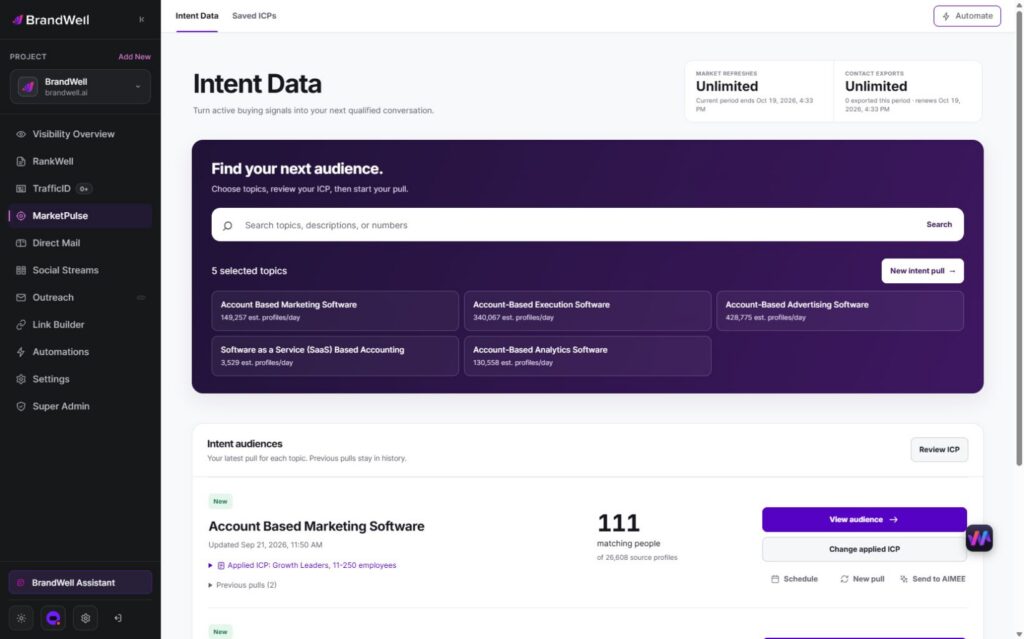
BrandWell MarketPulse: intent data starting at $500/mo. Find people researching topics relevant to what you sell, apply saved ICP filters, and review available contact details before taking action.
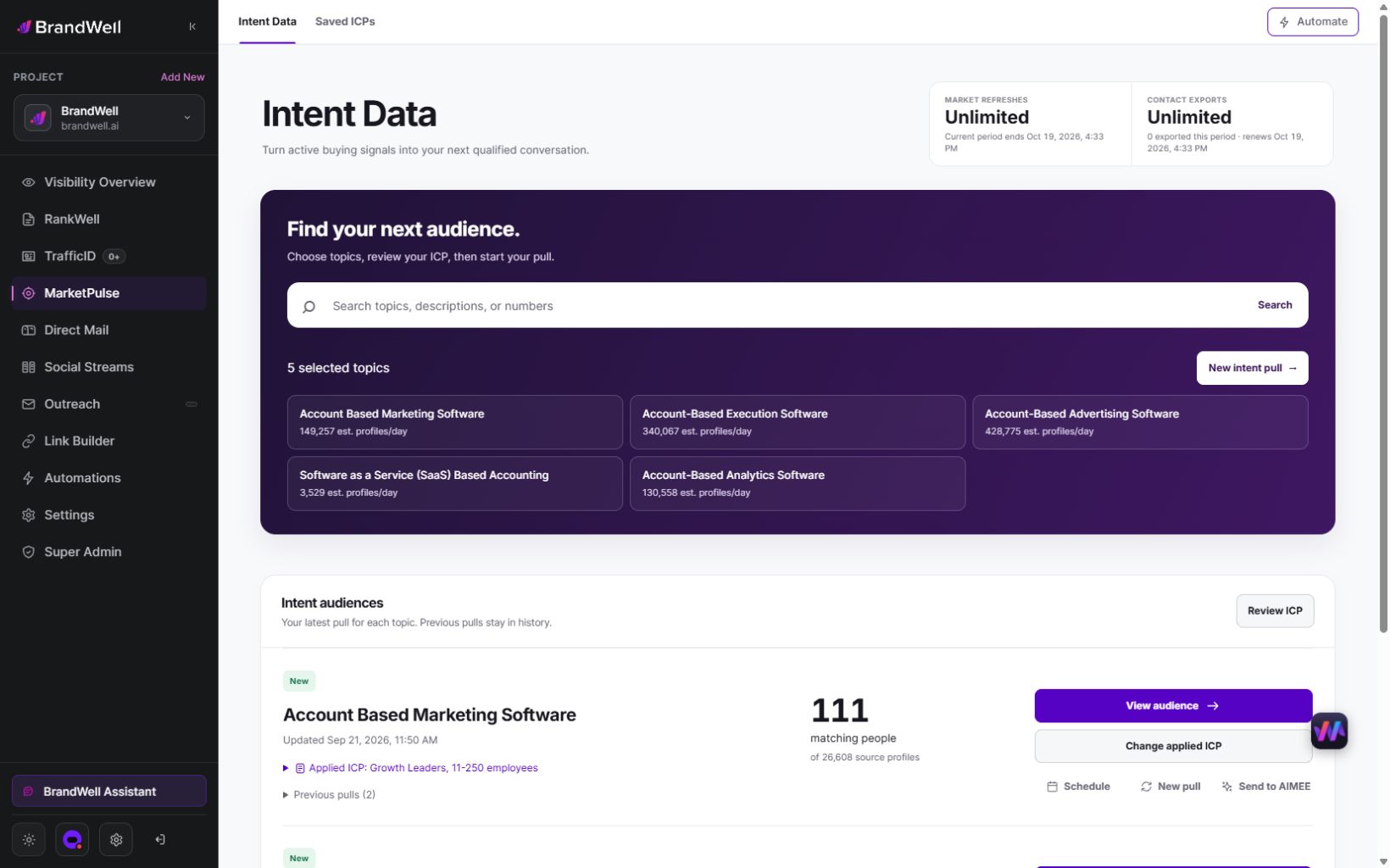
MarketPulse plans are starting at $500/mo. Verify current package scope and offers on the product page.
| Plan | Topics and refreshes | Monthly exports |
|---|---|---|
| Starter | 1 topic, weekly | 25,000 contacts |
| Growth | 3 topics, daily | 100,000 contacts |
| Scale | 10 topics, daily | Unlimited contacts |
Swipe the table to see all columns.
A pull retrieves available data from the previous 24 hours for one topic. Daily use across all included topics provides 90 Growth pulls or 300 Scale pulls in a 30-day month. Weekly Starter pulls vary by calendar month. Available audience size and contact fields vary, and audiences may overlap. Refreshes stop at the plan limit without overage charges.
- Find and qualify: search the topic catalog, save your ICP, and review the people and companies that match.
- Act on the research: export qualified contacts or prepare an Outreach or Direct Mail workflow. Connected products, channel usage, and fulfillment may cost extra.
- Get help from AIMEE: Growth and Scale include AIMEE for the initial user to research accounts and prepare the next step through connected tools.
Agencies and other service businesses can build client deliverables around their available Intent Scans and exports. Keep each client’s scope, permissions, and service fees clear. A subscription is not a promise of a white-label platform or exclusive access to a market.
Explore MarketPulse and watch the demo or compare plans starting at $500/mo. Any early-access discount is a separate, time-limited offer shown to an eligible recipient.
Choose the evidence model before the headline
Choose the evidence model before choosing the headline. Define the intended buyer decision, eligible client, permission scope, supported claims, production owner, review effort, distribution, and maintenance obligation. Prefer a narrow, well-supported conclusion over a large result that cannot be reconstructed. A case study should help a buyer decide whether the process fits, not imply the same outcome is available to everyone.
Protect growth by making approved proof easy for sales and marketing to find. Protect gross margin by scoping extraction, verification, client review, design, revisions, distribution, and refresh work. If a project requires extensive forensic reconstruction, price or budget it accordingly. The publication may support revenue quality, but no case study guarantees demand, pipeline, revenue, or profitability.
The eight-file case-study evidence binder
- Permission memo: permitted identifiers, quotes, screenshots, data uses, channels, review rights, expiry, and withdrawal process.
- Starting-state record: client decision, scope, baseline, prior activity, relevant constraints, and missing evidence.
- Signal record: source class, topic version, observation window, freshness, and known coverage limits.
- Identity and eligibility record: company resolution, hierarchy, fit, validation, exclusions, and denominator.
- Intervention log: approved actions, owners, timing, comparison assignment, concurrent activity, and deviations.
- Outcome ledger: receipts, dispositions, responses, meetings, opportunities, commercial events, corrections, and data owner.
- Method and limitation memo: observational, attribution, quasi-experimental, or experimental method plus alternative explanations.
- Approval and version file: claim-level client decisions, final assets, publication destinations, review date, revisions, and withdrawal status.
Do not draft the success narrative until the binder can support it. If the agency cannot reconstruct a number from the ledger, remove the number or label it as an unverified client report and reconsider publication.
Define inputs, claim classes and approval
Inputs include the client-approved brief, contract and data-use boundaries, baseline, cohort definition, signal records, identity checks, activation log, outcomes, costs, attribution rule, screenshots or quotes, source exports, and known limitations. Define claim classes: public fact, client-reported fact, calculated observation, attributed outcome, causal estimate, opinion, and prohibited claim. Each class needs a named approver.
Require client approval for company and person identifiers, direct quotes, recognizable screenshots, confidential terms, commercial figures, sensitive context, and publication channels. Internal legal, privacy, or security review may be necessary depending on facts and jurisdiction. Review before drafting, after fact-check, before design lock, before publication, and after a material correction or permission change. Set a maintenance cadence based on claim volatility rather than adding a visible date to the article.
Build a traceable calculation and asset record
Use a claim-evidence matrix, permission form, baseline worksheet, cohort and denominator specification, event ledger, attribution note, cost worksheet, quote approval form, screenshot register, revision log, and withdrawal checklist. A simple calculation workbook should show source cells, formulas, units, missing values, and reviewer. Lock approved outputs while preserving the raw evidence separately.
Useful systems include a permissioned evidence repository, client system export, controlled analytics workspace, approval workflow, version control, and asset library with claim-level metadata. Benchmarks are safe only when their population, period, definitions, and source match the intended comparison. Do not use an industry average to fill a missing client baseline. A case study calculator should expose assumptions, not manufacture precision.
Compare named, anonymized and process cases
A named, client-verified outcome case is easy for prospects to evaluate but requires the most permission, fact review, and reputation exposure. A permissioned anonymized case can reduce identification risk, but true anonymization may be difficult and the agency must not imply permission it lacks. A method or process case explains the workflow and evidence without leading with a commercial result; it is often simpler and durable. A controlled experiment case can support a stronger incremental claim when the design and sample are credible, but it requires more expertise and operating discipline.
Avoid a composite story presented as a real client. Multiple examples may be synthesized only when clearly labeled as a hypothetical or method illustration and when no confidential fact can be inferred. Compare options on buyer usefulness, permission burden, verification time, methodological strength, refresh cost, legal or trust risk, and expected sales use. Margin depends on actual production cost and commercial value, not the format label.
Budget verification, review and maintenance
Cost drivers include evidence retrieval, data reconciliation, analyst work, attribution or experiment design, client interviews, permission negotiation, legal or privacy review, copy, design, screenshot handling, revisions, distribution enablement, translation, maintenance, and withdrawal. Add opportunity cost for client and agency specialists. Separate a straightforward process case from a high-stakes quantified outcome case.
Do not make a positive quote or predetermined result a condition of a client benefit. If an approved commercial incentive exists, preserve truthful findings, record the arrangement and obtain appropriate disclosure review. Budget a nonpublication scenario because the client may decline the finished asset.
Case-study production budget
- Evidence work: retrieval, reconciliation, calculation, methodological review, and limitations.
- Permission work: stakeholder identification, claim approvals, quote and screenshot decisions, and withdrawal terms.
- Production work: interview, copy, design, accessibility, asset preparation, and revisions.
- Lifecycle work: sales enablement, distribution, monitoring, corrections, refresh, archiving, and withdrawal.
- Risk scenarios: extended review, disputed number, permission narrowed, publication delayed, or no public asset approved.
Measure usefulness without overstating attribution
Track evidence completeness, claims approved, claims revised or rejected, client review cycles, production hours, maintenance hours, proof freshness, approved asset usage, qualified opportunities that engage with the case, sales-stage questions answered, disqualification quality, related service attach, and feedback from buyers. Pair these with production cost and attributed or observed commercial events under a declared method.
Revenue quality may improve when the case helps unsuitable buyers self-exclude or helps qualified buyers understand required operations. Profitability depends on resulting contribution after case production and delivery cost, not the size of a featured number. Do not claim the case caused revenue because a prospect opened it. Use a careful pipeline attribution method and preserve other touches and pre-existing demand.
Choose clients with reconstructable evidence
Good candidates have a defined B2B use case, stable scope, reliable event capture, an accountable client sponsor, meaningful denominators, an explainable activation, permission authority, and a result that offers a transferable decision lesson. Recurring services are often stronger candidates because they preserve topic, delivery, correction, and outcome history. A bounded pilot can work when the claim remains proportional to its window and sample.
Pause clients with disputed data ownership, confidential situations that cannot be safely described, weak baselines, missing outcomes, ambiguous identities, unresolved invoices, active legal conflict, or a request for a predetermined success claim. Avoid case terms that make publication appear required regardless of accuracy. A contract should define review and permission, not override factual integrity.
The client’s communications capacity matters too. Identify one sponsor who can coordinate operations, legal, finance, sales, and brand reviewers. Agree on response windows and what happens when a reviewer is silent. Silence is not approval. If the named sponsor leaves or authority changes, pause publication until a new authorized reviewer confirms the binder and permissions.
Preserve source, identity and outcome states
Preserve each source separately: third-party topic observations, first-party web activity, campaign responses, client CRM events, sales dispositions, and commercial records have different evidentiary weight. Record topic version, observation time, freshness, and source limitations. For identity, document company resolution, hierarchy, geography, fit, duplicates, contact validation, exclusions, and corrections. Do not infer a named researcher from a company-level observation.
The activation log should show eligibility, approved destination, owner, action, timing, delivery receipt, deviations, and concurrent activity. The outcome ledger should include the full denominator, no-action cases, rejections, responses, meetings, opportunities, and commercial events under client-controlled definitions. A rigorous lead and intent data QA process should run before any claim enters the case binder.
Control permissions, selection and revision risk
Margin risk comes from unbounded revisions, difficult evidence retrieval, late stakeholder review, custom design, and a case that never receives approval. Scope risk appears when a simple interview becomes an audit or when the client adds markets, periods, and outcomes after analysis. Billing risk includes unclear ownership, contingent discounts, disputed work, and incentives tied to favorable results.
Record what the authorized client permitted, the exact approved asset and claim, the channels, dates, review rights and withdrawal process. Keep permissions distinct from a finding that every planned data use is lawful; obtain qualified review for the actual jurisdiction and facts.
Run an adversarial fact check before release. Ask a reviewer to recreate calculations, locate every denominator, test whether the headline matches the method, inspect whether exclusions changed the story, and search the asset for identifiers outside the permission memo. Log every correction. If the claim survives only after removing inconvenient records, the case is not ready.
Capture evidence throughout recurring delivery
Make evidence capture part of delivery instead of reconstructing it at renewal. Version topics, preserve source and identity states, log eligibility and action, collect client dispositions, reconcile outcomes, record corrections, and ask for case permission separately from service delivery. A recurring intent-data reporting process can feed the binder, but a client report is not automatically approved marketing evidence.
Create a case-study eligibility checkpoint in each review cycle, but do not pressure the client. The checkpoint asks whether evidence is complete, whether the lesson is useful, whether permissions can be requested fairly, and whether production effort fits the commercial plan. A “not yet” decision should leave delivery unchanged. Service access and support must not depend on approving a testimonial.
AIMEE can help organize supplied evidence and draft a bounded case outline through configured connected tools. Human analysts verify the calculations and authorized reviewers approve public claims and assets.
MarketPulse supplies topic audiences and saved ICP filtering starting at $500/mo. Preserve the actual pull window and available fields in a reviewed client brief. Agency case-study production, custom reporting and publication are separate work, not included operating services or proof of customer results.
Copyable agent-ready claim and evidence workflow
Build an evidence-disciplined intent-data case-study packet from the supplied client records.

Inputs: permission memo, baseline, signal records, identity and eligibility checks, intervention log, outcome ledger, cost model, contract terms, quotes, screenshots, and reviewer list.

1. Create one row per proposed claim with exact source, denominator, formula, evidence class, limitation, and owner.
2. Mark identifiers, quotes, screenshots, financial figures, and confidential facts that need explicit client approval.
3. Separate observed sequence, attribution, quasi-experimental estimate, and experimental estimate.
4. List selection, contamination, missing-data, prior-activity, and alternative-explanation risks.
5. Draft a case outline using only supported claims. Do not invent a quote, benchmark, identity, outcome, or causal statement.
6. Produce approve, revise, remove, or obtain-more-evidence recommendations for each claim.
7. Stop if permission, denominators, source records, calculation reconciliation, or publication rights are unresolved.

Claude, ChatGPT, or AIMEE may organize evidence and draft bounded language. Human analysts verify calculations. Authorized agency and client reviewers approve claims, identifiers, quotes, screenshots, pricing references, design, and publication.
Design the public asset for claim traceability. Put the client situation beside the supported baseline, describe the intervention without hidden steps, state the measured event with its denominator, and place limitations close to the result rather than in a distant disclaimer. Use a clear source note for client-reported numbers. Exclude decorative graphics that resemble evidence, and never turn an illustrative featured image into a performance chart.
After publication, monitor the approved channels and sales usage. Confirm that excerpts, social posts, proposals, and presentations preserve the scope and method. Record prospect questions and any client correction. If a material claim becomes stale, disputed, or outside permission, pause reuse, correct or withdraw the asset, and update the evidence binder. A case study is a maintained commercial record, not a permanent certificate.
Make the review record easy to audit. For each approved claim, retain the exact wording, source location, calculation version, reviewer, permission scope, and final publication location. If copy changes after approval, route the changed claim back through review rather than assuming the earlier approval still applies. This discipline protects both the client and the agency when excerpts are later reused.
The case study’s most valuable feature is not a dramatic result. It is a chain a skeptical buyer can follow and a responsible agency can defend, update, or withdraw.
Put the evaluation question before the success claim
CDC’s evaluation framework emphasizes credible evidence, supported conclusions and transparency. It originates in program evaluation, not commercial endorsement of an intent-data product. A useful agency application is to state the question and evidence needed before selecting a success headline.
Ask whether the approved workflow reached the intended accounts, produced an accepted handoff and was followed by a defined outcome. Include missing records, rejected accounts, concurrent campaigns and changes in the audience. If the design is observational, describe the sequence and remaining explanations rather than declaring incremental revenue.
Worked example: report counts and rates together
In a fictional baseline period, 12 of 200 eligible accounts become qualified opportunities: 6%. In a later period, 18 of 240 do: 7.5%. The rate increased by 1.5 percentage points, or 25% relative to the baseline rate. The opportunity count increased by six, or 50%, partly alongside a 20% increase in eligible accounts. These are different calculations.
A before-and-after comparison alone does not establish that intent data caused the change. Audience composition, sales capacity, seasonality and concurrent activity may differ. Preserve the cohort definition, periods, missing data and alternative explanations with the reported figures. Qualified opportunities are not collected revenue.
Suppose verifying and producing the case requires 12 hours at $100, plus $300 in design and review costs. Defined production cost is $1,500. If two approved assets result, allocating equally gives $750 per asset. If publication is declined, the $1,500 cost remains. These invented figures are not typical performance, return on investment or a complete production quote; include maintenance and other applicable expenses.
Build the product evidence without inventing a result
For a MarketPulse example, document the actual topic, saved ICP, preceding-24-hour data window, available fields and approved action. Separate the product screenshot from client performance evidence. AIMEE can organize supplied records and draft a source-linked outline through configured tools; analysts reconstruct the numbers and authorized client reviewers approve publication.
Frequently asked questions
Can an illustrative screenshot prove performance?
No. Label it as product context and retain separate source records for actual client results.
Is relative change the same as percentage-point change?
No. A change from 6% to 7.5% is 1.5 percentage points and a 25% relative rate increase.
Does a before-and-after case prove causality?
No. State its method and alternative explanations; stronger claims need appropriate supporting evaluation.
Can a case be published when approval is missing?
Pause publication and obtain the required authorized permissions rather than treating silence as approval.
Evaluate the topic-data input: explore MarketPulse and current plans.
Reviewed and updated October 3, 2026.

Written by