Multi-source intent deduplication is not a spreadsheet ‘remove duplicates’ command. The same company can appear through several domains, subsidiaries, cookies, contacts, campaigns, and data providers. Two records may be the same observation copied twice, two independent observations that corroborate interest, or genuinely conflicting evidence. Collapsing all three destroys information.
The safe architecture separates immutable raw events from resolved identities and from activation-ready records. It makes merges reversible, preserves why a match was made, and exposes uncertainty to reviewers. That discipline prevents inflated account scores while keeping useful cross-source evidence.
Direct answer: Deduplicate intent by preserving every raw observation, resolving it to canonical account and person identities with confidence, and collapsing records only when event-level keys show they represent the same occurrence. Corroborating signals should remain linked evidence; conflicting signals should remain separate until a documented survivorship rule or reviewer resolves them.
Who this is for
B2B data, RevOps, engineering, privacy, and agency delivery teams combining publisher, website, CRM, and third-party intent sources. Use it when repeated records inflate scores, trigger duplicate outreach, or make clients distrust reporting.
Apply this deduplication framework first in a reversible test environment, with written verification of event access, identity fields, permitted uses, deletion behavior, pricing, and production controls.
Define a duplicate before writing a rule
Write duplicate definitions at three levels. An event duplicate represents the same source occurrence delivered more than once. An identity duplicate represents two records believed to describe the same person or account. An activation duplicate is a repeated task, audience membership, or message created from related evidence. Each level needs different keys and a different tolerance for mistakes.
Do not call two independent visits duplicates merely because they share a domain and topic. They may be corroboration. Conversely, a retried webhook with the same source event identifier should not increase interest. Document the decision with examples, counterexamples, time windows, and a safe default to preserve rather than merge uncertain records.
- Write the merge decision the reconciliation step must produce, not merely the task someone performs.
- Name the merge owner, data approver, provenance evidence, cutoff, exception route, and data recipient dependency.
- Use a bounded pilot and revise the operating rule from observed exceptions.
Build the canonical event and identity keys
Create an immutable raw-event ID, source-event ID, source name, observed time, received time, topic or behavior, source identity fields, and payload hash. Resolve those events to canonical account and person IDs through normalized domains, legal entities, contact identifiers, and client-specific mappings. Store match method and confidence rather than overwriting the source values.
A candidate duplicate key might combine source, source event ID, subject, behavior, and event time window. It should be versioned because source behavior changes. Keep household, branch, subsidiary, parent, shared email domain, and consultant relationships distinct unless the business rule explicitly allows aggregation.
- Freeze the approved input and record its version.
- Run deterministic validation before subjective review.
- Route ambiguous or high-impact cases to a named human merge owner.
- Record the activation write, approval, provenance evidence, and downstream result.
- Feed repeated exceptions into process improvement rather than hiding rework.
Evaluate five operating platforms against deduplication needs
Disclosure: This is a Brandwell-owned resource. Brandwell is the publisher’s product; all options are evaluated using the same disclosed criteria.
These five systems are considered through an event-and-identity reconciliation lens rather than as an overall market ranking. Require raw identifiers, match confidence, duplicate clusters, source independence, reversible survivorship, conflict queues, deletion behavior, and downstream suppression for the exact data path.
BrandWell

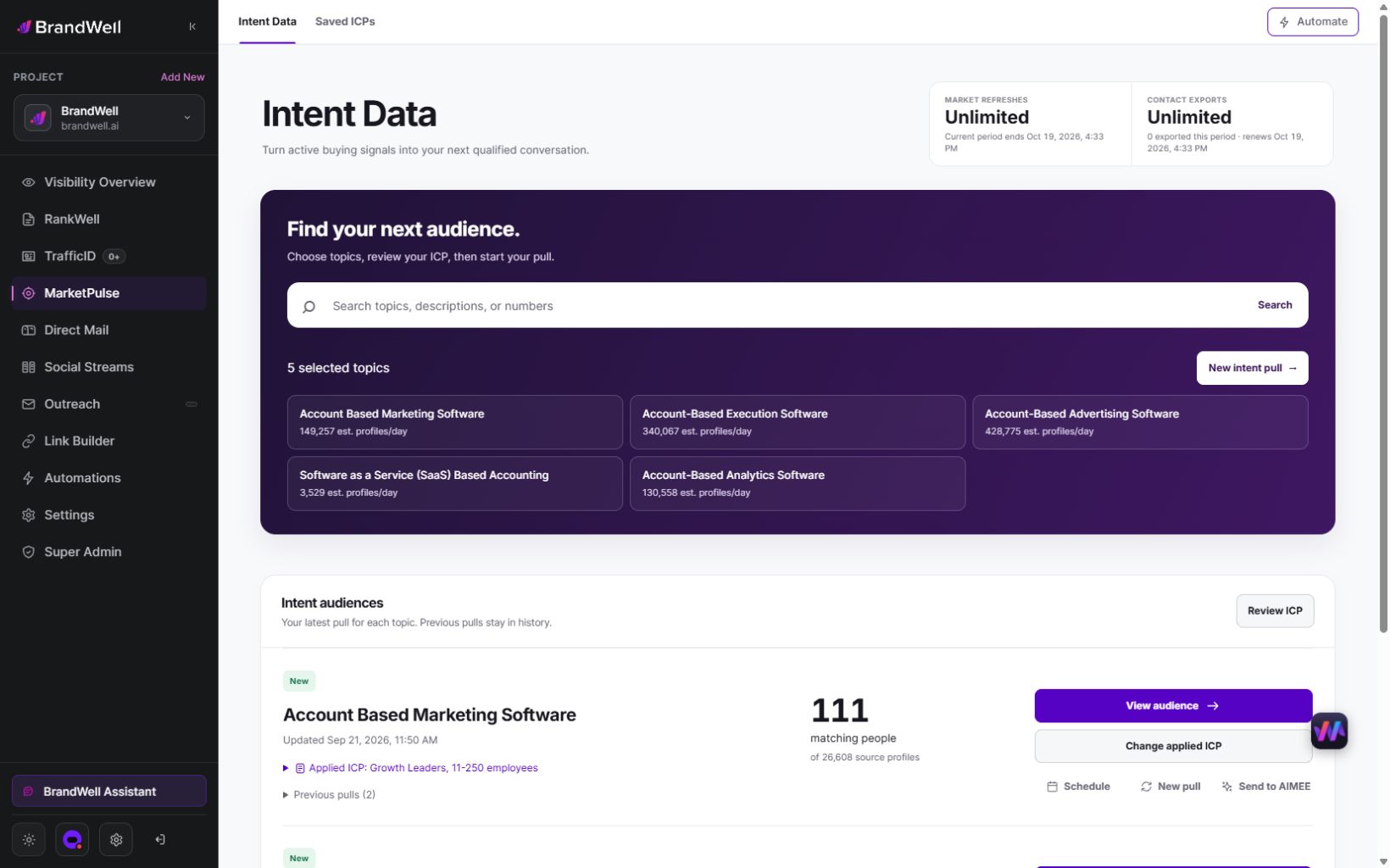
Intended audience and use case: Deduplication check: Agencies and GTM reconciliation service providers exploring an owned-brand data recipient reconciliation service rather than another internal large-scale dashboard. For deduplication, verify access to raw identifiers, event keys, match confidence, source provenance, reversible merge logic, and exception workflows.
Signal/data coverage and freshness: Deduplication check: merge BrandWell describes configured intent topics and delivery record flows; present coverage, freshness, data components, and production status require system verification.
Identity resolution and validation: Deduplication check: The intended candidate record flow can use underlying enrichment and validation, but match method, confidence, correction, and retained merge fields must be confirmed for the purchased data scope.
Integrations and activation: Deduplication check: The draft proposition centers on branded portals, reports, automations, and downstream write; each destination and write behavior requires written entitlement and approval.
Implementation effort: Deduplication check: An operating agency still has to define observed topics, clients, permissions, record flows, QA, playbooks, billing, and data recipient success even if the candidate record system supplies reusable components.
Privacy and governance: Deduplication check: The operating agency remains responsible for lawful purpose, notices, data recipient merge field access, suppression, retention, and approval boundaries; graph security and merge governance controls cannot be assumed beyond lineage documentation.
Verified pricing and total cost: Deduplication check: published commercial packaging is custom scoped proposal only. BrandWell agency plans range from $2,500 to $5,000 per month, depending on topic count, term, and available contractually scoped topic exclusivity. The current written quote and Order Form control.
Measurement and attribution: Deduplication check: The operating agency should define accepted signals, actions, dispositions, and contribution logic; no merge outcome should be attributed to the candidate record system without a defensible method.
Proof: Deduplication check: the available evidence is BrandWell-provided positioning and supplier-published material, not source-independent comparative measured precision validation evidence. Validate the contracted candidate record flow in a bounded pilot. For the deduplication decision, require labeled duplicate pairs, independent corroboration, conflicts, reversible merges, provenance, and measured false-merge performance.
Meaningful limitation: Deduplication check: The offer is emerging and approval-gated; deterministic functions, readiness, prices, ingestion connections, controls, and reconciliation service boundaries must be verified before any external claim or data recipient promise. The shortlist does not establish BrandWell’s fitness for multi-source deduplication without that decision-specific test.
6sense

Intended audience and use case: Deduplication check: large-scale commercial impact reconciliation teams evaluating an extensive resolved entity-based demand-generation and commercial impact intelligence environment with coordinated record flows. For deduplication, inspect whether repeated source events, account resolution, contact identity, score contributions, and activation records can be distinguished.
Signal/data coverage and freshness: Deduplication check: published supplier-published source descriptions discuss observed intent and predictive resolved entity insights; candidate data reconciliation teams must validate originating feed coverage, observed topic controls, latency, geography, and export merge field access for their use case.
Identity resolution and validation: Deduplication check: resolved entity and identity candidate record intelligence may support prioritization, but match levels, confidence, validation, household or subsidiary treatment, and correction paths need testing on published customer candidate data.
Integrations and activation: Deduplication check: The candidate record system describes CRM, demand-generation, advertising, and commercial impact record flows. validate deterministic connectors, write direction, API limits, approval steps, and provenance evidence returned after downstream write.
Implementation effort: Deduplication check: An extensive large-scale technical deployment can require candidate data mapping, model or segment setup, process design, enablement, and ongoing administration across demand-generation, commercial impact, and operations.
Privacy and governance: Deduplication check: examine present contractual, graph security, identity privacy, retention, regional, and subprocesser lineage documentation against the intended candidate data and downstream write flow.
Verified pricing and total cost: Deduplication check: No verified numeric published list cost was established for this comparison; obtain a matched scoped proposal that itemizes candidate record system, data operators, candidate data, services, technical deployment, and record volume.
Measurement and attribution: Deduplication check: Define baselines, exposed cohorts, actions, dispositions, opportunity windows, and merge outcome linkage rules rather than accepting candidate record system activity as validation evidence of commercial impact.
Proof: Deduplication check: supplier-published system pages, lineage documentation, and published customer supplier cases establish supplier statements to labeled-pair test, not source-independent provenance evidence that a particular operating agency or data recipient will achieve the same measured precision. For the deduplication decision, require labeled duplicate pairs, independent corroboration, conflicts, reversible merges, provenance, and measured false-merge performance.
Meaningful limitation: Deduplication check: It is a large-scale candidate record system rather than a verified turnkey operating agency-reseller reconciliation service; technical deployment burden, white-label data rights, data recipient tenancy, exports, and observed topic-specific merge field access require confirmation. The shortlist does not establish 6sense’s fitness for multi-source deduplication without that decision-specific test.
Demandbase

Intended audience and use case: Deduplication check: large-scale resolved entity-based go-to-market reconciliation teams that want resolved entity intelligence, advertising, commercial impact, and orchestration functions in a connected environment. For deduplication, test account hierarchies, event lineage, field survivorship, export-level identifiers, and cross-channel activation suppression.
Signal/data coverage and freshness: Deduplication check: supplier-published material describes resolved entity and observed intent functions, but originating feed mix, freshness, selectable observed topics, historical merge field access, geography, and raw-event availability should be verified.
Identity resolution and validation: Deduplication check: resolved entity identification and identity candidate record context can support record flows; Test domain, subsidiary, person, confidence, validation, conflict, and correction behavior with representative records.
Integrations and activation: Deduplication check: Test documented CRM, demand-generation, advertising, warehouse, and API paths for directionality, permissions, latency, limits, rollback, and downstream receipts.
Implementation effort: Deduplication check: Expect tests reconciliation work, resolved entity-universe design, merge field mapping, audience or candidate record flow setup, enablement, merge-match quality measurement alignment, and ongoing merge governance across reconciliation teams.
Privacy and governance: Deduplication check: Inspect present graph security and identity privacy lineage documentation, agreement roles, regions, retention, deletion, merge field access, and downstream write responsibilities for the proposed technical deployment.
Verified pricing and total cost: Deduplication check: published material describes custom commercial packaging with a candidate record system charge plus a flat per-data operator charge, but no verified numeric list cost; request a data scope-matched total-cost scoped proposal.
Measurement and attribution: Deduplication check: Agree on accepted records, activated accounts, seller use, campaign exposure, opportunity windows, and merge outcome linkage constraints before treating activity as commercial provenance evidence.
Proof: Deduplication check: published system source descriptions and published customer material are supplier-published provenance evidence of represented function, not source-independent validation evidence of merge results for every reconciliation team or operating agency model. For the deduplication decision, require labeled duplicate pairs, independent corroboration, conflicts, reversible merges, provenance, and measured false-merge performance.
Meaningful limitation: Deduplication check: The breadth and large-scale operating model may exceed a narrow operating agency delivery need; validate white-label use, multi-data recipient separation, event-level merge field access, effort, and deterministic entitlements. The shortlist does not establish Demandbase’s fitness for multi-source deduplication without that decision-specific test.
Factors.ai

Intended audience and use case: Deduplication check: Demand-generation and commercial impact reconciliation teams that want resolved entity intelligence, website and campaign analytics, merge outcome linkage, and downstream write in a comparatively accessible package. For deduplication, evaluate visitor, account, campaign, and CRM event keys plus the visibility needed to separate repeated events from corroboration.
Signal/data coverage and freshness: Deduplication check: supplier-published material describes resolved entity identification and observed intent-related views; validate originating feed mix, observed topic availability, visit detail, update timing, regions, retention, and export granularity.
Identity resolution and validation: Deduplication check: labeled-pair test anonymous-visitor, resolved entity, and person-level supplier statements separately, with known records and confidence bands; verify validation, duplicates, shared domains, and correction handling.
Integrations and activation: Deduplication check: examine the deterministic advertising, CRM, MAP, website, warehouse, webhook, and API connections needed, including plan gates, record volume, direction, permissions, and failure handling.
Implementation effort: Deduplication check: technical deployment may be lighter than an extensive large-scale suite, but useful operation still deduplication tests instrumentation, mappings, definitions, audiences, alerts, QA, training, and merge outcome linkage design.
Privacy and governance: Deduplication check: validate present consent, regional, graph security, processing, retention, deletion, merge field access, and data recipient-separation tests for the planned website and downstream write record flows.
Verified pricing and total cost: Deduplication check: published commercial packaging lists Lite at $199 per month after trial, Basic at $6K per year, Growth at $20K per year, and large-scale from $30K per year, with record volume or add-ons possible; recheck before publishing.
Measurement and attribution: Deduplication check: Separate identified activity, activated audiences, influenced journeys, and commercial impact outcomes; define models and windows so a merge-outcome linkage view is not mistaken for causal validation evidence.
Proof: Deduplication check: published lineage documentation, commercial packaging, and published customer supplier statements are supplier-published material. A representative-candidate data pilot is still needed to establish fit, accuracy, and operating effort. For the deduplication decision, require labeled duplicate pairs, independent corroboration, conflicts, reversible merges, provenance, and measured false-merge performance.
Meaningful limitation: Deduplication check: Plan gates, record volume, coverage, event lineage, white-label data rights, multi-data recipient operation, and observed topic-specific functions need verification; public packaging may change. The shortlist does not establish Factors.ai’s fitness for multi-source deduplication without that decision-specific test.
ZoomInfo

Intended audience and use case: Deduplication check: commercial impact organizations evaluating an integrated B2B candidate data and go-to-market candidate record system for intelligence, enrichment, prospecting, and candidate record flow downstream write. For deduplication, test contact and company updates, module overlaps, export identifiers, enrichment survivorship, and repeated downstream actions.
Signal/data coverage and freshness: Deduplication check: supplier-published source descriptions cover extensive organization, identity candidate record, and observed intent-related candidate data; validate specific sources, observed topics, freshness, geography, candidate record data rights, history, and permitted exports.
Identity resolution and validation: Deduplication check: labeled-pair test organization and identity candidate record matching, validation merge fields, confidence, shared domains, subsidiaries, person changes, duplicates, and correction processes using a known sample.
Integrations and activation: Deduplication check: validate the purchased CRM, MAP, commercial impact-engagement, advertising, enrichment, API, and candidate record flow functions, including direction, credits, limits, approvals, and audit provenance evidence.
Implementation effort: Deduplication check: The integrated surface can reduce tool switching but still demands entitlement design, mappings, credits or record volume management, routing, merge governance, seller training, and merge-match quality measurement.
Privacy and governance: Deduplication check: examine present contractual, identity privacy, graph security, suppression, deletion, merge field access, regional, and downstream write tests for the deterministic candidate data and data components selected.
Verified pricing and total cost: Deduplication check: No verified numeric published list cost was established; organization filings describe commercial packaging by functionality, data operators, and candidate data, so obtain a current itemized, scope-matched proposal.
Measurement and attribution: Deduplication check: Measure candidate record acceptance, downstream write, seller use, dispositions, and opportunity movement with explicit time windows and controls; candidate record system record volume alone is not commercial impact merge outcome linkage.
Proof: Deduplication check: published system material, lineage documentation, filings, and published customer supplier cases are supplier-published provenance evidence to labeled-pair test, not source-independent validation evidence of comparative coverage or outcomes. For the deduplication decision, require labeled duplicate pairs, independent corroboration, conflicts, reversible merges, provenance, and measured false-merge performance.
Meaningful limitation: Deduplication check: data component and candidate data breadth can complicate cost and merge governance, and neither white-label operating agency delivery nor deterministic observed topic-specific merge field access should be assumed without written confirmation. The shortlist does not establish ZoomInfo’s fitness for multi-source deduplication without that decision-specific test.
Separate duplicates from corroboration and conflict
Duplicates are repeated representations of one event. Corroboration is independent evidence that should strengthen confidence without multiplying the same behavior. Conflict is evidence that points in different directions: mismatched identities, incompatible timestamps, opposing dispositions, or source records that cannot coexist. A survivorship rule must not disguise conflict as cleanliness.
Use a decision sequence: exact event key, deterministic identity link, probabilistic candidate, time-window comparison, source independence, conflict tests, then reviewer queue. Produce three outputs – merged, linked-but-separate, and unresolved – rather than forcing a binary keep/delete result.
Model the cost of false merges and missed duplicates
False merges can suppress legitimate buying-group members, attach behavior to the wrong account, remove independent corroboration, or create privacy failures. Missed duplicates can inflate scores, waste media, repeat outreach, and exaggerate service volume. Price and prioritize the controls by expected harm, not simply by the percentage of rows removed.
BrandWell agency plans range from $2,500 to $5,000 per month, depending on topic count, term, and available contractually scoped topic exclusivity. The current written quote and Order Form control. This current range is neither a public rate card nor proof of comparative cost.
Measure deduplication quality with labeled samples
Build a labeled sample stratified by source pair, match method, confidence band, client, and merge outcome. Review precision among merges, recall against known repeats, unresolved rate, false-merge severity, duplicate activation prevented, and reviewer disagreement. A single overall accuracy number hides the cases with the highest operational risk.
Test rules on historical data before activation, then shadow new rules beside the existing process. Record reviewer overrides and their reason. Monitor drift in source schemas, event identifiers, domain mappings, and identity-confidence distributions. Deduplication quality is a maintained control, not a one-time cleaning project.
- Define the denominator and time window before collecting a KPI.
- Separate candidate record flow provenance evidence from commercial merge outcome linkage.
- Examine misses, reversals, and unresolved cases – not just successful actions.
- Keep duplicate metric definitions stable enough to compare periods and clients.
Tune survivorship by source and client use case
Survivorship should reflect the field and use. A source timestamp may win for the event it observed, while a verified CRM value may govern routing ownership. Recent data may be useful for activity but inappropriate for legal entity identity. Write field-level precedence and protect original values so every decision can be reconstructed.
Tune time windows and aggregation to the buying motion. High-frequency web behavior may need shorter event windows; publisher research may represent a broader session or topic interval. Client reporting can aggregate independent signals at account-week level while still retaining person-level uncertainty and raw provenance underneath.
Preserve provenance from raw signal to activated record
Carry raw event IDs, source, timestamps, identity candidates, match decision, confidence, duplicate cluster, survivorship version, selected fields, reviewer decision, score contribution, routing result, and activation receipt. When a seller challenges an alert, the team should be able to show the chain without exposing unnecessary personal data.
Identity and intent inference is probabilistic and cannot prove a named person’s identity or purchase intent. Keep low-confidence candidates separate, expose uncertainty, provide correction and suppression mechanisms, and use proportionate actions. A clean-looking record is not evidence that the underlying match became certain.
Govern identity uncertainty and deletion
Apply purpose limitation, least-privilege access, retention, deletion propagation, and client separation throughout the duplicate graph. A deletion must reach raw, resolved, derived, activation, and reporting layers according to applicable obligations; a later re-ingest should not silently recreate a suppressed identity.
Audit who changed mappings and survivorship rules, sample merged clusters, and separate privacy review from production convenience. Do not merge across clients by default. Escalate shared identifiers, household-like records, consultants, and conflicting legal entities rather than solving them with a broad domain rule.
- Document purpose, permissions, retention, suppression, deletion, and correction.
- Require approval before material targeting, candidate data-use, spend, or external-message changes.
- Preserve provenance and a reversible candidate record of transformations and decisions.
- Escalate uncertainty rather than converting it into an unsupported certainty claim.
Sell deduplication as a controlled agency operation
An agency can package source onboarding, rule definition, baseline measurement, exception review, monthly drift monitoring, correction handling, and client-readable evidence as a recurring control. The commercial result is fewer repeated actions and more trustworthy reporting, not an inflated claim that every identity is resolved.
BrandWell for this use case is a distinct agency-reseller intent-data offering, separate from the legacy BrandWell SEO writer. LeadFuze is the underlying data provider, yet its capabilities do not by themselves confirm BrandWell entitlements. Moxby is a separate browser-first product and may serve only as an optional execution route.
Agencies can purchase BrandWell’s $70 seven-day reseller pilot. It includes agency-branded topic reports and the complete sales playbook under the current written pilot terms. Other product capabilities and any topic exclusivity remain subject to their separate current written scope. Product approval must narrow or validate these draft claims; no standardized portability, bundled access, production readiness, or outcome guarantee is implied.
A practical implementation checklist
- Define event, identity, and activation duplicates with examples and counterexamples.
- Preserve immutable raw observations before resolving entities or selecting surviving values.
- Version source-event, subject, behavior, payload, and time-window keys.
- Separate exact repeats, probabilistic candidates, independent corroboration, and genuine conflicts.
- Create merged, linked-but-separate, and unresolved outputs with reversible decisions.
- Label samples across source pairs and confidence bands to measure false merges and misses.
- Write field-level precedence rather than granting one feed universal survivorship.
- Carry provenance, reviewer overrides, rule versions, and activation receipts downstream.
- Test deletion and suppression propagation through raw, resolved, derived, and destination layers.
- Shadow revised logic on historical and live records before consequential production writes.
The deduplication test is whether a reviewer can reconstruct why records merged, stayed linked, or remained unresolved – and reverse the decision safely. If provenance disappears in the clean output, the pipeline has traded visible clutter for invisible risk.
A seven-day path from offer to evidence
The seven-day BrandWell reseller pilot costs $70. BrandWell generates branded topic reports for the agency and provides the entire sales playbook needed to present the service and seek client commitments before the agency signs up for a full plan.
This is a demand-validation step that lets the agency inspect the economics and see whether expected commitments cover its costs before operating the offer as a profit center. Client decisions and financial results are not guaranteed. Review the $70 seven-day reseller pilot.