On this page
- Who owns the expansion decision
- Current MarketPulse research workflow
- Expand from an adopted client use case
- Maintain the test and decision owners
- Use eight controlled expansion artifacts
- Compare client requests and evidenced gaps
- Price the added work and downside
- Keep base and pilot results separate
- Choose accounts with actual readiness
- Preserve identity and source-to-action evidence
- Review new purposes and expectation risks
- Connect pilot evidence to a written change
- Worked example: more topic rows are not all new accounts
- Frequently asked questions
Direct answer: Expand an intent-data service from a proven client use case, not from a menu of available modules. Identify an adjacent decision, confirm an owner and data readiness, run a controlled test, price the added delivery burden, and expand only if the client adopts it. An upsell that adds reports without useful action can weaken renewal and margin.
Current MarketPulse offer: intent-data plans start at $500/mo. See the product, demo, and current plans. Updated October 3, 2026.
Expanding intent-data services within client accounts should feel like solving the next verified problem, not extracting more budget. The agency has an advantage because it can see where the current workflow stops: strong signals that never reach sales, identified visitors that lack a response path, paid audiences without feedback, or client teams asking for a different market view. The expansion method below converts those gaps into bounded offers with evidence and stop conditions.
Who owns the expansion decision
This guide is for account directors, growth strategists, customer-success leaders, and agency owners managing a recurring intent-data service. It assumes the current client scope is documented and that the agency can measure adoption, delivery effort, and at least one useful outcome.
Current MarketPulse research workflow
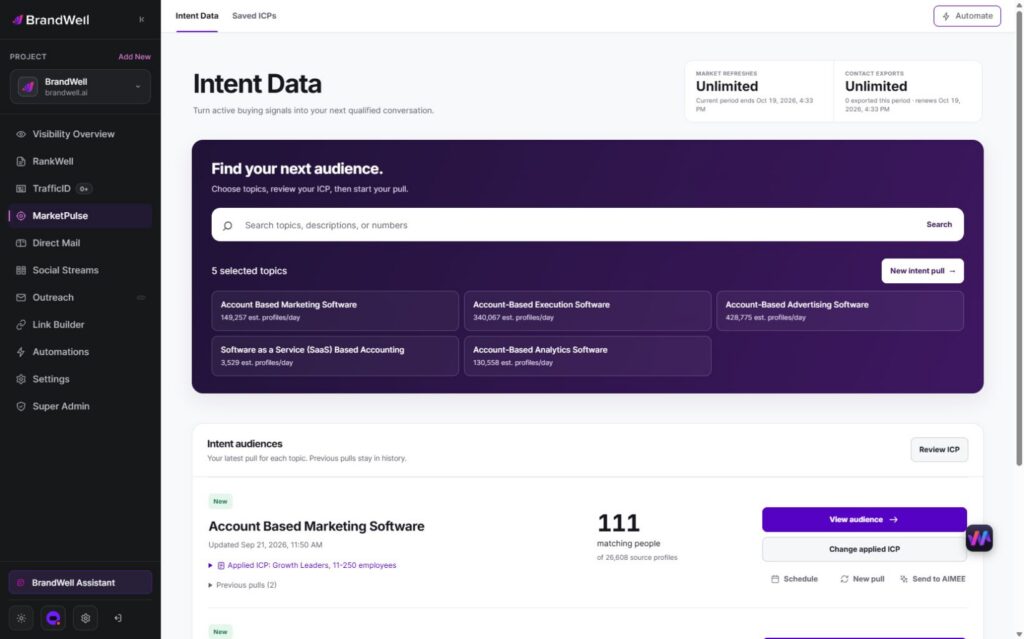
BrandWell MarketPulse: intent data starting at $500/mo. Find people researching topics relevant to what you sell, apply saved ICP filters, and review available contact details before taking action.
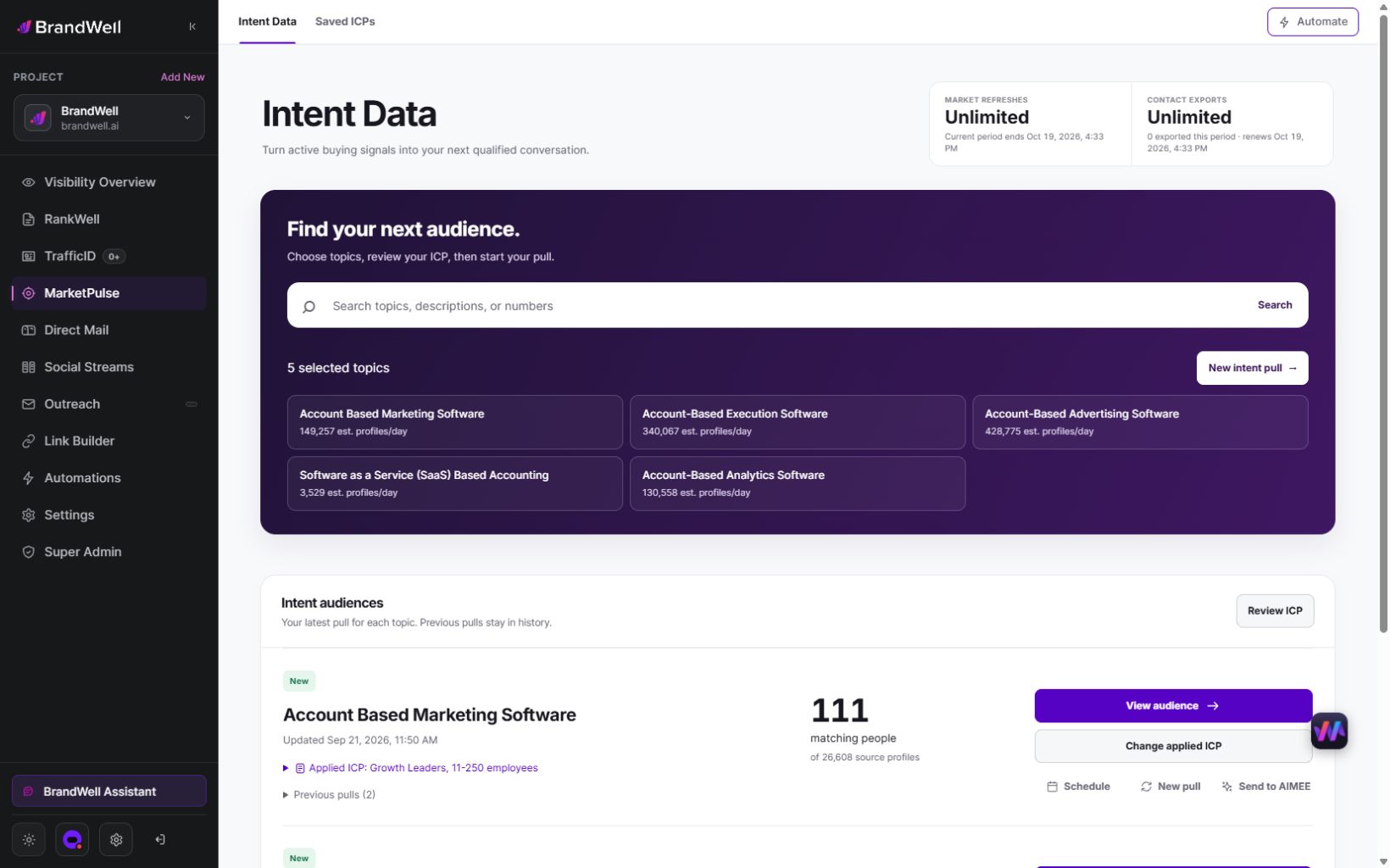
MarketPulse plans are starting at $500/mo. Verify current package scope and offers on the product page.
| Plan | Topics and refreshes | Monthly exports |
|---|---|---|
| Starter | 1 topic, weekly | 25,000 contacts |
| Growth | 3 topics, daily | 100,000 contacts |
| Scale | 10 topics, daily | Unlimited contacts |
Swipe the table to see all columns.
A pull retrieves available data from the previous 24 hours for one topic. Daily use across all included topics provides 90 Growth pulls or 300 Scale pulls in a 30-day month. Weekly Starter pulls vary by calendar month. Available audience size and contact fields vary, and audiences may overlap. Refreshes stop at the plan limit without overage charges.
- Find and qualify: search the topic catalog, save your ICP, and review the people and companies that match.
- Act on the research: export qualified contacts or prepare an Outreach or Direct Mail workflow. Connected products, channel usage, and fulfillment may cost extra.
- Get help from AIMEE: Growth and Scale include AIMEE for the initial user to research accounts and prepare the next step through connected tools.
Agencies and other service businesses can build client deliverables around their available Intent Scans and exports. Keep each client’s scope, permissions, and service fees clear. A subscription is not a promise of a white-label platform or exclusive access to a market.
Explore MarketPulse and watch the demo or compare plans starting at $500/mo. Any early-access discount is a separate, time-limited offer shown to an eligible recipient.
Expand from an adopted client use case
Begin with the client’s current decision chain. Map the signal received, qualification performed, action approved, channel used, outcome returned, and follow-up decision. Mark every broken or manual handoff. Expansion candidates come from gaps that block value, not from features the agency wants to sell.
Use an evidence threshold. The current service should meet its delivery standard, have active users, produce dispositions, maintain acceptable exceptions, and support a credible client decision. If those conditions are not met, fix the base service before adding scope. An expansion cannot rescue weak adoption by creating more complexity.
Choose one adjacent outcome and define a reversible test. For example, extend company-level topic reporting into a human-reviewed account-prioritization workflow for one segment, or extend verified website visitor identification into an approved routing process. Freeze eligibility, define acceptance, record labor, and review results. Expansion is earned when the new workflow is used and its economics fit both parties.
Protect the base service during the test. Use separate cohort labels, work queues, cost codes, and outcome fields so the experiment does not corrupt the established benchmark. Tell the client what remains unchanged. If an expanded workflow performs poorly, the agency should be able to stop it without interrupting the accepted core delivery.
Also distinguish capability interest from buying intent. A stakeholder asking whether a module exists is not a commitment. Record the business problem, urgency, decision process, budget authority, and operational owner before forecasting expansion revenue. This keeps the account plan honest and prevents delivery teams from preparing work that was never approved.
Maintain the test and decision owners
Maintain an expansion register with the observed gap, evidence, proposed use case, client owner, agency owner, required systems, risk level, estimated cost, success condition, and stop condition. Review it monthly, but do not pitch every item. The account director should bring only candidates whose current-service evidence is complete.
Use a four-meeting path. First, an operator interview validates the friction. Second, an internal feasibility review checks data rights, identity, activation, margin, and capacity. Third, a client design session agrees on the bounded test. Fourth, a decision review evaluates adoption, outcome evidence, exceptions, and economics. A renewal or QBR may surface the opportunity, but it should not replace these checks.
Communicate the distinction between hypothesis and commitment. State what the agency observed, what it proposes to test, what the client must do, what evidence will count, and what is not promised. Update the recurring scope only after written approval. The intent-service upsell framework provides a companion commercial process for qualifying and pricing the change.
Keep client communication role-specific. Operators need workflow and exception detail. Executives need the decision, economics, risk, and resource request. Procurement needs scope and terms. Security and privacy reviewers need the data-flow change. A single oversized deck often obscures these needs. Use one controlled source packet and tailored summaries that preserve the same facts.
Use eight controlled expansion artifacts
An agency does not need a massive expansion software stack. It needs shared evidence and controlled handoffs. Use these eight tools or artifacts:
- Current-state workflow map: shows where signals stop, wait, repeat, or lose context.
- Adoption ledger: records who reviewed, accepted, rejected, activated, and returned feedback.
- Expansion register: ranks adjacent problems by evidence, fit, effort, risk, and value.
- Readiness scorecard: tests owner, data, identity, channel, capacity, governance, and measurement.
- Controlled-test brief: freezes cohort, workflow, acceptance, cost, review point, and stop condition.
- Unit-economics model: includes data, usage, labor, support, integration, rework, and margin.
- Change order: defines added scope, responsibilities, approvals, fees, limits, and exit.
- Outcome ledger: connects approved records to actions and returned dispositions without overstating cause.
The CRM, portal, reporting layer, project system, and billing tool should reference the same client and use-case identifiers. Tools are useful when they reduce ambiguity. They are harmful when each creates a different version of adoption or revenue.
A copyable expansion design canvas
Complete the canvas in a working session before drafting a proposal. In the first column, describe the observed friction using client evidence, not assumptions. In the second, name the decision and person responsible for it. In the third, define the minimum signal, identity, and activation change. In the fourth, list client dependencies such as CRM access, feedback, creative approval, or sales capacity. In the fifth, record risk controls and prohibited actions. In the sixth, state acceptance, economics, review point, and exit.
An example might begin with: “The client reviews company-level topic reports but cannot consistently route approved accounts to regional sellers.” The minimum expansion is not every prospecting feature. It could be a governed route for one region, one segment, and one CRM queue, with human acceptance and returned dispositions. The test ends after the agreed cohort or review window, then the parties choose whether to adopt it.
Five expansion gates
- Use gate: the current service has named active users and completed decisions.
- Problem gate: the adjacent friction is documented and material to the client.
- Readiness gate: owners, data, channel, capacity, and approvals exist.
- Economic gate: conservative pricing covers incremental delivery and risk.
- Learning gate: the test can distinguish adoption, failure, and missing evidence.
If any gate fails, assign remediation or hold the proposal. Do not compensate by broadening the scope. A narrow test with a real decision is more informative than a large bundle with ambiguous use.
Compare client requests and evidenced gaps
Reactive expansion begins when a client requests a feature. It can respond quickly, but the request may be a workaround for an unexamined problem. Proactive expansion reviews workflow gaps and suggests adjacent use cases before a client asks. It can strengthen strategic value, yet it risks becoming constant selling.
Data-led expansion requires evidence that the current service works, a documented adjacent decision, and a controlled test. It slows the pitch enough to protect trust and margin. The recommended model is proactive discovery with a data-led gate. Treat reactive requests as candidates that must pass the same gate.
The crucial comparison is upsell every available module versus expand from proven use cases. A catalog-led pitch asks, “What else can we add?” A use-case-led proposal asks, “Which next decision is blocked, and what minimum change could unblock it?” The second question produces narrower offers, clearer measurement, and a credible option to decline.
Price the added work and downside
Estimate discovery, solution design, security or legal review, configuration, integration, QA, training, reporting, account management, and support. Add variable data usage and any minimum commitment. Include capacity displaced from other client work. A one-time setup fee can cover implementation, while the recurring fee should cover ongoing data, delivery, support, and risk at a sustainable margin.
Build three cases: expected adoption, low adoption, and operational stress. Calculate incremental recurring revenue, incremental direct cost, contribution margin, capacity use, payback, and downside exposure. Treat associated pipeline as contextual evidence, not cash. Expansion ROI should not assume every signal becomes a meeting or opportunity.
Use a stop condition that protects both sides. If the client does not provide the agreed owner or dispositions, if identity quality misses the acceptance threshold, if integration effort exceeds the cap, or if data use cannot be authorized, pause and review. A smaller retained scope can be more valuable than a larger unworkable contract.
Keep base and pilot results separate
Track base-service health separately from expansion-test performance. Base measures include on-time delivery, exception rate, correction time, active users, dispositions, actions, client questions, delivery hours, margin, and renewal risk. Expansion measures include eligible cohort, accepted records, time to action, activation completion, feedback returned, added labor, support demand, and the specific outcome tied to the new decision.
Commercial measures include added recurring revenue, setup revenue, data and usage cost, delivery margin, payback, contraction risk, and renewal status. Adoption depth is often more useful than account count. Show how many client roles use the workflow and whether it is embedded in a recurring operating meeting.
Do not combine base and expanded results until the test has stable definitions. Show denominators and identity states. Annotate changes to topics, cohorts, channels, and CRM stages. The metric should lead to an action: continue, correct, broaden, narrow, or stop. If it cannot, remove it from the decision view.
Choose accounts with actual readiness
The best candidates have a healthy base service, a named champion, an adjacent unmet decision, sufficient eligible volume, usable systems, feedback discipline, and budget aligned with the value. Early-stage clients may need to stabilize data and ownership before expanding. Mature clients may support multi-team or multi-channel tests, but stakeholder and governance complexity rises.
At renewal risk, do not disguise remediation as expansion. Resolve missed expectations and establish a recovery baseline first. Near renewal with strong adoption, a controlled extension can inform the next scope if the client has enough time to evaluate it. Mid-term expansion often provides a cleaner test window.
Higher-risk uses include person-level identity, sensitive segments, automated outreach, cross-client data movement, and new jurisdictions. These require stronger review, purpose limits, access controls, and counsel. Low-volume enterprise clients need longer windows and account-level qualitative evidence. High-volume programs require sampling, automation QA, and unit-cost discipline.
Preserve identity and source-to-action evidence
Match the signal to the expansion decision. Topic intent may support account prioritization or content planning. First-party behavior may support visitor routing or journey analysis. Lead data may support enrichment and approved prospecting. Combine signals only when the agency can explain each input and avoid double counting.
Preserve identity state: company, domain, known person, candidate person, unresolved, suppressed, or corrected. Verify fit, recency, recurrence, validation, client relationship, exclusions, and channel eligibility. Require human review at the point where a probabilistic signal becomes an external action. Do not expose inferred research behavior in outreach copy.
Activation evidence includes approval, mapping, destination acceptance, timing, rejection, and completion. Outcome evidence includes dispositions, conversations, opportunities, losses, stage changes, and controlled comparisons where practical. Maintain stable identifiers so the expanded workflow can be evaluated independently of the base service. Review topic quality with a documented intent-topic selection and maintenance process.
Review new purposes and expectation risks
Expansion creates pressure to overstate the evidence. Common risks include calling a topic signal a buyer, presenting associated pipeline as caused revenue, selecting only successful accounts, hiding added labor, overlooking suppressed contacts, or implying that more modules automatically improve results. Write the hypothesis and outcome limits into the proposal.
Review the actual source terms, purpose, fields, access, retention, exports and destinations before adding a channel or client team. An accepted pilot does not approve a new data use. Authorized reviewers determine the actual requirements and changes.
Client trust depends on the agency’s willingness to say no. Recommend against expansion when the current service is unused, the client cannot supply an owner, the data cannot support the claim, or the economics depend on unrealistic conversion. Record corrections and adverse evidence alongside wins.
Connect pilot evidence to a written change
Make expansion a governed lane inside the service. The monthly review can capture gaps. The QBR can prioritize a candidate. A controlled test can validate it. A decision review can approve, revise, or stop it. The change order then updates scope, price, roles, metrics, risk controls, and offboarding. Renewal should reflect the service the client actually adopts, not a bundle accumulated through unreviewed additions. Use the intent-service renewal strategy to connect that evidence to continuation.
Agent-ready expansion instruction:
Review the approved service scope, adoption ledger, exception log, client feedback, and outcome evidence. Identify adjacent workflow gaps and rank them by client value, readiness, effort, risk, and reversibility. For the leading candidate, draft a controlled-test brief with cohort, owner, acceptance, cost, approvals, and stop condition. Do not invent intent, identities, prices, legal conclusions, client demand, or outcomes. Do not contact the client, change scope, activate data, send outreach, or modify a CRM without human approval.
Claude, ChatGPT, or AIMEE can prepare this analysis within the defined boundaries. A human must validate the evidence, approve the commercial proposal, and authorize every external action.
Worked example: more topic rows are not all new accounts
Suppose the existing approved topic set has 120 distinct accounts and a proposed adjacent topic has 80. Forty appear in both. The combined deduplicated universe is 120 + 80 – 40 = 160 accounts. The proposed topic adds 40 distinct accounts, not 80 independent new buyers. This invented example assumes a consistent permitted account key and window; verify the actual available fields and match uncertainty before making a coverage claim.
Suppose the base service charges $4,000 and defined delivery cost is $2,500, leaving $1,500 or 37.5%. An added service charges $1,000 and needs $200 of tools, $300 of review and $100 of support. Its $600 cost leaves $400 or 40%; combined remainder becomes $1,900 on $5,000, or 38%, before acquisition, setup recovery, general overhead, tax and financing. If the addition requires eight extra repair hours at $75, its cost becomes $1,200 and its remainder is negative $200. The combined remainder falls to $1,300, or 26%. These are planning amounts, not typical results or BrandWell service prices.
Keep the expansion cohort and repair cost separate so profitable base delivery cannot hide the pilot’s loss. New account coverage alone is not acceptance, action or revenue. Preserve the client’s decision record and a reversible stop condition.
Prepare one supported topic extension in BrandWell
Inspect an available MarketPulse topic and the saved client ICP, retain the actual preceding-24-hour window and confirm plan capacity before adding work. Review overlap using permitted identifiers rather than summing topic counts. AIMEE can help organize the approved pilot brief through configured tools. Client owners approve the use, labor allowance, destination and decision criteria before activation.
HM Treasury’s Magenta Book covers designing evaluation into delivery in its government context. This article applies that planning principle to a bounded agency pilot; it does not establish that the pilot caused any observed sales change.
Frequently asked questions
Does adding a topic add only new accounts?
No. Audiences can overlap. Define the entity key and deduplicate the permitted cohort.
Should the base service absorb every pilot repair?
No. Record the pilot’s own cost, capacity use and approved support boundary.
Does added coverage establish added revenue?
No. Track acceptance, action and actual outcomes separately.
Should unused base delivery lead to a larger package?
Fix adoption and ownership first. Expansion needs its own supported decision.
Review the supported research product: explore MarketPulse and current plans.
Reviewed and updated October 3, 2026.

Written by