On this page
- Key announcements in their historical context
- Search announcements had different release conditions
- Keep device news and conference history straight
- What a demonstration cannot establish
- A practical checklist for technology-news articles
- An original example: evaluating a document-summary workflow
- Apply that discipline in BrandWell
- Frequently asked questions
Google I/O 2024 focused heavily on AI across models, search, productivity tools and Android. Its announcements included public previews, demonstrations and planned releases. Those categories should not be treated as interchangeable, and a 2024 recap should not serve as a current buying or implementation guide.
This historical summary highlights the relevant distinctions and explains how a content team can turn technology news into a verifiable article. It avoids assuming that a demonstration proves reliability, privacy or business results.
Key announcements in their historical context
Google’s official May 2024 roundup records the event’s announcements. Highlights included:
- Gemini 1.5 Flash and Pro: model updates with public-preview availability described at the event.
- Project Astra: a vision for future AI assistants, demonstrated rather than a universal finished product.
- Trillium: Google’s sixth-generation Tensor Processing Unit.
- Generative media: Imagen 3 and Veo announcements.
- Gemini Live: a conversational experience, distinct from an underlying model.
- Android: multimodal Gemini Nano capabilities and Android 15 features.
These are dated announcements. Confirm present availability and requirements in current documentation before relying on a feature.
Search announcements had different release conditions
Google’s May 14, 2024 search announcement began the US AI Overviews rollout. Other search capabilities in that post were described as experiments or forthcoming features. The release of one feature did not establish general availability for every demonstration.
For a website owner, the useful question is what appears for the actual reader’s query and context. Record the date, market and device when examining a result. Do not convert a conference preview into a promise of traffic or an assumption that every query receives the same layout.
Keep device news and conference history straight
Pixel 8a was announced on May 7, 2024, before the conference. It should not be confused with a newly unveiled Pixel 8 lineup, tablet or Pixel Watch 2 at I/O 2024.
Likewise, do not mix operating-system versions or describe a model, user interface and developer platform as the same product. Precise names and dates help readers understand what was actually announced.
What a demonstration cannot establish
A compelling example can show a proposed interaction. It does not establish that the system performs reliably across every task, understands people in a human sense or explains its internal reasoning faithfully.
Claims about privacy and security need the actual architecture, permissions and data-handling terms. Calling something “on-device” does not describe every part of a connected workflow. Before applying a feature to sensitive work, inspect what data it uses, where it goes and who has access.
Similarly, a faster component does not automatically make a business workflow cheaper or more productive. Evaluate the whole task, including setup, review, corrections and maintenance.
A practical checklist for technology-news articles
- Primary source: link to the dated announcement or official documentation.
- Status: distinguish demonstration, waitlist, preview and general availability.
- Scope: identify relevant language, market, account, device or plan conditions.
- Evidence: separate a company’s claim from an independently measured result.
- Current relevance: tell readers when the page is historical and where they should check today’s details.
- Product relationship: do not imply your own product includes every announced feature.
If a detail cannot be verified, remove it or identify the uncertainty. Avoid adding invented firsthand reactions such as “I tested this” or “as a developer” to make a recap sound authoritative.
An original example: evaluating a document-summary workflow
Suppose a marketing team sees a conference demonstration of document summarization. Before adopting a similar workflow, it defines a small test using approved, nonsensitive documents and a clear task.
The review asks whether the summary preserves dates, prices, conditions and source references. It records missing details and unsupported additions. A successful demonstration is not enough; the team needs a reviewer and a way to correct the output before it reaches a customer.
Keep drafting separate from execution. Preparing a response does not authorize sending it, changing a customer record or making a commitment on the business’s behalf. Establish permissions and approval responsibilities for the actual workflow.
Apply that discipline in BrandWell
For current BrandWell content work, use Visibility for keyword research and RankWell for article preparation and review. RankWell’s Content Hub organizes articles, strategy, queue and calendar work.
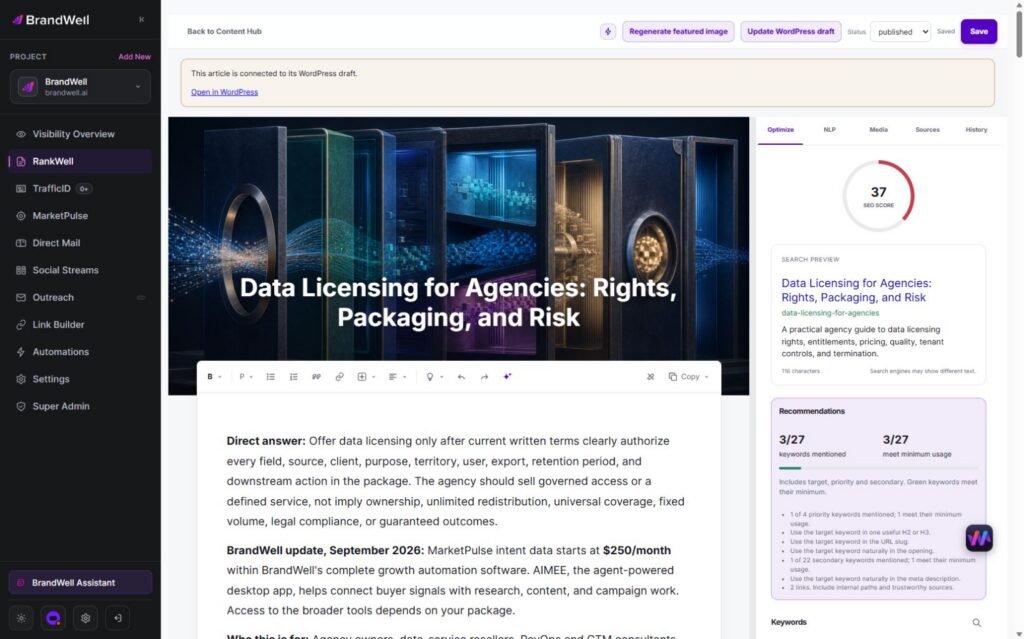
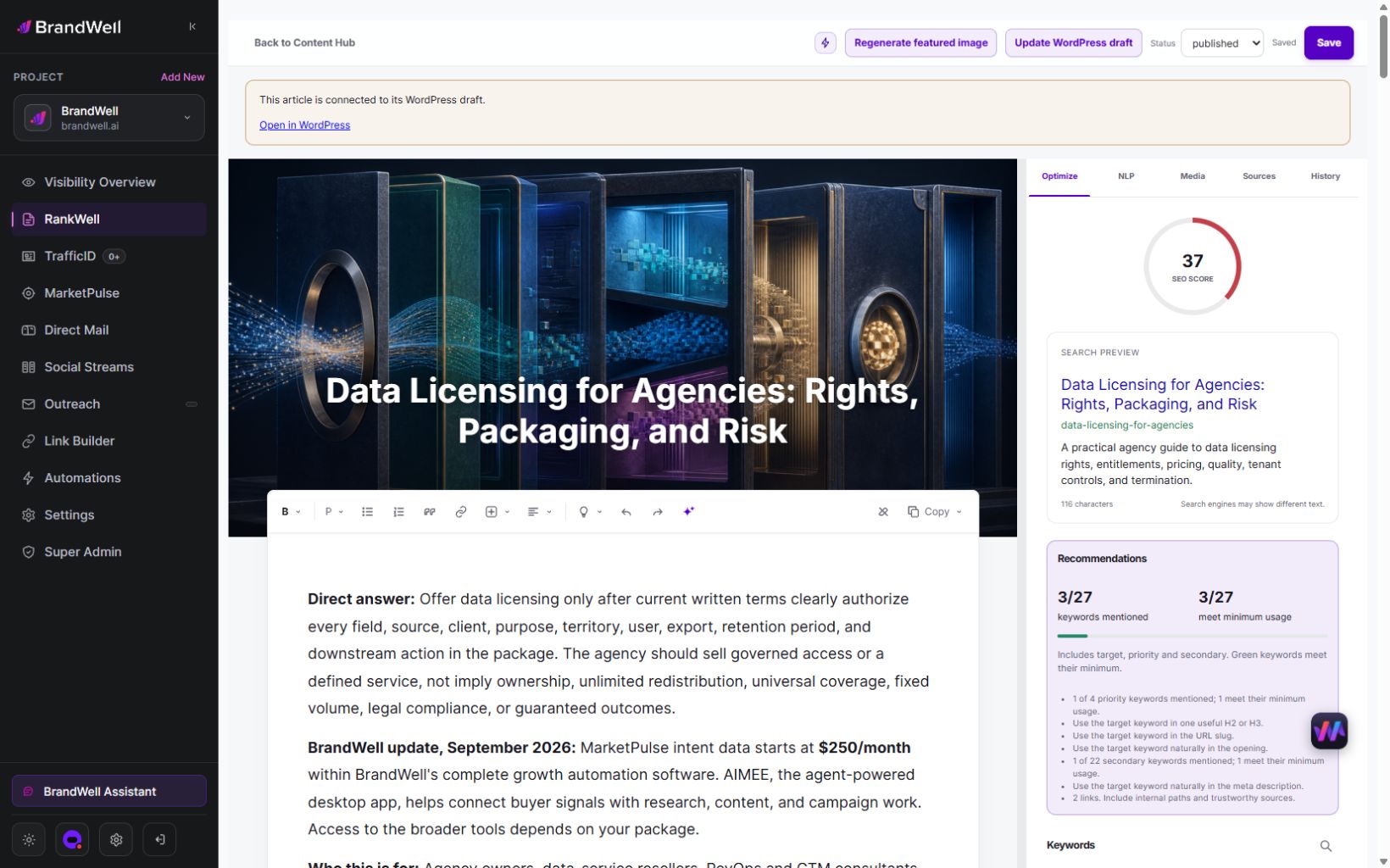
In the editor, inspect the draft alongside search preview, recommendations, media, sources and history. Add primary references, original explanations and actual product screenshots. Verify names, dates and availability before approving configured publication.
For execution workflows, BrandWell Automations depends on the configured tools, triggers and approvals. Do not infer a connection or capability from another company’s conference presentation.
Frequently asked questions
Is this a guide to Google’s current product lineup?
No. It is a corrected historical recap of I/O 2024, with a method for reviewing technology claims. Current implementation decisions require current documentation.
Was every announced capability available immediately?
No. Preview, experimental and planned capabilities had different conditions. Check the specific announcement and later documentation.
Should a content team repeat a vendor’s performance claim as fact?
Identify it as the vendor’s claim and preserve its comparison conditions. Do not imply it measures your own workflow or customer outcomes.
Explore RankWell to prepare and review sourced articles in the current BrandWell portal.
Reviewed and updated October 3, 2026.

Written by
Julia McCoy has contributed articles to BrandWell on content marketing, writing, and search engine optimization. This archive retains her original bylines; individual articles may be updated by the BrandWell editorial team.