On this page
Google began rolling out AI Overviews to US users on May 14, 2024. That release was distinct from other experimental features announced at the same event. For website owners, the important distinction is between a dated launch announcement, the experience available today and the actual results for their own pages.
This guide explains how to read the rollout, check an observed search result and turn that information into a useful content review. It does not assume that every query displays an AI Overview or that a particular format guarantees inclusion.
What the May 2024 rollout included
Google’s May 14, 2024 announcement said AI Overviews were beginning their US rollout. The same post described several other capabilities with separate availability conditions, including features in Search Labs and features planned for later release.
Those distinctions matter. A demonstration of planning, multi-step reasoning or video search should not be described as a feature every user had on launch day. A planned expansion is also not evidence of its eventual reach.
The older Search Generative Experience name refers to the experimental history. Google’s current public AI in Search page distinguishes AI Overviews from AI Mode. Use the feature’s actual name when describing a current result.
Record an observed result without overgeneralizing
If an AI Overview appears for a question relevant to your business, capture the conditions of the observation. Search layouts and availability can change, so one screenshot is not a universal rule.
- The exact query and the date checked.
- The market, language and device.
- Whether the user was signed in or using an experiment.
- The feature displayed and any source links shown.
- The question the result answered and what information was still missing.
Check the cited pages directly before claiming that a type of publisher is preferred. A handful of results does not establish a general citation rate. Do not present an unspecified study’s percentage as a current benchmark.
Turn the observation into an editorial question
Ask what a reader would need after seeing the summary. Your article might supply implementation details, current product limitations, an original comparison method or a checklist they can actually use.
For example, a short answer to “What should I check before hiring a marketing agency?” may list general factors. An agency’s own useful guide could show how to define scope, establish reporting responsibilities and prepare questions about ownership and access. The value is in the concrete explanation, not repeating the same general list at greater length.
Keep the example honest. Do not invent client successes, promise campaign results or claim every provider uses the same process. Show the work your business actually performs and identify where a customer’s circumstances change the recommendation.
Use a reader-focused page structure
Start with a direct answer, then organize the explanation around the reader’s decisions. Use descriptive headings and short paragraphs. Add a checklist, comparison or screenshot only when it clarifies a real step.
A Q&A format can make a question easier to find, but it does not guarantee that a search engine will highlight the answer. Similarly, adding markup is not a substitute for accurate visible content or a promise of AI placement.
Google’s May 2026 resource announcement emphasizes distinctive, valuable content and the continuing role of SEO fundamentals. It also points readers toward guidance addressing common AI-search optimization misconceptions.
Prioritize what makes the page useful to a person: evidence, clarity, working links, readable media and a relevant next action. Avoid publishing repetitive question pages solely to chase a result format.
Prepare and review the page in BrandWell
Use Visibility to investigate relevant search questions. Combine that research with actual customer questions and the business’s expertise. A search opportunity is not proof that a visitor is ready to buy.
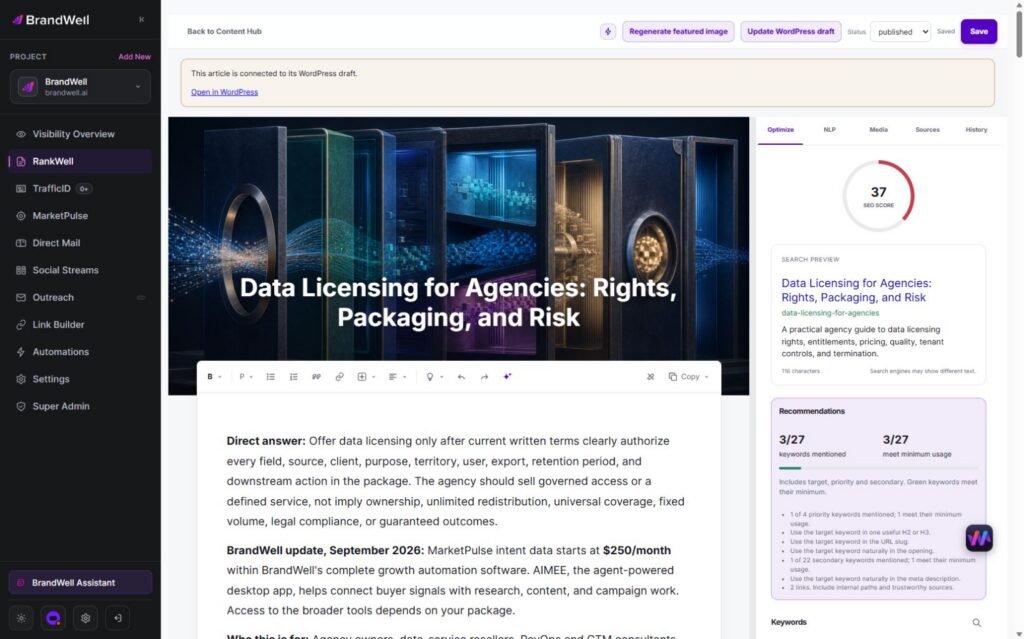
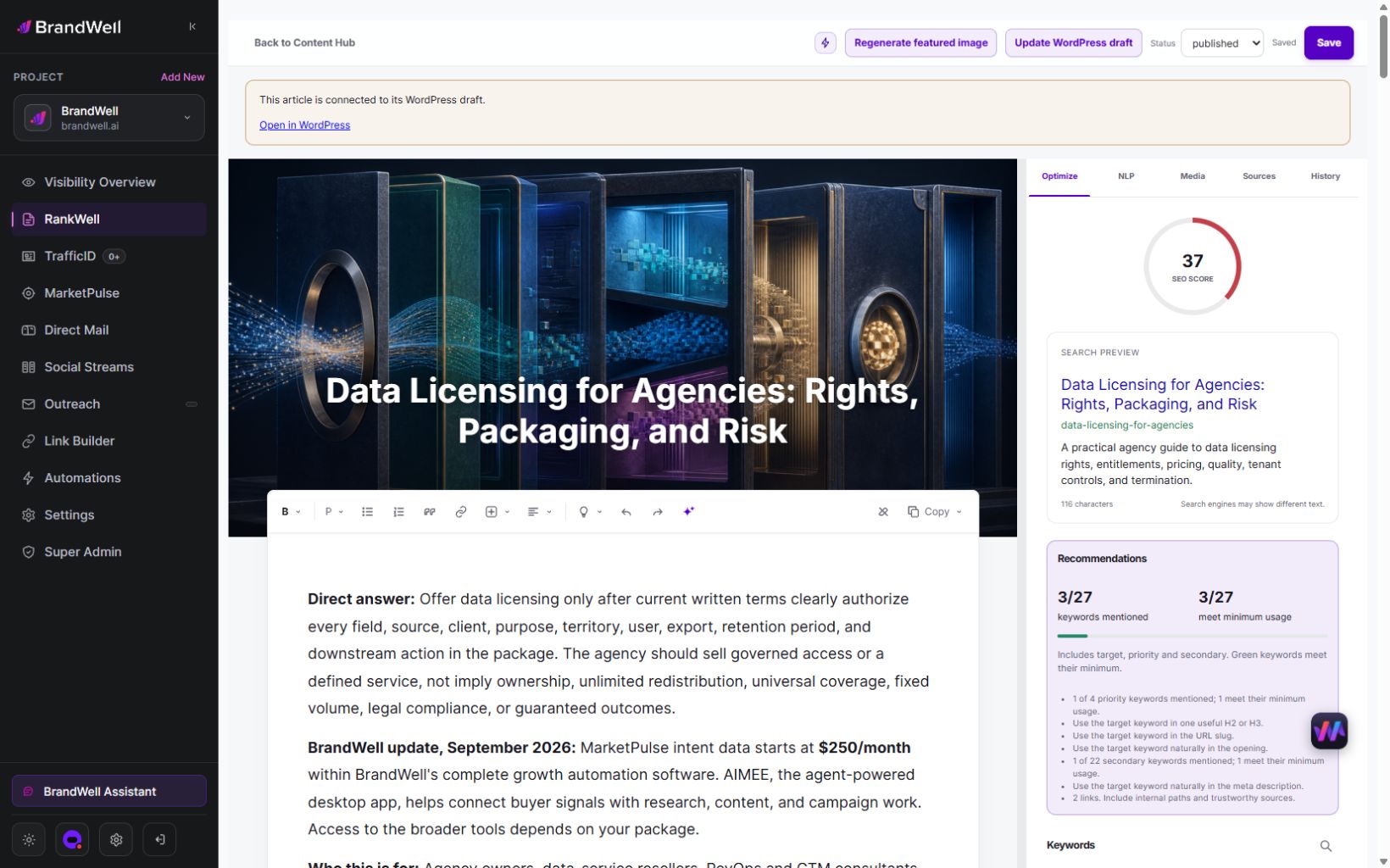
Use RankWell for the article workflow. The current Content Hub organizes articles, strategy, queue and calendar work. In the editor, review the draft, search preview, recommendations, media, sources and history.
Add a verified explanation of the product or service. Check facts against primary sources, label hypothetical examples, and use current screenshots with descriptive captions. Approve the finished work before configured publication. Neither a generated draft nor an editor score guarantees a search result.
Keep observation and performance measurement separate
Record the exact page’s impressions, clicks, CTR and average position before an edit. Compare later periods with consistent filters, and inspect query, device and market differences. A manually observed AI Overview is additional context, not the same measurement as page-level search traffic.
Also track the page’s intended on-site action. If its purpose is to help someone prepare an agency brief, a useful checklist interaction or qualified inquiry may matter more than a raw visit. Keep those definitions consistent.
Do not infer causation from a rise or fall after publication. Seasonality, query mix, rankings, campaigns and other changes can affect the result. Report what the data shows and what remains unknown.
Frequently asked questions
Did every announced feature launch with AI Overviews?
No. The May 2024 announcement gave different release and experimental conditions for different capabilities. Check the specific feature rather than treating the whole announcement as one launch.
Do AI Overviews appear on every search?
Do not assume that. Verify the actual result for the query and context you are studying.
Does a question heading guarantee an AI citation?
No. Use question headings when they help the reader. Citation and ranking outcomes require observation; they cannot be promised by a page template.
Explore RankWell to organize content preparation, source review and publication in the current BrandWell portal.
Reviewed and updated October 3, 2026.

Written by
Julia McCoy has contributed articles to BrandWell on content marketing, writing, and search engine optimization. This archive retains her original bylines; individual articles may be updated by the BrandWell editorial team.