On this page
- 1. Choose specific questions you can answer well
- 2. Maintain useful evergreen resources
- 3. Contribute to publications serving the same audience
- 4. Make the article easier to use
- 5. Send relevant updates to subscribers
- Use search data to prioritize the next update
- Prepare and review the article in RankWell
- Repurpose what is genuinely useful
- Frequently asked questions
To grow a blog’s audience, answer a specific reader need, keep useful articles current, make them easy to read, and distribute them where interested people already look. Measure relevant visits and useful next steps rather than publishing more simply to increase the article count.
No headline formula, word count or publishing frequency guarantees popularity. Start with a clear audience and an outcome: helping qualified readers understand a problem, subscribe to useful updates, or evaluate a relevant product.
Reviewed October 3, 2026.
1. Choose specific questions you can answer well
A broad topic such as “content marketing” can leave the reader’s actual task unclear. A narrower question such as “how to plan a content calendar for a small consulting team” gives the article a defined purpose.
Long-tail keywords generally refer to lower-demand searches within the larger distribution of search demand. They are not defined by a fixed number of words. A detailed query can still have substantial demand, and neither query length nor specificity proves buying readiness.
Collect questions from customer conversations, support requests and search data. For each proposed article, write the audience, problem, useful answer, evidence you can provide, and relevant next action. Combine overlapping questions when one strong page can answer them coherently.
For example, a fictional payroll-software company might explain how to check an import before processing payroll. A worked validation checklist would help the reader more than repeating “payroll software” throughout a generic article.
2. Maintain useful evergreen resources
Evergreen means the reader’s underlying need remains useful over time. It does not mean the facts, interfaces, prices or links never change. Give each important guide an owner and a review date.
- Check statistics against the original research and its population, dates and method.
- Update product screenshots when the interface or workflow changes.
- Replace broken or irrelevant links with a source that supports the actual claim.
- Remove instructions for retired products and unsupported features.
- Keep the title’s promise aligned with the article’s current answer.
Google’s date guidance recommends a clearly labeled visible publication or update date and consistent structured dates.
Do not change a date solely to make an unchanged article appear new. Describe a substantive revision when it helps readers understand what has changed. Turning a short list into a longer list is worthwhile only if the additions answer a real need.
3. Contribute to publications serving the same audience
A guest article can introduce your work to a relevant audience. Review the publication’s editorial standards, topic fit and actual reader needs before proposing a contribution.
Pitch a specific useful idea, include credible evidence, and be clear about your relationship to the product or business discussed. Meet the publisher’s requirements. Its follower count does not guarantee interested readers, referral visits, backlinks or search rankings.
Offer an original example, explanation or resource the publication does not already cover well. Let the editor decide which links belong. A guest contribution should stand on its own as useful reading rather than serve as an advertisement padded with keyword anchors.
4. Make the article easier to use
Place the direct answer near the beginning. Use headings for genuine subtopics, keep paragraphs focused, and use lists for steps or parallel information. Remove repeated introductions and unnecessary tables of contents that duplicate the page’s content.
- Title: accurately describe the question and useful answer.
- Opening: state what the reader can learn or do.
- Examples: label fictional calculations and distinguish them from observed results.
- Images: show a meaningful process, example or product screen, with readable labels and appropriate alternative text.
- Links: explain what the destination helps the reader do.
- Mobile: check headings, image readability, form controls and horizontal overflow on the published page.
High bounce rate alone does not establish that an article is unhelpful. A reader may find an answer and leave; measurement setup and the definition of engagement also matter. Review behavior alongside the article’s purpose and the event you actually want to measure.
5. Send relevant updates to subscribers
Make the subscription offer clear: what readers will receive, how often, and how they can stop. Collect only the information needed for the stated program and respect preferences and applicable requirements.
Write a concise message explaining why the article is useful. Link directly to the relevant resource rather than making subscribers find it again. Segment by expressed interests or an appropriate existing relationship instead of collecting unnecessary demographic information.
Test email layouts on small screens. If you compare subject lines, keep the audience, offer and measurement window consistent. Treat recorded opens cautiously and use useful clicks or downstream actions where appropriate. An email-preparation example is not proof that a product manages the full sending workflow.
Use search data to prioritize the next update
Search Console’s Performance report reports clicks, impressions, CTR and average position. CTR is clicks divided by impressions.
- Choose a consistent date range and search type.
- Review pages receiving impressions, then filter a particular page before examining its queries.
- Check whether those queries match the article’s purpose and the title’s promise.
- Compare devices and query groups before calling a low overall CTR a title problem.
- Improve a missing answer, unclear example, outdated fact or misleading snippet description.
- Record the change and review a later comparable period. Account for position, demand and other concurrent changes.
Do not assign site-wide query totals to one article. Small samples are also noisy: in a fictional example, three clicks from 100 impressions is 3% CTR, while four is 4%. One additional click does not establish that an edit caused a reliable improvement.
Prepare and review the article in RankWell
RankWell is BrandWell’s current content workflow. The Content Hub organizes articles, strategy, queue and calendar work; the editor brings together the draft, search preview, SEO recommendations, NLP, media, sources and history.
- Define the reader’s question and supply the evidence and original examples.
- Prepare the draft and verify each important factual or product claim.
- Review the search preview against what the article actually delivers.
- Replace outdated images with useful, current visuals.
- Check sources and links, approve the supported publishing destination, and inspect the live mobile page.
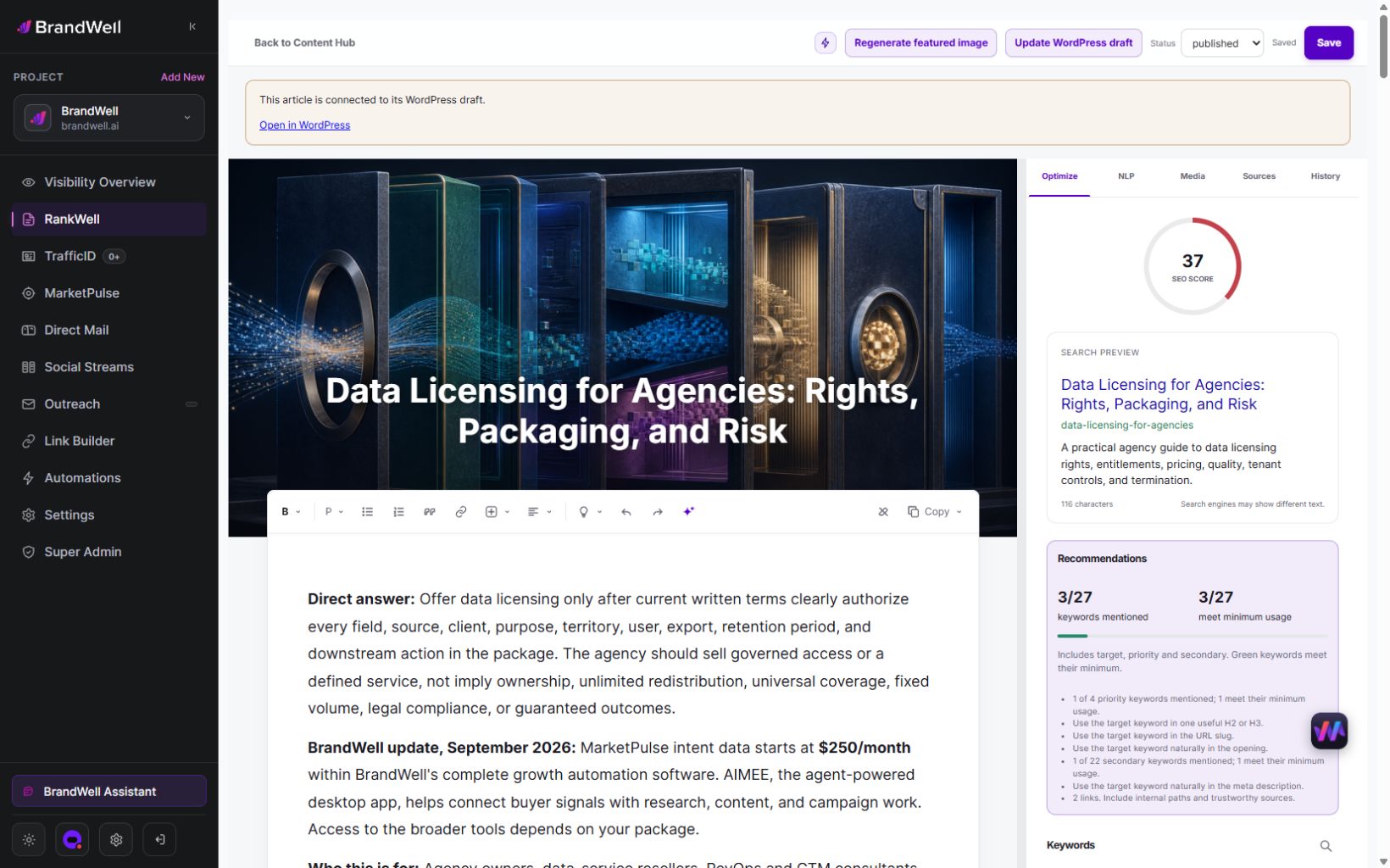
Explore RankWell. Review remains necessary; a generated draft, optimization score or large publishing queue is not a finished content strategy.
Repurpose what is genuinely useful
Adapt an article’s worked example into a short video, checklist or relevant social post. Link to the fuller explanation when that helps the reader. Check each format’s facts and readability rather than reposting the entire article everywhere.
Track which resources receive interested visits and meaningful responses. A large reaction count can be useful distribution feedback without establishing sales impact. Promote resources that help the audience, not only the latest publication.
Frequently asked questions
How often should I publish?
Choose a pace you can research, review and maintain. More articles are not automatically more useful.
Do longer articles always perform better?
No. Use the space required to answer the question clearly. Remove repetition and unsupported claims.
Will guest blogging make my blog popular?
It can introduce a relevant audience, but publication, referral traffic and rankings are uncertain.
Should I update a high-impression page with few clicks?
Investigate query fit, position, device and the search result first. Improve the actual mismatch rather than assuming a new title alone fixes it.
Reviewed and updated October 3, 2026.

Written by
Julia McCoy has contributed articles to BrandWell on content marketing, writing, and search engine optimization. This archive retains her original bylines; individual articles may be updated by the BrandWell editorial team.