On this page
- Current MarketPulse research workflow
- Check the actual creative question
- Map themes to useful message hypotheses
- Define eligibility, ownership and tests
- Use seven creative operating assets
- Keep a generic message control
- Count production and operating costs
- Measure qualified outcomes and skew
- Check actual creative-test feasibility
- Trace fit, freshness and outcome evidence
- Review claims, themes and destinations
- Scope separate agency creative work
- Copyable theme-to-message brief
- Frequently asked creative questions
Intent-based ad creative turns an approved research theme into a message hypothesis about a buyer problem. It should not reveal observed behavior or declare a named person ready to buy. Keep a generic control, a consistent destination and qualified outcome definitions, then test the proposed message.
Current MarketPulse offer: intent-data plans start at $500/mo. See the product, demo, and current plans. Updated October 3, 2026.
Current MarketPulse research workflow
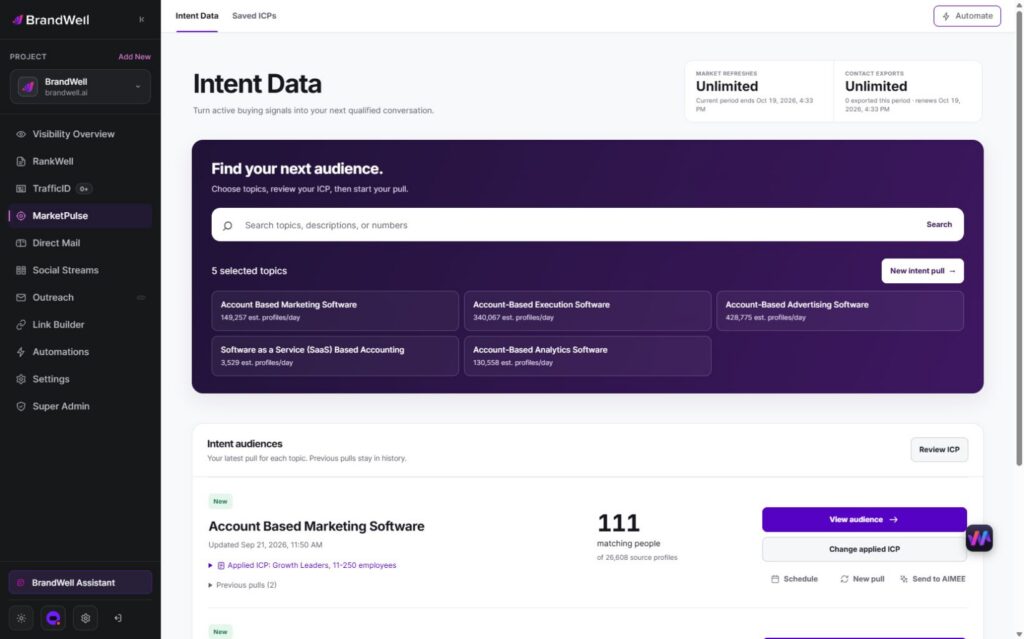
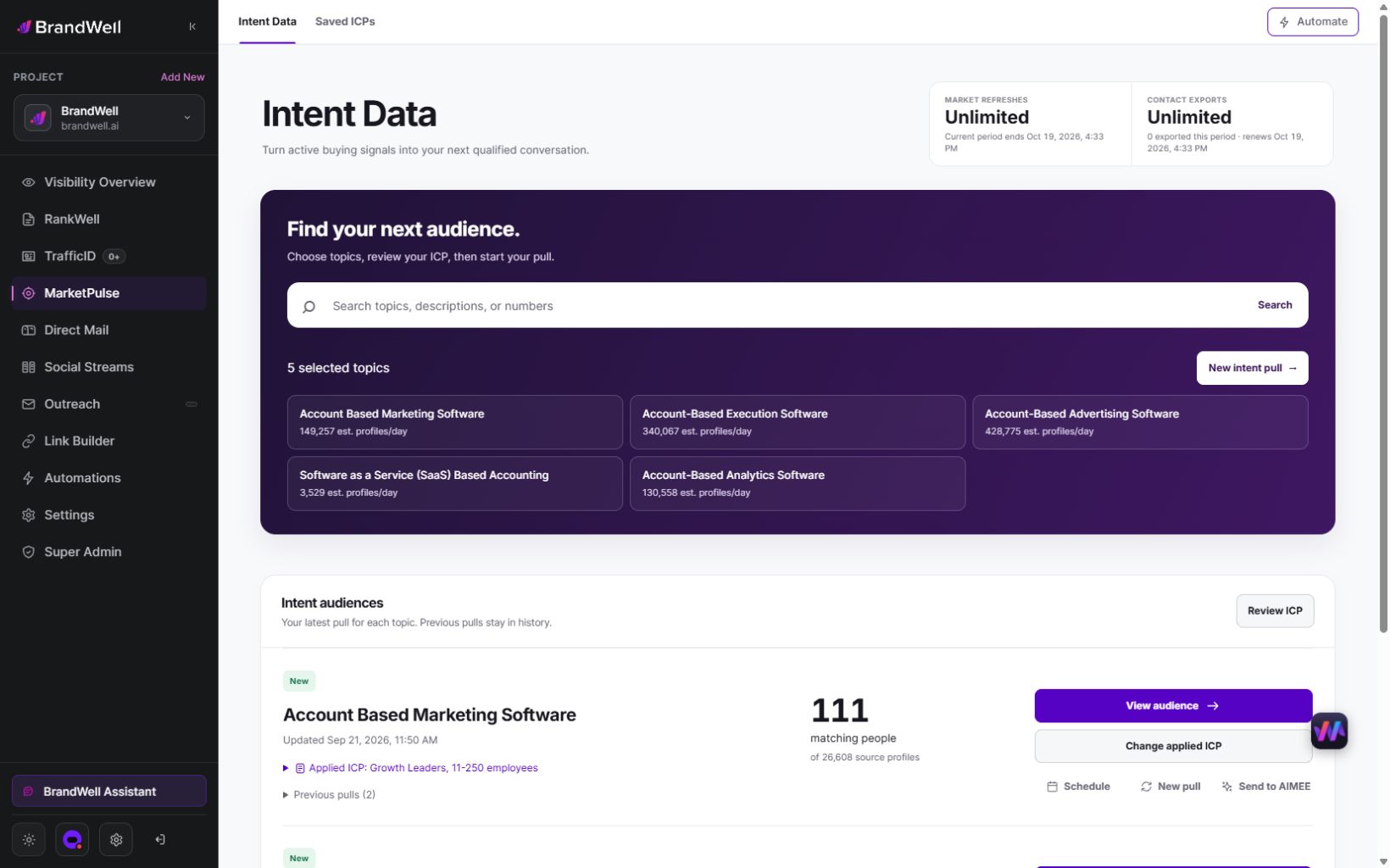
BrandWell MarketPulse: intent data starting at $500/mo. Find people researching topics relevant to what you sell, apply saved ICP filters, and review available contact details before taking action.
MarketPulse plans are starting at $500/mo. Verify current package scope and offers on the product page.
| Plan | Topics and refreshes | Monthly exports |
|---|---|---|
| Starter | 1 topic, weekly | 25,000 contacts |
| Growth | 3 topics, daily | 100,000 contacts |
| Scale | 10 topics, daily | Unlimited contacts |
Swipe the table to see all columns.
A pull retrieves available data from the previous 24 hours for one topic. Daily use across all included topics provides 90 Growth pulls or 300 Scale pulls in a 30-day month. Weekly Starter pulls vary by calendar month. Available audience size and contact fields vary, and audiences may overlap. Refreshes stop at the plan limit without overage charges.
- Find and qualify: search the topic catalog, save your ICP, and review the people and companies that match.
- Act on the research: export qualified contacts or prepare an Outreach or Direct Mail workflow. Connected products, channel usage, and fulfillment may cost extra.
- Get help from AIMEE: Growth and Scale include AIMEE for the initial user to research accounts and prepare the next step through connected tools.
Agencies and other service businesses can build client deliverables around their available Intent Scans and exports. Keep each client’s scope, permissions, and service fees clear. A subscription is not a promise of a white-label platform or exclusive access to a market.
Explore MarketPulse and watch the demo or compare plans starting at $500/mo. Any early-access discount is a separate, time-limited offer shown to an eligible recipient.
Check the actual creative question
This intent based ad creative implementation guide is for B2B advertisers, creative teams, demand generation leaders, and agencies that already have usable fit and intent signals but need a defensible way to turn them into messages. Evaluate it when one generic creative set is too broad, yet person-specific personalization would feel invasive or violate policy. It is not a substitute for platform eligibility checks, consent analysis, a creative-testing plan, or human judgment.
Map themes to useful message hypotheses
Use the signal to choose a problem family, not to narrate an individual’s behavior. A research theme such as implementation, comparison, migration, or pricing can suggest a message lane. It cannot establish that a named person is in a particular stage. An intent-based creative hypothesis can work at an approved account or cohort level and uses language a buyer could reasonably encounter without wondering how the advertiser knows.
A practical topic-to-message matrix has five fields: eligible signal theme, likely job to be done, safe abstraction, useful offer, and disallowed claim. For example, an implementation theme may support “Plan a lower-risk rollout” and a checklist offer. It should not support “We saw you researching implementation.” A comparison theme may support a neutral evaluation guide, not an assertion that the account is about to switch vendors.
- Awareness hypothesis: name the operational problem and offer a diagnostic.
- Evaluation hypothesis: clarify decision criteria and offer a comparison worksheet.
- Implementation hypothesis: reduce perceived effort and offer a rollout plan.
- Commercial hypothesis: explain scoping variables and offer a written assessment – not a false urgency claim.
The core decision rule is simple: use only themes approved for advertising, abstract them one level above observed behavior, and keep a generic control. If the safe abstraction removes all meaningful difference, retain generic creative until a useful difference can be tested.
Define eligibility, ownership and tests
The workflow begins before copywriting. A data owner defines the signal source, entity level, freshness window, and suppression rules. Marketing operations joins fit and eligibility fields without exposing raw behavioral detail. A creative strategist converts approved themes into message and offer hypotheses. Paid media implements platform-compatible audiences and experiments. RevOps returns opportunity outcomes. Privacy, legal, security, and platform-policy owners approve the permitted use.
- Document the signal’s source, entity resolution method, freshness, and permitted activation.
- Exclude sensitive themes, restricted categories, tiny audiences, and records without an approved basis for use.
- Group remaining themes into a small number of durable buyer problems.
- Create one message brief and one offer ladder per problem, plus a neutral control.
- Run preflight checks for audience size, exclusions, creative policy, landing-page consistency, and measurement.
- Launch a bounded test with a declared primary outcome and stop rule.
- Join exposure and cost data to accepted opportunities, then record what changed.
The minimum integrations are a governed signal store, audience activation path, ad platform, landing-page analytics, and CRM opportunity history. Consequential actions – including audience uploads, spend changes, CRM overwrites, and outreach – require explicit human approval, an audit trail, and a rollback path.
Use seven creative operating assets
1. Topic-to-message matrix
Map each eligible research theme to a buyer problem, safe abstraction, claim boundary, and control message. This is the core intent based ad creative template because it makes the leap from signal to copy reviewable. Limitation: the matrix documents a hypothesis; it does not validate the inferred problem.
2. Abstraction ladder
Rate proposed copy from broad category language through account-specific language to prohibited person-specific disclosure. Approve the least specific level that remains useful. Limitation: abstraction cannot make a prohibited data use permissible; policy and legal review still govern.
3. Offer ladder
Prepare offers from low-friction education to evaluation support and scoped consultation. Match the offer to the problem hypothesis rather than declaring a buying stage. Limitation: too many offers split learning and create production overhead.
4. Creative guardrail card
Put restricted themes, banned phrases, minimum cohort rules, disclosure requirements, and escalation owners on one review card. Limitation: a static card becomes stale when platform rules, jurisdictions, or data flows change.
5. Control-and-variant brief
Hold format, placement, audience eligibility, and offer destination steady while changing the intended message variable. Limitation: real auction delivery can still differ, so exposure balance must be checked after launch.
6. Evidence and decision log
Record hypothesis, launch gate, primary metric, minimum evidence rule, result, caveat, owner, and next action. Limitation: logging does not repair weak attribution or small samples.
7. Agent-ready production packet
AIMEE can prepare a review brief through configured connected tools. Keep proposed actions separate from actual approvals and destination acknowledgements. Confirm the implementation and permissions before execution.
Keep a generic message control
Use a generic set as a comparison when audiences are small, themes overlap, the buyer problem is shared or differentiated destinations cannot be maintained. Verify actual delivery and governance rather than assuming consolidated learning or a correct baseline for every campaign.
Keep message selection separate from audience targeting. Compare one approved message change with the generic control under a suitable design. Keep assignment, audience eligibility, offers, format, delivery balance, outcome maturity and uncertainty visible. Inconclusive evidence is not a creative winner.
Alternatives include lifecycle creative based on first-party actions, industry or role creative based on declared firmographics, contextual advertising, and a strong generic value proposition. Intent data is one hypothesis input, not a mandatory layer.
Count production and operating costs
Budget the whole operating loop: signal access, identity and enrichment, audience preparation, creative strategy, asset production, media, landing-page work, analytics, CRM hygiene, and governance. Pricing can be project-based for the initial matrix, a recurring managed-service fee, usage-based data fees, or a hybrid. An apparently inexpensive data subscription can become costly if poor match quality, stale signals, or missing outcome joins consume media and sales capacity.
Build a planning model with six inputs: number of eligible themes, required formats, regions and languages, refresh cadence, media spend, and analyst/review hours. Add a contingency for rejected audiences, policy rework, and variants that never reach an interpretable sample. There is no universal intent based ad creative benchmark or production cost; workload and evidence requirements determine total cost.
Measure qualified outcomes and skew
Choose one primary decision metric before launch. For sufficient-volume programs, that may be accepted-opportunity rate per eligible account or cost per accepted opportunity. Earlier indicators – qualified landing-page engagement, offer completion, sales acceptance, and meeting progression – can diagnose the path but should not replace the commercial outcome.
- Delivery: eligible accounts, match rate, reach, frequency, and spend by variant.
- Message response: qualified visits, meaningful offer actions, and response quality.
- Pipeline: accepted opportunities, opportunity value bands, stage movement, and time to acceptance.
- Guardrails: policy rejections, complaints, suppressions, data-age exceptions, and manual overrides.
Report absolute counts, denominators, windows, missingness and uncertainty. Attribution assigns credit under a chosen model; it does not establish causal uplift. Label actual evidence as experimental, attributed or observational and keep realized economics separate from associated pipeline.
Check actual creative-test feasibility
Evaluate actual ICP, distinct research themes, eligible audience volume, maintained destinations and reliably recorded qualified outcomes. Example hypotheses include migration versus first implementation, evaluation versus rollout and different client markets; none establishes a buyer stage.
Poor fits include very small markets, heavily restricted categories, products with no theme-to-offer difference, missing consent or role analysis, and teams that cannot maintain destinations or outcome data. A buyer should pause when the only justification is “personalization usually works.” The decision guide is evidence-based: if no safe, useful and measurable difference exists, use the generic control.
Trace fit, freshness and outcome evidence
Treat the system as a chain of independent evidence. Fit asks whether the account could reasonably buy. Intent suggests what problem may be receiving attention. Identity estimates which company or person may be associated with activity and remains probabilistic. Freshness defines how long the hypothesis may influence messaging. Activation confirms the audience reached the intended platform under its rules. Downstream outcomes reveal whether the treatment produced useful commercial behavior.
Each link needs a status and reason code. An account can be high fit but too stale to activate, or recently active but poorly matched. Do not collapse those conditions into one opaque “hot” score. BrandWell describes configurable qualification and routing into CRM, ads, exports, dashboards, and AI workflows; use that capability as workflow infrastructure, not as proof that any signal is true. See the BrandWell workflow methodology.
Review claims, themes and destinations
The largest intent based ad creative mistakes are revealing observed behavior in copy, using sensitive themes, building overly narrow audiences, treating identity matches as certain, ignoring signal decay, and declaring winners from delivery-skewed tests. Stereotyping is another failure: a topic can indicate a research task without revealing the role, motivation, urgency, or preferred solution.
Keep actual approved themes, cohort rules, recency, uncertain identity, suppression, purpose and destination checks. Verify source, recipient, jurisdiction, account and channel eligibility before activation. Abstract copy does not make prohibited data use permissible.
Never use automated copy generation to bypass review. Keep a human approval gate for sensitive classifications, audience creation, live creative, budget changes, CRM updates, and outreach. Preserve a rollback schedule and retain the reason a variant was allowed.
Scope separate agency creative work
Sell a governed operating cycle, not “more personalized ads.” A defensible monthly service includes signal eligibility review, topic-to-message matrix maintenance, one controlled creative hypothesis per cycle, offer and destination QA, activation checks, outcome joining, a decision log, and a client review. State what the service does not include: guaranteed pipeline, person-level certainty, legal advice, or unrestricted audience activation.
Review an available MarketPulse topic, saved ICP and actual preceding-24-hour matches for the approved research purpose. Keep uncertain company context visible. AIMEE can organize supplied context through configured tools; named owners approve actual exports, messages, audience uploads and CRM writes.
Keep research access distinct from agency creative production and reporting. Verify actual usage, branding, access, recipient rights, implementation, approval, delivery responsibilities and separate fees. A subscription does not establish every creative or client-interface capability.
Copyable theme-to-message brief
Theme: [Approved research context and uncertainty.] Problem: [Useful buyer task without inferred personal behavior.] Message: [Claim, supporting evidence and neutral wording.] Offer: [Actual available resource and matching destination.] Control: [Generic message and unchanged test variables.] Outcome: [Qualified event, denominator, maturity and costs.] Approval: [Owner, destination checks, stop rule and version.]
Three message hypotheses without behavior disclosure
- IT rollout: Try “Plan your next IT rollout with a practical readiness checklist.” Offer an actual checklist with scope, ownership and transition risks. Avoid “We saw your team researching IT providers.” A theme does not establish a contract renewal or vendor decision.
- Agency prospecting: Try “Build a repeatable prospect-research workflow for your agency.” Offer a worksheet covering topics, fit, review and follow-up ownership. Do not promise client exclusivity, guaranteed leads or native white-label rights from a research subscription.
- Payroll evaluation: Try “Compare payroll rollout requirements before choosing a system.” Offer a genuine requirements worksheet. Do not assert that a named company has payroll problems or is switching software.
Check the actual offer and cost disclosure
Google’s misrepresentation policy addresses misleading claims, unavailable offers and unclear payment information. Review the actual ad and destination together. This policy is not approval for a particular audience or a guarantee of ad acceptance.
A current MarketPulse message can say plans are starting at $500/mo and link to the actual product and plan details. It should not present a recipient-specific early-access price as universally available, imply all contact fields are always present or call a research match a guaranteed buyer. Keep connected-product and usage costs clear where relevant.
Count variants before commissioning production
Five fictional themes across three formats and two regions require 30 defined assets, not five. At an invented $100 per asset, production is $3,000 before research, media, localization review, destination work and maintenance. Reduce or stage the scope if the test cannot supply interpretable evidence for each variant. These invented service inputs are not BrandWell creative-service prices.
A click winner can lose on qualified outcomes
Assume fictional control and variant each spend $1,000. The control produces 400 clicks and eight accepted opportunities; the variant produces 800 clicks and four. Media cost is $2.50 versus $1.25 per click, but $125 versus $250 per opportunity. Keep actual assignment, comparable delivery, uncertainty, observation age and outcome definitions before interpreting the difference. These invented counts do not establish BrandWell performance or causal uplift.
Prepare the brief from actual product research
Review an available MarketPulse topic, saved ICP and actual preceding-24-hour matches for the approved purpose. Preserve uncertain company context. AIMEE can organize supplied research and a draft brief through configured tools. Owners review claims, resources and destinations and approve exports, messages, Outreach enrollment, audience uploads and CRM writes. Custom creative production, reporting and routing require separately verified implementation, rights, scope and fees.
Frequently asked creative questions
Does a research theme establish an individual’s buying stage?
No. Treat the buyer problem as a hypothesis.
Can the ad claim a free worksheet that is not available?
No. Verify the actual resource and destination.
Does a higher click rate prove qualified commercial impact?
No. Compare actual qualified outcomes and full costs.
Does MarketPulse include every creative-production service?
No. Verify actual implementation, rights and scope.
Review the research product: explore MarketPulse and current plans.
Reviewed and updated October 3, 2026.

Written by