On this page
- Current MarketPulse research workflow
- Choose a non-sensitive B2B account purpose
- Assign evidence and approval owners
- Evaluate the supported account workflow
- Compare research and approved first-party context
- Model specialist review and exceptions
- Measure service health before commercial outcomes
- Choose clients with an approved B2B scope
- Keep business evidence separate from health inference
- Control sensitive data and tracking assumptions
- Maintain the recurring account review
- Define the business topic and excluded inputs together
- Worked example: accepted business briefs and specialist-review cost
- Frequently asked questions
Direct answer: A healthcare or health-tech agency should offer intent-data services only around approved B2B account signals, an explicit business purpose, and controlled activation. Keep patient, clinical, protected-health, diagnosis, treatment, and sensitive consumer inferences out of scope. The recurring value is a governed account-prioritization workflow, not a claim that a person has a condition or that an account will buy.
Current MarketPulse offer: intent-data plans start at $500/mo. See the product, demo, and current plans. Updated October 3, 2026.
This guide scopes a separately reviewed B2B service around supported MarketPulse research starting at $500/mo. Verify the actual topics, fields and connections before use. Neither a plan price nor an agency checklist establishes HIPAA suitability, a business associate agreement or permission to process patient information.
Healthcare is not a standard vertical with a compliance paragraph added at the end. The service design has to start with the data boundary. A company researching an approved operational topic may justify account research. It does not justify inferring an individual’s health, a clinic’s patient mix, or a confidential care need.
This guide treats intent as one input to a human-reviewed B2B decision. For implementation, connect the workflow to an agency intent-data compliance program that records purpose, source, approvals, retention, and incident handling. Applicability is fact-specific, so qualified privacy, security, and legal reviewers must decide what a particular client may do.
Current MarketPulse research workflow
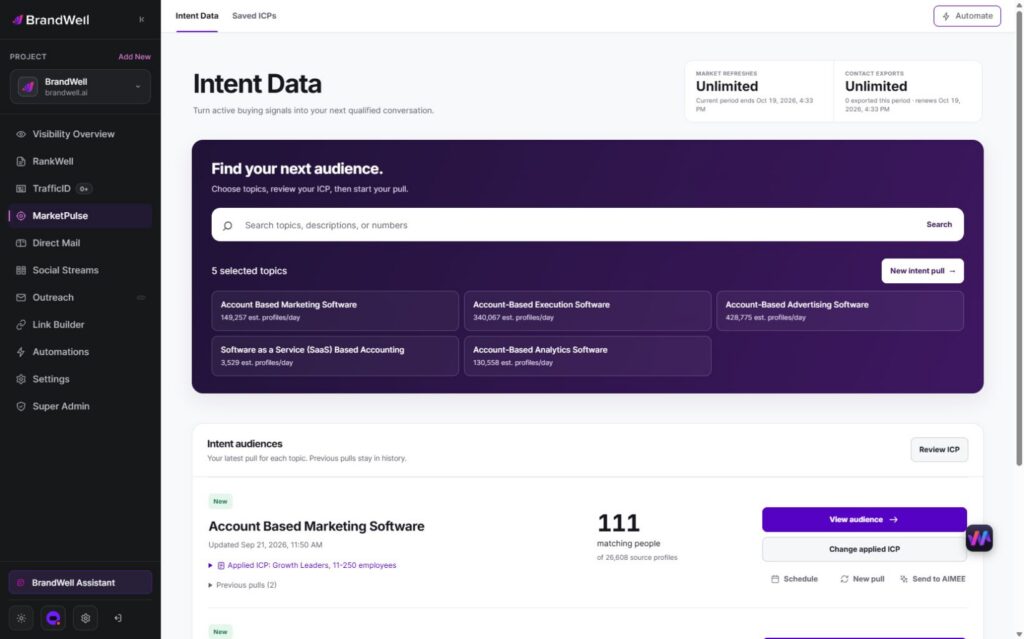
BrandWell MarketPulse: intent data starting at $500/mo. Find people researching topics relevant to what you sell, apply saved ICP filters, and review available contact details before taking action.
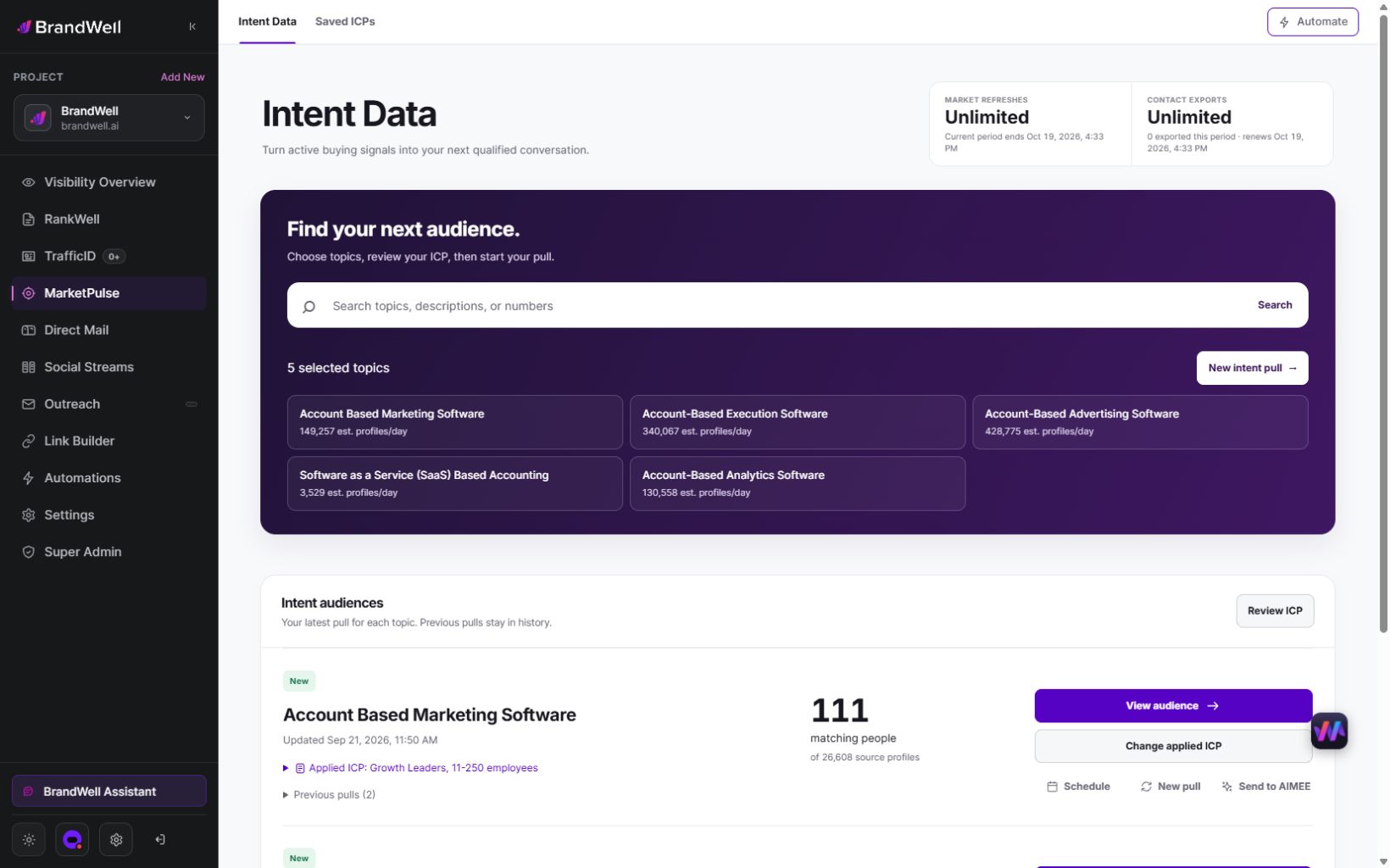
MarketPulse plans are starting at $500/mo. Verify current package scope and offers on the product page.
| Plan | Topics and refreshes | Monthly exports |
|---|---|---|
| Starter | 1 topic, weekly | 25,000 contacts |
| Growth | 3 topics, daily | 100,000 contacts |
| Scale | 10 topics, daily | Unlimited contacts |
Swipe the table to see all columns.
A pull retrieves available data from the previous 24 hours for one topic. Daily use across all included topics provides 90 Growth pulls or 300 Scale pulls in a 30-day month. Weekly Starter pulls vary by calendar month. Available audience size and contact fields vary, and audiences may overlap. Refreshes stop at the plan limit without overage charges.
- Find and qualify: search the topic catalog, save your ICP, and review the people and companies that match.
- Act on the research: export qualified contacts or prepare an Outreach or Direct Mail workflow. Connected products, channel usage, and fulfillment may cost extra.
- Get help from AIMEE: Growth and Scale include AIMEE for the initial user to research accounts and prepare the next step through connected tools.
Agencies and other service businesses can build client deliverables around their available Intent Scans and exports. Keep each client’s scope, permissions, and service fees clear. A subscription is not a promise of a white-label platform or exclusive access to a market.
Explore MarketPulse and watch the demo or compare plans starting at $500/mo. Any early-access discount is a separate, time-limited offer shown to an eligible recipient.
Choose a non-sensitive B2B account purpose
Begin with a narrow service promise: identify and prioritize business accounts showing research activity around client-approved, non-sensitive topics, then prepare evidence-aware next actions. Define the account universe first. A provider organization, payer, employer, health-tech vendor, laboratory supplier, or device company can be an account. A patient, caregiver, household, or anonymous person cannot be converted into a healthcare sales inference.
Use three independent tests. First, is the topic tied to the client’s actual B2B offer? Second, does the account meet declared fit criteria such as organization type, region, size band, or operating model? Third, does the client have an approved route for research, nurture, advertising, or sales follow-up? Passing one test never substitutes for the others.
The commercial model becomes recurring when the agency owns topic maintenance, evidence review, prioritization, suppressions, activation recommendations, and reporting. This can help a client focus finite selling capacity, but it cannot promise qualified pipeline or revenue. The agency should report what it observed, what it rejected, what the client acted on, and what outcomes were later recorded.
Assign evidence and approval owners
Assign named owners before ingesting signals. The service owner controls scope and client expectations. A data steward maintains sources, topic definitions, identity fields, permissions, and retention. A privacy or legal reviewer handles ambiguous uses and jurisdiction questions. An analyst reviews account fit and evidence. The client approver owns exclusions and message posture. The activation owner controls destinations and follow-up.
A practical cadence has four loops. Intake establishes business purpose, account boundary, topics, exclusions, sources, destinations, and reviewers. Weekly operations review new records, false matches, suppressions, routing exceptions, and feedback. A monthly governance review examines source changes, retention, incidents, topic quality, and client acceptance. A change-control loop pauses new activation whenever the purpose, source, topic, geography, or destination changes.
Systems should preserve separate fields for source observation, account resolution, company fit, contact validation, reviewer decision, activation, and outcome. Do not compress them into a mysterious score. Give each field an owner, allowed values, timestamp, and evidence note. That makes disagreements inspectable and keeps a data-quality problem from masquerading as a sales conclusion.
Evaluate the supported account workflow
The best stack is the one that exposes evidence and permissions instead of hiding them. Select capabilities, not a fashionable vendor bundle:
- Purpose and source register: approved use, source context, contractual permission, geography, owner, and retention.
- Topic ledger: approved business topics, sensitive exclusions, example inclusions, version history, and reviewer.
- Account-resolution layer: company identity, domain, match method, confidence, and ambiguity state.
- Contact-validation layer: role relevance and contactability recorded separately from buying intent.
- Suppression service: client exclusions, existing relationships, unsubscribes, sensitive records, and do-not-activate states.
- CRM or marketing destination: explicit field mapping, entitlement, audit trail, and reversal process.
- Evidence report: delivered, accepted, rejected, activated, progressed, and suppressed records with definitions.
Useful templates include a purpose statement, source questionnaire, topic approval sheet, account evidence card, exception log, activation approval, and monthly review packet. A platform is a poor fit if it cannot explain provenance, permitted use, identity method, deletion, or destination controls.
Compare research and approved first-party context
Governed account intent is useful when the client has a defined market, approved non-sensitive topics, sufficient signal evidence, and capacity to review prioritized accounts. Manual research is better for a short named-account list, novel markets, unusually complex account structures, or cases where context matters more than scale. Client first-party engagement can be stronger for known visitors or contacts because the interaction belongs to the client, but it still needs purpose and use controls.
Broad firmographic targeting is appropriate when the market is stable and timing evidence is weak. It answers who might fit, not who is researching now. Non-intent advertising can build awareness without pretending to know account timing. Use a hybrid approach when intent narrows the weekly research queue, manual review supplies context, and first-party engagement guides the next interaction.
Compare methods on source context, identity confidence, sensitivity, freshness, setup effort, review burden, addressable account count, and available action. Do not compare them on a promised pipeline number. The right answer can differ by client and topic, and a manual program can be safer than a scaled program when evidence or approvals are incomplete.
Model specialist review and exceptions
Build a scenario worksheet rather than borrowing a market average. Start with wholesale platform and data cost. Add approved topic count, analyst review time, privacy or legal review, account and contact QA, activation preparation, reporting, client support, exception handling, and a contingency for rework. Then add the agency’s target contribution and proposed retail price.
Healthcare service economics worksheet
- Monthly fixed cost: platform, secure workspace, governance, and base reporting.
- Variable cost: topics, records reviewed, contacts validated, destinations, and client-specific exceptions.
- Human cost: analyst hours, specialist review, activation support, client meetings, and documentation.
- Capacity limit: records the client can review and follow up within its agreed service level.
- Observed economics: retail fee minus direct delivery cost, tracked beside rework and client acceptance.
Model conservative, expected, and high-effort cases. If the high-effort case destroys margin, narrow topics, reduce cadence, or raise price before launch. Do not assume a lead count, close rate, or recovery period. The worksheet is a planning tool, and the agency should replace assumptions with observed delivery data after each review cycle.
Measure service health before commercial outcomes
Separate service-health metrics from client commercial outcomes. Service health includes usable-account rate, account-confidence distribution, false-match rate, rejection and suppression rates, activation latency, client acceptance, follow-up coverage, exception volume, and delivery hours. These reveal whether the service is reliable and repeatable.
Commercial observations include responses by approved cohort, meetings actually accepted, opportunities that the client’s system records, delivery cost per accepted account, contribution under the agency’s stated cost model, renewal, expansion, and cancellation reasons. Use influenced language only when the attribution method is defined and the underlying event exists. A signal preceding an opportunity does not prove that it caused the opportunity.
Pair every KPI with a definition, source, owner, update cadence, and limitation. Review trends by topic and account cohort rather than presenting one blended number. Maintenance matters: recheck topic performance, source behavior, identity quality, suppression patterns, and client response each month, then document keep, revise, pause, or retire decisions.
Choose clients with an approved B2B scope
The strongest fit is a B2B seller with recognizable accounts, a specific offering, non-sensitive business topics, enough selling capacity, a responsible reviewer, and an agreed destination. Good examples include provider-facing software, administrative technology, enterprise infrastructure, equipment, or professional services where the topic describes an organizational problem rather than a person’s health.
Pause or exclude consumer and patient acquisition, diagnosis or treatment inference, unclear data purposes, campaigns built around fear or vulnerability, unsupported volume expectations, and clients without legal or operational review. Also pause when the account universe is too small to justify automation or the client cannot act on the queue.
Stage matters. Early-stage clients may use a limited topic test to learn the language and account universe. Established sellers may add recurring prioritization to a named-account process. Agencies should not use maturity as a shortcut for permission. A sophisticated client can still propose an impermissible or unwise use, while a smaller client with narrow scope and strong controls may be workable.
Keep business evidence separate from health inference
Keep the evidence chain legible. A topic observation says a source reported research activity. First-party engagement says the client observed an interaction in its own property or system. Account resolution says the evidence was associated with a business organization at a stated confidence. Company fit says the account met declared ICP criteria. Contact validation says a business contact and role passed separate checks. None of these alone establishes buying intent, authority, or a healthcare condition.
Before routing, run a lead and intent data QA checklist across provenance, company match, role evidence, contactability, duplicates, suppressions, and destination permissions. Activation options should follow confidence: analyst research, client review, approved nurture, account advertising, or sales handoff. Ambiguous records go to review or suppression, not a more confident label.
Outcome evidence should record delivery, client acceptance, action, reply, qualification, observed opportunity progression, rejection, and suppression. Preserve the event source and date internally, while visible client reporting explains limitations. An evidence ledger lets the agency refine topics and identity thresholds without rewriting history.
Control sensitive data and tracking assumptions
HHS tracking guidance addresses regulated entities and PHI and notes that part of its guidance was vacated by a court in June 2024. Obtain current qualified review for the actual use; this article does not determine HIPAA applicability or approve tracking.
The 7-gate Healthcare Account Signal Safety Model
- Business-purpose gate: document the B2B use case, client, audience, approved topic, and prohibited sensitive inferences.
- Source gate: record collection context, contractual permission, geography, and restrictions.
- Account gate: resolve only to a business account at the permitted confidence, never to a personal health claim.
- Fit gate: apply organization type, geography, client exclusions, and other declared ICP rules separately.
- Activation gate: approve channel, destination, message posture, frequency, and suppressions before action.
- Evidence gate: log delivery, acceptance, action, rejection, progression, and suppression without claiming causation.
- Review gate: privacy, security, legal, and client owners review exceptions, incidents, retention, and topic changes.
Any failed gate pauses activation. This is an operational control model, not a compliance certification. The agency should document the referral, decision, and conditions for resuming.
A practical quality policy should also define the minimum evidence required for each action, the maximum age allowed for an observation, the process for correcting account identity, and the reviewer who can reopen a suppressed record. These operational limits protect client trust because the agency can explain not only why a record was used, but why another record was withheld.
Before launch, ask the client to approve a red-line vocabulary list. Include forbidden sensitive claims, acceptable company-level descriptions, escalation language, and examples of copy that remains neutral. Review new messages against the list, log exceptions, and update it when topics or channels change. This creates a practical bridge between governance policy and the words a seller actually uses.
Maintain the recurring account review
Package the recurring work as approved topic maintenance, account-level reports, evidence QA, activation recommendations, suppression management, outcome review, exception handling, and a monthly governance decision. Define what the agency delivers and what the client must approve. Prepare security, privacy, contract, and operational material early so the client can assess the service for procurement.
AIMEE can help organize a minimized, approved business account brief through configured connected tools. Do not supply patient records, clinical information or health-status inferences. Authorized reviewers approve the actual fields, purpose and destination.
Copyable agent-ready workflow: healthcare signal safety review
Use this in Claude, ChatGPT, or AIMEE. Human approval is required before any consequential action.
Goal: Build a review packet for company-level B2B healthcare intent records.
Inputs: approved business purpose; ICP; approved topics; prohibited sensitive inferences; source and contract register; account and contact evidence; channels; destinations; suppressions.
For each record: show source context, account-confidence evidence, fit evidence, prohibited-inference test, permitted next action, missing evidence, assigned reviewer, and stop reason.
Stop if: the record suggests patient, diagnosis, treatment, health status, care need, individual or household identity; source rights are unclear; legal applicability is unresolved; or the message could imply a sensitive condition.
Output only: a human review queue. Do not send outreach, upload an audience, write to a CRM, or make a compliance determination.
Approvals: privacy or legal approves purpose and source; client approves topics and copy posture; data owner approves identity threshold; activation owner approves channel and destination.
Use the pilot to test the operating model
This guide scopes a separately reviewed B2B service around supported MarketPulse research starting at $500/mo. Verify the actual topics, fields and connections before use. Neither a plan price nor an agency checklist establishes HIPAA suitability, a business associate agreement or permission to process patient information.
MarketPulse plans are starting at $500/mo. Starter includes 1 topic, weekly refreshes, and 25,000 exportable contacts per month. Growth includes 3 topics, daily refreshes, and 100,000 exportable contacts. Scale includes 10 topics, daily refreshes, and unlimited contact exports. AIMEE for the initial user is included with Growth and Scale. Compare MarketPulse plans and current offers.
Define the business topic and excluded inputs together
For a provider-facing administrative software seller, an internal brief might assess an organization’s operating model and a separately approved business technology topic. It should not infer a patient’s diagnosis, a caregiver’s needs or a clinic’s patient mix. Check that the actual topic is available and its meaning fits the approved scope; the example does not establish a specific BrandWell catalog entry.
Write the allowed fields and the exclusion rule before intake. Use synthetic prohibited fields to test rejection without copying real patient data into a marketing workspace. Record the human reviewer and stop reason. If suitability, rights or contract terms remain unresolved, hold the affected work rather than labeling the record “compliant.”
Worked example: accepted business briefs and specialist-review cost
Suppose a fictional month has 100 distinct approved business accounts for research. Forty meet the organization’s fit rule, and 25 have enough evidence and approval for a complete business brief. Complete-brief yield is 25 / 40 = 62.5% of fit accounts or 25 / 100 = 25% of the initial cohort. If the client records action on 15, activation is 60% of complete briefs or 15% of the initial cohort. These are account workflow metrics, not patient or care outcomes.
Suppose tools cost $500, analyst review costs $600, specialist review costs $400 and reporting costs $200. Defined recurring cost is $1,700, or $68 per complete brief and $113.33 per acted-on account. At a $2,500 fee, the $800 remainder is 32% before acquisition, setup recovery, general overhead, tax and financing. Four extra specialist hours at $150 add $600 and reduce the remainder to $200, or 8%. These are invented planning amounts, not legal-service quotes, typical results or BrandWell healthcare terms.
A later recorded opportunity remains a business association under a stated observation window. Preserve missing feedback and other active channels. Do not convert the brief’s existence into proof of sales causation or a sensitive inference about any individual.
Prepare an approved business brief in BrandWell
Review a relevant available MarketPulse topic and the saved client ICP using only approved business fields. Preserve each pull’s actual preceding-24-hour window. AIMEE can help draft a minimized account brief through configured tools, with missing evidence labeled. Review the message, source rights and destination before any allowed activation. Do not use this workflow to justify collecting clinical data, inferring health conditions or installing visitor tracking on a patient experience.
Frequently asked questions
Does this guide establish HIPAA compliance?
No. Actual applicability and contractual suitability require current qualified review.
Can we infer a person’s health from topic activity?
No. This article scopes non-sensitive business account research and excludes health inference.
Does a MarketPulse plan establish a BAA?
Do not assume that. Verify the actual contract and permitted processing separately.
Are accepted account briefs patient outcomes?
No. They are explicitly defined business workflow states.
Review the supported research product: explore MarketPulse and its current plans.
Reviewed and updated October 3, 2026.

Written by