On this page
- Current MarketPulse workflow
- Test market viability before local rollout
- Assign central and local owners
- Evaluate the supported hierarchy and routing stack
- Compare account intent with local research
- Allocate shared and location-specific costs
- Measure location distributions and client use
- Choose viable locations within the client network
- Keep location, company and person states separate
- Control hierarchy and routing changes
- Maintain different launch tiers
- Use regional business statistics as context, not live intent
- Worked example: the same allocation produces different location economics
- Frequently asked questions
Direct answer: Use B2B intent for local and multi-location clients only after testing whether each market has enough resolvable business accounts and enough client capacity to act on them. Build a location hierarchy before scoring. Keep parent, branch, franchise, person, and household identities separate, and never convert company-level activity into an individual or household intent claim.
Current MarketPulse offer: intent-data plans start at $500/mo. See the product, demo, and current plans. Updated October 3, 2026.
Who this is for: Local marketing and franchise agency owners serving B2B multi-location brands, branch networks, dealer groups, or franchise systems with defined territories, business-account audiences, and local follow-up owners.
The phrase “local intent” can conceal two different markets. Consumer local marketing aims to reach people near a store or service area. This guide addresses B2B account prioritization for multi-location organizations that sell to other businesses. The account, entity, location, and person boundaries must remain explicit.
Before selecting data, agree on what a location means: corporate branch, legal entity, franchisee, dealer, operator, territory, or sales assignment. Then choose and maintain intent topics that describe a real B2B problem the local team can address. A national topic set is not useful if a local office has no relevant accounts or follow-up capacity.
Current MarketPulse workflow
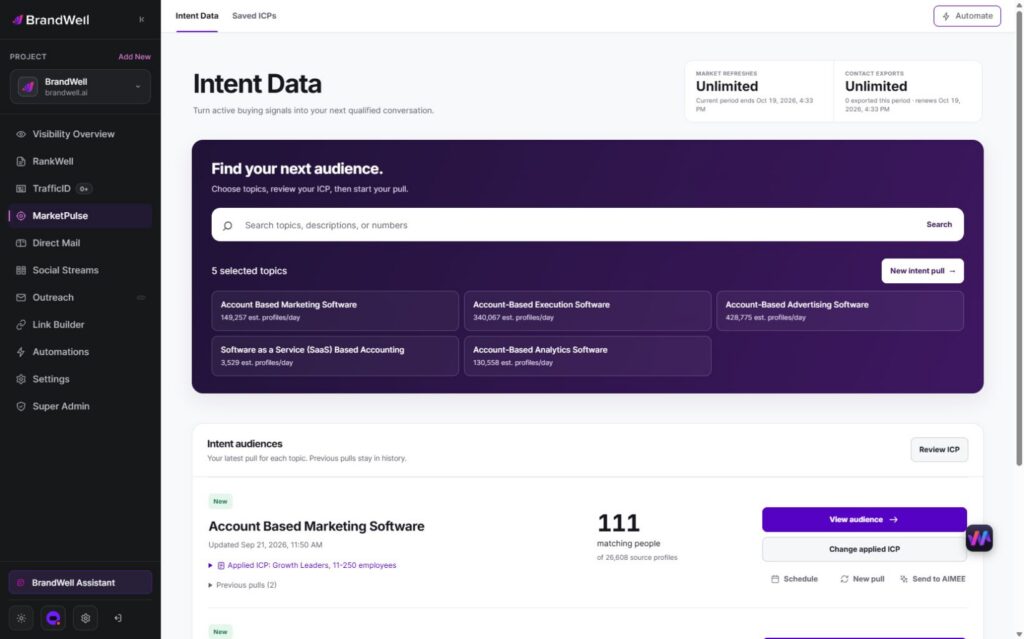
BrandWell MarketPulse: intent data starting at $500/mo. Find people researching topics relevant to what you sell, apply saved ICP filters, and review available contact details before taking action.
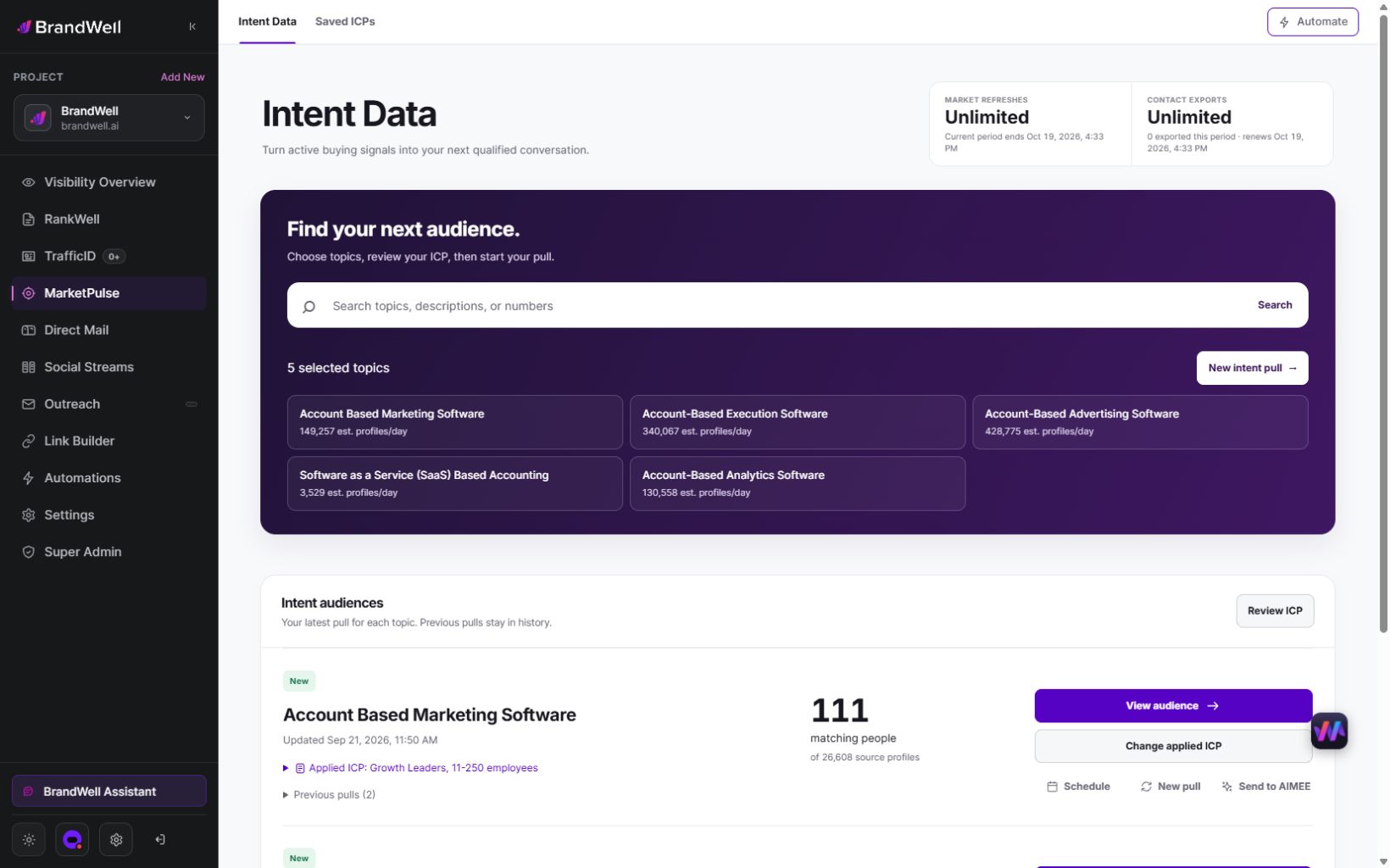
MarketPulse plans are starting at $500/mo. Verify current package scope and offers on the product page.
| Plan | Topics and refreshes | Monthly exports |
|---|---|---|
| Starter | 1 topic, weekly | 25,000 contacts |
| Growth | 3 topics, daily | 100,000 contacts |
| Scale | 10 topics, daily | Unlimited contacts |
Swipe the table to see all columns.
A pull retrieves available data from the previous 24 hours for one topic. Daily use across all included topics provides 90 Growth pulls or 300 Scale pulls in a 30-day month. Weekly Starter pulls vary by calendar month. Available audience size and contact fields vary, and audiences may overlap. Refreshes stop at the plan limit without overage charges.
- Find and qualify: search the topic catalog, save your ICP, and review the people and companies that match.
- Act on the research: export qualified contacts or prepare an Outreach or Direct Mail workflow. Connected products, channel usage, and fulfillment may cost extra.
- Get help from AIMEE: Growth and Scale include AIMEE for the initial user to research accounts and prepare the next step through connected tools.
Agencies and other service businesses can build client deliverables around their available Intent Scans and exports. Keep each client’s scope, permissions, and service fees clear. A subscription is not a promise of a white-label platform or exclusive access to a market.
Explore MarketPulse and watch the demo or compare plans starting at $500/mo. Any early-access discount is a separate, time-limited offer shown to an eligible recipient.
Test market viability before local rollout
Begin with a market viability test, not a blanket rollout. For each location, define the B2B account universe, topics, entity relationships, territory, exclusions, sales owner, service-level expectation, and approved action. Test whether company records can be associated with the correct location at an agreed confidence and whether the local owner can review the queue.
Prioritize accounts by combining independent states: topic observation, company fit, business entity, location or territory relationship, contact validation, suppression, and human acceptance. Do not treat a shared domain as proof that the nearest branch owns the account. Do not treat network activity as a household or individual visit.
Recurring value comes from maintaining the hierarchy, testing coverage, routing the right records, resolving exceptions, and reporting location-level outcomes. This may help focus local selling activity, but no location receives a guaranteed lead count, pipeline, revenue, or sales result.
Assign central and local owners
Assign a central program owner, entity-hierarchy steward, data QA owner, privacy reviewer, activation owner, client success lead, and a named approver for every participating location. For franchise or dealer structures, document which party owns the data, client relationship, territory decision, and follow-up.
Intake should reconcile parent brand, legal entities, operators, branches, domains, addresses used only for business entity matching, territories, and local owners. The weekly process ingests observations, resolves companies, applies fit, checks hierarchy and ownership, validates contacts where allowed, runs suppressions, and creates local review queues. Unresolved duplicates and territory conflicts stay out of activation.
Review exceptions weekly and location health monthly. The monthly session examines usable accounts, acceptance, response capacity, routing errors, stale entities, duplicate ownership, suppressions, delivery hours, and margin. A location opening, closure, ownership transfer, territory change, or CRM reassignment triggers change control before routing resumes.
Evaluate the supported hierarchy and routing stack
The useful stack is an entity and routing system, not a collection of location pins:
- Entity hierarchy: parent, legal entity, franchisee or operator, branch, domain, territory, and accountable owner.
- Account-resolution evidence: company match method, location relationship, confidence, ambiguity, and source.
- Contact validation: business role, contactability, and location relevance kept separate from account activity.
- Territory rules engine: precedence, named accounts, national ownership, exceptions, and reversible assignments.
- CRM routing: destination fields, owner, SLA, rejection codes, and feedback return.
- Suppression layer: customers, active opportunities, duplicates, opt-outs, household or person-only records, and exclusions.
- Location report: coverage, acceptance, action, outcome, exception, cost allocation, and maintenance decision.
Templates should include an entity-tree worksheet, location launch card, coverage test, ownership exception form, local SLA, routing QA log, and tiered report. Require exports and auditability. A platform that cannot distinguish parent, operator, branch, and sales territory will create more administrative work than prioritization value.
Compare account intent with local research
B2B account intent can help prioritize a viable local business market when identity and territory evidence are strong. Consumer retargeting addresses a different audience and should not be described as company intent. Manual local prospecting is best where the account universe is small, local relationships dominate, or hierarchy evidence is weak. Central brand campaigns are appropriate for awareness across regions without making a local ownership claim.
Use intent as a supplement when a central team can screen account activity and local sellers can add context. Keep lower-confidence records in central nurture or research. Send only accepted, correctly owned accounts to a local team. If each branch receives so few usable accounts that the operating cost exceeds the value of a recurring workflow, manual research is more honest.
Compare approaches on audience type, entity evidence, local coverage, action capacity, message context, setup effort, ongoing maintenance, and cost. Do not blend consumer and B2B results into one ROI number. Each method answers a different question.
Allocate shared and location-specific costs
Divide costs into shared and location-specific components. Shared cost includes platform access, topic governance, central reporting, the entity model, security, and program management. Variable cost includes location onboarding, hierarchy exceptions, accounts reviewed, contacts validated, routes, local support, and reporting. Add the cost of weak participation: unused queues still consume delivery time.
Location viability economics worksheet
- Shared monthly cost allocated by an agreed method, such as active location tier or delivery effort.
- Per-location work for entity maintenance, QA, routing, support, and client review.
- Usable account estimate after duplicates, suppressions, low-confidence matches, and out-of-territory records.
- Human capacity for acceptance, follow-up, feedback, and exception resolution.
- Contribution by launch tier under conservative, expected, and high-effort scenarios.
If visitor identification is one input, model it separately using a website visitor identification service framework, then include only the approved evidence and usage cost in this broader service. Do not assume a universal per-location price, conversion rate, or data volume.
Set a minimum viable action threshold for each tier. A location may need a named owner, a maximum queue size, a response SLA, and a minimum accepted-account rate before the agency treats it as an active module. These are client-selected operating thresholds, not industry benchmarks. Review them after actual delivery effort becomes visible.
Measure location distributions and client use
Operational measures should reveal geography and ownership quality: usable accounts by location, entity-hierarchy match, ambiguous ownership, duplicates, suppressions, local acceptance, routing accuracy, activation latency, follow-up coverage, rejection reasons, and stale-location rate. Track distributions, not only totals, because one large market can hide ten unviable ones.
Commercial observations include replies by accepted cohort, actual qualification, observed opportunity progression, cost per accepted account, delivery hours, contribution by service tier, renewal, location expansion, and cancellation reasons. State how shared cost is allocated so margin by location is not an accounting illusion.
Use maintenance thresholds chosen with the client. A location may move from launch to limited, central-only, manual, or paused when coverage, capacity, or data quality falls below the agreed level. This is not a performance guarantee; it is a way to prevent weak markets from absorbing service effort indefinitely.
Choose viable locations within the client network
The strongest fit is a B2B branch, franchise, dealer, or multi-office network with clear territories, stable entity records, enough addressable companies, approved topics, local sellers, and central governance. A regional services network may fit when each office can act on business accounts and share a common reporting model.
Exclude consumer-only demand, household targeting, tiny B2B markets, locations without a follow-up owner, unclear franchise or branch rights, unresolved national accounts, and clients expecting identical volume everywhere. A market can be strategically important and still be unsuitable for a recurring automated queue.
Use agency discovery questions about buying-intent fit to expose entity structure, territory rules, account universe, sales capacity, suppressions, and outcome expectations. Qualify each location, not just the corporate client.
Keep location, company and person states separate
Keep topic observations and client first-party engagement distinct. Resolve the business account first, then locate it within the entity hierarchy. Record whether the relationship is parent, subsidiary, operator, branch, franchise, dealer, or merely geographic proximity. Validate the business contact and role separately. Location evidence should never be used to invent a household or person identity.
Activation depends on confidence and ownership. High-confidence accounts with accepted local ownership may enter the local seller queue. Accounts owned centrally remain central. Ambiguous records go to hierarchy review. Lower-confidence but relevant accounts may enter approved account advertising or research. Duplicates, opt-outs, existing relationships, and person-only records are suppressed.
Evidence should record source observation, match, territory decision, client acceptance, actual action, response, qualification, progression, rejection, and exception. Preserve changes to ownership instead of rewriting the old route. This creates a reliable feedback loop for the next coverage review.
Control hierarchy and routing changes
The characteristic risks are parent-branch conflation, wrong territory, duplicate ownership, franchise and corporate conflict, stale openings or closures, person or household inference, over-frequency across locations, inconsistent follow-up, unapproved destination access, and reporting that exposes another location’s records. Local rules and client contracts may also change permitted use, so qualified review remains necessary.
The 7-step Location Viability Worksheet
- Define the entity tree: parent brand, legal entity, operator, branch, territory, domain, and local owner.
- Freeze the B2B audience: industries, company attributes, roles, exclusions, and prohibited consumer inference.
- Test usable coverage: resolvable accounts, location confidence, contactability, duplicates, and suppressions by market.
- Set the human capacity gate: identify who reviews, routes, follows up, and closes the loop locally.
- Choose activation by confidence: central nurture, local handoff, account advertising, research, or suppress.
- Allocate cost and evidence: attribute delivery effort, then track acceptance, action, outcome, and exception.
- Approve launch tier: launch, limited pilot, central-only, manual, or do not offer for that location.
Document thresholds before evaluating a market. The worksheet does not prove local coverage or economics; it forces the team to test them.
Test for cross-location leakage in exports, dashboards, and agent inputs. Each local reviewer should see only the records and fields authorized for that role. Central teams may need aggregate visibility, while local teams need a narrower queue. Permission design should follow the entity and client contract, not the convenience of a shared spreadsheet.
Location-level reporting should include an exception narrative, not only a ranking. Explain whether a weak cohort came from limited account coverage, identity ambiguity, local capacity, topic mismatch, delayed follow-up, or suppression. That distinction tells the agency whether to change data, operations, scope, or the client expectation. It also prevents low-volume markets from being portrayed as delivery failures without context.
Create a quarterly reconciliation with the client’s official entity and territory records. Confirm openings, closures, operator changes, domains, local owners, named accounts, and national-account precedence. Compare the result with routing history and correct future assignments. A hierarchy that is accurate at onboarding will decay unless this maintenance has an owner and an evidence trail.
For a limited pilot, choose locations that expose different conditions: a mature market, a smaller market, and a location with a known hierarchy challenge. Do not cherry-pick only the easiest branch and then claim the model represents the network. Label the sample, document exclusions, and use the findings to set launch tiers rather than to promise uniform coverage.
Make the service recoverable when local ownership changes. Keep a routing rollback procedure, an account reassignment record, and a way to withdraw pending queues from an old owner. Confirm access removal and suppress duplicate follow-up before a new location resumes. The operating design should protect the client even during ordinary organizational change.
Maintain different launch tiers
A recurring package can include hierarchy maintenance, topic review, location coverage tests, tiered queues, route and suppression management, central and local reports, exception review, and location-level economics. Standardize definitions while allowing different launch tiers. Do not sell the same row count to every branch.
AIMEE can help prepare a read-only location and account brief through configured connected tools. Preserve the hierarchy, owner, uncertainty and allowed fields. Client territory rules, permissions and routing infrastructure need their own verified implementation.
Copyable agent-ready workflow: location hierarchy and routing QA
Claude, ChatGPT, or AIMEE can organize the review. Humans approve identity thresholds and every route.
Goal: Recommend a launch tier and route for each location and candidate business account.
Inputs: parent, legal entity, franchisee or operator, branch, territory, domain, local owner; approved B2B ICP and topics; account and contact evidence; routing and suppression rules; local capacity and SLA; cost assumptions.
Check: hierarchy conflicts, duplicate ownership, territory ambiguity, missing local owner, low-evidence records, stale entity data, and prohibited consumer or household inference.
Output: launch, limited-pilot, central-only, manual, or suppress recommendation with evidence and reviewer.
Stop if: the record resolves only to a person or household; entity or territory ownership is ambiguous; coverage or follow-up capacity misses the client threshold; a duplicate or suppression exists; or geography, source right, or contact is unverified.
Do not: reassign CRM ownership, send outreach, upload audiences, or make an identity claim.
Approvals: client hierarchy owner, data owner, local owner, and privacy reviewer.
Start with a bounded multi-location test
MarketPulse supplies topic research audiences and saved ICP filtering starting at $500/mo. Review the available geography and account fields before an approved next step through configured tools. A custom branch hierarchy, local ownership engine or separate client portal is additional verified agency work, not an automatic plan entitlement.
MarketPulse plans are starting at $500/mo. Starter includes 1 topic, weekly refreshes, and 25,000 exportable contacts per month. Growth includes 3 topics, daily refreshes, and 100,000 exportable contacts. Scale includes 10 topics, daily refreshes, and unlimited contact exports. AIMEE for the initial user is included with Growth and Scale. Compare MarketPulse plans and current offers.
Use regional business statistics as context, not live intent
Census SUSB documentation distinguishes firms and establishments and describes annual business statistics by geography, industry and enterprise size. Use the stated reference year and entity when assessing a market. These statistics are not a live list of identified buyers or proof of current local intent.
Then test the actual source records against the client’s hierarchy, territory rules and review capacity. A reported establishment count does not establish how many accounts your selected topic can resolve today, who owns each account, or whether a local seller can act. Keep market context and the campaign’s usable cohort separate.
Worked example: the same allocation produces different location economics
Suppose a fictional monthly service allocates $900 of shared research and program cost equally to three locations, or $300 each. Location A requires $600 of review and support and produces 30 accepted accounts. Its defined cost is $900, or $30 per accepted account. Location B requires $300 and produces ten accepted accounts: $600 total, or $60 each. Location C requires $300 and produces two: $600 total, or $300 each.
The portfolio has 42 accepted accounts at $2,100 defined cost, or $50 per accepted account. That average conceals C’s workload and low usable volume. It does not prove C should close; the client must assess account value, local capacity and strategic purpose. C could move to central review or a bounded manual brief rather than a recurring local queue.
If each location is charged $1,000, the defined remainders are $100 for A and $400 each for B and C, before acquisition, setup recovery, general overhead, financing and tax. Those fee remainders do not prove equal client value. If C adds six unpriced support hours at $75, its cost becomes $1,050 and its remainder becomes negative $50. All counts, fees and labor are invented; disclose the actual allocation method and avoid counting shared cost twice.
Prepare a local account review in BrandWell
Search a relevant available topic in MarketPulse and apply the saved client ICP using supported fields. Preserve each pull’s actual preceding-24-hour window. Compare the account against separately verified client hierarchy and territory evidence; do not infer a branch from proximity alone. AIMEE can help organize a draft through configured tools. Release only the reviewed fields to the approved owner and record unresolved assignments separately.
Frequently asked questions
Should every branch receive the same number of accounts?
No. Test usable coverage and review capacity separately for each market.
Does a shared domain establish local account ownership?
No. Review parent, operator, branch and territory evidence.
Can a low-volume location still be useful?
Possibly. Assess account value and the best delivery scope rather than relying on volume alone.
Does MarketPulse include a custom territory routing engine?
Do not assume it. Verify any added hierarchy, routing and client-interface work separately.
Review topic research and current plan limits: explore MarketPulse.
Reviewed and updated October 3, 2026.

Written by