On this page
- Current MarketPulse workflow
- Define the practice and useful brief
- Assign owners and a review cadence
- Evaluate seven workflow capabilities
- Compare manual, assisted and relationship research
- Model investment and review capacity
- Measure quality, use and client economics
- Choose suitable client use cases
- Keep identity evidence and unknowns separate
- Manage professional duties and trust
- Package the recurring service
- Worked example: count accepted briefs and review cost
- Frequently asked questions
Direct answer: Intent-data services for professional-services firms should operate as a research-to-relationship workflow. Detect relevant firm-level business context, verify the firm, office, and practice, assemble an evidence-labeled brief, and let the responsible expert decide whether and how to act. The service should make relationship owners better prepared. It should not pretend a behavioral signal replaces expertise, reputation, trust, or professional judgment.
Current MarketPulse offer: intent-data plans start at $500/mo. See the product, demo, and current plans. Updated October 3, 2026.
The agency’s useful deliverable is not a list of people who supposedly need legal, accounting, consulting, or advisory help. It is a controlled briefing that separates what was observed, what it might mean, what remains unknown, and which human review is required.
Who this is for: Agencies serving B2B legal, accounting, consulting, advisory, or similar firms with long, trust-heavy buying cycles. It is not for programs that infer confidential matters, individual needs, or professional intent from ambiguous data.
Current MarketPulse workflow
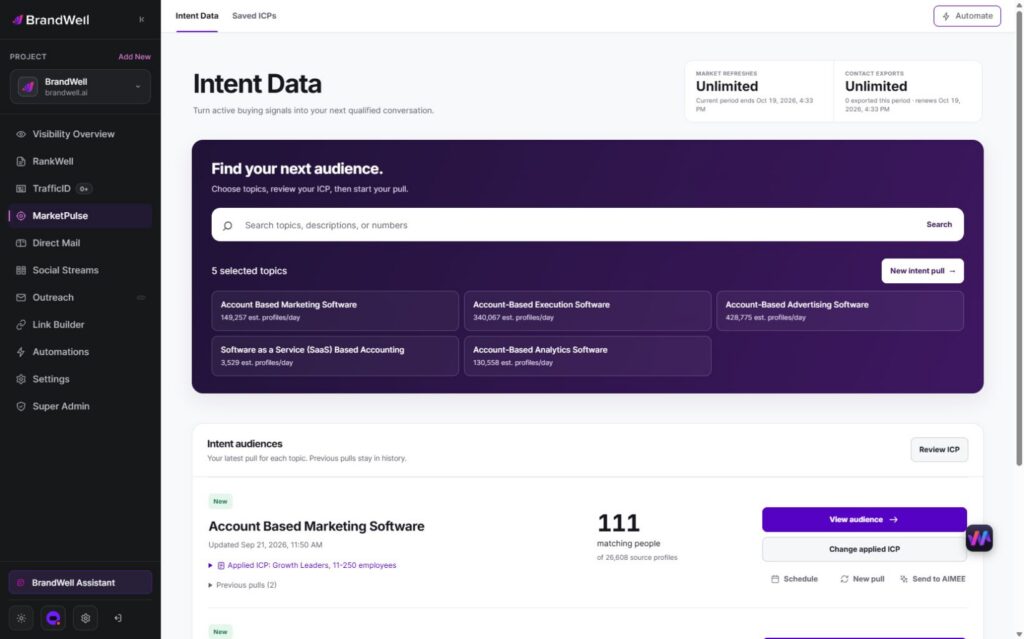
BrandWell MarketPulse: intent data starting at $500/mo. Find people researching topics relevant to what you sell, apply saved ICP filters, and review available contact details before taking action.
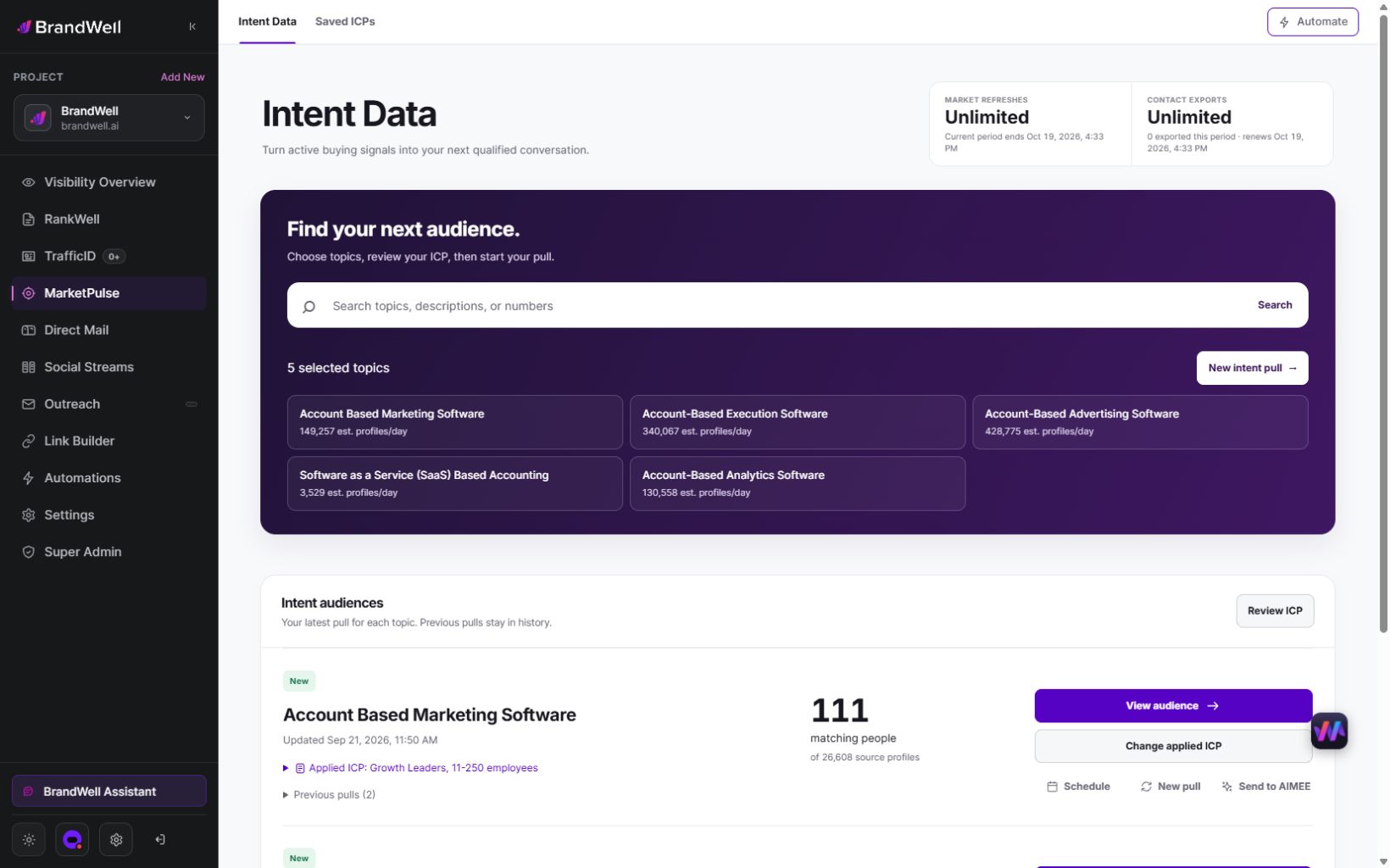
MarketPulse plans are starting at $500/mo. Verify current package scope and offers on the product page.
| Plan | Topics and refreshes | Monthly exports |
|---|---|---|
| Starter | 1 topic, weekly | 25,000 contacts |
| Growth | 3 topics, daily | 100,000 contacts |
| Scale | 10 topics, daily | Unlimited contacts |
Swipe the table to see all columns.
A pull retrieves available data from the previous 24 hours for one topic. Daily use across all included topics provides 90 Growth pulls or 300 Scale pulls in a 30-day month. Weekly Starter pulls vary by calendar month. Available audience size and contact fields vary, and audiences may overlap. Refreshes stop at the plan limit without overage charges.
- Find and qualify: search the topic catalog, save your ICP, and review the people and companies that match.
- Act on the research: export qualified contacts or prepare an Outreach or Direct Mail workflow. Connected products, channel usage, and fulfillment may cost extra.
- Get help from AIMEE: Growth and Scale include AIMEE for the initial user to research accounts and prepare the next step through connected tools.
Agencies and other service businesses can build client deliverables around their available Intent Scans and exports. Keep each client’s scope, permissions, and service fees clear. A subscription is not a promise of a white-label platform or exclusive access to a market.
Explore MarketPulse and watch the demo or compare plans starting at $500/mo. Any early-access discount is a separate, time-limited offer shown to an eligible recipient.
Define the practice and useful brief
Start with one practice, one firm profile, and one decision the research should improve. A litigation practice, tax advisory team, and operations consultancy do not share the same buyer, triggers, evidence, or ethical boundary. Use buyer-intent discovery questions to identify the firm’s service line, current relationship motion, account value, buying group, approved data use, and definition of a useful brief.
Position the offer as account research with a recurring cadence. A brief might help a partner prepare for an existing-account conversation, help business development prioritize public company changes, or help a practice leader review a focused market. Those are service objectives. More qualified pipeline and recurring agency revenue remain outcomes to measure, not promises.
The fastest route to value is a brief that an expert accepts and uses. Define acceptance before launch: correct firm and office, relevant practice context, source provenance, no prohibited inference, and a clear research question. If the responsible professional cannot explain why the evidence matters, the agency should not activate it merely because a score is high.
Assign owners and a review cadence
The service needs a research owner, data steward, relationship owner, practice expert, and someone accountable for compliance and reporting. One person can hold several roles in a small program, but the approvals should remain explicit. The research owner gathers approved evidence. The expert interprets it. The relationship owner decides on contact. The agency records what happened without claiming a later opportunity came from one signal.
Six-stage signal-to-advisor handoff
- Scope the question: define the practice, ideal firm, business question, allowed evidence, and prohibited inference.
- Observe context: collect approved firm-level signals with a source, date, topic, and freshness rule.
- Resolve the entity: distinguish firm, office, practice, professional, person, and contact.
- Build the brief: separate observed facts, interpretation, unknowns, confidence, and suggested research.
- Obtain expert review: route the brief to the relationship owner or subject-matter expert before activation.
- Record the decision: capture the chosen action, delivery receipt, response, correction, and later outcome status.
Choose a cadence that matches how the practice works. Weekly review can fit active account development. Monthly synthesis can fit a thought-leadership or market-monitoring program. Maintain topics as a governed set rather than adding every phrase a client suggests; the process for how to choose and maintain client intent topics should include ownership, rationale, exclusions, evidence, and a retirement rule.
Evaluate seven workflow capabilities
The best choice is a capability stack that preserves context and review. This page does not rank vendors because professional-services use cases differ, public pricing may be unavailable, and a logo list would not resolve the operating decision. Evaluate seven capabilities: topic monitoring, firm and office resolution, evidence capture, relationship context, approval workflow, suppression, and reporting.
- Topic monitoring needs source and freshness fields, not only a score.
- Entity resolution must preserve the distinction between a global firm, local office, practice, and person.
- Evidence capture should retain the origin and observation without copying confidential content into a prompt.
- Relationship context should show current ownership, open work, restrictions, and do-not-contact status where authorized.
- Approval and suppression must stop activation until the responsible human accepts the brief.
- Reporting should show use, decisions, corrections, and outcome association, not decorative activity.
Test with ambiguous firm names, multiple offices, overlapping practices and former employees. Include a record that invites an unsupported sensitive inference. The reviewer should be able to reject it, mark unknowns and correct the entity. Confirm each proposed tool supports the actual workflow.
Compare manual, assisted and relationship research
Manual expert research offers the richest context but takes time and may vary by researcher. Intent-assisted research can surface a narrower review queue, but it still needs entity verification and professional interpretation. A white-label service can create consistent branded delivery, yet it adds configuration, governance, and vendor dependency. Relationship-only business development remains a valid choice when the account universe is small or the work is too sensitive for behavioral signals.
| Approach | Use it when | Limitation to manage |
|---|---|---|
| Manual expert research | Few high-value accounts need deep context | Slow, hard to standardize, dependent on researcher judgment |
| Intent-assisted research | A known account set has repeatable business themes | Signals can be ambiguous and still need review |
| White-label managed service | The agency needs branded recurring briefs across clients | Requires scopes, permissions, QA, and change control |
| Relationship-only status quo | Trusted networks already cover the reachable market | May miss useful public context outside the network |
Swipe the table to see all columns.
The practical default is hybrid. Let the system collect and organize approved context. Let the professional decide meaning, priority, and communication. Do not write the comparison as generic appointment setting versus a superior signal engine. The point is to strengthen expertise-led business development, not replace it.
Model investment and review capacity
Model investment from practices, topics, firms, offices, source access, research depth, expert review, integrations, report cadence, and exception work. A broad firm-level monitoring service with a monthly brief has a different cost structure from daily account alerts routed into a CRM. Separate one-time discovery and setup from recurring data, research, review, reporting, account management, and governance.
Practice-intelligence cost worksheet
Record the number of practices, topics per practice, firm and office count, source and usage cost, analyst minutes per brief, expert-review minutes, integration cost, corrections, reporting cadence, and account-management time. Add a scenario for low, expected, and high exception load. Then compare agency retail revenue with direct delivery cost without treating the result as a market benchmark.
Price the service for the scope and decision value, not for an assumed number of leads. The client pays for disciplined research, evidence labeling, review, and a reliable operating cadence. Agency margin depends on its retail price, wholesale and usage costs, labor, exceptions, and client support. No single gross margin is realistic for every professional-services niche, and no price should be invented when a source says quote required.
Protect review capacity in the package. If five practice leaders can request unbounded custom research, the recurring service becomes a queue of bespoke projects. Set a request allowance, a definition of standard brief, an exception price, and a change-control path. This preserves the very consistency the client is buying.
Measure quality, use and client economics
Begin with brief quality and use. Track firm-resolution acceptance, correct office and practice rate, evidence completeness, prohibited-inference catches, expert acceptance, time to review, action selected, correction rate, and briefs used in a client or prospect interaction. Those measures show whether the service works before a slow buying cycle produces a commercial event.
For economics, track service revenue, direct delivery cost, analyst and reviewer minutes, exception load, support, renewal, scope changes, and contribution by client. For client outcomes, record opportunity association, prior relationship, other active channels, and the time between brief, action, and outcome. Use a documented method to attribute pipeline to intent-data programs, but do not describe association as sole-source causation.
A useful monthly review asks: Were the right firms resolved? Did experts accept and act on the briefs? Which topics produced noise? Which accounts already had active relationships? Which corrections changed the process? Did cost to serve remain within the package? Revenue, margin, and retention can be tracked, but they are influenced by the agency’s price, the client’s follow-up, service quality, market timing, and many other factors.
Choose suitable client use cases
The best fit is a B2B firm with repeatable services, identifiable company-level themes, meaningful account value, an accountable relationship owner, and enough research volume to justify a recurring process. Agencies with vertical expertise are better placed to design relevant topics and recognize when a signal is merely interesting rather than useful.
Good early use cases include focused account research for a named market, practice-specific market briefs, existing-account context, and public-event monitoring that supports an expert’s preparation. Poor fits include consumer matters, small one-time engagements, a firm with no business-development owner, or a client that wants the agency to infer a confidential problem. Also disqualify clients that will not document permissible use, suppression, review, and correction.
Use a fit checklist: Is the buyer a company or institution? Can the use case be expressed at firm level? Is there a known practice and action owner? Does the firm have a relationship policy? Can a human inspect every proposed action? Can the agency delete or correct records? If several answers are no, start with a general market brief or avoid the service.
Keep identity evidence and unknowns separate
Prefer evidence that can be explained without guessing at a private matter: public firm changes, approved engagement activity, topic research at an appropriate account level, website activity where the client has proper controls, and verified company information. Label each source, date, entity level, confidence, and limitation. Keep firm, office, practice, professional, person, and contact as separate records.
A firm signal can support a research question. It does not show that one individual has intent, authority, budget, or a confidential need. Activation should therefore move from evidence to a brief, then to an expert decision. The outcome record should show whether the brief was accepted, whether action occurred, and what later state was observed. It should not rewrite uncertainty after the fact.
Include a blank evidence row in the brief when a fact is missing. That is more useful than filling the space with a plausible inference. The expert can then decide whether to research the gap, contact a known relationship, wait for another signal, or close the record. Unknown is a valid operating state.
Agent-ready evidence-labeled advisor brief
In Claude, ChatGPT, or AIMEE, use only the supplied firm-level evidence.
Inputs: firm and office identifiers, practice scope, approved topic, dated evidence, relationship-owner context, suppression list, and jurisdiction notes.
Return four labeled parts: observed facts, interpretation, unknowns, and prohibited inferences. Add one research question and one optional human-reviewed next action.
Do not infer a confidential matter, legal need, audit issue, transaction, or individual professional intent.
Stop if the entity cannot be resolved, provenance is missing, a sensitive inference is required, one person's activity is treated as firm intent, or no authorized reviewer exists.
AIMEE can help organize an evidence-labeled brief through configured connected tools. Verify the output and supported destination action. It does not replace the relationship owner or professional reviewer.
Manage professional duties and trust
The central risk is turning weak context into a strong claim. Other risks include resolving the wrong office, applying one practice’s topic to another, exposing existing-client information, ignoring a relationship owner, copying confidential material into an external system, retaining research too long, and measuring activity as revenue proof.
For one profession-specific example, the CFP Board Code and Standards requires CFP professionals to safeguard client privacy and confidentiality. That certification context is not a rulebook for every lawyer, accountant or consultant. Review the actual profession, jurisdiction, contract and proposed communication channel with qualified advice.
Use a control card for every program: allowed firm-level evidence, prohibited inferences, authorized reviewers, suppression sources, retention, external processors, client communication rule, correction path, and incident owner. Stop the workflow when the evidence concerns a private client matter, the firm hierarchy is unresolved, the relationship owner objects, or an automated action would bypass professional judgment.
Package the recurring service
Package a practice-intelligence service with discovery, topic design, firm and office rules, evidence-labeled briefs, expert review, a recurring cadence, corrections, and an outcome review. Keep the client promise operational: deliver relevant, reviewable context under the firm’s rules. Do not promise meetings, matters, pipeline, revenue, or retention.
Start with a relevant MarketPulse topic and saved ICP. Review the available audience, then use AIMEE through configured connected tools to prepare an account brief. Scope agency research, reporting, implementation and commercial rights separately.
MarketPulse plans are starting at $500/mo. Starter includes 1 topic, weekly refreshes, and 25,000 exportable contacts per month. Growth includes 3 topics, daily refreshes, and 100,000 exportable contacts. Scale includes 10 topics, daily refreshes, and unlimited contact exports. AIMEE for the initial user is included with Growth and Scale. Compare MarketPulse plans and current offers.
Start with one practice and one accepted brief
Choose a narrow firm segment, document what the service may and may not infer, and have a real relationship owner review a small set of evidence-labeled briefs. Expand only after the firm trusts both the findings and the restraint.
Worked example: count accepted briefs and review cost
A fictional consultancy reviews 40 account briefs in a month. Its experts accept 24 as useful for the agreed practice, use 12 in a business-development activity, and record three later opportunities. Acceptance is 24 / 40 = 60%. Use is 12 / 24 = 50% among accepted briefs, or 12 / 40 = 30% among all briefs. Keep both denominators visible.
Assume $250 allocated software cost, ten analyst hours at $60/hour and four expert-review hours at $100/hour. The defined monthly cost is $1,250, or $52.08 per accepted brief. Expert time is part of the workflow cost even when the agency does not invoice for it. Other products, setup, reporting, taxes and overhead can add cost.
The three opportunities are associated outcomes, not proof that the briefs caused them. Existing relationships, other campaigns and expert follow-up may contribute. These numbers are invented to explain the worksheet, not typical results or a profitability forecast.
Frequently asked questions
Can a research topic reveal a confidential client matter?
No such conclusion should be drawn from a topic match. Use it to frame a reviewable business question and preserve unknowns.
Who approves contact?
The responsible relationship owner or professional, under the firm’s rules. An agency score does not replace that decision.
Is this a native professional-services CRM?
MarketPulse supplies topic audiences and ICP filtering. Practice hierarchies, client relationship records and custom briefing workflows require their own supported tools and service scope.
How should a small firm start?
Choose one practice, a narrow market and a manageable set of briefs. Check relevance, review time and actual use before expanding.
Reviewed and updated October 3, 2026.

Written by