On this page
- Define seven signal-to-action steps
- Compare the actual work and deliverable
- Assign signal, action and client owners
- Maintain an inspectable evidence ledger
- Compare lists, research and managed services
- Budget interpretation and maintenance
- Measure actual adoption and decisions
- Qualify client readiness
- Keep signal and identity states distinct
- Review relabeling and unsupported claims
- Scope the recurring operating cycle
- Copyable service acceptance sheet
- Copyable assistant signal review
- Current MarketPulse research workflow
- Keep agency and product scope separate
- Maintain versions and client reporting
- Sell the deliverable honestly
- Worked example: price the accepted action
- Frequently asked questions
Direct answer: A lead list delivers a defined set of contacts or accounts. In this article, a managed intent-intelligence service adds a documented cycle of signal review, fit assessment, identity handling, approved action and client feedback. A contact database can refresh, and a research signal can remain incomplete. Compare the actual deliverable and operating work rather than relying on the label.
Current MarketPulse offer: intent-data plans start at $500/mo. See the product, demo, and current plans. Updated October 3, 2026.
An agency should sell the managed decision cycle only if it can operate that cycle. Renaming a contact export “intent intelligence” creates confusion, not differentiation.
Who this is for: Agency founders, marketers, GTM consultants, and client buyers comparing a data delivery with an ongoing signal-to-action service.
Define seven signal-to-action steps
This blueprint turns the positioning claim into inspectable work. Every part has an input, an owner, a decision, and an artifact the client can review.
- Question: Name the buying problem, account segment, and decision the client wants to improve.
- Signal: Define permitted first-party and contracted third-party inputs, topics, time windows, and freshness rules.
- Identity: Separate verified contacts, matched accounts, inferred companies, and unresolved activity.
- Qualification: Apply fit, exclusions, score rules, and a reason code instead of sending every record.
- Activation: Route each qualified state to advertising, research, nurture, sales review, or no action.
- Feedback: Capture client acceptance, rejection, follow-up timing, stage movement, and exceptions.
- Decision: Recommend what to keep, change, expand, or stop in the next cycle.
A lead list can be an input at steps three or four. It is not the whole service. The differentiator is the governed movement from evidence to a client decision.
Compare the actual work and deliverable
Explain the difference in verbs. A list is collected, filtered, validated, exported, and delivered. Intent intelligence is monitored, interpreted, qualified, activated, reviewed, and revised. That language helps the buyer understand why the first may be a project while the second can justify recurring work.
Then demonstrate the distinction with one account record. Show the fit reason, signal source, time window, identity state, qualification rule, recommended action, owner, and eventual disposition. Do not say the account is ready to buy. Say what was observed, what remains uncertain, and why a specific next step is reasonable.
The service can support more qualified pipeline when the client’s team uses the prioritization and records outcomes, but neither intent nor a list guarantees pipeline. Recurring agency revenue should rest on a repeatable operating loop and defined deliverables, not a claim that more records necessarily create more deals.
Assign signal, action and client owners
Use three accountable roles. The signal owner manages topics, sources, freshness, and permitted use. The activation owner manages routing, destinations, service levels, and suppressions. The client outcome owner accepts records, records reasons, and brings sales or campaign feedback. Add a privacy, security, or legal reviewer when the source, jurisdiction, identity state, or activation requires it.
The weekly process should review new and decaying signals, unresolved identities, high-fit exceptions, destination failures, and client response. The monthly process should examine adoption, source quality, account movement, delivery cost, and scope decisions. A quarterly methodology review can revisit topics, scoring, sources, access, and retention. Cadence should follow how quickly the underlying signals and client actions change, not a generic reporting habit.
The system of record can be a CRM, portal, warehouse, or controlled operations sheet. What matters is that it preserves provenance, versions, owners, and outcomes. A dashboard with no decision log is reporting, not intelligence operations.
Maintain an inspectable evidence ledger
Choose capabilities by control point. The stack needs a signal source register, identity and enrichment states, a rules layer, a client-facing view, activation destinations, and an evidence ledger. A static contact database may still be useful for enrichment. It should not be asked to perform the work of topic monitoring, orchestration, account review, or outcome collection if it does not support those jobs.
The most useful template is a signal-to-action ledger with these fields: account, fit reason, observed signal, source, time window, identity state, confidence note, exclusion result, recommended treatment, assigned owner, approval, destination, client disposition, and next review. A second template should record changes to topics, rules, and sources.
Agencies comparing packaging options can start with intent-data service models for agencies. Tool selection should follow the chosen service model. Buying more software before the agency defines the deliverable usually increases cost without clarifying value.
Compare lists, research and managed services
| Model | Client receives | Best fit | Honest limitation |
|---|---|---|---|
| Static lead list | A defined set of contact or account records | A bounded campaign with clear filters and validation rules | It does not show continuing research or prescribe action |
| Manual account research | Analyst context and selected account notes | Small strategic markets where depth matters more than scale | Labor grows quickly and coverage can vary |
| Intent-intelligence service | Recurring prioritized accounts, reasons, actions, and review | Clients able to act, give feedback, and maintain a cadence | Signals remain incomplete and outcomes depend on client execution |
| Non-intent demand generation | Programs based on fit, content, channel, or broad response | Markets with weak identity or limited intent coverage | Timing may be less specific at the account level |
Swipe the table to see all columns.
Use a list when the buyer genuinely needs a validated file and nothing more. Use manual research for named accounts that merit depth. Use intent intelligence when new evidence can change prioritization and the client has an activation owner. A hybrid may be best: intent narrows the queue, research adds context, and validated contact data supports an approved action.
Budget interpretation and maintenance
Separate acquisition cost from interpretation cost. Data access, enrichment, validation, and portal modules are wholesale or software inputs. Topic design, rule setup, review, client coordination, activation, reporting, and quality work are service labor. Include support, rework, source changes, and client-specific integration in the model.
A list project is often priced around filter complexity, record count, validation standard, and delivery. An intent-intelligence service is better scoped around topic count, monitored accounts, refresh cadence, identity work, activation destinations, report depth, and analyst involvement. Count usage only where the contract actually uses it. Do not publish an unsupported per-lead value or assume every signal will become a usable contact.
Build low, expected, and high delivery-cost cases. Stress-test what happens when signal volume rises, match quality falls, the client requests extra destinations, or review time doubles. The service is economically healthy only when the agency can deliver the promised operating cycle within a bounded scope.
Measure actual adoption and decisions
Measure whether the service changes decisions. Useful operational metrics include signal freshness, records with provenance, account-match state, excluded-record rate, qualified-account acceptance, time to review, time to activation, destination success, and seller disposition coverage. Quality metrics include reason-code consistency, sampled validation findings, duplicate rate, stale-record rate, and rule exceptions.
Business metrics can include opportunity creation or progression under the client’s definitions, but report them alongside selection and attribution limits. Agency metrics include wholesale cost, delivery hours, rework, support load, defined delivery contribution, renewal, and expansion. Retention without adoption is not proof of value, and a busy dashboard is not evidence of client use.
A strong review asks: did the client act on the output, did the action differ from what it would have done with a list alone, and is that difference worth the cost of the service?
Qualify client readiness
The managed model fits demand-generation, ABM, RevOps, outbound, paid-media, and data-service agencies whose clients have a definable account market and an owner for follow-up. It works best where account timing can change a campaign, seller queue, research priority, or nurture path.
It is a poor fit when the client wants only contacts, cannot define an approved use, has no CRM discipline, will not provide dispositions, or expects the agency to guarantee meetings or revenue. It may also be too heavy for a tiny one-time campaign. In that case, a validated list or manual research sprint can be more honest and economical.
The agency should qualify readiness in discovery: What decision will signals change? Who receives the output? How fast can they act? Which system records the result? The agency discovery questions for buying intent provide a practical starting point.
Keep signal and identity states distinct
Prioritize signals that have a clear relationship to the client’s buying problem: relevant site behavior, repeated engagement, content or event activity, contracted topic research, product or customer activity where permitted, and seller-confirmed context. Preserve source, time, frequency, and topic. Do not convert a weak action into certainty by multiplying it with an opaque score.
Keep verified business contacts, enriched records, account matches, inferred visitors and unresolved events distinct. An available business email does not establish consent or buying readiness. Account advertising and person outreach both need an approved purpose and supported channel use; unresolved identity or permission remains a hold.
Map each qualified state to one approved treatment and expiration rule. Record destination success and client disposition. A rigorous lead and intent-data quality assurance process helps make the evidence review part of delivery rather than an emergency after a client complaint.
Review relabeling and unsupported claims
The central trust risk is relabeling. If the deliverable is a contact file with a generic score, call it that. Other risks include source ambiguity, weak identity joins, outdated contacts, irrelevant topics, duplicated records, hidden exclusions, unapproved enrichment, overbroad access, excessive retention, and activation that exceeds the original purpose.
Review actual source rights, purpose, fields, identity boundaries, access, retention and destination approvals. A category label or complete contact record is not proof of permission, buying readiness or a downstream outcome.
Scope the recurring operating cycle
Package recurring work around decisions: topic maintenance, fresh signal review, identity-state handling, fit rules, account prioritization, activation recommendations, client disposition, evidence reporting, and a decision meeting. Include a service calendar, named owners, acceptance rules, and out-of-scope work. The client should be able to see what changed since the last cycle and why.
Protect economics by limiting custom topics, destinations, exports, analyst research, report variants, and urgent requests. Separate the base operating cycle from optional contact enrichment, paid activation, manual research, or custom integrations. Expansion should follow documented client use, not a larger record count.
Copyable service acceptance sheet
Complete this before selling the managed package:
- Client decision: What choice will the intelligence change?
- Inputs: Which sources, topics, identity states, and exclusions are allowed?
- Deliverable: What arrives, how often, and with which reason codes?
- Action: Who approves and executes each treatment?
- Evidence: Which operational and business events will be recorded?
- Boundary: What will the agency not infer, promise, export, or automate?
Copyable assistant signal review
AIMEE can help triage approved topic records and summarize missing evidence through configured connected tools. Preserve actual identity states and source windows. Human owners approve exports, destinations and client-facing claims.
ROLE: Managed intent-service analyst.
INPUTS: approved topics, source register, fit rules, identity-state definitions, exclusions, prior client dispositions, activation rules, and current signal records.
TASK:
1. Validate required provenance, time-window, identity, and fit fields.
2. Group records by recommended treatment and explain the reason code.
3. Flag duplicates, stale evidence, conflicting identities, and out-of-policy records.
4. Draft a client review with additions, removals, exceptions, and open questions.
5. Compare this cycle with the prior cycle without claiming causation.
DO NOT: enrich outside approved sources, merge uncertain identities, contact prospects, upload audiences, or publish outcome claims.
HUMAN APPROVAL REQUIRED: source and permitted use, identity decision, qualification rule, export, activation, outreach, client-facing claim, and final report.
Current MarketPulse research workflow
BrandWell MarketPulse: intent data starting at $500/mo. Find people researching topics relevant to what you sell, apply saved ICP filters, and review available contact details before taking action.
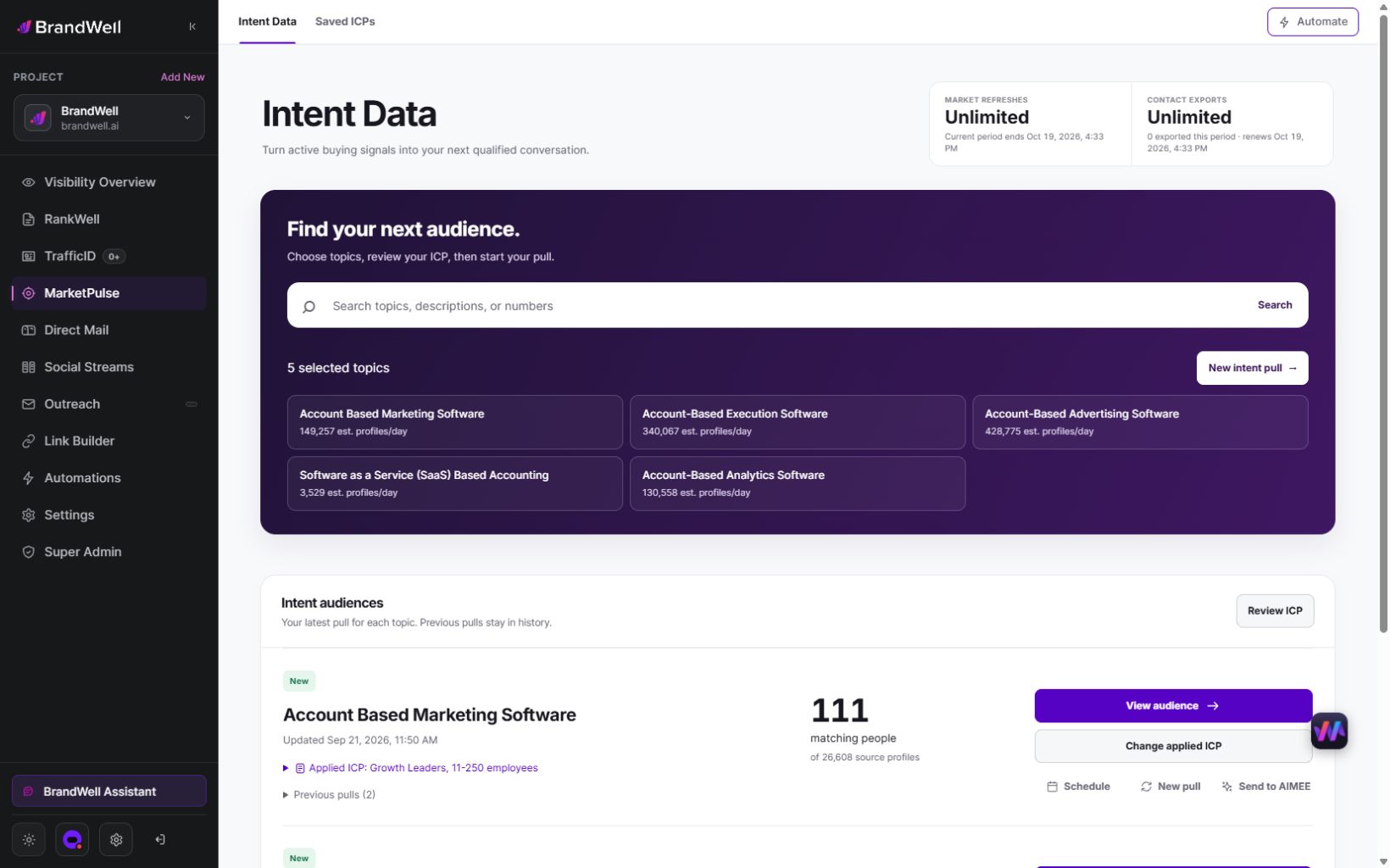
MarketPulse plans are starting at $500/mo. Verify current package scope and offers on the product page.
| Plan | Topics and refreshes | Monthly exports |
|---|---|---|
| Starter | 1 topic, weekly | 25,000 contacts |
| Growth | 3 topics, daily | 100,000 contacts |
| Scale | 10 topics, daily | Unlimited contacts |
Swipe the table to see all columns.
A pull retrieves available data from the previous 24 hours for one topic. Daily use across all included topics provides 90 Growth pulls or 300 Scale pulls in a 30-day month. Weekly Starter pulls vary by calendar month. Available audience size and contact fields vary, and audiences may overlap. Refreshes stop at the plan limit without overage charges.
- Find and qualify: search the topic catalog, save your ICP, and review the people and companies that match.
- Act on the research: export qualified contacts or prepare an Outreach or Direct Mail workflow. Connected products, channel usage, and fulfillment may cost extra.
- Get help from AIMEE: Growth and Scale include AIMEE for the initial user to research accounts and prepare the next step through connected tools.
Agencies and other service businesses can build client deliverables around their available Intent Scans and exports. Keep each client’s scope, permissions, and service fees clear. A subscription is not a promise of a white-label platform or exclusive access to a market.
Explore MarketPulse and watch the demo or compare plans starting at $500/mo. Any early-access discount is a separate, time-limited offer shown to an eligible recipient.
Keep agency and product scope separate
MarketPulse supports topic research and saved ICP review. An agency managed service, custom portal and implementation work are separately scoped commitments. Verify actual permissions, fields, supported destinations and terms rather than presenting them as included BrandWell capabilities.
Start with supported MarketPulse research starting at $500/mo and preserve the actual topic, available fields and pull window. AIMEE can help organize an approved brief through configured tools. The agency owns its separate deliverable, operating cadence and client agreement.
Maintain versions and client reporting
Review the service definition whenever a source, topic, identity rule, destination, or client objective changes. Archive the prior version, record the reason, test the new rule on a sample, and tell the client what changed before the next delivery. Track whether the client still uses each output and remove fields or modules that no longer change an action.
Distribution should preserve the same boundary. Sales pages, proposals, portal labels, training, and account reviews should describe observed signals, confidence, and recommended actions consistently. Rescan client questions and search behavior only as feedback on usefulness. Do not promise that publishing the distinction will create a ranking, recommendation, or citation.
Sell the deliverable honestly
Take one current deliverable and mark where it proves source, identity, qualification, action, feedback, and decision. If most of those fields are missing, improve the operation before changing the label. Clear scope is a stronger sales asset than a category claim the team cannot demonstrate.
Worked example: price the accepted action
Suppose a fictional file contains 500 records, including 100 repeat records. Of the 400 unique records, 250 satisfy the documented required-field check; 100 fit the approved account criteria and 40 have a reviewed treatment and owner. That is 80% uniqueness among delivered records, 62.5% required-field completeness among unique records, 40% fit among complete records and 40% treatment acceptance among fit records. The final 40 are 8% of delivered records. None of these rates establishes buying readiness or sales conversion.
The Government Data Quality Framework distinguishes completeness from accuracy. A populated email or topic field can still be incorrect. State the actual verification method, source window and unresolved questions before assigning a treatment.
Suppose source access and validation cost $500, operator review costs $600 and client coordination costs $200. The $1,300 total is $2.60 per delivered record or $32.50 per accepted treatment. A $2,000 service fee leaves $700, or 35%, before acquisition, overhead, tax and financing. Eight additional review hours at $75 leave $100, or 5%. These invented planning inputs are not BrandWell prices, typical agency performance or a value assigned to every lead.
If the client acts on 20 of the 40 treatments and records a disposition for 15, action completion is 50% of accepted treatments and feedback coverage is 75% of completed actions. The other five are unknown, not automatic failures or successes. Compare defined cohorts and an appropriate baseline before claiming the managed cycle improved outcomes.
Show a supported BrandWell workflow
Review an available MarketPulse topic with a saved ICP, preserve the actual preceding-24-hour window and inspect the available fields. Export the approved audience within the plan allowance or prepare a supported handoff. AIMEE can help draft an approved account brief through configured tools. Human owners approve use, next actions and the separately scoped client report.
Frequently asked questions
Can a lead database refresh?
Yes. Evaluate its actual capabilities rather than assuming every list is static.
Does a complete record prove accuracy?
No. Completeness and correctness are separate checks.
Does a review-ready treatment guarantee a sale?
No. Buyer decisions and client follow-up remain separate.
Is the agency operating service included in MarketPulse?
Do not assume that. Scope the agency’s labor and deliverables separately.
Review the supported research product: explore MarketPulse and current plans.
Reviewed and updated October 3, 2026.

Written by