On this page
- Current MarketPulse research workflow
- Compare five commitment levels
- Define four operating boundaries
- Set inputs, approval limits and cadence
- Maintain evidence and cost artifacts
- Compare delivery, quality and remedy options
- Model audit and remedy costs
- Measure delivery and economic effects
- Qualify the client and workflow
- Test the observable signal chain
- Review scope, billing and data use
- Reassess the promise at renewal
- Copyable assistant guarantee review
- Test the service with a bounded pilot
- Worked example: reserve cost differs from a triggered remedy
- Frequently asked questions
Direct answer: Begin intent-service guarantee design with observable work the agency controls. Define eligibility, client inputs, tasks, acceptance checks, the review clock, evidence and remedy. Avoid unsupported promises about cost recovery, profit, pipeline, revenue, data volume, rankings or AI citations. The actual contract, costs and qualified review determine which commitment is appropriate.
Current MarketPulse offer: intent-data plans start at $500/mo. See the product, demo, and current plans. Updated October 3, 2026.
A guarantee should narrow ambiguity. If it transfers risks the agency cannot price or control, it is not a growth tool. It is an uncapped liability disguised as sales copy.
Who this is for: Agency owners, founders, GTM consultants, RevOps consultants, and demand generation leaders packaging a recurring buyer-intent service.
Current MarketPulse research workflow
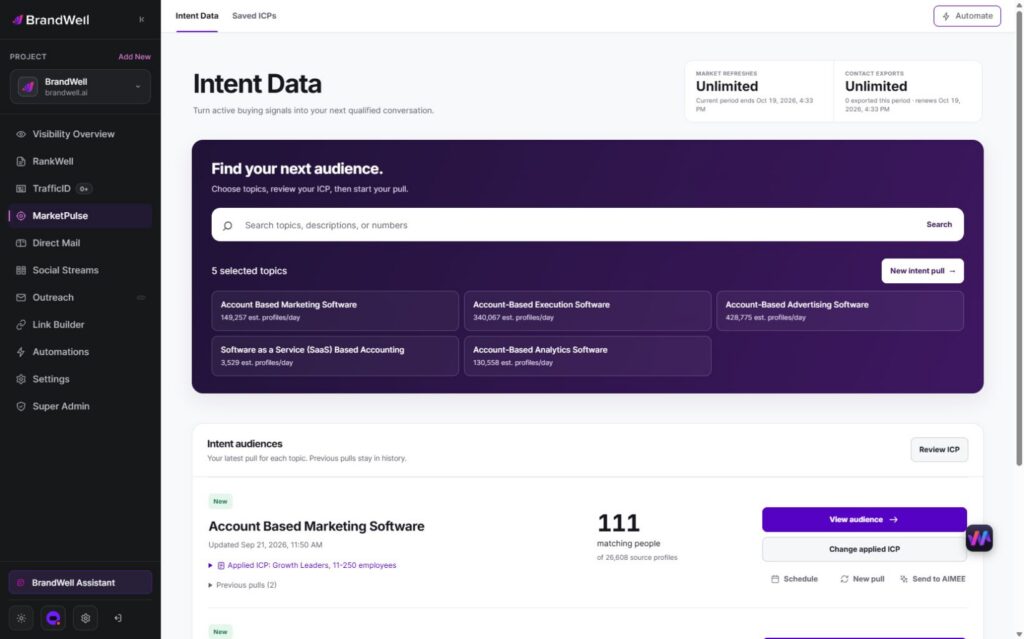
BrandWell MarketPulse: intent data starting at $500/mo. Find people researching topics relevant to what you sell, apply saved ICP filters, and review available contact details before taking action.
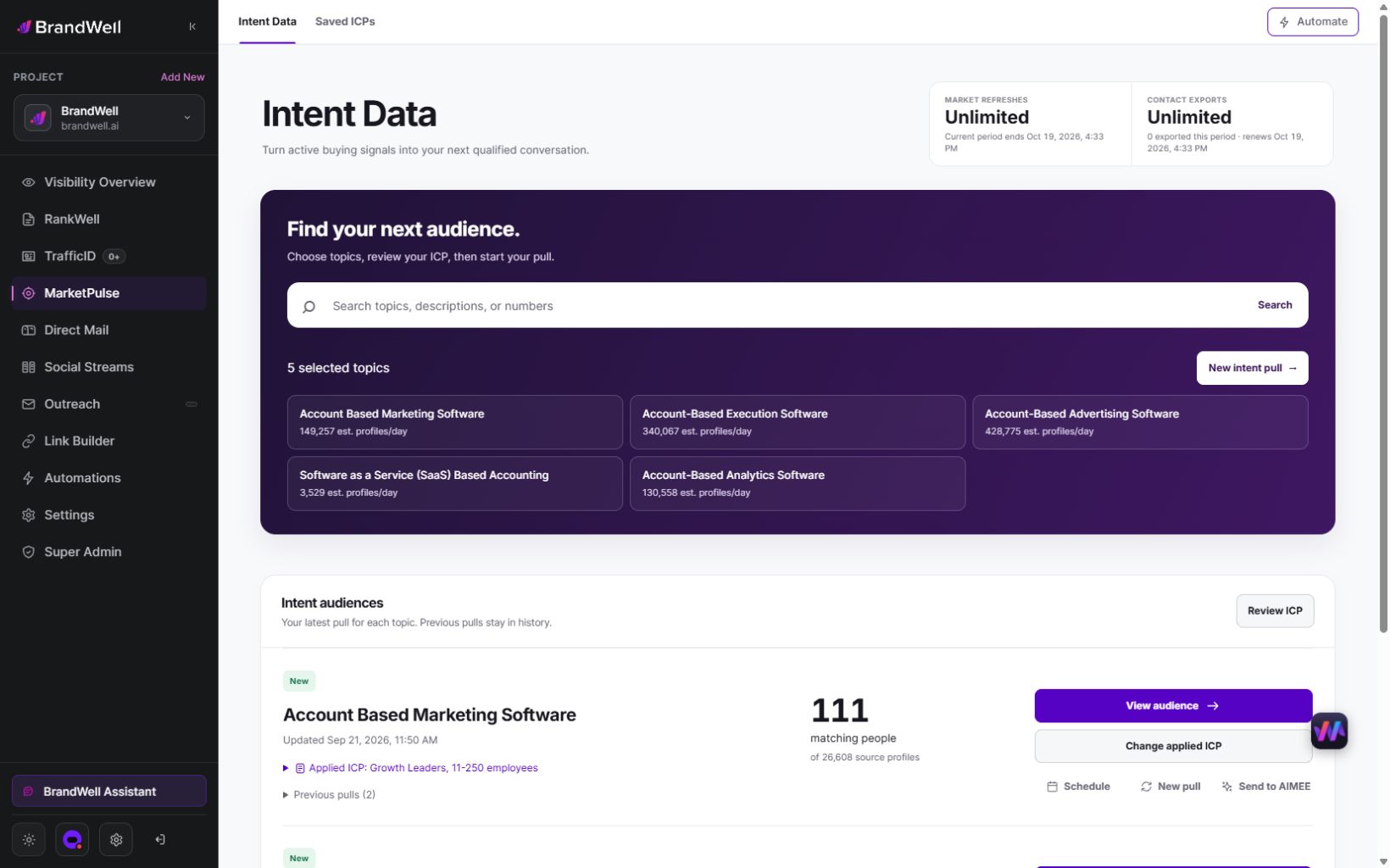
MarketPulse plans are starting at $500/mo. Verify current package scope and offers on the product page.
| Plan | Topics and refreshes | Monthly exports |
|---|---|---|
| Starter | 1 topic, weekly | 25,000 contacts |
| Growth | 3 topics, daily | 100,000 contacts |
| Scale | 10 topics, daily | Unlimited contacts |
Swipe the table to see all columns.
A pull retrieves available data from the previous 24 hours for one topic. Daily use across all included topics provides 90 Growth pulls or 300 Scale pulls in a 30-day month. Weekly Starter pulls vary by calendar month. Available audience size and contact fields vary, and audiences may overlap. Refreshes stop at the plan limit without overage charges.
- Find and qualify: search the topic catalog, save your ICP, and review the people and companies that match.
- Act on the research: export qualified contacts or prepare an Outreach or Direct Mail workflow. Connected products, channel usage, and fulfillment may cost extra.
- Get help from AIMEE: Growth and Scale include AIMEE for the initial user to research accounts and prepare the next step through connected tools.
Agencies and other service businesses can build client deliverables around their available Intent Scans and exports. Keep each client’s scope, permissions, and service fees clear. A subscription is not a promise of a white-label platform or exclusive access to a market.
Explore MarketPulse and watch the demo or compare plans starting at $500/mo. Any early-access discount is a separate, time-limited offer shown to an eligible recipient.
Compare five commitment levels
Use the lowest rung that resolves the buyer’s real objection. Moving higher on the ladder can make a proposal sound stronger, but it also increases validation work, dispute risk, and the amount of margin that must be reserved for remediation.
| Level | What the agency commits to | Useful evidence | Main caution |
|---|---|---|---|
| 1. Process clarity | Named workflow, owners, dependencies, and meeting cadence | Kickoff record, task log, decision log | Too weak if the client fears missed delivery |
| 2. Delivery service level | Defined reports, refreshes, reviews, or handoffs within a stated window | Delivery timestamps and acceptance record | Define dependency delays and clock treatment in the agreed terms |
| 3. Quality commitment | Agreed checks for completeness, relevance, validation, or rework | Sample audit and exception log | The test and sample must be written before work starts |
| 4. Service credit | A bounded credit or extra work if a controlled commitment is missed | Miss record and remedy approval | Cap the remedy and prevent double recovery |
| 5. Outcome-linked risk | A limited fee component tied to a jointly defined business event | Shared system of record and attribution rules | Use only when control, data, economics, and counsel support it |
Swipe the table to see all columns.
A delivery or quality commitment may address a buyer concern when the agency can observe, price and correct that work. Higher outcome-linked exposure is not inherently more persuasive or better suited to the account. Review the actual dependencies, acceptance method and downside cost before selecting a structure.
Define four operating boundaries
Design the guarantee from the operating model backward. First name the client concern: missed delivery, unusable records, slow follow-up, unclear reporting, or fear that the service will become shelfware. Then select the smallest commitment that directly addresses that concern. A broad promise such as “we guarantee pipeline” does not solve uncertainty. It hides the variables that determine the result.
Protect margin with four boundaries. The eligibility boundary defines which clients and campaigns can enter the guarantee. The control boundary separates agency work from client work. The evidence boundary states how performance will be judged. The remedy boundary caps what happens when a controlled commitment is missed. Put these boundaries in the proposal, order form, delivery plan, and account-management script so sales and operations do not tell different stories.
Objective claims require support before publication. A refund promise does not replace evidence. FTC advertising substantiation policy addresses support for claims before dissemination. Align the actual promise and prominently stated conditions with the evidence; qualified owners review the proposed language and use case.
Set inputs, approval limits and cadence
The minimum input set is a signed scope, client profile, approved topic set, permitted signal sources, identity rules, activation destinations, delivery owners, client response obligations, systems of record, acceptance test, and remedy. Every item needs an owner. “The client will follow up quickly” is not operational. “The client’s sales-operations owner will assign accepted records within the agreed window, and the CRM timestamp will be the record” is.
Approval limits keep the account team from inventing concessions under pressure. Specify who may approve topic changes, replacement work, service credits, extra destinations, data exports, and deadline extensions. A project lead can usually approve routine rework within scope. A finance or agency owner should approve credits, fee-at-risk changes, or contract exceptions. Privacy or security questions should go to the named reviewer rather than an account manager improvising an answer.
- Before signature: confirm eligibility, control, evidence, and remedy.
- At kickoff: validate access, topics, exclusions, and client obligations.
- During delivery: record exceptions as they happen, not at the monthly call.
- At each review: separate delivered work, accepted work, activated work, and downstream outcomes.
- Before renewal: decide whether the guarantee still matches the workflow and observed risks.
Maintain evidence and cost artifacts
The best guarantee tools are ordinary operating controls used consistently. Start with a qualification scorecard, a responsibility matrix, an acceptance-test sheet, a margin model, an evidence ledger, a change-request form, and a remedy log. Connect them to the CRM or project system that already owns client decisions. A specialized guarantee application cannot repair an undefined obligation.
Qualification scorecard
Tests client fit, activation readiness, access, decision speed, and data-use constraints before a promise is made.
Control map
Assigns each variable to agency, client, shared, vendor, or outside-control ownership.
Unit-economics model
Models wholesale, usage, labor, support, remedy reserve, and contribution before discounting.
Claim-evidence ledger
Places the promise, test, source record, reviewer, and result in one auditable row.
Do not import an industry benchmark and call it a guarantee threshold. Establish a baseline from the client’s own systems, label missing data, and state when a sample is too small to support a conclusion. The useful benchmark is often a delivery or adoption standard the parties can observe, not a market-wide revenue percentage.
Compare delivery, quality and remedy options
A no-outcome policy is simplest and preserves margin, but it may leave a cautious buyer without enough reassurance. A delivery service level is easy to audit and fits standardized work. A quality commitment is stronger when the agency controls validation and can define the sample. A service credit adds a tangible remedy but needs a cap and an exclusive-remedy clause reviewed by counsel. A fee-at-risk or outcome promise creates the most commercial complexity because it depends on attribution, client behavior, and shared systems.
Choose based on the objection, not bravado. If a buyer worries that reports will arrive late, promise timing. If the worry is poor record quality, agree on a sample test and rework rule. If the buyer wants the agency to own revenue, pause. Clarify the client’s offer, traffic, sales process, budget, response time, attribution access, and authority before pricing that risk. In many cases, a well-defined pilot is a better decision mechanism than a bigger promise.
Agencies evaluating the wider operating model can compare the tradeoffs in the intent-data service models guide before selecting guarantee language.
Model audit and remedy costs
Model the guarantee as a cost-bearing feature. Start with the normal delivery floor: wholesale platform and module cost, usage, onboarding, analysis, account management, support, reporting, security review, and allocated overhead. Add the expected cost of quality audits and remediation. Then test a downside case in which the remedy is triggered more often than planned. If one ordinary exception erases the month’s contribution, the remedy is too broad or the price is too low.
Copyable guarantee cost model
Monthly contribution before remedy = client fee - wholesale and usage - delivery labor - support - allocated overhead
Expected remedy reserve = trigger probability x average remedy cost
Contribution after guarantee = monthly contribution before remedy - audit cost - expected remedy reserve
Stress test = contribution after two simultaneous exceptions and one client-caused delay
Use ranges where inputs vary. Do not present an invented “realistic margin” as a benchmark. The agency should set a floor based on its own cost ledger, capacity, sales expense, risk tolerance, and contract. Discounting should reduce scope or remedy exposure, not silently remove the margin buffer.
Measure delivery and economic effects
Track leading and economic measures separately. Leading measures include eligibility-pass rate, on-time delivery, acceptance rate, quality-test pass rate, rework hours, client dependency delays, activation adoption, and time to close an exception. Economic measures include contribution after support, remedy frequency, remedy cost, scope-change revenue, renewal, and expansion. Downstream meetings, opportunities, pipeline, and revenue can be reported as observed outcomes with attribution limits, not as proof that one signal caused the result.
Evaluate whether the guarantee is associated with fewer disputes, clearer approvals and consistent handoffs. Do not assume the commitment itself improved decisions. A low remedy rate can reflect good delivery, a weak test or poor client adoption; inspect the account evidence before choosing an explanation.
Do not turn an internal KPI into a public claim until the source, sample, method, and limitations are documented. The guarantee policy should make it easier to produce reliable evidence, not easier to decorate a proposal with percentages.
Qualify the client and workflow
The best fit is a client with a defined market, an approved topic set, enough operational capacity to act, a usable system of record, named owners, and a willingness to accept mutual responsibilities. Standardized recurring retainers are easier to support than open-ended projects because the agency can define a repeatable workflow and review pattern.
Use caution with a new offer that has no baseline, a client that will not grant required access, a team that cannot follow up, a contract with unlimited custom work, or a buyer demanding a revenue result while retaining control of budget and sales execution. Exclude prohibited or sensitive use cases until the data rights, purpose, security, and legal review are clear. A guarantee should not be used to overcome a fundamental fit problem.
A paid, bounded pilot can test the working relationship without pretending to prove every downstream result. Fit should be reassessed when the client changes market, offer, team, traffic, activation channel, or data-use purpose.
Test the observable signal chain
Write the signal chain in order: source, topic or behavior, identity state, validation, qualification, destination, action, and outcome record. Label whether each record is company-level, person-level, inferred, validated, or unresolved. A guarantee that ignores identity state can make a delivery look complete even when the client cannot use it.
Only guarantee steps that have an observable test. Examples include delivering the contracted topic report, applying exclusion rules, validating required fields under an agreed method, routing an approved record, logging a destination response, or completing a scheduled review. Do not guarantee that an observed company is ready to buy, that a person caused the research activity, or that an activation will create pipeline.
Keep the source and test in the evidence ledger. Review provider rights, destination terms, client instructions, and retention controls before expanding use. The intent-data vendor evaluation guide provides a companion checklist for source quality and delivery rights.
Review scope, billing and data use
Margin risk comes from uncapped rework, repeated credits, bespoke reporting, and sales concessions that operations never priced. Scope risk appears when topics, regions, destinations, or review frequency can expand without a change order. Billing risk appears when the contract does not say whether a credit is the sole remedy, how a dispute is raised, or what happens when the client misses a dependency.
Review necessary fields, access, source rights, permitted purposes, destination approvals and retention before offering a workflow guarantee. Record unresolved questions and obtain qualified review for the actual jurisdictions and client contract. A provider subscription is not approval for every downstream use.
Trust also depends on language. Present intent as a prioritization signal, not a surveillance revelation or certainty about an individual. Put material exclusions next to the promise, not in a disconnected appendix. Maintain a single approved sales explanation so the website, proposal, and account team do not create different implied claims.
For a deeper operating checklist, use the agency intent-data compliance program guide.
Reassess the promise at renewal
A recurring service needs a guarantee that can survive ordinary change. Tie commitments to the contracted module, topic set, refresh pattern, destination, client obligations, and review process. Use a change-control rule when volume, topics, regions, identity depth, activation channels, or support needs change. Renewal should reassess the guarantee instead of copying the original language forward.
AIMEE can help organize an approved guarantee specification and identify missing supplied evidence through configured connected tools. Human owners approve public claims, contract terms, client communication and any remedy action. A generated draft does not establish source rights or contractual authority.
Copyable assistant guarantee review
Give the agent only approved, necessary information. Remove personal data that is not needed. Require a human to approve contract language, public claims, credits, and client communications.
Act as an operations reviewer, not a lawyer. Review this proposed intent-service guarantee.

Inputs:
- qualified client profile:
- contracted deliverables and cadence:
- agency-controlled variables:
- client-controlled variables:
- acceptance test and evidence source:
- proposed remedy and cap:
- pricing and delivery cost range:
- data-use and retention rules:

Return:
1. ambiguous promises or implied outcome claims
2. missing dependencies, exclusions, and owners
3. a control-versus-risk table
4. a margin stress test using only the supplied numbers
5. questions that require legal, privacy, finance, or executive review
6. a revised plain-language draft marked "human approval required"

Do not invent facts, legal conclusions, benchmarks, results, or guarantees.
Claude, ChatGPT, or AIMEE can organize the review. None should approve the guarantee or publish it without a responsible human.
Test the service with a bounded pilot
The practical next step is to choose one qualified prospect, define a narrow acceptance test, price the delivery, and document the evidence before adding a guarantee to the proposal. If the operating model cannot support the promise on paper, do not sell it.
Evaluate MarketPulse with a representative topic and a defined ICP. Review the matching audience, prepare one useful action with BrandWell’s connected tools and AIMEE, and measure the operating effort. MarketPulse plans are starting at $500/mo; agree on the package, evaluation period, and success criteria before expanding.
Worked example: reserve cost differs from a triggered remedy
Assume a fictional monthly service fee of $2,000, ordinary delivery cost of $1,300 and a $100 audit cost. A planning assumption of a 20% remedy probability multiplied by a $400 remedy cost gives an $80 expected reserve. The planning remainder is $520, or 26%, before acquisition, general overhead, tax and financing. The assumed probability is not an observed benchmark or a statement of typical agency risk.
If the remedy actually triggers, the defined actual remainder is $2,000 – $1,300 – $100 – $400 = $200, or 10%. Do not deduct both the expected $80 reserve and the same actual $400 remedy when measuring that month’s economic cost. Additional two-hour support at $100 reduces the actual remainder to zero. Two separately incurred $400 remedies leave negative $200 before extra support, if the agreement permits both.
Preserve the remedy unit, cap, approval and actual accounting treatment. Correlated failures and changing client dependencies can make a single estimated trigger probability a poor model. These invented figures are for sensitivity planning, not BrandWell fees, contract terms or financial advice.
Keep MarketPulse’s product policy separate
The current MarketPulse page describes a three-day refund guarantee within 72 hours of the first purchase, conditional on no exports and no more than two Intent Scans. Verify the current purchase terms before relying on it. An agency’s separate reporting, integration or outcome promise is not that product policy and must not be presented as included.
Use BrandWell for the supported evidence review
Review an available MarketPulse topic, saved ICP, actual preceding-24-hour matches and plan allowances. Agree what the agency will deliver and inspect actual client acceptance separately. AIMEE can organize the approved evidence through configured tools. Owners approve any public promise or separately scoped client work; available contacts do not establish an individual buyer’s intentions or downstream permission.
Frequently asked questions
Does a refund promise substantiate a performance claim?
No. Support the claim before publishing it.
Is an expected remedy reserve the same as an actual expense?
No. Preserve the distinction and avoid double-counting the same remedy.
Can low remedy frequency prove excellent delivery?
No. Inspect test strength, adoption and actual exception records.
Is the agency’s promise MarketPulse’s refund policy?
No. They have separate scope, conditions and responsible parties.
Review the supported research product: explore MarketPulse and current plans.
Reviewed and updated October 3, 2026.

Written by