On this page
Using ChatGPT for content creation is a drafting workflow: define the reader and task, supply relevant context, review the output and verify the finished work before publishing. A fast response does not establish that an article is complete, supported or useful.
This guide replaces the archive’s unsupported production-time promises and old limitations with a practical editorial process. It does not report a new speed benchmark or promise search rankings.
Choose the deliverable before prompting
Start with one output and its purpose. An article outline, newsletter opening, service description and social summary need different inputs and review criteria. Avoid asking for an entire campaign when the approved brief covers only one message.
- Outline: identify the reader’s questions and useful section order.
- Draft: develop supported material for editorial review.
- Rewrite: improve clarity while preserving meaning.
- Summary: condense an approved source without adding claims.
- Variation: explore different wording within the same verified offer.
Build a brief with useful constraints
State the audience, intended decision, source material, output and important boundaries. Include the details that change the work. A longer prompt is not automatically a better brief, and a rigid formula is not required.
Use permitted source material. Mark facts the writer may use, questions that remain unresolved and claims that should not appear. Do not ask the assistant to fill a gap with an invented statistic or customer result.
Original IT-services prompt example
Prepare an outline for an IT-services buyer guide about planning an office migration. The reader is an operations manager. Use the approved service brief and public source notes supplied here. Cover responsibility, prerequisites and questions to discuss with the provider. Do not invent downtime guarantees, customer results or services not documented in the brief. Return proposed headings and the evidence each section will need. Flag missing information.
This is an original illustrative prompt. It requests an outline and evidence requirements, not a finished verified article. Replace the scenario with your actual audience and permitted materials.
Review the outline before expanding it
Check whether each section answers a real question. Remove repetition and unrelated background. Identify where an original example or expert explanation would help, then collect the material needed to support it.
For the migration guide, a checklist of who owns backups and access may be useful. A claim that every migration is completed without disruption needs actual support and should not be inferred from a general service description.
Use follow-up instructions to correct a specific issue. For example: keep the responsibility checklist, remove the unsupported timeline and identify what information is needed before discussing implementation. Review the revised output rather than assuming the correction was applied everywhere.
Verify the complete draft
Read the entire text, including captions, lists and FAQs. Open the sources and compare each material claim with the actual evidence. Check dates, quantities, scope, attribution and product details.
- Facts: is the claim supported by the cited material?
- Scope: does it apply to this audience and situation?
- Examples: are invented scenarios labeled clearly?
- Product: does the description match the actual offer?
- Media: are images permitted, relevant and legible?
- Next step: does the CTA fit what the page explains?
The NIST AI Risk Management Framework provides voluntary guidance for evaluating and managing AI-related risk. It is not a certification that generated content is ready to publish.
Use current BrandWell for the content workflow
Use Visibility to investigate keyword opportunities and RankWell for content work. Begin with the reader and evidence, then review the article alongside the editor’s search preview, recommendations, media and sources.
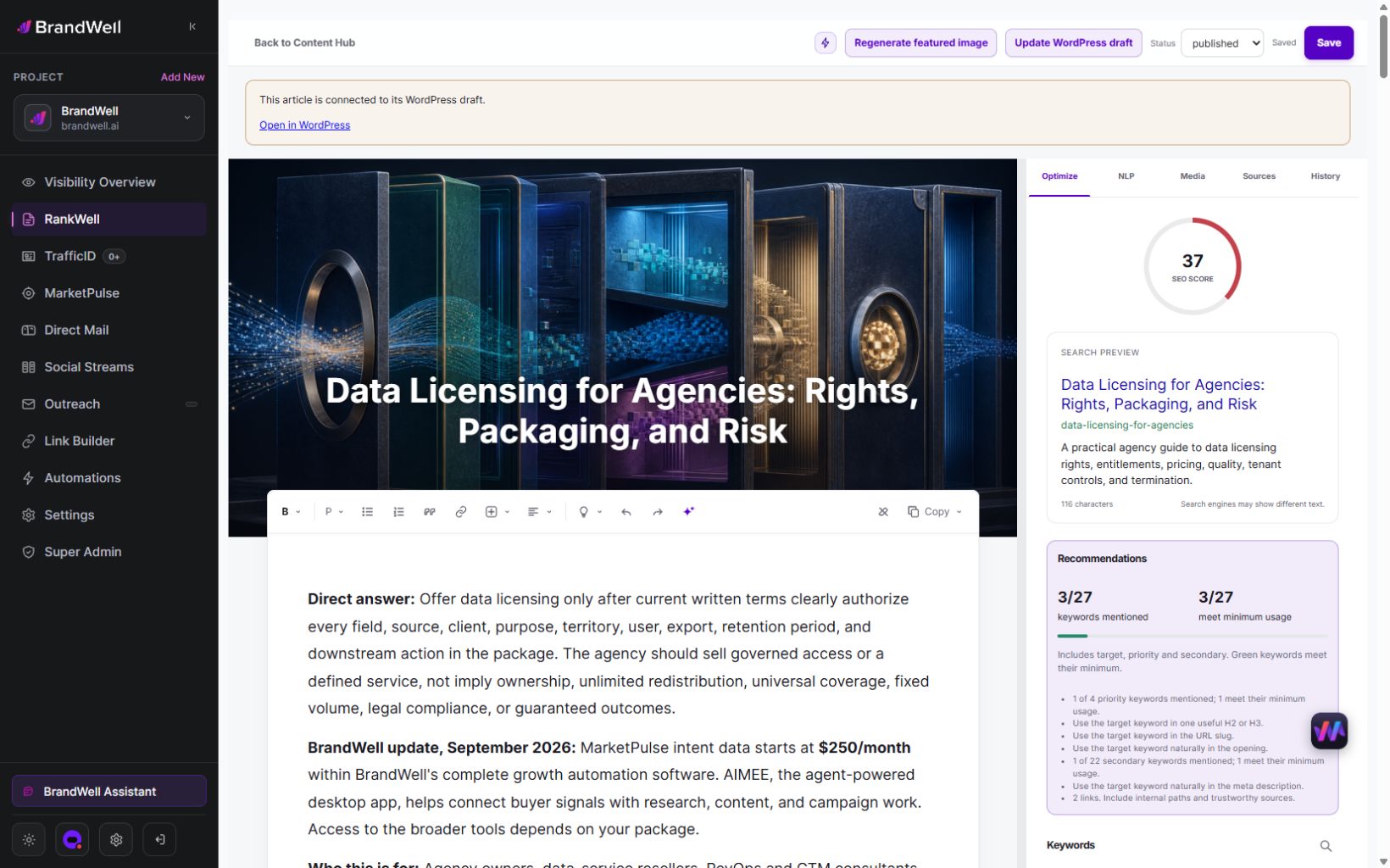
Check the approved text, destination and configured publishing process before publication. AIMEE can help carry approved work through configured tools and permissions. A draft, an approved article and a confirmed publication remain distinct steps.
Review current product plans for the content and growth capabilities you need. Legacy Content at Scale allowances and old chat-model restrictions are not the basis of this workflow.
Prepare search and social versions after approval
Write a descriptive title and summary that match the finished page. Use headings to organize real questions and internal links to help readers reach related material. Describe informative images appropriately and verify that they fit the mobile layout.
Adapt an approved article into a social summary without changing its claims. If the guide describes prerequisites, the short version must preserve them instead of becoming an unconditional promise. Check the actual destination’s requirements before publishing.
Measure production and outcomes separately
Record research, drafting, editing, media and publishing work. Count approved deliverables rather than the number of responses generated. Search impressions, clicks and business outcomes require their own measurement.
In an original hypothetical project, eight outlines become five approved articles. Report five approved articles and the remaining work. Do not describe all eight as finished content merely because the first drafting step completed. These are illustrative numbers, not measured product results.
Common questions
Can one prompt replace source review?
No. The reviewer still needs to check the evidence and the complete finished draft.
Does AI-generated content automatically rank better?
This workflow makes no ranking claim. Evaluate the actual page and later search results separately.
Should every generated section be published?
No. Keep material that answers the reader’s question and meets the brief; remove unsupported or repetitive additions.
Reviewed and updated October 3, 2026.

Written by
Julia McCoy has contributed articles to BrandWell on content marketing, writing, and search engine optimization. This archive retains her original bylines; individual articles may be updated by the BrandWell editorial team.