


On this page
- 1. Define the audience and outcome
- 2. Establish a usable evidence record
- 3. Distinguish fit from activity
- 4. Use BrandWell sources for their intended roles
- 5. Make the handoff actionable
- 6. Automate a defined process
- 7. Report the funnel with clear denominators
- 8. Improve through a controlled comparison
- Common questions
Data-driven sales outreach uses recorded evidence to choose an audience, decide the next action and assess outcomes. It requires more than collecting contacts. Define fit, verify information, review channel eligibility, assign an owner and compare qualified conversations with the work and cost involved.
Data can inform a decision without revealing a person’s motives. A website visit is an observation, an inferred need is a hypothesis and a reply is a separate event. Keeping those distinctions visible makes the process easier to improve.
1. Define the audience and outcome
Write an ideal customer profile around the business problem you solve. Include relevant industry, service area, company characteristics and exclusions. Explain why each criterion matters instead of collecting every available field.
Choose the outcome before choosing metrics. A qualified conversation needs a definition that sales and marketing can apply consistently. An email reply, a meeting booked, a meeting held and a purchase are separate stages.
2. Establish a usable evidence record
- Source: where the information came from.
- Date: when it was collected or checked.
- Observed event: the actual activity, where available.
- Business fit: the verified reason the offer may be relevant.
- Eligibility: the intended channel, permission records and suppression status.
- Owner: who reviews and handles the next step.
- Outcome: what happened after the action.
Resolve duplicate records and conflicting company details. Keep uncertainty visible. A populated field may be outdated or refer to a different person, and an enriched phone number does not document permission for marketing texts.
The FTC’s business data-security guide recommends inventorying information, keeping only what is needed, controlling access and disposing of unnecessary data. Apply those principles to your outreach records as well as your customer files.
3. Distinguish fit from activity
A company may fit your offer without showing recent activity. Another may have activity but be outside your service area. Keep these dimensions separate so a noisy activity score does not hide poor fit.
Fictional triage example: a payroll-services provider reviews three companies. Company A matches its territory and describes payroll needs publicly, but has no recorded recent visit. Company B has an identified visit but operates outside the territory. Company C requested a consultation and matches the service criteria. The request supports a specific response to C; it does not turn A or B into confirmed buyers.
Document your rules and review whether they help. A points-based rule is a prioritization method, not a validated predictive model. Do not call it purchase prediction unless you have tested evidence supporting that claim.
4. Use BrandWell sources for their intended roles
TrafficID supports review of identified visitors to your own website and available person, role, company, audience-source and activity fields. Coverage varies. Select the project, check the tag and exclusions, then review Identified visitors and suppression controls.
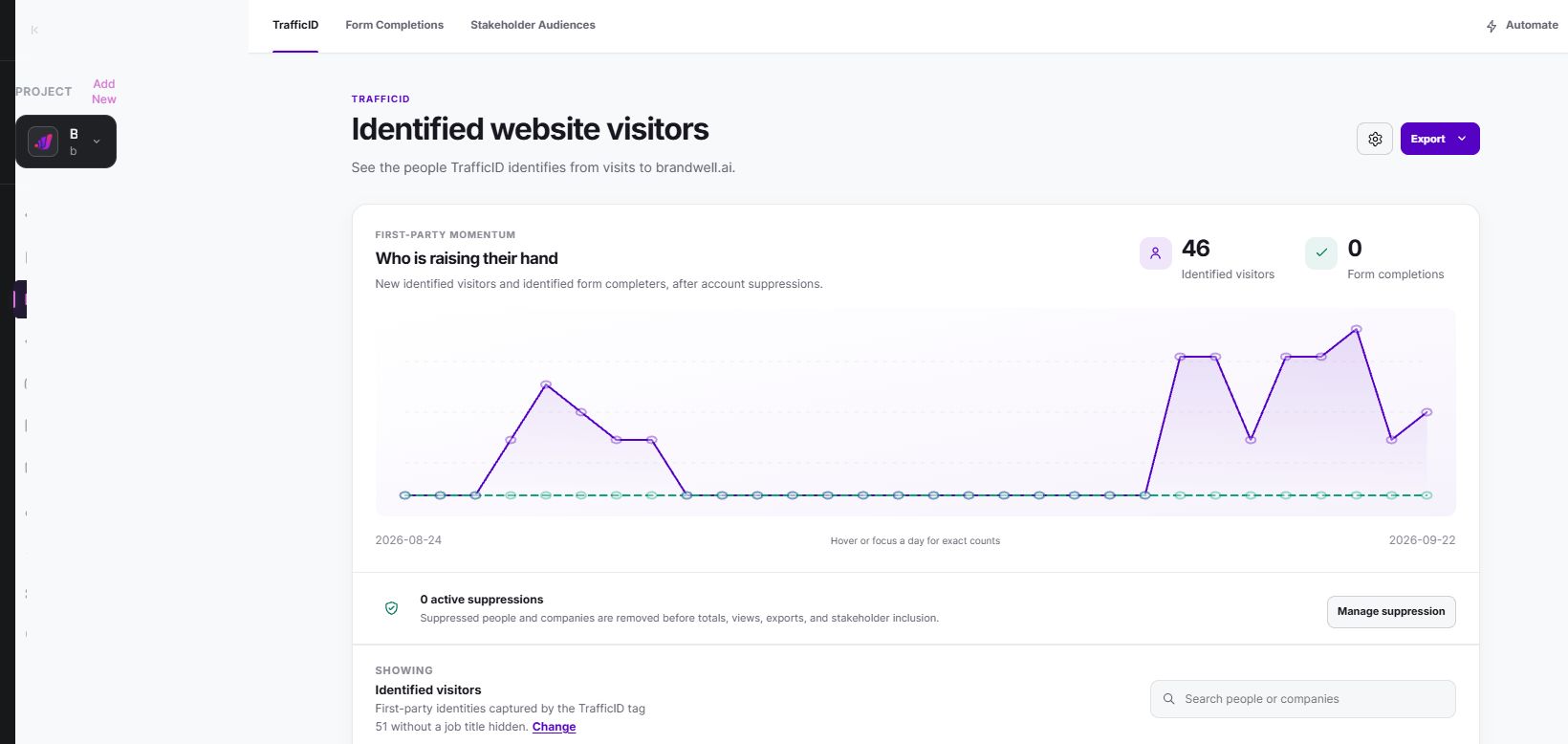
Form Completions and Stakeholder Audiences are separate views. Do not assume every record has complete page history, time-on-page data or permission to contact.
MarketPulse supports topic-based intent research, with plans starting at $500/mo. Available data, filters and overlapping audiences affect the results. Topic research and own-site visitor activity are different evidence sources, and neither guarantees a sale.
RankWell supports content briefs and drafts for useful resources. Configured Automations and AIMEE can help carry approved work into connected tools. Confirm your package, configuration and destination requirements before planning a workflow.
5. Make the handoff actionable
Provide the owner with a short evidence note, the proposed action and a reason it would help the recipient. Avoid handoffs that contain only a name and an unexplained score. Agree a response process for direct requests and a review process for other records.
Give sales a way to mark accepted, rejected, duplicate, already a customer or needs research. Record why a record was rejected so marketing can improve selection. Keep the qualification definition stable during a comparison.
6. Automate a defined process
Specify the trigger, eligible records, required fields, approval owner, destination and stop conditions. Test a small authorized example and inspect the destination. Preparing a message or exporting a record is not proof that it was delivered or acted upon.
Suppress opt-outs and ineligible records. Route replies to a responsible person. Reassess a sequence when someone purchases, replies or changes status. Do not continue acquisition follow-ups after the outcome they were designed to achieve.
A useful message addresses verified business context and offers one relevant resource or next step. For drafting examples, see the personalized outreach guide. Do not claim to know why a person visited.
7. Report the funnel with clear denominators
Track reviewed records, eligible records, delivered messages, replies, qualified conversations, meetings held and purchases separately. Keep delivery failures and exclusions visible. Use the same period and record definitions across reports.
Hypothetical funnel: a team reviews 120 records, finds 80 eligible and delivers messages to 72. It receives nine replies and qualifies four conversations. The reply rate is 12.5% among delivered messages, and 3.3% of reviewed records reach a qualified conversation. Different denominators answer different questions.
If reviewing those records takes six hours, the example produces about 0.67 qualified conversations per review hour. Include additional preparation and sales time when evaluating efficiency. These figures illustrate calculations, not expected performance.
8. Improve through a controlled comparison
Change one meaningful element when feasible, such as the selection rule or message offer. Keep the audience, time window and qualification definition comparable. Record the change and inspect negative responses as well as successes.
Small samples, seasonality, deliverability and sales capacity can affect the result. A higher reply rate alone does not establish better revenue or causation. Review the downstream conversations and costs before scaling the process.
Common questions
Does data-driven outreach require predictive analytics?
No. A clear evidence record, consistent decisions and measured outcomes are a useful starting point. Predictive claims require their own validation.
Should a pricing-page visit trigger an immediate call?
Do not make that automatic assumption. Check whether the activity is actually recorded, whether the company fits and whether the channel and action are appropriate.
What should sales and marketing share?
Share the qualification definition, source and verification notes, suppression rules, ownership and outcomes. That lets both teams investigate why records progressed or were rejected.
Reviewed and updated October 3, 2026.

Written by

