On this page
- Current MarketPulse workflow
- Define the decision and comparison
- Build nine delivery steps and assign owners
- Choose tools for reproducible analysis
- Build, resell, refer or decline
- Price the method and recurring work
- Measure decisions before revenue
- Qualify comparable clients
- Keep source coverage visible
- Manage disclosure and comparison risks
- Define the recurring package
- Worked example: client average versus pooled rate
- Worked example: cost a recurring release
- Privacy review needs more than a size threshold
- Frequently asked questions
Direct answer: Offer a benchmark subscription only if you can publish a stable methodology and protect every contributing client. A benchmark is useful when it helps a client interpret its own movement against a defined cohort, denominator, time window, normalization rule, confidence limit, and refresh policy. It is not a ranking, a universal performance standard, or proof that one tactic caused an outcome.
Current MarketPulse offer: intent-data plans start at $500/mo. See the product, demo, and current plans. Updated October 3, 2026.
Who this is for: Agency owners, analysts, RevOps consultants, demand generation teams, and service operators who want recurring decision support rather than another static report.
The product is the method as much as the result. If cohort membership changes silently, a denominator is unclear, or one client can infer another client’s data, the benchmark becomes misleading or unsafe. A credible benchmark subscriptions strategy therefore starts with methodology governance and ends with an interpretation conversation.
Current MarketPulse workflow
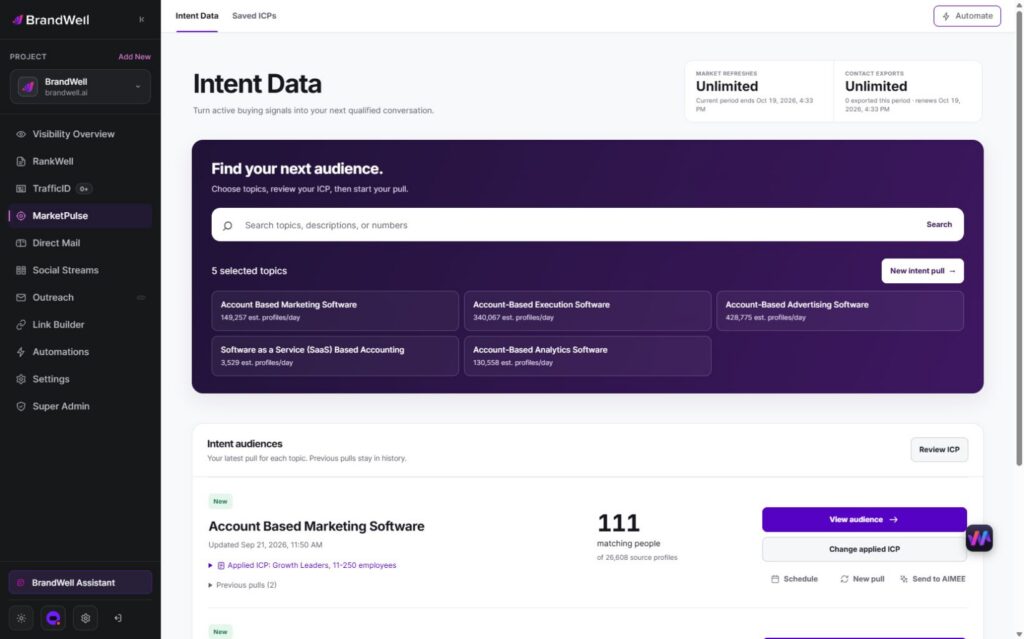
BrandWell MarketPulse: intent data starting at $500/mo. Find people researching topics relevant to what you sell, apply saved ICP filters, and review available contact details before taking action.
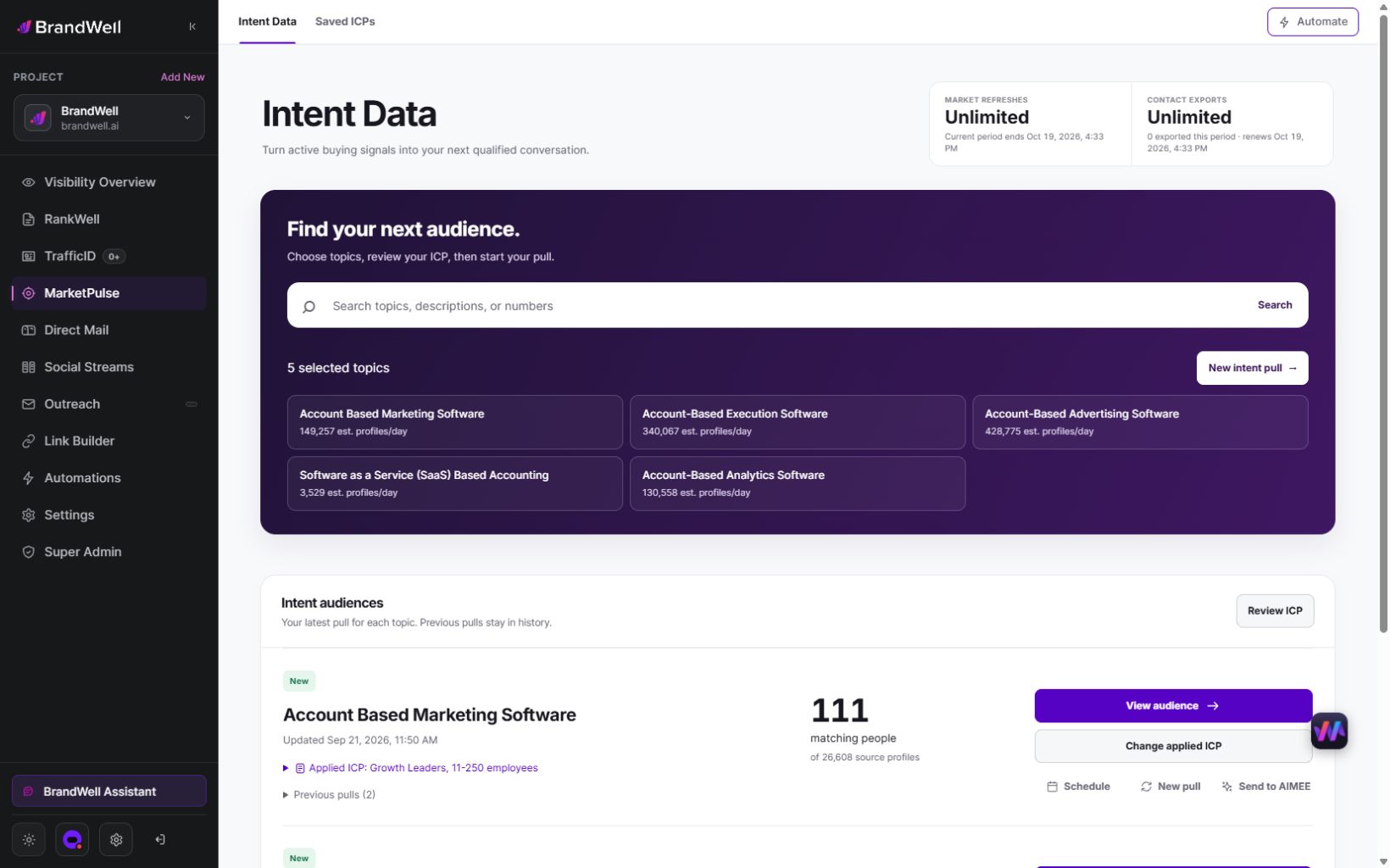
MarketPulse plans are starting at $500/mo. Verify current package scope and offers on the product page.
| Plan | Topics and refreshes | Monthly exports |
|---|---|---|
| Starter | 1 topic, weekly | 25,000 contacts |
| Growth | 3 topics, daily | 100,000 contacts |
| Scale | 10 topics, daily | Unlimited contacts |
Swipe the table to see all columns.
A pull retrieves available data from the previous 24 hours for one topic. Daily use across all included topics provides 90 Growth pulls or 300 Scale pulls in a 30-day month. Weekly Starter pulls vary by calendar month. Available audience size and contact fields vary, and audiences may overlap. Refreshes stop at the plan limit without overage charges.
- Find and qualify: search the topic catalog, save your ICP, and review the people and companies that match.
- Act on the research: export qualified contacts or prepare an Outreach or Direct Mail workflow. Connected products, channel usage, and fulfillment may cost extra.
- Get help from AIMEE: Growth and Scale include AIMEE for the initial user to research accounts and prepare the next step through connected tools.
Agencies and other service businesses can build client deliverables around their available Intent Scans and exports. Keep each client’s scope, permissions, and service fees clear. A subscription is not a promise of a white-label platform or exclusive access to a market.
Explore MarketPulse and watch the demo or compare plans starting at $500/mo. Any early-access discount is a separate, time-limited offer shown to an eligible recipient.
Define the decision and comparison
Yes, when the agency has comparable observations, a defensible cohort, and a recurring client decision the comparison can support. Promise consistent context: where the client sits under the stated method, how its position changed, what may explain the movement, and which controlled experiment or operational review to consider next. Do not promise that being above a benchmark creates revenue or that being below it proves failure.
Good benchmark subscriptions for agency clients reduce ambiguity without hiding uncertainty. Each release should state the question being answered, units, inclusion rules, time period, sample limits, confidence or completeness caveats, and methodology changes. The client should be able to distinguish its own measurement from aggregated comparison context.
Build nine delivery steps and assign owners
Staff the service with a methodology owner, data steward, analyst, client strategist, and privacy or contract approver where needed. Onboarding should capture the client’s definitions, source systems, time zone, market segment, data rights, and decision cadence. The agency maps these inputs to a frozen cohort and records exceptions before computing a comparison.
- Frame the decision. Name the client question and the action a comparison may inform.
- Define the measure. Specify numerator, denominator, unit, inclusion, exclusion, and missing-data treatment.
- Design the cohort. Use relevant attributes, minimum size, rare-attribute controls, and a documented membership rule.
- Normalize carefully. Align time windows, source definitions, seasonality treatment, and material changes.
- Protect contributors. Apply tenant isolation, aggregation thresholds, suppression, access control, and disclosure review.
- Run quality checks. Test duplicates, outliers, source drift, denominator shifts, and re-identification risk.
- Publish with context. Show the method, client value, cohort reference, uncertainty, and allowed interpretation.
- Hold a decision review. Record the client’s interpretation, approved next step, and questions for the next cycle.
- Version the method. Announce changes and preserve enough history to explain breaks in comparability.
Set the SLA around controllable milestones: accepted data cutoff, QA completion, report delivery, correction handling, and method-change notice. Do not guarantee cohort size, external data availability, or a particular result. A weekly and monthly reporting discipline can keep delivery predictable without disguising methodological limits.
Choose tools for reproducible analysis
Evaluate tool categories, not logos. You may need ingestion and validation, metric definitions, cohort assignment, privacy-preserving aggregation, version control, report generation, client access, and an audit trail. Score each component on tenant separation, reproducibility, suppression thresholds, missing-data controls, access permissions, exports, deletions, and method documentation.
The best platform depends on the benchmark question and data rights. A dashboard alone cannot repair incomparable inputs. A spreadsheet can support an early, small program when controls are strong, while larger recurring programs may require governed data models and automated QA. Verify current primary documentation before relying on a vendor capability or price.
Build, resell, refer or decline
Build the methodology when it is core intellectual property and the agency can maintain definitions, privacy controls, and revisions. Resell a platform when repeatability and tenant controls matter more than custom computation. Refer when the client wants direct ownership and the agency’s role is interpretation. Avoid the offer when cohorts are too small, definitions cannot be reconciled, rights do not permit aggregation, or the client expects a public ranking disguised as a benchmark.
Use a comparison matrix with method control, source rights, implementation time, reproducibility, privacy, client transparency, maintenance, and exit portability. Choosing a path is not just a software decision. It allocates responsibility for every reported comparison.
Price the method and recurring work
Price from methodology complexity and recurring work: source onboarding, normalization, cohort design, privacy review, QA, report generation, interpretation sessions, revisions, and support. Separate a one-time method and data setup from the recurring refresh. Define how new sources, segments, or custom cohorts change scope.
Stress-test the defined service costs under clean inputs, delayed data, method changes, suppressed results and custom analysis. State which costs are included before reporting any margin. A low-cost input can still require expensive reconciliation and review.
AIMEE can help draft calculation notes and interpretation questions through configured connected tools. Check calculations with a reproducible method and named reviewer. It is not a native benchmark certification or unrestricted execution system.
MarketPulse provides topic audiences, saved ICP filtering and available contact details. Use it for an approved research workflow. Cross-client aggregation, custom calculations, branded reports and commercial rights require separate evidence, permission and service scope.
Measure decisions before revenue
Do not “prove revenue” by attributing a business outcome to the benchmark itself. Prove that the subscription created an auditable decision process. Track on-time releases, comparable-data coverage, suppressed results, methodology exceptions, client attendance, approved actions, experiment launches, and later outcomes recorded by the client.
When the client links an action to an opportunity or revenue event, show the evidence chain and competing influences. The agency can use a QBR structure for intent-data clients to review decisions and learning. It should label correlation, client-reported influence, and unknown attribution rather than claiming causation.
Qualify comparable clients
Best-fit clients share comparable definitions, have enough observations to support the cohort, accept methodology transparency, and make recurring decisions that the benchmark informs. Exclude clients demanding individual competitor data, tiny or uniquely identifiable cohorts, universal targets, retroactive cherry-picking, or comparisons built from incompatible systems.
Qualification questions include: What decision changes? Which metric definition controls? Who owns input quality? What minimum cohort protects contributors? May the data be aggregated? How are methodology changes approved? What happens when a result must be suppressed? A “no” or “unknown” can be a stop condition, not an objection to sell around.
Keep source coverage visible
Buyer intent and website behavior can provide comparable activity measures when sources and windows align. Identity and enrichment can help assign observations to accounts, segments, or cohorts where permitted. Keep match state, enrichment coverage, and source completeness visible because changes can move a benchmark without any real market shift.
MarketPulse topic audiences can inform a separately designed research workflow. They are not a ready-made peer benchmark dataset. If you aggregate client outcomes, confirm permissions, consistent definitions, coverage and the calculation method independently.
Manage disclosure and comparison risks
Risks include incomparable definitions, denominator drift, selection bias, small-cohort disclosure, cross-client leakage, stale data, source changes, survivorship bias, and clients treating a percentile as a target. Controls include a data dictionary, minimum cohort rule, rare-attribute suppression, versioned methodology, tenant tests, change logs, and an interpretation guide.
Never expose one client through another, even indirectly. If a cohort becomes too small or a rare combination could reveal a participant, suppress the result or broaden the cohort under the written method. Privacy and contract review should happen before publication, not after a client complains.
Benchmark methodology worksheet
For every metric, record the business question, numerator, denominator, unit, time window, inclusion and exclusion rules, source systems, missing-data treatment, normalization, cohort attributes, minimum cohort size, rare-attribute suppression, refresh cadence, confidence or completeness limitation, and methodology owner. Add a version identifier and effective release so a client can tell whether two periods remain comparable.
The interpretation block should require four statements: what the result says under the method, what it does not say, which inputs could explain movement, and which approved decision or test follows. This prevents a benchmark from becoming a score with no operational use.
How to handle method changes
Classify changes as correction, source change, definition change, cohort change, or presentation change. A correction may require restating prior results. A source or definition change may break the trend line. A cohort change may require dual reporting for one cycle. A presentation change should not alter the underlying value. Document the reason, affected releases, approver, client notice, and whether historical values were recomputed.
Never backfill a favorable interpretation after seeing the result. Freeze the method before computation, then record exceptions. If an exception is material, either suppress the result or publish it with a clear limitation.
Benchmark subscription examples
An operating benchmark could compare accepted-signal rate across a client’s own teams using the same definition. A trend benchmark could compare the client’s current period with its prior comparable periods. An anonymized cohort benchmark could compare normalized activity across a sufficiently large contracted group. A process benchmark could compare acknowledgment or disposition completion. Each has different rights, sample, and interpretation needs.
Avoid ranking named clients, implying a universal top quartile, or setting a performance target from a cohort that does not match the client. Benchmark subscriptions best practices favor comparable decisions over impressive charts.
Renewal checklist
- The client used the benchmark in a named decision.
- Definitions and sources remain comparable.
- Cohort size and privacy thresholds still pass.
- Method changes and corrections were disclosed.
- Input work and interpretation fit the contracted capacity.
- The next cycle has a clear question and owner.
Client interpretation meeting template
Open with the decision and method, not the client’s position. Confirm the metric definition, cohort, period, source coverage, suppressed segments, and any method change. Then review the client value, comparable reference, meaningful movement, and uncertainty. Ask the client which operational facts may explain the change before recommending action.
End with an action record: hypothesis, approved owner, test or review, start condition, evidence to collect, decision date, and stop condition. A benchmark without this final record is interesting context, not a managed subscription.
Cost and capacity controls
Track analyst time by input validation, reconciliation, privacy review, computation, explanation, correction, and custom analysis. A subscription that looks automated can still become labor-heavy when client definitions drift. Set a standard number of measures, cohorts, releases, interpretation sessions, and correction windows. Quote new custom comparisons after reviewing rights and comparability.
Capacity planning should reserve time for method changes and suppressed results, not just routine report generation. This keeps benchmark subscriptions cost transparent and protects the client from rushed analysis.
Data intake acceptance checklist
Before calculation, confirm source owner, extract time, schema version, period, time zone, duplicates, late events, missing values, exclusions, and material system changes. Reconcile totals to a client-controlled reference where possible. If the source changed, decide whether to restate, break comparability, or suppress the release.
Keep the accepted input and calculation version together. Corrections should identify the original release, issue, affected measures, corrected value, approval, and client notice. This makes benchmark subscriptions operationally auditable.
What not to benchmark
Avoid measures the client cannot define consistently, cohorts that reveal participants, vanity counts detached from decisions, and outcomes dominated by variables the method ignores. Do not manufacture a benchmark from a small convenience sample merely because the client asked for a target. Sometimes the honest answer is to publish the client’s own trend until comparable evidence improves.
Benchmark planning note: Keep a plain-language appendix with the calculation formula, data exclusions, cohort logic, privacy threshold, and worked fictional example. Let the client reproduce the reasoning even if it cannot access other contributors. Reproducibility builds trust and makes correction faster.
Record the client questions that remain unresolved and the evidence needed next cycle. Unknowns are a valid benchmark output when the current method cannot support a comparison.
Define the recurring package
A recurring package should include metric definitions, cohort rules, input validation, normalization, privacy controls, a scheduled benchmark release, method notes, an interpretation session, action log, corrections, method-change governance, and renewal criteria. Higher scopes can add approved segments or sources, but should not promise unlimited custom analysis.
Copyable agent-ready benchmark workflow: Give Claude, ChatGPT, or AIMEE the approved data dictionary, cohort policy, minimum aggregation rule, missing-data treatment, calculation specification, and output template. Instruct it to validate and draft, never publish. Require human approval for cohort membership, suppressed results, methodology changes, client interpretations, and external delivery. Stop when definitions conflict, sample limits fail, tenant data may be exposed, source rights are unclear, or a requested statement implies causation. Preserve calculation inputs, version, proposal, reviewer, and release decision.
Begin with one decision metric and one defensible cohort. Run a shadow cycle, explain every exception, and let the client challenge the method. That is a stronger benchmark subscriptions implementation guide than a dashboard full of unexplained comparisons.
Worked example: client average versus pooled rate
In an invented two-client calculation, Client A accepts 10 of 20 reviewed records, or 50%. Client B accepts 40 of 100, or 40%. The unweighted mean of their rates is (50% + 40%) / 2 = 45%. It gives each client equal weight.
The pooled record rate is (10 + 40) / (20 + 100) = 41.7%. It gives each reviewed record equal weight. Neither calculation is automatically the right benchmark: choose the unit your decision needs, state the weighting and keep definitions consistent.
This tiny example explains arithmetic, not a publishable peer cohort or universal target. Do not label it representative. A selected contributor set can differ from the client’s market, and changes in its membership can move the result without a change in individual performance.
Worked example: cost a recurring release
A fictional service allocates $250 to software, $600 to analysis, $200 to interpretation and $150 to quality review each month. Defined cost is $1,200. Four scheduled releases imply $300 per release, before setup, overhead, taxes and other excluded costs. Suppressed results and corrections still consume work; include them in capacity planning. These inputs are invented, not product pricing beyond the stated allocation or expected profitability.
Privacy review needs more than a size threshold
The ICO’s anonymisation guidance considers identification risk in context, including other available information and who receives the data. A minimum count alone does not establish anonymity. Also protect commercial client confidentiality under the actual agreements; it is a separate concern from identifying individuals. Obtain appropriate review for the proposed release.
Frequently asked questions
Which average should the report use?
Choose based on the decision and unit of analysis. State whether clients, records or another unit receive equal weight.
Does aggregation automatically make data safe to share?
No. Review permissions, identifiability, recipient context and contractual confidentiality before release.
Can a percentile be treated as a universal target?
No. Its meaning depends on the selected cohort, definitions and data quality. Use it to ask a useful question.
Does MarketPulse include a peer benchmark service?
Its subscription provides topic-data software allowances. Custom peer analysis and client reporting are separately designed services.
Start with one clear research decision: explore MarketPulse, then document any additional benchmark method before comparing clients.
Reviewed and updated October 3, 2026.

Written by